Heritage · Country
Guyana Culture and Heritage
The only English-speaking nation in South America pours over the lip of Kaieteur Falls in a single 226-metre drop, yet keeps its heart in the Caribbean. This is a guide to the heritage of a land of many waters, and to the Nine Night wakes, Hindu river rites and Indigenous customs with which Guyanese remember their dead.Written to last.
By Confinity Heritage Editorial · Updated 2026-07-31 · 8-minute readQuiet tools, kept out of the way.
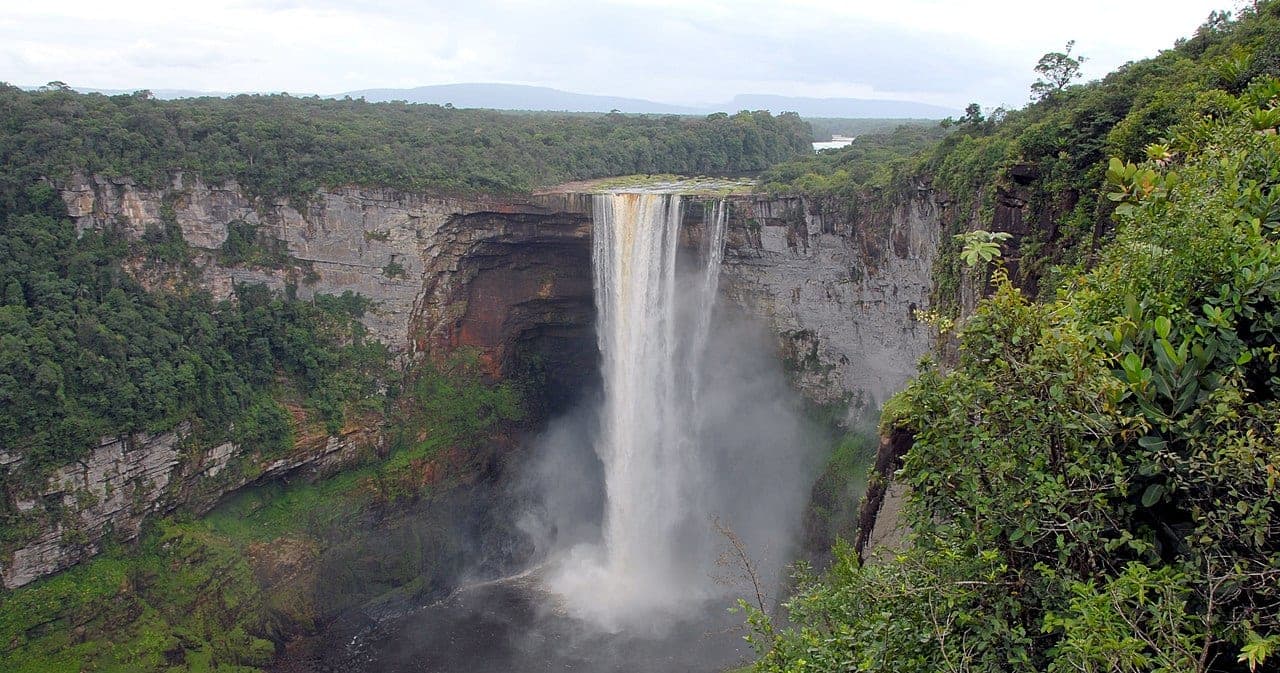
The Co-operative Republic of Guyana sits on the north-eastern shoulder of South America, facing the Atlantic between Venezuela and Suriname, with Brazil filling the vast interior to the south. It is a country of paradoxes worn lightly: the only English-speaking state on the continent, yet Caribbean in almost every reflex; a coastal nation whose capital lies below the daily tide and whose deep south is savannah and forest reaching hundreds of kilometres without a road. On the Potaro River, deep in that interior, the Kaieteur Falls drop 226 metres in a single unbroken sheet, one of the most powerful single-drop waterfalls on earth, while all around them the Amazonian rainforest and the Rupununi savannah shelter jaguars, giant otters and nine Indigenous peoples whose presence here predates every colony.
Guyana's other inheritance is its plural society, and remembrance is where that plurality speaks most clearly. The nation was assembled out of Indigenous settlement, Dutch and British colonial rule, a plantation economy built on enslaved African labour, and waves of Indian and other indentured migration that followed emancipation. Today Afro-Guyanese keep the Nine Night wake rooted in Akan Africa, Hindu families give their dead to the rivers, Muslim households bury quickly and gather to recite, and Indigenous communities hold their own passages for the dead. Around them the National Trust of Guyana, the wooden cathedral of Georgetown and the Walter Roth Museum work to hold the memory of a country still learning to tell its whole story.
Guyana covers roughly 215,000 square kilometres, about the size of Britain, but its population is only around 800,000, one of the smallest in the hemisphere. Forest blankets some 85 per cent of the land, giving the country one of the world's lowest deforestation rates and making its interior a stronghold of Amazonian biodiversity. Almost everyone lives on the narrow coastal plain, a strip reclaimed from the sea and defended by a long sea wall and a Dutch-built lattice of canals and sluice gates known as kokers. Georgetown, the capital, lies about a metre below the high-tide mark, and holding the ocean back is part of daily life.
Guyana belongs politically to South America but culturally to the Caribbean. It is a founding member of the Caribbean Community, whose secretariat has sat at Turkeyen in Greater Georgetown since 2005, and its first sport is cricket. The country is divided into ten administrative regions, from the coastal belt to the Rupununi in the far south-west. Since offshore production began in the Stabroek block in December 2019, oil has turned one of the region's poorest economies into one of its fastest-growing, raising both new resources and hard questions about safeguarding heritage and environment through sudden wealth.
Georgetown. The capital is a low, green, wooden city laid out on the Dutch grid, its streets shaded by flowering trees and lined with white-painted timber houses on stilts. Its landmarks are built almost entirely of wood: St George's Cathedral, the Gothic City Hall of 1889, and the Stabroek Market with its cast-iron clock tower over the Demerara waterfront. The National Museum, the 1763 Monument and the Walter Roth Museum gather the country's memory in a few square kilometres.
 Georgetown is built in wood, below sea level, behind a sea wall and a drainage system inherited from the Dutch, and its cathedral is among the tallest timber buildings in the world. Photograph by Dan Lundberg, CC BY-SA 2.0, via Wikimedia Commons.
Linden. The second city, on the Demerara River in the central forest, grew around bauxite mining and carries much of Guyana's industrial history. It is the birthplace of Mashramani, the republic festival first held here in 1970, and a gateway to the interior road running south toward Brazil.
New Amsterdam. Set at the mouth of the Berbice River in the east, New Amsterdam was founded by the Dutch in 1733 and served as the capital of the colony of Berbice. Its older streets preserve the layered Dutch and British character of the coast, and the surrounding county remains a heartland of Indo-Guyanese rural life.
Bartica. Where the Essequibo, Cuyuni and Mazaruni rivers meet, Bartica is the traditional staging post for the goldfields and the deep interior, long called the gateway to the interior, the point where the coastal country gives way to the rivers and forests leading toward Kaieteur.
Long before Europeans arrived, the region was home to Indigenous peoples whose descendants form nine recognised nations today: the Warao (Warrau), Lokono (Arawak) and Kalina (Carib) near the coast and rivers, and the Akawaio, Arekuna (Pemon), Patamona, Makushi, Wapishana and Wai-Wai across the interior. Their knowledge of the land, from cassava cultivation to river travel, shaped everything that followed, and their villages still govern much of the south under their own leaders.
Dutch traders established the first lasting colonies from the early seventeenth century, founding Essequibo around 1616 and later Berbice and Demerara; Berbice was run by a chartered company floated on the Amsterdam exchange. The colonies were built as a plantation economy of sugar, coffee and cotton worked by enslaved Africans under a system of extreme brutality, and resistance was continuous. In 1763 the enslaved people of Berbice rose in one of the earliest and largest revolts in the Americas: beginning on the Magdalenenberg plantation on 23 February, some 5,000 people under the leadership of an Akan man remembered as Cuffy (Kofi) took control of much of the colony for the better part of a year before the rebellion was suppressed. Cuffy is Guyana's foremost national hero, and 23 February is now the national day.
Britain took the three colonies during the Napoleonic wars, and they were formally ceded in 1814 and united as British Guiana in 1831. Slavery was abolished across the British Empire in 1834, with full freedom following the end of the apprenticeship period in 1838; many of the newly freed pooled their savings to buy abandoned estates and found their own villages. To replace their labour, planters turned to indenture, and from the arrival of the first ships in 1838 to the end of the system in 1917 more than 230,000 workers came from India, alongside smaller numbers of Portuguese from Madeira, Chinese and others, migrations that made Guyana's plural society. The colony became independent on 26 May 1966 and a republic on 23 February 1970. Since the mid-twentieth century, party allegiance has tended to follow the two largest communities, Indo-Guyanese and Afro-Guyanese, a division that has at times shaped elections and produced strain; recent governments have stressed national unity.
English is the official language, and Guyana is the only country in South America where it holds that role, a legacy of British rule that anchors the country firmly in the Anglophone Caribbean. Alongside standard English almost everyone speaks Guyanese Creole, an English-lexified creole often called Creolese, whose grammar and vocabulary carry African, Indian, Dutch and Indigenous layers laid down over three centuries of contact. Words and turns of phrase from Bhojpuri and Hindi survive in the speech of Indo-Guyanese communities, and Indigenous languages remain in daily use in the interior, from Makushi and Wapishana in the Rupununi to Akawaio and Patamona in the highlands.
The name Guyana itself is Indigenous, usually translated as "land of many waters," a description earned by the Essequibo, Demerara, Berbice, Corentyne and Potaro rivers and the countless creeks that thread the forest. The old colonial names still map the coast: Demerara, which gave its name to a variety of raw sugar, Essequibo after the great river, and Berbice in the east. Place names of the interior, and of Kaieteur itself, carry Indigenous origins, keeping the first languages present even where they are no longer widely spoken.
Guyanese culture blends its Caribbean and Indian inheritances more thoroughly than almost anywhere else. The signature national celebration is Mashramani, held each 23 February to mark the republic; the name comes from an Amerindian term for a celebration after cooperative work, and the day fills the streets of Georgetown with costume bands, float parades, steel-pan music and calypso. Cricket is the shared passion, played through the West Indies team that has drawn some of its finest players from Guyana, from the historic Bourda ground to the newer Providence Stadium.
The table is where the plural society is most at ease. Pepperpot, a slow-cooked meat dish preserved with cassareep, a syrup drawn from bitter cassava by Indigenous cooks, is the national dish and the centrepiece of Christmas. Roti and curry arrived with Indian indenture and are now everyday food, as are cook-up rice, metemgee, Portuguese-derived garlic pork and Chinese chow mein taken into the Guyanese kitchen. The festival calendar is equally shared: Phagwah (Holi) and Diwali, Eid, Christmas and Emancipation Day are all public occasions, and chutney, calypso and soca mingle at each of them.
Guyana is one of the most religiously plural countries in the Americas, its faiths following the ethnic makeup of the population. Hindus make up around a quarter to a third of the country, the highest proportion of any nation in the Western Hemisphere, and their temples, or mandirs, are landmarks of coastal towns and villages. Christianity, brought under Dutch and British rule and spread by many churches, is the largest overall grouping, with Pentecostal, Roman Catholic, Anglican, Methodist and other congregations; Muslims, most of South Asian descent with a significant Afro-Guyanese minority, account for roughly seven per cent and worship in mosques found the length of the coast.
These communities live closely intertwined, and it is ordinary for neighbours to share in one another's festivals, from Diwali motorcades to Phagwah water play to Eid gatherings. Beneath the scriptural religions run older currents: Indigenous nations of the interior keep their own spiritual traditions and healers, and elements of African-derived belief survive in coastal folk practice. The result is a country where a church, a mandir and a masjid may share a single village street, and where public life makes room for all three calendars.
Mourning in Guyana follows the lines of its communities, each keeping its own passage for the dead. In Afro-Guyanese custom the central rite is the Nine Night, a wake held over the nine evenings after a death, with the largest gathering on the ninth night, when the spirit is believed to complete its journey and depart. Rooted in Akan practice carried across the Atlantic, it fills the home of the deceased, the "wake house," with hymns, storytelling and food, turning grief into shared and sustaining work. Christian wakes across the communities commonly run for five to nine days in the same spirit.
Hindu funerary rites turn on cremation, traditionally beside a river or the sea so that the ashes can be given to the water, followed by some thirteen days of observance during which the household mourns and performs the prescribed last rites for the soul's passage. Muslim families bury their dead quickly after the janazah prayer, gathering afterwards to recite the Qur'an in the days that follow. Indigenous communities keep their own customs of burial and remembrance, tied to the land and the ancestors.
Above these individual passages sits a shared memory of how the population came to be here. Emancipation Day on 1 August honours the ancestors who were enslaved, and the 1763 Monument in Georgetown, the bronze figure of Cuffy by the artist Philip Moore, gives that memory public form. Indian Arrival Day on 5 May marks the coming of the indentured, and together the two hold the sober history of slavery and indenture at the centre of the nation's calendar.
Guyana's records are Dutch, then British, and the most valuable single series was created by indenture.
The Dutch held Essequibo, Demerara and Berbice into the early nineteenth century, and the Dutch colonial archive, held in The Hague, includes plantation records and the registers of the enslaved. Berbice in particular has an unusually complete series, and the surviving records of that colony are among the most studied in Caribbean slavery scholarship, because they document individuals over time.
Under British rule the slave registers of 1817 to 1832 name individuals with age, origin and mother, and the compensation records of 1834 name the owners. Anglican parish registers and civil registration from 1869 carry the rest, held by the Registrar General and the National Archives in Georgetown.
Indenture is the other half of the country. Between 1838 and 1917 around 240,000 people came from India to work the sugar estates, more than to any other British colony, and each was recorded on an emigration pass with name, father's name, caste, village and district. Those passes survive and are the route back to a specific village in Bihar or Uttar Pradesh. UNESCO added the combined Indian indenture records of Guyana, Fiji, Suriname and Trinidad and Tobago to the Memory of the World Register in 2011. Portuguese labourers from Madeira and Chinese labourers arrived under similar arrangements and are similarly documented.
The Indigenous peoples of the interior, Wai Wai, Wapishana, Makushi and others, keep their own descent and their land is titled to villages.
The National Trust of Guyana, established in 1972, is the state body charged with protecting the country's monuments and historic sites. The most celebrated of the monuments in its care is St George's Cathedral in Georgetown, an Anglican cathedral built almost entirely of local greenheart timber to a design by Sir Arthur Blomfield and consecrated in 1892. At about 43 metres it ranks among the tallest wooden buildings in the world, the emblem of the capital's timber architecture alongside the Gothic City Hall and the Kirk of St Andrew.
Indigenous heritage has its own dedicated home in the Walter Roth Museum of Anthropology, founded in 1974 and opened to the public in 1982 in a colonial timber house on Main Street; it was the first anthropology museum in the Caribbean and gathers artefacts and research on the ancient and living cultures of Guyana's nine Indigenous peoples. The National Museum, the National Archives and regional collections carry the wider story, while the greatest preservation challenge is the coast itself, where salt air, flooding and the cost of maintaining timber put constant pressure on the fabric that makes Georgetown distinctive.
Guyana's digital heritage work is young but growing, turning on the twin archives of colonial administration and family descent. The National Trust maintains an online register of the country's monuments, and for the descendants of indenture the immigration records of British Guiana, the ships' registers and estate papers that name arriving labourers, have become the key to family history; genealogists in Guyana and the diaspora rely on digitised versions to reach ancestors who left India more than a century ago.
The same impulse reaches to the Indigenous interior, where oral history, place names and language are recorded before their last fluent speakers pass, and to the archives of slavery, where the naming of the enslaved is slowly made searchable for a diaspora tracing its roots.
Guyana today is as much a diaspora as a homeland: large communities in New York, Toronto and London, including the Richmond Hill district of Queens sometimes called Little Guyana, keep the culture in circulation across the Atlantic and beyond. That diaspora carries the country's literature, which holds an outsized place in Caribbean letters through the novelist Wilson Harris, the poet Martin Carter, and later writers such as David Dabydeen, Grace Nichols and Fred D'Aguiar, whose work returns to the histories of plantation, indenture and memory. In sport, Guyanese cricketers from Clive Lloyd and Rohan Kanhai to Shivnarine Chanderpaul have shaped the West Indies game for generations.
Music keeps the plural inheritance moving, from calypso and soca to the chutney and chutney-soca that grew out of Indo-Guyanese wedding song. The oil boom of the 2020s has brought rapid change, drawing Guyanese home, reshaping Georgetown and testing whether new wealth will strengthen the archives, museums and living traditions of a small society or overwhelm them. That the country is now debating how to grow without losing the coast, the forest and the memory that made it is itself a sign of a heritage taken seriously.
Iwokrama and the model forest. In 1996 Guyana set aside 371,000 hectares of central rainforest for the Iwokrama International Centre for Rain Forest Conservation and Development, created with the Commonwealth to show that a tropical forest can be conserved and used sustainably at once. Managed with the region's Indigenous communities, it is now an internationally cited example of research, ecotourism and community stewardship together.
A forest nation goes low-carbon. Building on its exceptional forest cover, Guyana pioneered payment for keeping its rainforest standing, first through a partnership with Norway from 2009 and then, in 2022, through one of the first jurisdiction-scale forest carbon credit agreements under the ART and TREES standard. The approach has turned the living forest into a recognised global asset and a source of finance for Indigenous and coastal communities.
Kaieteur kept wild. The national park created around Kaieteur Falls in 1929 is among the oldest protected areas in the region, and nearly a century on the falls remain free-flowing and undeveloped, reached only by small aircraft or a long river-and-forest trek, one of the world's great waterfalls preserved in its natural setting.
Georgetown is built in wood, below sea level, behind a sea wall and a drainage system inherited from the Dutch, and its cathedral is among the tallest timber buildings in the world. Photograph by Dan Lundberg, CC BY-SA 2.0, via Wikimedia Commons.
Linden. The second city, on the Demerara River in the central forest, grew around bauxite mining and carries much of Guyana's industrial history. It is the birthplace of Mashramani, the republic festival first held here in 1970, and a gateway to the interior road running south toward Brazil.
New Amsterdam. Set at the mouth of the Berbice River in the east, New Amsterdam was founded by the Dutch in 1733 and served as the capital of the colony of Berbice. Its older streets preserve the layered Dutch and British character of the coast, and the surrounding county remains a heartland of Indo-Guyanese rural life.
Bartica. Where the Essequibo, Cuyuni and Mazaruni rivers meet, Bartica is the traditional staging post for the goldfields and the deep interior, long called the gateway to the interior, the point where the coastal country gives way to the rivers and forests leading toward Kaieteur.
Long before Europeans arrived, the region was home to Indigenous peoples whose descendants form nine recognised nations today: the Warao (Warrau), Lokono (Arawak) and Kalina (Carib) near the coast and rivers, and the Akawaio, Arekuna (Pemon), Patamona, Makushi, Wapishana and Wai-Wai across the interior. Their knowledge of the land, from cassava cultivation to river travel, shaped everything that followed, and their villages still govern much of the south under their own leaders.
Dutch traders established the first lasting colonies from the early seventeenth century, founding Essequibo around 1616 and later Berbice and Demerara; Berbice was run by a chartered company floated on the Amsterdam exchange. The colonies were built as a plantation economy of sugar, coffee and cotton worked by enslaved Africans under a system of extreme brutality, and resistance was continuous. In 1763 the enslaved people of Berbice rose in one of the earliest and largest revolts in the Americas: beginning on the Magdalenenberg plantation on 23 February, some 5,000 people under the leadership of an Akan man remembered as Cuffy (Kofi) took control of much of the colony for the better part of a year before the rebellion was suppressed. Cuffy is Guyana's foremost national hero, and 23 February is now the national day.
Britain took the three colonies during the Napoleonic wars, and they were formally ceded in 1814 and united as British Guiana in 1831. Slavery was abolished across the British Empire in 1834, with full freedom following the end of the apprenticeship period in 1838; many of the newly freed pooled their savings to buy abandoned estates and found their own villages. To replace their labour, planters turned to indenture, and from the arrival of the first ships in 1838 to the end of the system in 1917 more than 230,000 workers came from India, alongside smaller numbers of Portuguese from Madeira, Chinese and others, migrations that made Guyana's plural society. The colony became independent on 26 May 1966 and a republic on 23 February 1970. Since the mid-twentieth century, party allegiance has tended to follow the two largest communities, Indo-Guyanese and Afro-Guyanese, a division that has at times shaped elections and produced strain; recent governments have stressed national unity.
English is the official language, and Guyana is the only country in South America where it holds that role, a legacy of British rule that anchors the country firmly in the Anglophone Caribbean. Alongside standard English almost everyone speaks Guyanese Creole, an English-lexified creole often called Creolese, whose grammar and vocabulary carry African, Indian, Dutch and Indigenous layers laid down over three centuries of contact. Words and turns of phrase from Bhojpuri and Hindi survive in the speech of Indo-Guyanese communities, and Indigenous languages remain in daily use in the interior, from Makushi and Wapishana in the Rupununi to Akawaio and Patamona in the highlands.
The name Guyana itself is Indigenous, usually translated as "land of many waters," a description earned by the Essequibo, Demerara, Berbice, Corentyne and Potaro rivers and the countless creeks that thread the forest. The old colonial names still map the coast: Demerara, which gave its name to a variety of raw sugar, Essequibo after the great river, and Berbice in the east. Place names of the interior, and of Kaieteur itself, carry Indigenous origins, keeping the first languages present even where they are no longer widely spoken.
Guyanese culture blends its Caribbean and Indian inheritances more thoroughly than almost anywhere else. The signature national celebration is Mashramani, held each 23 February to mark the republic; the name comes from an Amerindian term for a celebration after cooperative work, and the day fills the streets of Georgetown with costume bands, float parades, steel-pan music and calypso. Cricket is the shared passion, played through the West Indies team that has drawn some of its finest players from Guyana, from the historic Bourda ground to the newer Providence Stadium.
The table is where the plural society is most at ease. Pepperpot, a slow-cooked meat dish preserved with cassareep, a syrup drawn from bitter cassava by Indigenous cooks, is the national dish and the centrepiece of Christmas. Roti and curry arrived with Indian indenture and are now everyday food, as are cook-up rice, metemgee, Portuguese-derived garlic pork and Chinese chow mein taken into the Guyanese kitchen. The festival calendar is equally shared: Phagwah (Holi) and Diwali, Eid, Christmas and Emancipation Day are all public occasions, and chutney, calypso and soca mingle at each of them.
Guyana is one of the most religiously plural countries in the Americas, its faiths following the ethnic makeup of the population. Hindus make up around a quarter to a third of the country, the highest proportion of any nation in the Western Hemisphere, and their temples, or mandirs, are landmarks of coastal towns and villages. Christianity, brought under Dutch and British rule and spread by many churches, is the largest overall grouping, with Pentecostal, Roman Catholic, Anglican, Methodist and other congregations; Muslims, most of South Asian descent with a significant Afro-Guyanese minority, account for roughly seven per cent and worship in mosques found the length of the coast.
These communities live closely intertwined, and it is ordinary for neighbours to share in one another's festivals, from Diwali motorcades to Phagwah water play to Eid gatherings. Beneath the scriptural religions run older currents: Indigenous nations of the interior keep their own spiritual traditions and healers, and elements of African-derived belief survive in coastal folk practice. The result is a country where a church, a mandir and a masjid may share a single village street, and where public life makes room for all three calendars.
Mourning in Guyana follows the lines of its communities, each keeping its own passage for the dead. In Afro-Guyanese custom the central rite is the Nine Night, a wake held over the nine evenings after a death, with the largest gathering on the ninth night, when the spirit is believed to complete its journey and depart. Rooted in Akan practice carried across the Atlantic, it fills the home of the deceased, the "wake house," with hymns, storytelling and food, turning grief into shared and sustaining work. Christian wakes across the communities commonly run for five to nine days in the same spirit.
Hindu funerary rites turn on cremation, traditionally beside a river or the sea so that the ashes can be given to the water, followed by some thirteen days of observance during which the household mourns and performs the prescribed last rites for the soul's passage. Muslim families bury their dead quickly after the janazah prayer, gathering afterwards to recite the Qur'an in the days that follow. Indigenous communities keep their own customs of burial and remembrance, tied to the land and the ancestors.
Above these individual passages sits a shared memory of how the population came to be here. Emancipation Day on 1 August honours the ancestors who were enslaved, and the 1763 Monument in Georgetown, the bronze figure of Cuffy by the artist Philip Moore, gives that memory public form. Indian Arrival Day on 5 May marks the coming of the indentured, and together the two hold the sober history of slavery and indenture at the centre of the nation's calendar.
Guyana's records are Dutch, then British, and the most valuable single series was created by indenture.
The Dutch held Essequibo, Demerara and Berbice into the early nineteenth century, and the Dutch colonial archive, held in The Hague, includes plantation records and the registers of the enslaved. Berbice in particular has an unusually complete series, and the surviving records of that colony are among the most studied in Caribbean slavery scholarship, because they document individuals over time.
Under British rule the slave registers of 1817 to 1832 name individuals with age, origin and mother, and the compensation records of 1834 name the owners. Anglican parish registers and civil registration from 1869 carry the rest, held by the Registrar General and the National Archives in Georgetown.
Indenture is the other half of the country. Between 1838 and 1917 around 240,000 people came from India to work the sugar estates, more than to any other British colony, and each was recorded on an emigration pass with name, father's name, caste, village and district. Those passes survive and are the route back to a specific village in Bihar or Uttar Pradesh. UNESCO added the combined Indian indenture records of Guyana, Fiji, Suriname and Trinidad and Tobago to the Memory of the World Register in 2011. Portuguese labourers from Madeira and Chinese labourers arrived under similar arrangements and are similarly documented.
The Indigenous peoples of the interior, Wai Wai, Wapishana, Makushi and others, keep their own descent and their land is titled to villages.
The National Trust of Guyana, established in 1972, is the state body charged with protecting the country's monuments and historic sites. The most celebrated of the monuments in its care is St George's Cathedral in Georgetown, an Anglican cathedral built almost entirely of local greenheart timber to a design by Sir Arthur Blomfield and consecrated in 1892. At about 43 metres it ranks among the tallest wooden buildings in the world, the emblem of the capital's timber architecture alongside the Gothic City Hall and the Kirk of St Andrew.
Indigenous heritage has its own dedicated home in the Walter Roth Museum of Anthropology, founded in 1974 and opened to the public in 1982 in a colonial timber house on Main Street; it was the first anthropology museum in the Caribbean and gathers artefacts and research on the ancient and living cultures of Guyana's nine Indigenous peoples. The National Museum, the National Archives and regional collections carry the wider story, while the greatest preservation challenge is the coast itself, where salt air, flooding and the cost of maintaining timber put constant pressure on the fabric that makes Georgetown distinctive.
Guyana's digital heritage work is young but growing, turning on the twin archives of colonial administration and family descent. The National Trust maintains an online register of the country's monuments, and for the descendants of indenture the immigration records of British Guiana, the ships' registers and estate papers that name arriving labourers, have become the key to family history; genealogists in Guyana and the diaspora rely on digitised versions to reach ancestors who left India more than a century ago.
The same impulse reaches to the Indigenous interior, where oral history, place names and language are recorded before their last fluent speakers pass, and to the archives of slavery, where the naming of the enslaved is slowly made searchable for a diaspora tracing its roots.
Guyana today is as much a diaspora as a homeland: large communities in New York, Toronto and London, including the Richmond Hill district of Queens sometimes called Little Guyana, keep the culture in circulation across the Atlantic and beyond. That diaspora carries the country's literature, which holds an outsized place in Caribbean letters through the novelist Wilson Harris, the poet Martin Carter, and later writers such as David Dabydeen, Grace Nichols and Fred D'Aguiar, whose work returns to the histories of plantation, indenture and memory. In sport, Guyanese cricketers from Clive Lloyd and Rohan Kanhai to Shivnarine Chanderpaul have shaped the West Indies game for generations.
Music keeps the plural inheritance moving, from calypso and soca to the chutney and chutney-soca that grew out of Indo-Guyanese wedding song. The oil boom of the 2020s has brought rapid change, drawing Guyanese home, reshaping Georgetown and testing whether new wealth will strengthen the archives, museums and living traditions of a small society or overwhelm them. That the country is now debating how to grow without losing the coast, the forest and the memory that made it is itself a sign of a heritage taken seriously.
Iwokrama and the model forest. In 1996 Guyana set aside 371,000 hectares of central rainforest for the Iwokrama International Centre for Rain Forest Conservation and Development, created with the Commonwealth to show that a tropical forest can be conserved and used sustainably at once. Managed with the region's Indigenous communities, it is now an internationally cited example of research, ecotourism and community stewardship together.
A forest nation goes low-carbon. Building on its exceptional forest cover, Guyana pioneered payment for keeping its rainforest standing, first through a partnership with Norway from 2009 and then, in 2022, through one of the first jurisdiction-scale forest carbon credit agreements under the ART and TREES standard. The approach has turned the living forest into a recognised global asset and a source of finance for Indigenous and coastal communities.
Kaieteur kept wild. The national park created around Kaieteur Falls in 1929 is among the oldest protected areas in the region, and nearly a century on the falls remain free-flowing and undeveloped, reached only by small aircraft or a long river-and-forest trek, one of the world's great waterfalls preserved in its natural setting.
National Overview
Notable Cities
Historical Foundations
Linguistic and Etymological Roots
Cultural Identity
Religion and Spirituality
Remembrance and Mourning Traditions
Tracing a Family in Guyana
Heritage Preservation Efforts
Digital Heritage
Contemporary Cultural Influences
Success Stories
References and resources
- Encyclopaedia Britannica: Guyana. Geography, history and political background.
- Encyclopaedia Britannica: Kaieteur Falls. The single 226-metre drop on the Potaro River.
- Wikipedia: History of Guyana. The colonial, emancipation and independence timeline.
- Wikipedia: Berbice Rebellion. The 1763 uprising and the leadership of Cuffy.
- Wikipedia: Indigenous peoples in Guyana. The nine recognised nations and their territories.
- National Trust of Guyana. The state body for monuments and historic sites, and its online register.
- St George's Cathedral, Georgetown. The greenheart cathedral among the tallest wooden buildings in the world.
- National Trust of Guyana: Walter Roth Museum of Anthropology. The museum of Indigenous heritage founded in 1974.
- Wikipedia: Mashramani. The republic festival and the meaning of its name.
- Iwokrama International Centre. The 371,000-hectare rainforest conservation programme.
- Secretariat of the Caribbean Community (CARICOM). The regional body headquartered in Georgetown.