Heritage · Country
Somalia Culture and Heritage
At Laas Geel, painted herds have kept their colour on cave walls for some five thousand years, among the best-preserved Neolithic art in Africa.Written to last.
By Confinity Heritage Editorial · Updated 2026-07-31 · 8-minute readQuiet tools, kept out of the way.
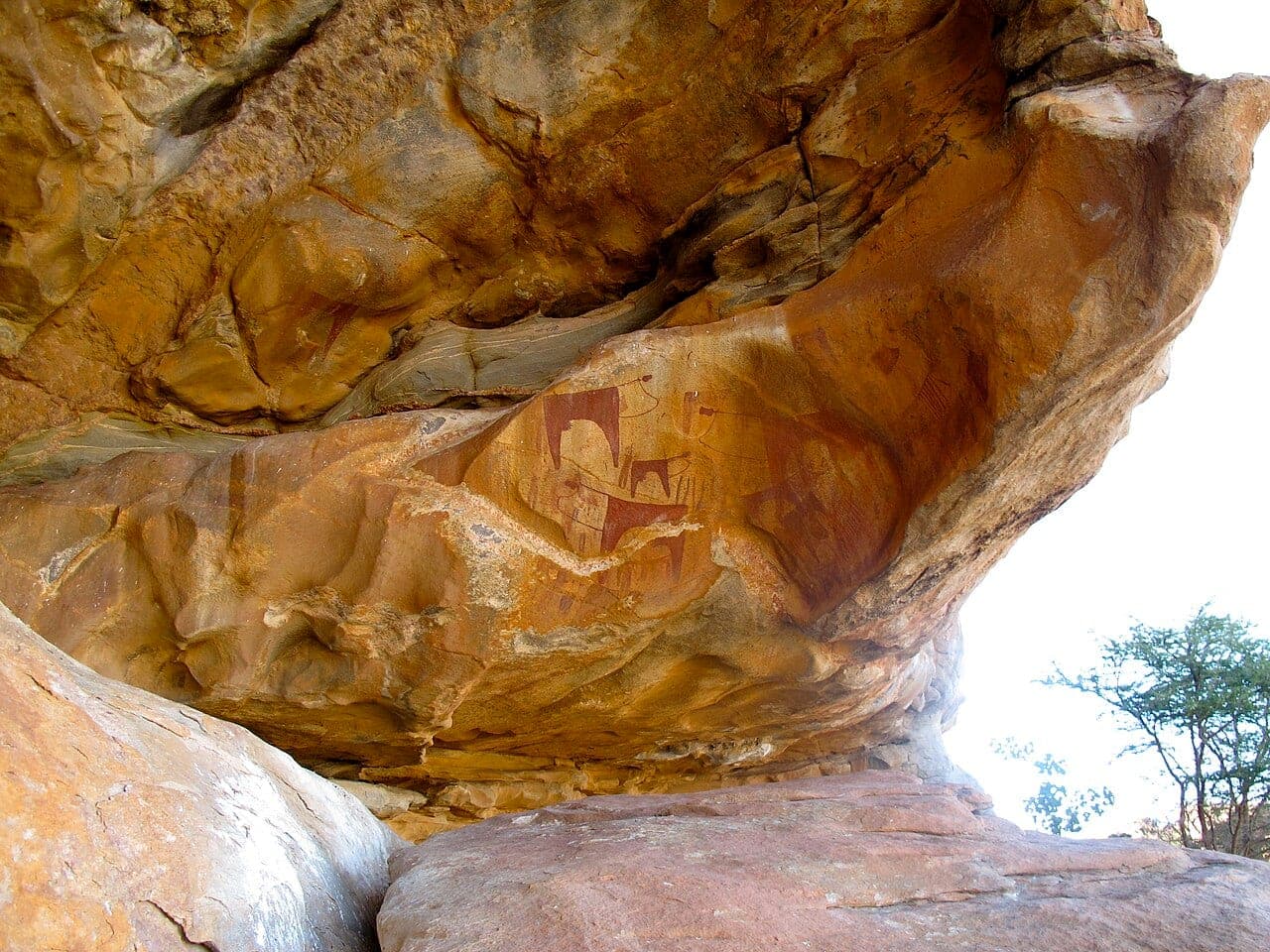
Somalia occupies the outer edge of the Horn of Africa and holds the longest coastline on the African mainland. On a granite outcrop near Hargeisa, at a place the herders call Laas Geel, the source of water for camels, Neolithic painters covered the walls of rock shelters with cattle, worshippers and wild animals in red, orange and white, and the colours have survived for roughly five thousand years, counted among the oldest and best-preserved rock paintings on the continent (UNESCO; CyArk). Further north and east, the incense trees that Egypt once sailed to buy still grow on the hills, in a land the pharaohs called Punt.
Yet the deepest Somali archive is not painted or built; it is spoken. Somalis have long been described as a nation of poets, a people who compose, memorise and answer verse with a formality other cultures reserve for written law, and who carry their genealogies in the same trained memory.
The Federal Republic of Somalia covers about 637,000 square kilometres at the easternmost point of Africa, bordered by Djibouti, Ethiopia and Kenya, with the Gulf of Aden to the north and the Indian Ocean down its long eastern flank. Its coastline, running for roughly 3,300 kilometres, is the longest of any country on the African mainland (Britannica). The land behind it is mostly semi-arid, from the Golis ranges of the north to the Haud grazing plains, with the Jubba and Shabelle rivers watering the more fertile south.
Somalia's population of roughly seventeen to eighteen million is unusual in Africa for its cultural unity: the great majority are ethnic Somalis, sharing a single language, the Muslim faith and a pastoral heritage, organised into clan families whose genealogies structure society (Britannica). A slight majority remain nomadic or semi-nomadic pastoralists herding camels, sheep, goats and cattle, while farming communities work the riverine south and fishers hold the coast. The country is a federal republic rebuilding its institutions after decades of upheaval, with its capital at Mogadishu on the Indian Ocean.
Mogadishu. The capital, known in Somali as Xamar, is an ancient Indian Ocean port that grew from the tenth century into one of the leading trading cities of the East African coast, minting its own currency and drawing merchants from Arabia and Persia; the fourteenth-century traveller Ibn Battuta described a large and wealthy city of cloth-weavers and generous hosts. Its old quarters of Hamar Weyne and Shangani and the medieval Fakr ad-Din mosque record its many layers, much of it battered by later fighting and now the object of restoration.
Hargeisa. The largest city of the north-west and the region's commercial and cultural centre, Hargeisa is the gateway to the Laas Geel rock-art shelters that lie roughly fifty kilometres outside it. Rebuilt after heavy damage in the late 1980s, it has become a focus of Somali literary life, home to the annual Hargeisa International Book Fair and, since 2024, to a national museum.
Kismayo. A southern port at the mouth of the Jubba river, Kismayo has long linked the farming valleys of the interior to Indian Ocean trade in livestock, hides and charcoal, and it remains the principal city of the far south.
Berbera. A historic harbour on the Gulf of Aden, Berbera was for centuries a seasonal trading fair where caravans met merchants from Arabia and India, and it served as an administrative centre under British rule. Its deep natural port remains a commercial outlet for the interior and neighbouring Ethiopia.
Human memory in Somalia reaches back into the Neolithic. The painted shelters of Laas Geel, brought to wider attention by a French archaeological team in 2002 after generations of local knowledge, hold polychrome scenes of long-horned cattle, human figures and wild game estimated at roughly five thousand years old, evidence of a settled herding society long before written record (CyArk; Britannica). Nearby sites such as Dhagah Kureh and Dhagah Nabi Gelay extend the same pastoral world across the northern hills, and the herding the paintings show has continued in unbroken line to the present.
By the second millennium BCE these coasts were trading with the wider world. Ancient Egyptian inscriptions, most famously the reliefs of Queen Hatshepsut's expedition of about 1470 BCE at Deir el-Bahari, record voyages to the Land of Punt for frankincense, myrrh, gold and ebony, and modern botanical work places Punt's incense country in the northern Horn of what is now Somalia (World History Encyclopedia). Boswellia and Commiphora trees still yield those resins on the northern hills today.
Islam arrived early and by sea. From the faith's first centuries, Muslim traders settled along the Somali seaboard. Zeila in the north-west was the headquarters of a Muslim community by the ninth or tenth century and later the seat of the sultanates of Ifat and, from the fourteenth century, Adal, whose armies under Ahmad ibn Ibrahim al-Ghazi campaigned deep into the Ethiopian highlands in the sixteenth century. Mogadishu rose as a powerful trading sultanate from the tenth to the sixteenth century, dominating the regional gold trade, before being drawn into the Ajuran Sultanate, which ruled much of southern Somalia between roughly the thirteenth and late seventeenth centuries, built wells and stone architecture and resisted both Oromo and Portuguese pressure (Wikipedia).
From the late nineteenth century European powers partitioned the Somali lands: Britain took the north as the Somaliland Protectorate, Italy built Italian Somaliland in the south, and France held the enclave that became Djibouti, while Somali-inhabited regions also fell within Ethiopia and Kenya. British Somaliland and the Italian-administered south won independence in June 1960 and united on 1 July 1960 as the Somali Republic (Britannica). A parliamentary decade gave way in 1969 to the military government of Mohamed Siad Barre. In 1991 that government fell and the central state collapsed into prolonged civil conflict; in the north-west a separate administration was declared, and the region has since kept a large measure of its own stability. Since the early 2000s Somalia has gradually rebuilt federal institutions, and reconstruction of its damaged and looted heritage continues.
Somali is a Cushitic language of the Afroasiatic family, related to Afar and Oromo, and spoken as a first language by nearly the whole population, one of the more widely shared indigenous languages in Africa (Britannica). Long a language of the voice, with a developed poetic literature but no agreed script, Somali was given an official Latin orthography in October 1972 under the Siad Barre government, chosen for its simplicity, and followed by a mass rural literacy campaign (Omniglot). An earlier indigenous script, the Osmanya devised by Osman Yusuf Kenadid in the 1920s, never displaced the older reliance on memory and on Arabic. Arabic remains important as the language of the Qur'an, of religious scholarship and of trade, and many Somalis are bilingual in it for matters of faith.
The origin of the name Somali is told in more than one way. A widely repeated folk etymology derives it from the phrase soo maal, an invitation meaning roughly "go and milk", the gesture of pastoral hospitality offered to a guest; another tradition traces the people to a common ancestor named Samaale, from whom many clan genealogies descend; still others connect the name to older regional terms. As with much of Somali heritage, the explanation lives inside the oral tradition itself, carried in genealogy and story rather than any single document.
Poetry holds the place that monuments hold elsewhere. Somali verse is a formal art with named genres, the weighty gabay for serious argument and public affairs, the geeraar, the jiifto and the women's buraanbur, all governed by strict rules of metre and of alliteration that bind every line to a chosen consonant, which makes a poem exact, memorable and checkable as it passes between reciters (ASC Leiden). A powerful poem travels across the country and down the generations, answered by rival poets and quoted in disputes years afterward. The Canadian writer Margaret Laurence, who translated Somali verse in the 1950s, helped fix the description of Somalia as a nation of poets. The tradition has its remembered masters: Sayyid Mahammad Abdille Hasan, the poet and religious leader who led resistance to colonial rule between 1899 and 1920 and whose verse is still recited, and Elmi Boodhari, who in the 1920s broke convention by making romantic love his open subject and is remembered as a founder of the Somali love poem.
The camel is the measure of pastoral life, valued for milk, transport, wealth and honour, and celebrated in its own body of poetry and proverb. The nomadic household lives in the aqal, a portable dome of bent boughs covered with woven mats and hides, which women dismantle, load onto camels and rebuild at each move. Material culture is largely light to suit this life: woven mats and milk vessels, carved headrests, and the silver bangles and necklaces of marriage. Women's dress includes the draped guntiino and the flowing dirac. The kitchen tells the crossroads story: canjeero, the fermented flatbread eaten at breakfast; bariis with the spice blend xawaash; sambusa pastries; grilled meats; and the sweet xalwo served at weddings and Eid.
Somalis are overwhelmingly Sunni Muslims of the Shafi'i school, and Islam is woven through daily life, law and the calendar (Britannica). The faith reached the coast within its first century and spread inland along trade and kinship, and by the medieval period Zeila and Mogadishu were among its early centres of learning.
Popular practice has long been shaped by Sufism. The Qadiriyya order, the oldest and most widespread, together with the Ahmadiyya and its Salihiyya offshoot, organised much of Somali religious life, and their sheikhs founded rural settlements, taught the Qur'an, mediated between clans and led communal dhikr recitation (History Rise). Reverence for saintly figures and visits to the tombs of revered sheikhs sit within this devotional tradition. Religious scholars, the wadaad, held a role beside the poet and the clan elder, and Qur'anic schooling remains near-universal in childhood.
Death is met with the speed and plainness of Islamic rite. The dead are buried quickly, on the day of death where possible; relatives of the same sex wash the body, which is then wrapped in plain white cloth, prayed over in the congregational funeral prayer, the salaad janaasa, and carried by the men to the grave, where it is laid on its right side facing Mecca without a coffin (EthnoMed). Elaborate tombs are discouraged, for in death all are held equal. A mourning period of three days follows, when the bereaved receive condolences, tacsiyad, and kin bring food so the household need not cook, while the Qur'an is recited. Grief is expected to be sincere but restrained, and a widow observes the iddah of four months and ten days. Charity and prayer offered in the name of the dead keep the bond open.
Alongside the rites of faith runs the remembrance of the word. In a culture where verse is the record, an elegy is a monument: the tradition includes the baroorodiiq, the lament composed on the death of a notable person, so that the great dead live on in lines recited long after their graves have faded. Genealogy is itself an act of remembrance. Children learn abtirsi, the recitation of the chain of forefathers' names reaching back many generations, so that every person carries a spoken family archive, the ancestors named aloud in each lifetime. Between the poem and the genealogy, a people whose monuments were often perishable built a durable memory in the mind.
Somali genealogy is spoken, exact, and the most complete record the country has.
Abtirsiin is the recitation of a person's line of fathers, and a Somali is expected to be able to give it to a considerable depth and to place themselves within clan and sub-clan by doing so. It is not sentimental. It determines diya, the compensation group responsible for a person's actions, and it has organised politics, marriage and land for centuries. Children learn it as a list.
The written record is a different matter. Italian and British colonial administrations kept records for their own purposes; the Somali Republic built a civil registration system after 1960; and the collapse of the state in 1991 destroyed or dispersed most of it, along with the national archives, the university and the museum. There is no functioning national vital records system across much of the country, and identity documents are frequently issued on the basis of testimony rather than paperwork.
What exists instead is a diaspora archive by accident. Around two million Somalis live outside the country, and their asylum claims, resettlement files and naturalisation papers, in Kenya, Ethiopia, Yemen, the Gulf, Britain, the Nordic countries, Canada and the United States, are often the fullest written record a family has.
Somaliland and Puntland have built their own registration systems and issue their own documents, which the wider world recognises unevenly.
Somalia's most celebrated cultural site is Laas Geel and the wider group of northern rock-art shelters. Their remarkable preservation, sheltered by overhanging granite, has made them a focus of conservation, and Somalia has placed them and other sites on its tentative list for possible World Heritage nomination (UNESCO). The challenge is protection on the ground, where exposure, unmanaged visits and fragile pigment threaten the paintings, and safeguarding depends on the archaeologists and communities that watch over the sites.
 Mogadishu holds Italian colonial, Ottoman and older Swahili fabric, much of it wrecked or looted since 1991, and the national museum's collections were largely dispersed. Photograph by AMISOM Public Information, CC0, via Wikimedia Commons.
Museum heritage suffered gravely in the collapse after 1991, when the National Museum in Mogadishu was damaged and looted and portable objects were carried off, some onto the international market (Wikipedia; UNESCO). Recovery has been slow but real. With international and UNESCO support, the National Museum of Somalia was rehabilitated and reopened in 2020, staff were trained and a campaign begun to trace and reclaim lost artefacts. In the north-west, Hargeisa has grown into a centre of Somali cultural life, its annual book fair drawing writers from across the Somali-speaking world, and a national museum opened there in 2024. Across the country, the recovery of heritage remains bound up with the recovery of stability itself.
Digital tools have become central to safeguarding Somali heritage precisely because so much of it is fragile or dispersed. In 2013 the conservation organisation CyArk, with the Horn Heritage charity and ICCROM, laser-scanned and photographed the Laas Geel, Dhagah Kureh and Dhagah Nabi Gelay shelters, building three-dimensional records of the paintings that survive independently of the rock (CyArk). The models have since been published through platforms such as Google Arts and Culture, opening the sites to those who cannot travel to them.
The Somali-born archaeologist Sada Mire, who has documented dozens of previously unrecorded sites across the northern Horn, has argued for such recording as a form of cultural survival. Beyond the formal projects, the diaspora has built an unplanned digital archive of its own, uploading poetry recitations, wedding songs, oral histories and family genealogies daily, so that a tradition once held only in memory now also lives on screens from Mogadishu to Minneapolis.
Decades of conflict scattered Somalis across the world, and the resulting diaspora, in North America, Europe, the Gulf and East Africa, has become a powerful carrier of Somali culture. Its most visible expression remains the word. The rapper and poet K'naan, raised in Mogadishu and Toronto, carried Somali storytelling into global music; the poet Warsan Shire gave voice to migration and belonging for a new generation of readers; and the novelist Nuruddin Farah has written Somalia into world literature. Somali music, from mid-twentieth-century orchestras to contemporary singers, circulates through satellite channels and streaming worldwide.
This diaspora is not only an audience but a lifeline. Remittances sustain families, cultural associations run language and poetry classes for children born abroad, and returnees carry recordings and investment home to Hargeisa, Mogadishu and Kismayo. In a heritage whose great archive was always the trained memory, the diaspora has become a distributed keeper of that memory, wired together across continents.
The National Museum reopens. After the losses that followed 1991, the rehabilitation and 2020 reopening of the National Museum of Somalia in Mogadishu, with international support and a campaign to recover looted artefacts, returned a national institution once thought lost.
Laas Geel recorded for the future. The 2013 laser-scanning of the northern rock-art shelters created a durable three-dimensional archive of paintings some five thousand years old, protecting the record even as the physical sites remain fragile.
Hargeisa becomes a city of books. The annual Hargeisa International Book Fair, one of the largest literary gatherings in the Horn of Africa, has renewed the public life of Somali poetry and prose, joined in 2024 by a new regional museum.
A poetic nation goes global. From Nuruddin Farah's novels to the verse of Warsan Shire and the music of K'naan, Somali storytelling has carried the cadences of an oral civilisation into world culture.
Mogadishu holds Italian colonial, Ottoman and older Swahili fabric, much of it wrecked or looted since 1991, and the national museum's collections were largely dispersed. Photograph by AMISOM Public Information, CC0, via Wikimedia Commons.
Museum heritage suffered gravely in the collapse after 1991, when the National Museum in Mogadishu was damaged and looted and portable objects were carried off, some onto the international market (Wikipedia; UNESCO). Recovery has been slow but real. With international and UNESCO support, the National Museum of Somalia was rehabilitated and reopened in 2020, staff were trained and a campaign begun to trace and reclaim lost artefacts. In the north-west, Hargeisa has grown into a centre of Somali cultural life, its annual book fair drawing writers from across the Somali-speaking world, and a national museum opened there in 2024. Across the country, the recovery of heritage remains bound up with the recovery of stability itself.
Digital tools have become central to safeguarding Somali heritage precisely because so much of it is fragile or dispersed. In 2013 the conservation organisation CyArk, with the Horn Heritage charity and ICCROM, laser-scanned and photographed the Laas Geel, Dhagah Kureh and Dhagah Nabi Gelay shelters, building three-dimensional records of the paintings that survive independently of the rock (CyArk). The models have since been published through platforms such as Google Arts and Culture, opening the sites to those who cannot travel to them.
The Somali-born archaeologist Sada Mire, who has documented dozens of previously unrecorded sites across the northern Horn, has argued for such recording as a form of cultural survival. Beyond the formal projects, the diaspora has built an unplanned digital archive of its own, uploading poetry recitations, wedding songs, oral histories and family genealogies daily, so that a tradition once held only in memory now also lives on screens from Mogadishu to Minneapolis.
Decades of conflict scattered Somalis across the world, and the resulting diaspora, in North America, Europe, the Gulf and East Africa, has become a powerful carrier of Somali culture. Its most visible expression remains the word. The rapper and poet K'naan, raised in Mogadishu and Toronto, carried Somali storytelling into global music; the poet Warsan Shire gave voice to migration and belonging for a new generation of readers; and the novelist Nuruddin Farah has written Somalia into world literature. Somali music, from mid-twentieth-century orchestras to contemporary singers, circulates through satellite channels and streaming worldwide.
This diaspora is not only an audience but a lifeline. Remittances sustain families, cultural associations run language and poetry classes for children born abroad, and returnees carry recordings and investment home to Hargeisa, Mogadishu and Kismayo. In a heritage whose great archive was always the trained memory, the diaspora has become a distributed keeper of that memory, wired together across continents.
The National Museum reopens. After the losses that followed 1991, the rehabilitation and 2020 reopening of the National Museum of Somalia in Mogadishu, with international support and a campaign to recover looted artefacts, returned a national institution once thought lost.
Laas Geel recorded for the future. The 2013 laser-scanning of the northern rock-art shelters created a durable three-dimensional archive of paintings some five thousand years old, protecting the record even as the physical sites remain fragile.
Hargeisa becomes a city of books. The annual Hargeisa International Book Fair, one of the largest literary gatherings in the Horn of Africa, has renewed the public life of Somali poetry and prose, joined in 2024 by a new regional museum.
A poetic nation goes global. From Nuruddin Farah's novels to the verse of Warsan Shire and the music of K'naan, Somali storytelling has carried the cadences of an oral civilisation into world culture.
National Overview
Notable Cities
Historical Foundations
Linguistic and Etymological Roots
Cultural Identity
Religion and Spirituality
Remembrance and Mourning Traditions
Tracing a Family in Somalia
Heritage Preservation Efforts
Digital Heritage
Contemporary Cultural Influences
Success Stories
References and resources
- UNESCO World Heritage Centre, Somalia: the state-party page and tentative list, including the northern rock-art sites.
- UNESCO, Somalia's rehabilitated National Museum: the reopening and the effort to strengthen its management.
- CyArk, Rock Art Sites of Somaliland: the 2013 laser-scanning of Laas Geel and neighbouring shelters.
- Encyclopaedia Britannica, Somalia: geography, history and political background.
- Encyclopaedia Britannica, Somali people: language, pastoral life and social organisation.
- Wikipedia, Laas Geel: the discovery, dating and imagery of the painted shelters.
- Wikipedia, Ajuran Sultanate: the medieval southern Somali state and its architecture and hydraulics.
- World History Encyclopedia, Punt: the ancient incense land and its trade with Egypt.
- African Studies Centre Leiden, Somali literature: the genres, rules and history of Somali oral poetry.
- EthnoMed, Somali funeral traditions: burial, condolence and mourning practice as observed in Somali communities.