Heritage · Country
Tigray Culture and Heritage
Tigray holds the ruins of one of the ancient world's great powers, some of the oldest churches in Christianity and one of the oldest mosques anywhere, and between 2020 and 2022 a war ran through all of it. This is a guide to Tigrayan heritage, and to what researchers have documented about what was damaged, looted and lost.Written to last.
By Confinity Heritage Editorial · Updated 2026-08-20 · 8-minute readQuiet tools, kept out of the way.
Most of this series describes heritage lost slowly: a language that stops being passed on, a craft with no apprentices, a building that loses its congregation and then its roof. Tigray is the other case. Here the objects were kept successfully for well over a thousand years, in monastery libraries and church treasuries where parchment survives because someone is responsible for it, and then a war arrived in November 2020 and much of it was destroyed or removed inside two years.
That makes this profile different in shape. The heritage is extraordinary: the capital of the Aksumite empire, a church that claims to hold the Ark of the Covenant, more than a hundred churches cut into rock, a mosque built for the first Muslims to leave Arabia, and a working manuscript tradition in a language nobody has spoken conversationally for centuries. The state of it is contested, incompletely surveyed, and the subject of active research. Both things are set out below.
Tigray is the northernmost region of Ethiopia, roughly 50,000 square kilometres of highland plateau, escarpment and lowland, bordering Eritrea to the north and Sudan to the west. The regional capital is Mekelle. Population figures are unusually uncertain: pre-war estimates ran between five and seven million, and the displacement, death and return of the war years mean no reliable current count exists, which is itself part of the picture.
The land is high, between about 1,500 and 3,000 metres over most of the settled area, farmed in terraces, and subject to the rain failures that produced the famines Tigray is internationally best known for. Ethiopia is a federation of regional states with substantial constitutional autonomy, and Tigray has its own regional government, its own language of administration and its own long-established political identity, which is the context for the conflict that began in November 2020 and was formally ended by an agreement signed at Pretoria on 2 November 2022.
Mekelle. The regional capital, and the seat of Emperor Yohannes IV, whose palace of the 1880s is now a museum holding his throne, weapons and regalia. Mekelle University is the main research institution in the region and has been central to heritage documentation.
Aksum. The old imperial capital and the religious centre of Ethiopian Orthodoxy, inscribed on the World Heritage List in 1980. It holds the stelae fields, the tombs and thrones of the Aksumite kings, and the Church of Our Lady Mary of Zion.
Adwa. Where Ethiopian forces defeated an invading Italian army on 1 March 1896, the most consequential single event in modern Ethiopian history and a reference point for anti-colonial movements across Africa and the diaspora.
Wukro. The base for visiting the Gheralta churches, with its own rock-hewn church of Chirkos and a museum, and close to the Negash site.
Yeha. North-east of Aksum, where a stone tower temple of about the seventh or eighth century BCE still stands to a considerable height, the oldest standing building in Ethiopia and a pre-Aksumite one.
Before Aksum there was Dʿmt, a first-millennium BCE polity with South Arabian connections whose temple at Yeha survives. From roughly the first century CE, the Aksumite empire grew into one of the major powers of the ancient world, trading through the Red Sea port of Adulis with Rome, India and beyond, minting its own gold, silver and bronze coinage, and controlling territory that at times extended into southern Arabia.
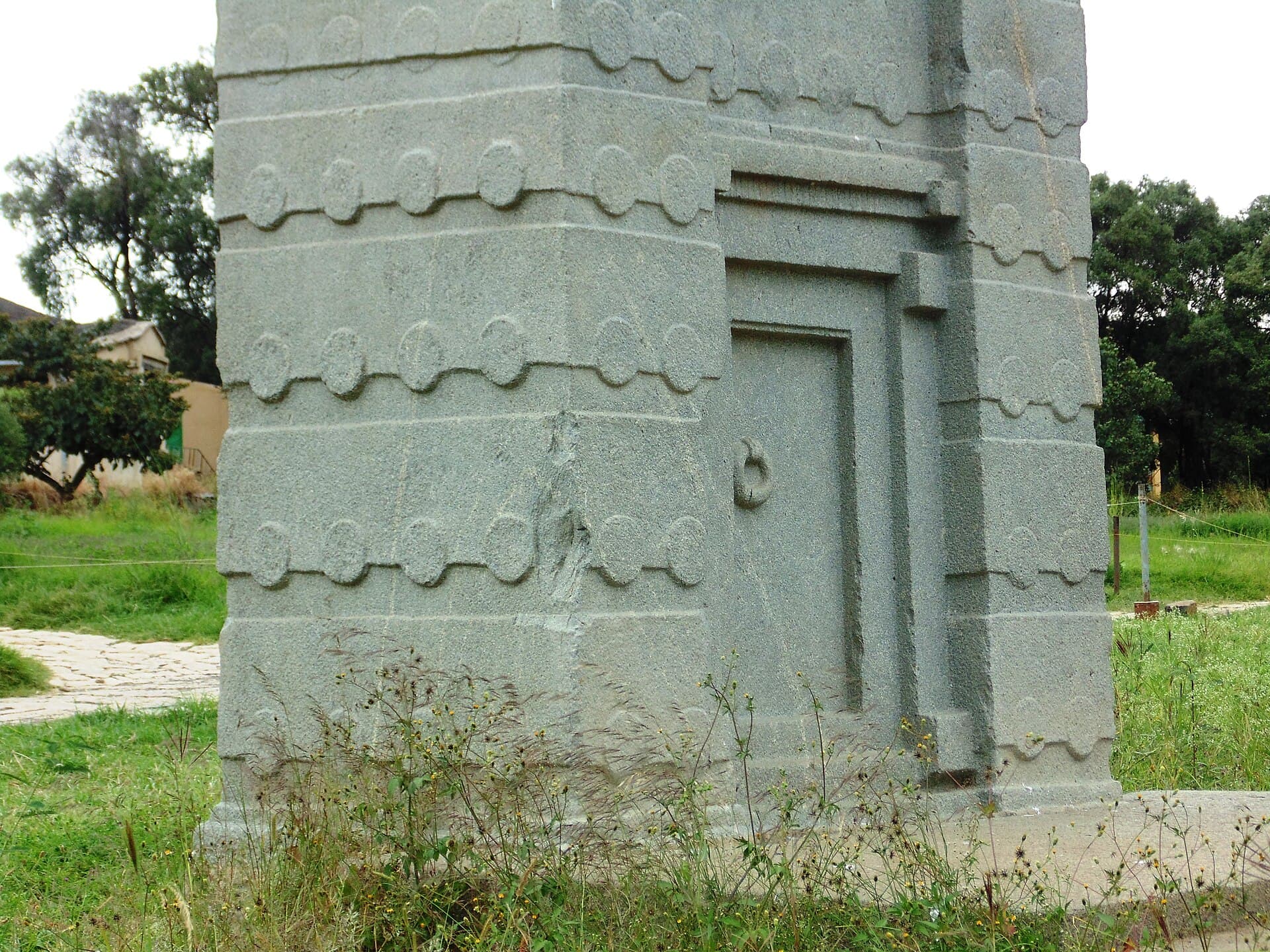
Aksum's kings marked their reigns with granite stelae, quarried, carved to represent multi-storey buildings with false doors and windows, and raised over tombs. The largest ever attempted, over thirty metres, fell in antiquity and lies broken where it landed. Around the 330s, King Ezana converted to Christianity, making Aksum one of the earliest states anywhere to adopt the religion officially and giving the Ethiopian Orthodox Tewahedo Church a claim to unbroken continuity from that date.
The empire declined from around the seventh century as trade shifted, and the political centre of Ethiopia moved south, but Tigray retained the religious primacy. It returned to the centre of Ethiopian politics in the nineteenth century with Emperor Yohannes IV, and again at Adwa in 1896, when the Ethiopian victory preserved the country's independence through the era of European partition.
The twentieth century brought the Italian occupation of 1936 to 1941, during which the largest standing stele at Aksum was cut into pieces and shipped to Rome, where it was re-erected in 1937. It took the Ethiopian government most of the following century to get it back. The obelisk was flown home in three sections on 19, 22 and 25 April 2005 and re-erected at Aksum on 4 September 2008, which makes it one of the few genuinely completed restitutions of a major looted monument.
Tigrinya is the language of the region, a Semitic language descended from Geʽez and closely related to Tigre and Amharic, spoken by several million people in Tigray and by the majority in neighbouring Eritrea. It is the language of regional administration, schooling and media, and it is not endangered.
Geʽez is the older layer and the more remarkable one. It was the language of the Aksumite state and has been the liturgical language of the Ethiopian Orthodox Tewahedo Church ever since, so it has been continuously read, chanted, copied and taught for well over 1,500 years without being anyone's mother tongue for most of that period. Its script, the Ethiopic abugida in which each character carries a consonant and a vowel, is used to write Tigrinya and Amharic today, so an alphabet devised for Aksum remains in daily use on phones across the Horn of Africa.
The manuscript tradition that goes with it is the point at which language and heritage become the same object. Geʽez texts are written on parchment prepared from goatskin, bound between wooden boards, and kept in church and monastery libraries by clergy trained to read and copy them. Ethiopia holds one of the largest bodies of manuscript material in Africa, much of it never catalogued, and a substantial share of it is in Tigray.
The traditional highland house is the hidmo, built of dry stone with heavy timber beams and a flat earth roof, arranged around a courtyard, and designed for a farming household with livestock. Village life is organised through customary law and the authority of shimagille, respected elders who mediate disputes and whose role in reconciliation is formally recognised alongside the courts.
The best known celebration is Ashenda, held in Tigray and neighbouring Amhara areas in the days after the Assumption in mid August, when girls and young women dress in embroidered white cloth and elaborate jewellery, weave the tall grass that gives the festival its name into a bundle worn at the waist, and go from house to house singing and drumming. It is unusual in being a festival by and for young women, who receive gifts and, for a few days, considerable licence. Ethiopia has prepared a nomination to have Ashenda inscribed by UNESCO, though it has not been listed.
Tigrayan music has its own instruments and modes, the krar lyre, the masinko one-string fiddle, and the begena, and the church has a separate and much older tradition of chant. Weaving, silver crosses and basketry are the principal crafts, and the neck cross and hand cross of Tigrayan design are among the most recognisable objects in Ethiopian material culture, which is precisely why they have a resale market.
Tigray is overwhelmingly Ethiopian Orthodox Tewahedo, with a long-established Muslim minority whose presence in the region predates almost all Islamic communities outside Arabia.
 Abuna Yemata Guh is reached by a climb up a sheer face and a walk along a narrow ledge. Its paintings survive precisely because getting there is that difficult. Photograph by Evan Williams, CC BY-SA 4.0, via Wikimedia Commons.
The Church of Our Lady Mary of Zion at Aksum is held by Ethiopian tradition to contain the Ark of the Covenant, kept in a chapel beside the older church and seen by no one except a single appointed guardian monk who does not leave the enclosure and who names his successor. Every Ethiopian Orthodox church holds a tabot, a consecrated tablet representing the Ark, and it is the tabot rather than the building that makes a church, which is why processions carrying the tabot, particularly at Timkat in January, are the central public ritual.
The rock-hewn churches are Tigray's other religious signature. More than a hundred are cut into the sandstone of the Gheralta range and the surrounding districts, many of them reached only by climbing. Abuna Yemata Guh is approached up a sheer rock face and along a ledge, and its painted interior has survived precisely because getting there is difficult. Debre Damo, an amba monastery on a flat-topped mountain in the north, is reached only by rope hauled up the cliff, has been in continuous monastic use since roughly the sixth century, and holds an important manuscript library.
The Al-Nejashi complex at Negash marks the first hijra. In about 615, according to Islamic tradition, a group of Muhammad's followers fled persecution in Mecca and were given refuge by the Aksumite king, and the graves of companions of the Prophet are held to be at the site. It is among the oldest Muslim burial and worship sites anywhere and a place of pilgrimage.
Ethiopian Orthodox mourning is communal, immediate and long. When a death occurs, neighbours and relatives gather at the house for the lekso, a mourning assembly held over several days in which the family does not cook or manage practicalities because the community does it for them. Grief is expressed openly and audibly, including in formal lament, and restraint is not the expectation.
Burial is normally within a day, in the grounds of the parish church, and the church continues to hold the relationship afterwards. A memorial service and feast, the tazkar, is held at intervals following the death, most importantly on the fortieth day, and again at the anniversary, and these are substantial obligations. The dead are prayed for by name, and mourning dress and abstention from celebration are observed for a defined period.
The institution that carries the practical weight is the iddir, a mutual burial society that households join and pay into, which then meets the cost of a funeral and provides the tents, chairs, cooking and labour when a member dies. The iddir is not ancient. It was developed by migrants in Addis Ababa in the early twentieth century, people who had left the villages where this help would have come automatically and had to build a substitute, and it spread from there across the country. Iddirs are governed by their own written rules and elected officers, and a family’s ability to bury and mourn its dead properly is underwritten collectively rather than individually. It is one of the clearest examples anywhere of a mourning tradition inventing new machinery to keep an old obligation.
The war has left a version of this unfinished. Where people were killed away from home, where bodies were not recovered, or where survivors were displaced for years, the sequence of burial, fortieth day and anniversary could not be performed in the normal way, and reporting from the region since 2022 has repeatedly described communities carrying out delayed collective ceremonies. In a tradition where the memorial obligations are this specific, an interrupted funeral is a continuing injury rather than a closed one.
Tigrayan family records are church records, and both the churches and the record have been under direct attack.
The Ethiopian Orthodox Tewahedo Church has been in Tigray since the fourth century, and its monasteries hold manuscripts of extraordinary age: the Abba Garima Gospels at Adwa are among the oldest illuminated Christian manuscripts in the world. Those collections contain land grants, chronicles and the genealogies of noble houses, and they are held by the monasteries themselves rather than by any state library.
Ordinary families were documented by the church and by the land system. Rist tenure tied a claim on land to descent from an ancestor who held it, so establishing a right meant reciting a line, and the records of land disputes preserve those recitations. Universal civil registration in Ethiopia began only in 2016.
The war between 2020 and 2022 did enormous damage. Churches and monasteries were shelled and looted, manuscripts were stolen or burned, and the Al Nejashi mosque at Negash, one of the oldest in Africa, was damaged. Universities, archives and the regional administration's records were destroyed or emptied. Estimates of the dead run into the hundreds of thousands, and there is no name-by-name accounting.
What holds is the practice. The edir burial association organises the funeral and the mourning, and the tazkar, the memorial feast, gathers a family to name its dead. Tigrayans in the diaspora have been documenting the war and the losses because nobody inside the region could.
Aksum was inscribed on the World Heritage List in 1980, covering the stelae fields, the royal tombs, the ruins of palaces and the inscribed stones. The return and re-erection of the obelisk between 2005 and 2008 is the best documented restitution success in the region.
The war of November 2020 to November 2022 then produced what researchers describe as extensive damage and looting. Published analyses, notably by the archaeologist Hagos Abrha Abay and colleagues writing in academic and public venues, and reporting collated by African Arguments, record: the shelling and looting of the sixth-century monastery of Debre Damo in early 2021; damage to the Church of Mary of Zion complex, the main stelae field and the Aksum World Heritage site management office in November 2020; the bombardment of the Al-Nejashi mosque in December 2020, damaging its dome, minaret and tombs; and the removal from the monastery at Waldibba of thousands of parchment manuscripts and hundreds of gold and silver crosses. These accounts attribute much of the destruction to Eritrean forces operating in Tigray alongside Ethiopian federal troops. The Eritrean and Ethiopian governments have rejected allegations of this kind. No comprehensive independent survey of the region's heritage has been completed, and the honest summary is that the scale is documented in outline and not yet in full.
Two consequences follow. The first is a market problem: looted Ethiopian manuscripts, crosses and icons have appeared for sale internationally, and in 2024 eBay halted sales of Ethiopian religious material following research into the trade. The second is a capacity problem: the institutions that would ordinarily survey and conserve, Mekelle University and the regional culture and tourism bureau among them, were themselves disrupted for two years, so documentation is being rebuilt at the same time as it is being used.
The most consequential digital project affecting Tigray long predates the war. The Ethio-SPaRe project and, on a larger scale, the Hill Museum and Manuscript Library and the Ethiopian Manuscript Microfilm Library have photographed Ethiopian and Eritrean manuscripts in situ over decades, producing images of thousands of Geʽez codices from churches and monasteries including many in Tigray. Because of that work, a proportion of what has been looted or burned since 2020 exists as a readable digital record, which is the strongest possible argument for surveying collections before anything happens to them.
Since the war, documentation has become a form of advocacy. Researchers have used satellite imagery, dated photographs and testimony to build damage assessments for individual sites, and databases of looted objects are being assembled so that items appearing at auction can be identified. This is heritage work conducted under evidential rules closer to those of a human rights investigation than of an art history department.
The gap is straightforward and expensive. Most Tigrayan church libraries are still uncatalogued, so for many objects there is no record of what existed, which means a loss cannot be proved and a recovery cannot be matched to an owner.
Adwa is Tigray's largest export as an idea. The 1896 victory over Italy made Ethiopia the state that was not colonised, and it became a reference for pan-Africanist and Black internationalist movements across the twentieth century, so a battlefield in northern Ethiopia carries meaning in Kingston, Harlem and Accra.
The Aksumite claim to the Ark, and the associated Kebra Nagast tradition of descent from Solomon and the Queen of Sheba, is the foundation of Rastafari's attachment to Ethiopia, which has given Tigrayan religious history a global cultural afterlife entirely outside its own church.
Within Ethiopia, the war has changed the terms of everything. A very large Tigrayan diaspora, enlarged again by the displacement of the war years, now funds reconstruction, documentation and advocacy from abroad, and much of the heritage recording described above depends on that support. Tourism to the rock churches and to Aksum, which was significant before 2020, has not recovered, and the guides, guards and priests whose livelihoods maintained access to remote sites lost their income at the same moment the sites became most vulnerable.
An obelisk brought home and stood back up. The stele taken to Rome in 1937 was returned in three sections in April 2005 and re-erected at Aksum on 4 September 2008, a completed restitution of a monument of the first rank.
A liturgical language read continuously for 1,500 years. Geʽez has been copied, chanted and taught without interruption since Aksum, and its script is now used daily to write Tigrinya and Amharic.
Manuscripts photographed before the war. Long-running digitisation of Ethiopian and Eritrean church libraries means a share of what has since been looted or burned survives as a readable record.
A burial society in every community. The iddir underwrites the cost and labour of a funeral collectively, so that the obligations of mourning can be met by families who could not meet them alone.
Abuna Yemata Guh is reached by a climb up a sheer face and a walk along a narrow ledge. Its paintings survive precisely because getting there is that difficult. Photograph by Evan Williams, CC BY-SA 4.0, via Wikimedia Commons.
The Church of Our Lady Mary of Zion at Aksum is held by Ethiopian tradition to contain the Ark of the Covenant, kept in a chapel beside the older church and seen by no one except a single appointed guardian monk who does not leave the enclosure and who names his successor. Every Ethiopian Orthodox church holds a tabot, a consecrated tablet representing the Ark, and it is the tabot rather than the building that makes a church, which is why processions carrying the tabot, particularly at Timkat in January, are the central public ritual.
The rock-hewn churches are Tigray's other religious signature. More than a hundred are cut into the sandstone of the Gheralta range and the surrounding districts, many of them reached only by climbing. Abuna Yemata Guh is approached up a sheer rock face and along a ledge, and its painted interior has survived precisely because getting there is difficult. Debre Damo, an amba monastery on a flat-topped mountain in the north, is reached only by rope hauled up the cliff, has been in continuous monastic use since roughly the sixth century, and holds an important manuscript library.
The Al-Nejashi complex at Negash marks the first hijra. In about 615, according to Islamic tradition, a group of Muhammad's followers fled persecution in Mecca and were given refuge by the Aksumite king, and the graves of companions of the Prophet are held to be at the site. It is among the oldest Muslim burial and worship sites anywhere and a place of pilgrimage.
Ethiopian Orthodox mourning is communal, immediate and long. When a death occurs, neighbours and relatives gather at the house for the lekso, a mourning assembly held over several days in which the family does not cook or manage practicalities because the community does it for them. Grief is expressed openly and audibly, including in formal lament, and restraint is not the expectation.
Burial is normally within a day, in the grounds of the parish church, and the church continues to hold the relationship afterwards. A memorial service and feast, the tazkar, is held at intervals following the death, most importantly on the fortieth day, and again at the anniversary, and these are substantial obligations. The dead are prayed for by name, and mourning dress and abstention from celebration are observed for a defined period.
The institution that carries the practical weight is the iddir, a mutual burial society that households join and pay into, which then meets the cost of a funeral and provides the tents, chairs, cooking and labour when a member dies. The iddir is not ancient. It was developed by migrants in Addis Ababa in the early twentieth century, people who had left the villages where this help would have come automatically and had to build a substitute, and it spread from there across the country. Iddirs are governed by their own written rules and elected officers, and a family’s ability to bury and mourn its dead properly is underwritten collectively rather than individually. It is one of the clearest examples anywhere of a mourning tradition inventing new machinery to keep an old obligation.
The war has left a version of this unfinished. Where people were killed away from home, where bodies were not recovered, or where survivors were displaced for years, the sequence of burial, fortieth day and anniversary could not be performed in the normal way, and reporting from the region since 2022 has repeatedly described communities carrying out delayed collective ceremonies. In a tradition where the memorial obligations are this specific, an interrupted funeral is a continuing injury rather than a closed one.
Tigrayan family records are church records, and both the churches and the record have been under direct attack.
The Ethiopian Orthodox Tewahedo Church has been in Tigray since the fourth century, and its monasteries hold manuscripts of extraordinary age: the Abba Garima Gospels at Adwa are among the oldest illuminated Christian manuscripts in the world. Those collections contain land grants, chronicles and the genealogies of noble houses, and they are held by the monasteries themselves rather than by any state library.
Ordinary families were documented by the church and by the land system. Rist tenure tied a claim on land to descent from an ancestor who held it, so establishing a right meant reciting a line, and the records of land disputes preserve those recitations. Universal civil registration in Ethiopia began only in 2016.
The war between 2020 and 2022 did enormous damage. Churches and monasteries were shelled and looted, manuscripts were stolen or burned, and the Al Nejashi mosque at Negash, one of the oldest in Africa, was damaged. Universities, archives and the regional administration's records were destroyed or emptied. Estimates of the dead run into the hundreds of thousands, and there is no name-by-name accounting.
What holds is the practice. The edir burial association organises the funeral and the mourning, and the tazkar, the memorial feast, gathers a family to name its dead. Tigrayans in the diaspora have been documenting the war and the losses because nobody inside the region could.
Aksum was inscribed on the World Heritage List in 1980, covering the stelae fields, the royal tombs, the ruins of palaces and the inscribed stones. The return and re-erection of the obelisk between 2005 and 2008 is the best documented restitution success in the region.
The war of November 2020 to November 2022 then produced what researchers describe as extensive damage and looting. Published analyses, notably by the archaeologist Hagos Abrha Abay and colleagues writing in academic and public venues, and reporting collated by African Arguments, record: the shelling and looting of the sixth-century monastery of Debre Damo in early 2021; damage to the Church of Mary of Zion complex, the main stelae field and the Aksum World Heritage site management office in November 2020; the bombardment of the Al-Nejashi mosque in December 2020, damaging its dome, minaret and tombs; and the removal from the monastery at Waldibba of thousands of parchment manuscripts and hundreds of gold and silver crosses. These accounts attribute much of the destruction to Eritrean forces operating in Tigray alongside Ethiopian federal troops. The Eritrean and Ethiopian governments have rejected allegations of this kind. No comprehensive independent survey of the region's heritage has been completed, and the honest summary is that the scale is documented in outline and not yet in full.
Two consequences follow. The first is a market problem: looted Ethiopian manuscripts, crosses and icons have appeared for sale internationally, and in 2024 eBay halted sales of Ethiopian religious material following research into the trade. The second is a capacity problem: the institutions that would ordinarily survey and conserve, Mekelle University and the regional culture and tourism bureau among them, were themselves disrupted for two years, so documentation is being rebuilt at the same time as it is being used.
The most consequential digital project affecting Tigray long predates the war. The Ethio-SPaRe project and, on a larger scale, the Hill Museum and Manuscript Library and the Ethiopian Manuscript Microfilm Library have photographed Ethiopian and Eritrean manuscripts in situ over decades, producing images of thousands of Geʽez codices from churches and monasteries including many in Tigray. Because of that work, a proportion of what has been looted or burned since 2020 exists as a readable digital record, which is the strongest possible argument for surveying collections before anything happens to them.
Since the war, documentation has become a form of advocacy. Researchers have used satellite imagery, dated photographs and testimony to build damage assessments for individual sites, and databases of looted objects are being assembled so that items appearing at auction can be identified. This is heritage work conducted under evidential rules closer to those of a human rights investigation than of an art history department.
The gap is straightforward and expensive. Most Tigrayan church libraries are still uncatalogued, so for many objects there is no record of what existed, which means a loss cannot be proved and a recovery cannot be matched to an owner.
Adwa is Tigray's largest export as an idea. The 1896 victory over Italy made Ethiopia the state that was not colonised, and it became a reference for pan-Africanist and Black internationalist movements across the twentieth century, so a battlefield in northern Ethiopia carries meaning in Kingston, Harlem and Accra.
The Aksumite claim to the Ark, and the associated Kebra Nagast tradition of descent from Solomon and the Queen of Sheba, is the foundation of Rastafari's attachment to Ethiopia, which has given Tigrayan religious history a global cultural afterlife entirely outside its own church.
Within Ethiopia, the war has changed the terms of everything. A very large Tigrayan diaspora, enlarged again by the displacement of the war years, now funds reconstruction, documentation and advocacy from abroad, and much of the heritage recording described above depends on that support. Tourism to the rock churches and to Aksum, which was significant before 2020, has not recovered, and the guides, guards and priests whose livelihoods maintained access to remote sites lost their income at the same moment the sites became most vulnerable.
An obelisk brought home and stood back up. The stele taken to Rome in 1937 was returned in three sections in April 2005 and re-erected at Aksum on 4 September 2008, a completed restitution of a monument of the first rank.
A liturgical language read continuously for 1,500 years. Geʽez has been copied, chanted and taught without interruption since Aksum, and its script is now used daily to write Tigrinya and Amharic.
Manuscripts photographed before the war. Long-running digitisation of Ethiopian and Eritrean church libraries means a share of what has since been looted or burned survives as a readable record.
A burial society in every community. The iddir underwrites the cost and labour of a funeral collectively, so that the obligations of mourning can be met by families who could not meet them alone.
National Overview
Notable Cities
Historical Foundations
Linguistic and Etymological Roots
Cultural Identity
Religion and Spirituality
Remembrance and Mourning Traditions
Tracing a Family in Tigray
Heritage Preservation Efforts
Digital Heritage
Contemporary Cultural Influences
Success Stories
References and resources
- UNESCO, Aksum: the 1980 World Heritage inscription.
- Obelisk of Axum, Wikipedia: the removal to Rome in 1937 and the return and re-erection in 2005 and 2008.
- The Destruction and Looting of Heritage in the Tigray War, African Arguments: the collated damage and looting record.
- Ethiopia's war in Tigray risks wiping out centuries of the world's history, The Conversation: the researchers' assessment.
- Church of Our Lady Mary of Zion, Wikipedia: the Ark tradition and the guardian monk.
- Al Nejashi Mosque, Wikipedia: the first hijra and the December 2020 damage.
- Debre Damo, Wikipedia: the cliff monastery and its library.
- Geʽez, Wikipedia: the liturgical language and the script.
- Eder, Wikipedia: the iddir burial societies, their origin and how they work.
- Tigray Region, Wikipedia: geography, population and administration.