Heritage · Landmark
Lalibela — rock-hewn keeping
Eleven churches carved downward into the red rock of the Ethiopian highlands, kept in daily use for eight centuries by hereditary priests, barefoot pilgrims, and families who never stopped coming.Written to last.
By Confinity Heritage Editorial · 2026-07-10 · 7-minute readQuiet tools, kept out of the way.
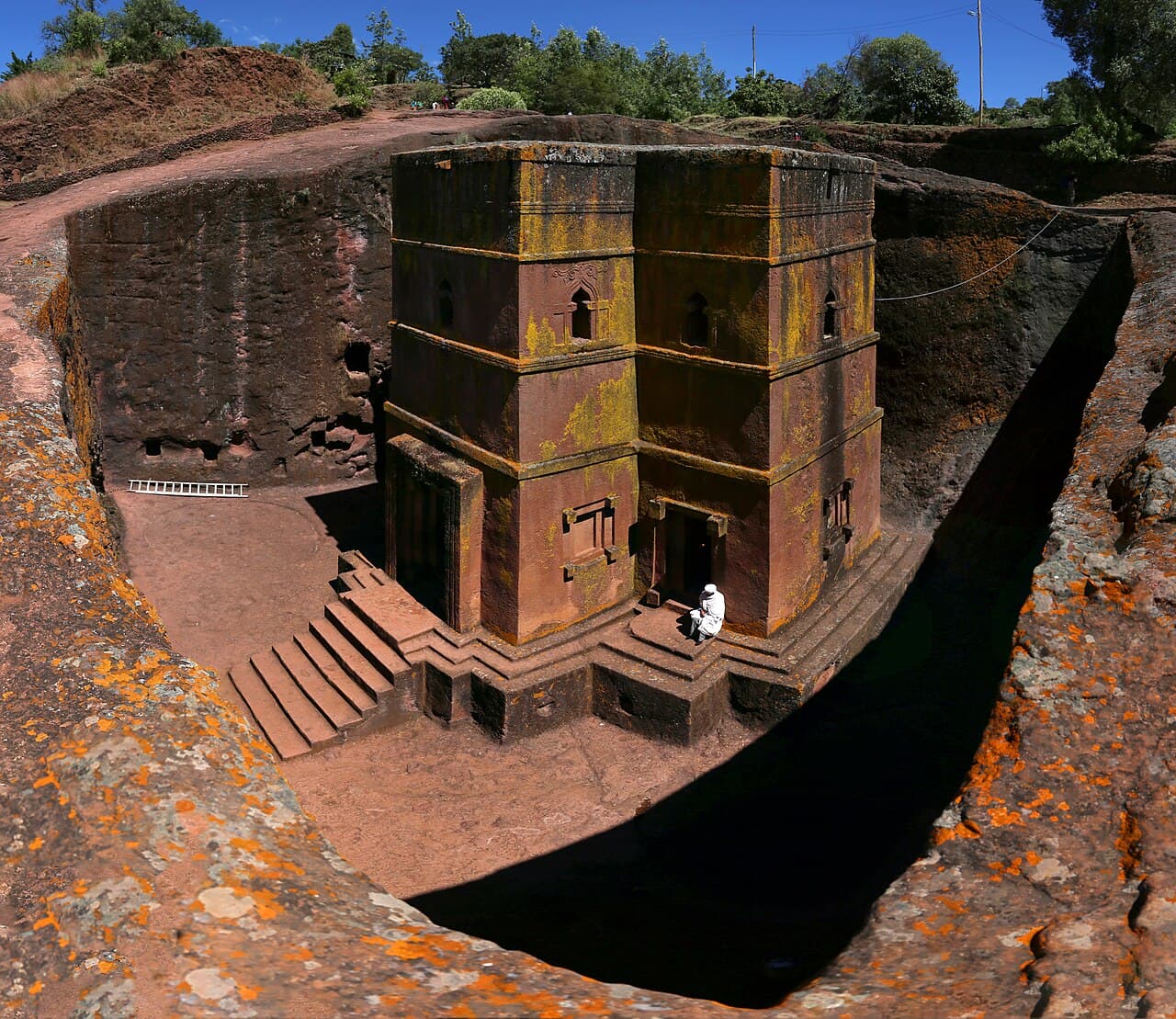
Most monuments are built up. Lalibela was built down. In the highlands of northern Ethiopia, at about 2,500 metres above sea level, eleven medieval churches were cut straight into the living rock and released from the ground itself, roofs level with the surrounding earth, floors sunk ten or twelve metres below it. You do not approach these churches. You descend into them.
They have never been museums. For roughly eight hundred years the churches of Lalibela have held daily services of the Ethiopian Orthodox Tewahedo Church, one of the oldest Christian traditions in the world. Priests keep the same hours their predecessors kept. Chant in Ge'ez, the ancient liturgical language, still moves through the trenches and tunnels before dawn. That continuity is what makes Lalibela one of the most remarkable acts of keeping on earth.
Tradition attributes the churches to King Gebre Mesqel Lalibela of the Zagwe dynasty, who ruled in the late twelfth and early thirteenth centuries. The dating is debated, some scholars believe the complex grew over a longer period, and that parts of it may rework older structures, but the core story is consistent: after Saladin's capture of Jerusalem in 1187 made pilgrimage to the Holy Land perilous for Ethiopian Christians, the king set out to build a New Jerusalem at home.
The town's landscape was renamed to match. The seasonal watercourse dividing the two main clusters of churches is called the Yordanos, the River Jordan. There is a Golgotha, a Mount of Olives, a Tomb of Adam. A pilgrim who could not reach Jerusalem could walk its geography here, in the rock of Lasta. Hagiographies say angels worked alongside the masons at night, finishing what human hands began by day. What the archaeology says is in some ways more astonishing: thousands of workers removing an estimated hundreds of thousands of cubic metres of volcanic tuff with iron tools, planning each church from the roof downward, where a single deep mistake could not be undone.
The churches fall into two main groups joined by a warren of trenches, tunnels, and passageways, with one outlier that has become the emblem of the whole site. Biete Medhane Alem, in the northern group, is believed to be the largest monolithic church in the world, a full basilica with rows of external columns, all of one piece with the mountain. Biete Maryam is thought by many to be the oldest; its interior carries painted decoration and carved reliefs. Biete Golgotha Mikael holds relief figures of saints and, by tradition, the tomb of King Lalibela himself; parts of it remain closed to all but priests.
 Bete Giyorgis stands in a pit of its own making. The masons began at ground level and cut downwards, freeing the church from the rock on all four sides before hollowing it out. Photograph by Bernard Gagnon, CC BY-SA 3.0, via Wikimedia Commons.
Set apart from both groups stands Biete Ghiorgis, the Church of Saint George, a cruciform tower carved free on all four sides, standing in a pit some twelve metres deep. Seen from the rim, its roof forms a Greek cross flush with the ground, weathered by eight centuries of rain. It is the photograph everyone knows, and it does not prepare you for the vertigo of the real thing.
In 1978 the Rock-Hewn Churches of Lalibela were inscribed on the UNESCO World Heritage List, among the first twelve sites ever listed, alongside the Galápagos Islands and the historic centre of Kraków. The listing recognised not just the architecture but the site's unbroken religious life.
Lalibela belongs on any list of vanishing rituals precisely because its rituals have not vanished, and because keeping them has required deliberate, generational work. The clergy here number in the hundreds; many inherit their vocation, trained from childhood in Ge'ez liturgy, chant, and the care of church treasures, processional crosses, illuminated manuscripts, vestments, that priests guard in the churches themselves, as their fathers and teachers did.
Twice each year the town's population multiplies. At Genna, Ethiopian Christmas, on 7 January, and at Timkat, the feast of Epiphany, less than two weeks later, tens of thousands of pilgrims arrive, many on foot, some having walked for weeks, wrapped in white cotton shammas. They sleep on the terraces and hillsides around the churches. All-night vigils fill the trenches with candlelight and chant. Children are brought so that they will remember having been brought, and will one day bring their own. Pilgrimage here is not tourism's ancestor; it is a family practice, transmitted the way recipes and prayers are transmitted, by taking someone with you.
Lalibela's dangers are quieter than a headline, and they are real.
The stone itself is the first problem. The churches are carved from soft, porous volcanic tuff that absorbs water and sheds its surface in thin layers. Rain, wind, temperature swings, and seismic activity have opened cracks in facades and roofs; water infiltration threatens the painted interiors. In 2008, temporary steel shelters funded by the European Union were erected over several of the most fragile churches. They were meant to last a decade at most. They still stand, visually intrusive, resented by many clergy and residents, and now a conservation concern in their own right, since their footings sit close to the carved rock and their spans alter how wind and water move across the site.
Conflict is the second. During the war in northern Ethiopia, Lalibela was occupied between August and December 2021 and changed hands more than once. The churches escaped physical damage, but the town endured months without reliable power, telecommunications, or supplies; tourism, a mainstay of local income, collapsed and has been slow to rebuild. Conservation work paused and had to restart.
Tourism itself is the third, more ambiguous risk. Visitor numbers in good years bring income the town depends on, but foot traffic wears the soft floors and steps, and the infrastructure of a growing town, roads, hotels, drainage, presses on a landscape that was shaped as sacred geography.
Since a Franco-Ethiopian agreement signed in March 2019, the Sustainable Lalibela project, funded by the French foreign ministry and the Agence Française de Développement, and coordinated by the CNRS with Ethiopian partners, has been documenting the churches, studying the stone's decay, training local craftspeople and heritage professionals, and designing lighter, less intrusive shelters, including proposals using bamboo structures, to replace the ageing steel canopies. The World Monuments Fund has also supported conservation at the site, and UNESCO missions continue to monitor its condition.
What is striking in all of these programmes is how much they depend on people who were already there. The priests know where the roofs leak. The deacons know which steps have worn dangerous. The masons' skills being formalised in training courses descend from the skills that cut the churches in the first place. Lalibela was never lost and rediscovered, never abandoned to romantic ruin. It has been continuously kept, swept, chanted in, repaired, argued over, handed down, by the community that lives beside it.
The lesson of Lalibela is that preservation is not an event but a practice. No single intervention saved these churches; eight hundred years of small, repeated acts did, the daily service held whether or not anyone travelled to see it, the child taught the chant, the pilgrimage made again. Family memory works the same way. The stories, recordings, and photographs that survive in a family are rarely the ones rescued in a crisis; they are the ones someone kept returning to, year after year, until returning became a tradition of its own. Lalibela is what that looks like carved in stone.
Bete Giyorgis stands in a pit of its own making. The masons began at ground level and cut downwards, freeing the church from the rock on all four sides before hollowing it out. Photograph by Bernard Gagnon, CC BY-SA 3.0, via Wikimedia Commons.
Set apart from both groups stands Biete Ghiorgis, the Church of Saint George, a cruciform tower carved free on all four sides, standing in a pit some twelve metres deep. Seen from the rim, its roof forms a Greek cross flush with the ground, weathered by eight centuries of rain. It is the photograph everyone knows, and it does not prepare you for the vertigo of the real thing.
In 1978 the Rock-Hewn Churches of Lalibela were inscribed on the UNESCO World Heritage List, among the first twelve sites ever listed, alongside the Galápagos Islands and the historic centre of Kraków. The listing recognised not just the architecture but the site's unbroken religious life.
Lalibela belongs on any list of vanishing rituals precisely because its rituals have not vanished, and because keeping them has required deliberate, generational work. The clergy here number in the hundreds; many inherit their vocation, trained from childhood in Ge'ez liturgy, chant, and the care of church treasures, processional crosses, illuminated manuscripts, vestments, that priests guard in the churches themselves, as their fathers and teachers did.
Twice each year the town's population multiplies. At Genna, Ethiopian Christmas, on 7 January, and at Timkat, the feast of Epiphany, less than two weeks later, tens of thousands of pilgrims arrive, many on foot, some having walked for weeks, wrapped in white cotton shammas. They sleep on the terraces and hillsides around the churches. All-night vigils fill the trenches with candlelight and chant. Children are brought so that they will remember having been brought, and will one day bring their own. Pilgrimage here is not tourism's ancestor; it is a family practice, transmitted the way recipes and prayers are transmitted, by taking someone with you.
Lalibela's dangers are quieter than a headline, and they are real.
The stone itself is the first problem. The churches are carved from soft, porous volcanic tuff that absorbs water and sheds its surface in thin layers. Rain, wind, temperature swings, and seismic activity have opened cracks in facades and roofs; water infiltration threatens the painted interiors. In 2008, temporary steel shelters funded by the European Union were erected over several of the most fragile churches. They were meant to last a decade at most. They still stand, visually intrusive, resented by many clergy and residents, and now a conservation concern in their own right, since their footings sit close to the carved rock and their spans alter how wind and water move across the site.
Conflict is the second. During the war in northern Ethiopia, Lalibela was occupied between August and December 2021 and changed hands more than once. The churches escaped physical damage, but the town endured months without reliable power, telecommunications, or supplies; tourism, a mainstay of local income, collapsed and has been slow to rebuild. Conservation work paused and had to restart.
Tourism itself is the third, more ambiguous risk. Visitor numbers in good years bring income the town depends on, but foot traffic wears the soft floors and steps, and the infrastructure of a growing town, roads, hotels, drainage, presses on a landscape that was shaped as sacred geography.
Since a Franco-Ethiopian agreement signed in March 2019, the Sustainable Lalibela project, funded by the French foreign ministry and the Agence Française de Développement, and coordinated by the CNRS with Ethiopian partners, has been documenting the churches, studying the stone's decay, training local craftspeople and heritage professionals, and designing lighter, less intrusive shelters, including proposals using bamboo structures, to replace the ageing steel canopies. The World Monuments Fund has also supported conservation at the site, and UNESCO missions continue to monitor its condition.
What is striking in all of these programmes is how much they depend on people who were already there. The priests know where the roofs leak. The deacons know which steps have worn dangerous. The masons' skills being formalised in training courses descend from the skills that cut the churches in the first place. Lalibela was never lost and rediscovered, never abandoned to romantic ruin. It has been continuously kept, swept, chanted in, repaired, argued over, handed down, by the community that lives beside it.
The lesson of Lalibela is that preservation is not an event but a practice. No single intervention saved these churches; eight hundred years of small, repeated acts did, the daily service held whether or not anyone travelled to see it, the child taught the chant, the pilgrimage made again. Family memory works the same way. The stories, recordings, and photographs that survive in a family are rarely the ones rescued in a crisis; they are the ones someone kept returning to, year after year, until returning became a tradition of its own. Lalibela is what that looks like carved in stone.
A New Jerusalem, cut into the ground
Eleven churches, one act of devotion
A holy city that never emptied
What is at risk
The keeping now
What Lalibela teaches about keeping
References and resources
- UNESCO World Heritage Centre, Rock-Hewn Churches, Lalibela
- UNESCO World Heritage Centre, State of Conservation reports, Rock-Hewn Churches, Lalibela
- Agence Française de Développement, Churches of Lalibela: supporting the conservation of a heritage site
- CNRS, Sustainable Lalibela project
- World Monuments Fund, Rock-Hewn Churches of Lalibela
- Expertise France, Feasibility study for the conservation and restoration of the Lalibela churches site