Heritage · Country
Somaliland Culture and Heritage
On a granite ceiling near Hargeisa, cattle painted five thousand years ago still hold their colour, and almost nobody outside the region knew until a French team walked in during 2002. This guide follows Somaliland's heritage: Laas Geel and the coral ports, the gabay and the buraanbur, xeer, and the graves of 1988.Written to last.
By Confinity Heritage Editorial · Updated 2026-08-17 · 8-minute readQuiet tools, kept out of the way.
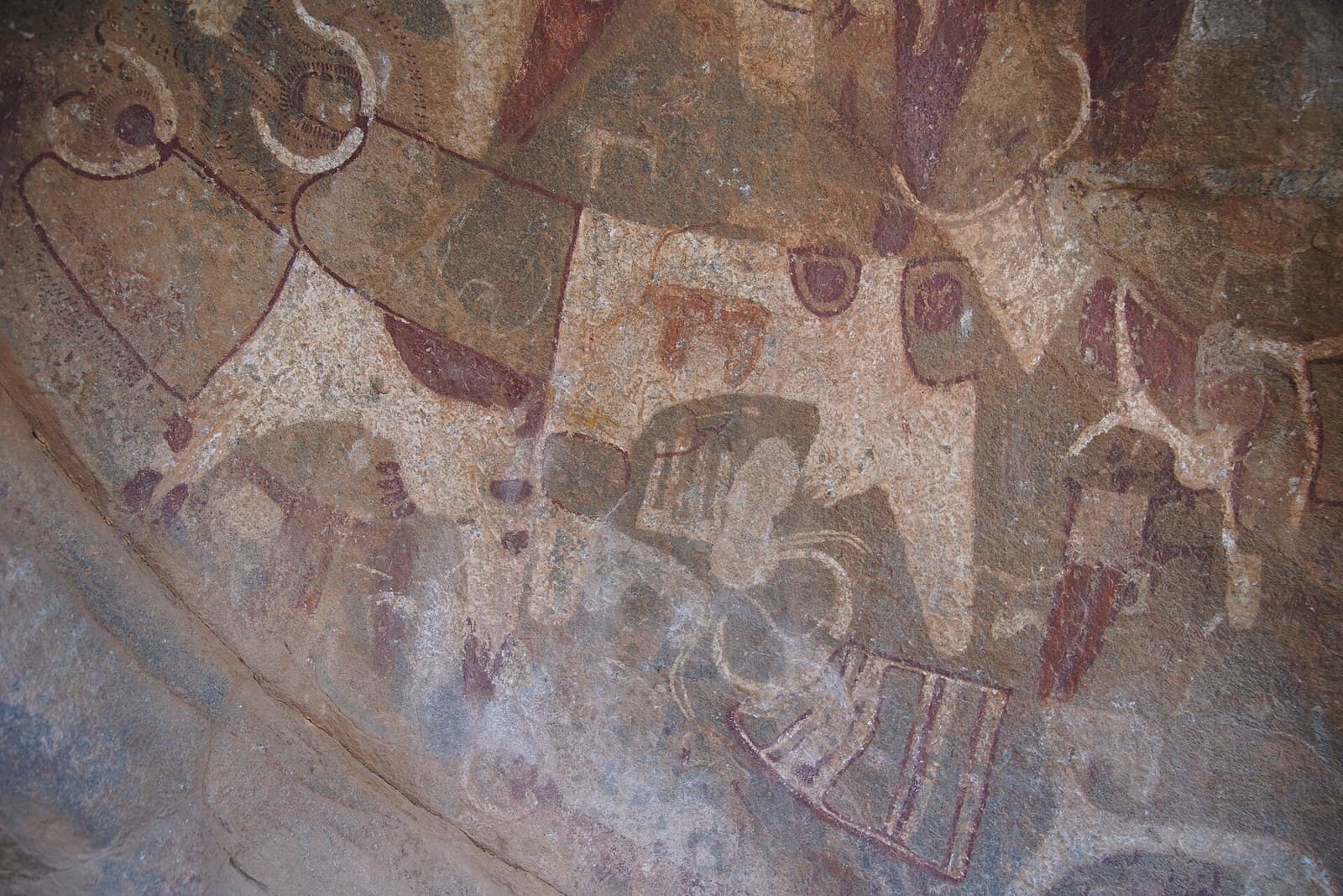
About fifty kilometres from Hargeisa, where two seasonal watercourses meet, granite boulders form a set of shallow overhangs. Under them, painted on rock, stand herds of long-horned cattle with decorated collars around their necks, and beside them small human figures with arms raised. The colours are still red, ochre and white. A French archaeological team surveyed the shelters in late 2002 and found ten of them; the paintings are usually dated to somewhere between about 5000 and 3000 BCE, and they are among the best preserved rock art anywhere in Africa. Herders had known it for generations. The rest of the world had not.
Somaliland declared independence from Somalia on 18 May 1991, at a conference of northern clans in Burao, after the collapse of Siad Barre's government. It has held presidential elections, issues its own currency and passports, and has functioned as a de facto state for more than three decades. For thirty-four years no state recognised it; on 26 December 2025 Israel became the first United Nations member state to do so, and no other has followed. The African Union rejected that recognition and restated its commitment to Somalia's unity and territorial integrity, and the United Nations continues to treat the territory as part of Somalia. This page takes no position on recognition, and spends its length on the heritage.
Somaliland covers roughly 176,000 square kilometres along the southern shore of the Gulf of Aden, bordered by Djibouti, Ethiopia and the rest of Somalia. Three bands run east to west: the Guban, a hot coastal plain; the Ogo escarpment behind it, rising to the Cal Madow range in the east where Shimbiris reaches about 2,400 metres and pockets of juniper and dragon's blood trees survive; and the Haud, a grazing plateau running south into Ethiopia. No census has been taken in decades and population estimates range widely, from around four million to over six.
The capital is Hargeisa. The economy runs on livestock exported live through Berbera to the Gulf, on the port itself, and on money sent home by a large diaspora, which researchers reckon a substantial share of household income. Government is a hybrid: an elected president and House of Representatives alongside the Guurti, a House of Elders formalised at the Borama conference of 1993 (Britannica). In November 2024 the opposition candidate Abdirahman Mohamed Abdullahi won the presidency and power changed hands peacefully, as it had in 2010.
Hargeisa. Rebuilt almost from nothing after 1991, the capital is a low, spread-out city of markets, money changers sitting behind stacked bricks of shilling notes, and the Freedom Square memorial. It holds the Hargeysa Cultural Centre, the book fair each summer, and the road east to Laas Geel.
Berbera. The historic port and the seasonal fair that once drew caravans from deep inland, with an old town of coral-stone and timber houses, Ottoman and Egyptian era buildings and mosques, much of it now fragile (Berbera). A concession agreed with DP World in 2016 has rebuilt the harbour beside it.
Zeila (Saylac). A near-empty town on the Djibouti border, once among the great trading ports of the Red Sea and the seat of the Adal Sultanate. Its ruins include the Masjid al-Qiblatayn, the mosque of two qiblas, held locally to be among the oldest in Africa (Zeila).
Borama, Burao and Erigavo. Borama in the west is a university town and the site of the 1993 conference that produced the national charter. Burao is the livestock capital and the place where independence was declared. Erigavo sits under the Cal Madow, gateway to the frankincense country.
Ancient Egyptian records describe trading voyages to a land called Punt, from which came incense, myrrh, ebony and gold, most famously in an expedition sent by Hatshepsut around 1470 BCE. Where Punt lay is still argued: candidates run from the Eritrean and Sudanese coasts to this shore, and no site has settled it (Land of Punt). What is certain is that the coast traded aromatics for millennia. Frankincense and myrrh, tapped from Boswellia and Commiphora trees in the eastern mountains, moved through Zeila and Berbera to Arabia, Persia, India and Rome, and the harvesting families still work the same trees under inherited rights.
Islam arrived early, by sea. Zeila became a centre of Muslim states in the Horn, and from the fifteenth century the Adal Sultanate ran from there and later from Harar. Its best-known figure, Imam Ahmad ibn Ibrahim al-Ghazi, remembered in Somali as Ahmad Gurey, led campaigns against the Christian kingdom of Ethiopia from 1529 until his death in 1543, a war that reshaped the region and remains a fixture of oral history on both sides (Adal Sultanate).
Britain took treaties with northern clans from 1884 and ran the British Somaliland Protectorate, largely to secure meat supplies for Aden. From 1899 to 1920 Sayyid Mohammed Abdullah Hassan led the Dervish movement against British, Italian and Ethiopian forces from stone forts at Taleex, and he was, characteristically, also one of the language's major poets. The protectorate became independent on 26 June 1960 and five days later joined Italian Somaliland to form the Somali Republic, a union agreed quickly and never legislated identically by both parliaments (British Somaliland).
Siad Barre took power in 1969. Northern grievance hardened into the Somali National Movement, founded in 1981, and in May 1988 the SNM attacked Hargeisa and Burao. The government answered with artillery and aerial bombardment of both cities. When Barre's government fell in 1991, the north withdrew from the union. Internal fighting followed in 1994 to 1996 and was ended by clan conferences rather than outside mediation; a constitution was approved by referendum in 2001. On 1 January 2024 Somaliland and Ethiopia signed a memorandum of understanding giving Ethiopia access to a stretch of coast, reportedly against a promise of recognition; Somalia rejected it, and in December 2024 Ethiopia signed the Ankara Declaration, brokered by Türkiye, affirming Somalia's territorial integrity (International recognition of Somaliland).
Somali is a Cushitic language of the Afroasiatic family, spoken across Somaliland, Somalia, eastern Ethiopia, Djibouti and northern Kenya. Writing it was an argument that lasted half a century. Several scripts were invented for the purpose, among them Osmanya, devised in the 1920s, and the Borama and Kaddare scripts, while others pressed for Arabic letters. In October 1972 the government settled on a Latin orthography developed by the linguist Shire Jama Ahmed, and a mass literacy campaign carried it into the countryside within a year, so that a language which had lived almost entirely in memory and speech acquired a standard spelling in a single season (Somali language). Arabic remains the language of religion and much commerce, and English is used in administration and the universities.
The names on the map are mostly plain description. Laas Geel joins laas, a water hole, to geel, camels: the camels' well. Cal Madow is the black range. Guban, the coastal plain, means burnt. Saylac and Berbera are old enough that their origins are argued, Berbera being linked to the Barbaria of Greek and Roman sailing manuals. Somaliland itself is a British colonial coinage, the protectorate's name kept after 1991 for a territory whose people call themselves Somali and whose state was born from that older boundary.
The central art form is poetry, composed and carried by memory. Somali verse requires alliteration throughout: a poem chooses a consonant, and every line must contain a word beginning with it, sustained sometimes over hundreds of lines. The forms are distinct and ranked. The gabay is the long classical measure, used for argument, praise, war and judgment; the geeraar and jiifto are shorter; the heello and the modern hees moved poetry on to radio and into song. The buraanbur is the women's form, with its own metre, performed at weddings and public occasions and often composed collectively.
 The paintings at Laas Geel are around five thousand years old and among the best preserved in Africa. Local people always knew they were there; archaeologists reached them in 2002. Photograph by Tinasimonrowe, CC BY-SA 4.0, via Wikimedia Commons.
Poetry here has weight in public affairs. A poem could start a feud or settle one, and in the twentieth century cassettes of political verse circulated faster than newspapers. Richard Burton, passing through in the 1850s, wrote that the country teems with poets, and the phrase "a nation of poets" was coined a century later by the Canadian writer Margaret Laurence, whose 1954 collection was the first English gathering of Somali oral literature (Somali literature). The best known modern poet, Mohamed Ibrahim Warsame, called Hadraawi, wrote against the Barre government, spent years in prison, walked a peace march across the region in 2003, and was mourned nationally when he died in Hargeisa in August 2022.
Social life runs on clan genealogy and on xeer, the customary law. Xeer is contract rather than code: groups of related families form a mag or diya unit that stands surety for its members, compensation for injury or death is paid in camels, and disputes go before xeer beegti, elders chosen for their knowledge and judgment, who hear witnesses and work toward a settlement both sides accept (Xeer). It predates Islam, has absorbed a good deal of it, and functions today alongside sharia and statutory courts. Camels sit at the centre of the older culture as wealth, compensation, poetry and food, and the aqal, the portable domed house of bent saplings and woven mats built and owned by women, is the pastoral family's home.
Somalilanders are almost entirely Sunni Muslims of the Shafi'i school. Islam came from across the water in the first centuries of the faith, and the coastal towns were Muslim long before the interior. Religious learning has been carried by the Sufi orders, chiefly the Qadiriyya and the Salihiyya, whose sheikhs founded settled farming communities, taught the Quran and mediated between clans.
The result is a landscape of saints' tombs. Pilgrimage to them, the siyaaro or ziyara, brings families to pray, seek intercession and mark an anniversary with recitation and a shared meal. The tomb of Sheikh Isaaq at Maydh on the northern coast, ancestor of the clan family that bears his name, draws visitors from across the country and from the diaspora. Aw-Barkhadle, north of Hargeisa, is a saint's shrine standing on a much older site of standing stones and a medieval town, excavated by the archaeologist Sada Mire, and is one of the clearest places to see pre-Islamic and Islamic practice layered on the same ground (Aw-Barkhadle). Salafi currents have grown since the 1990s and are often critical of the shrines, so the tombs are now a live question as well as an old practice.
Muslim burial is prompt and plain. The body is washed, wrapped in a white kafan, prayed over in the salat al-janazah and buried the same day where possible, laid on its right side facing Mecca in a grave usually marked with nothing more than stones. Elaborate monuments are discouraged. What follows is social: tacsi, the condolence gathering, runs for three days at the family's home, with Quran recitation, tea and food brought by neighbours, and money collected for the household; a widow observes idda, four months and ten days. Charity given in the name of the dead, sadaqa, is the usual way of continuing to do something for them. The absent are named in poetry, and the elegy remains a recognised commission.
The heaviest remembrance in Somaliland is the memory of 1988. After the SNM attacks in May, government forces shelled Hargeisa and bombed it from the air with aircraft flying from the city's own airport, and Burao was hit in the same weeks. Estimates of the dead across the campaign of 1987 to 1989 range from about 50,000 to 200,000, mostly civilians; roughly 90 per cent of Hargeisa was destroyed and about 70 per cent of Burao; and up to half a million people crossed into Ethiopia in what has been described as one of the fastest large displacements recorded in Africa. An investigation commissioned in 2001 by United Nations bodies and led by the lawyer Chris Mburu concluded that "the crime of genocide was conceived, planned and perpetrated" by the Somali government against the Isaaq, and genocide scholars including Gregory Stanton and Adam Jones have taken the same view (Isaaq genocide). That is their assessment, and no international tribunal has ruled on the question.
The graves have been coming up since 1997. Somaliland's own war crimes investigation commission, working with forensic teams and volunteers, has opened mass graves around Hargeisa, at Berbera and near Erigavo, sometimes on ground that families had pointed to for years. Remains are examined, and where identification is possible they are returned; where it is not, they are reburied together with prayers and a marker, which is itself a decision about how to remember people who cannot be named. Personal effects recovered from the pits, sandals, glasses, a comb, have been shown publicly, and relatives have travelled from Britain, Scandinavia and Minnesota for reburials.
In Freedom Square in the centre of Hargeisa, a Somali Air Force MiG-17 stands on a plinth. It is a real aircraft, downed near the city, raised as a memorial to the people killed in the bombardment and rebuilt in 2020; beneath it a painted panel shows a woman holding the Somaliland flag and looking up (Hargeisa War Memorial). Placing the weapon itself on the pedestal is an unusual choice, and it is the first thing most visitors to Hargeisa photograph. Around it walks a city that a diaspora came back to rebuild, house by house, through the 1990s.
Somaliland runs a functioning civil registration system for a state nobody recognises, which is the central fact of every document it produces.
Since declaring independence in 1991, Somaliland has held elections, issued passports and identity cards, and built a national registration system that works within its own territory. The trouble is that documents issued by an unrecognised state are not accepted abroad, so Somalilanders travelling or claiming asylum are documented by other countries as Somalis, and the paperwork that says who they are does not travel.
Underneath it is abtirsiin, the recitation of the line of fathers, which is precise, universal and does most of the practical work. Clan and sub-clan determine diya, the compensation group, and they underpin the beel system by which Somaliland's political settlement distributes power. A Somalilander can place another Somalilander by asking for a genealogy.
The written colonial record is British Somaliland's, and it is thin: the protectorate was administered lightly and most files are at Kew. Islamic court records and the registers of the Sufi orders carry what else exists.
The hardest record is 1988. Government forces bombed Hargeisa and Burao and killed a large number of civilians, and the city was largely destroyed; mass graves have been exhumed since, and the War Memorial in Hargeisa is a fighter jet on a plinth. The documentation of that period was produced by survivors and by Somaliland's own investigators rather than by any recognised authority.
Laas Geel is the country's outstanding site and also its clearest heritage problem. It is fenced and guarded, visited by permit from the responsible ministry in Hargeisa, and protected mainly by the granite overhangs that have kept sun and rain off the pigment for five thousand years (Laas Geel). What it does not have is any standing under international heritage law. The World Heritage Convention operates through States Parties, and only a state that has ratified it can nominate a site on its own territory; Somaliland cannot accede while it is unrecognised, and Somalia has never put the site forward. One of the best preserved rock art complexes in Africa therefore sits outside every mechanism built for exactly such places, and outside the funding that follows them.
Other sites are less lucky. Dhambalin, a painted shelter near Berbera documented in 2007 by the archaeologist Sada Mire, carries the first known depictions of sheep in Somali rock art; the rock-art sites of Haylaan and Sanaag are largely unsurveyed; and quarrying, graffiti and road building threaten several (Dhambalin). Mire, the first Somali to take a doctorate in archaeology, has argued that heritage work in the Horn should be led by the communities who already regard these places as theirs, and her organisation has recorded sites, trained fieldworkers and pressed for a national inventory (Sada Mire). In Berbera, the coral-stone old town is decaying while the port beside it is rebuilt, and conservation there is a race.
The most important archive is made of cassette tape. From the 1970s onward Somalis recorded poems, plays, songs and spoken letters on cassettes and posted them between home and the diaspora, and the Hargeysa Cultural Centre, founded in 2014 by the mathematician and publisher Jama Musse Jama, has been tracking those tapes down, digitising them and building a wall of thousands of them in its building (Hargeysa Cultural Centre). The recordings hold verse that was never written down and messages sent to people who have since died.
The library also collects Somali books, manuscripts and newspapers, and Jama Musse Jama has assembled a digital Somali corpus for research. Diaspora publishers keep Somali literature in print and online, and the tape wall has become the thing visitors are brought to see (Atlas Obscura).
The Hargeisa International Book Fair, held since 2008, has grown into one of the largest literary gatherings in the Horn, running in Somali, Arabic and English with a guest country each year, and around it sits a culture of readings, translation and small publishing that did not exist thirty years ago.
The diaspora carries much of the rest. Nadifa Mohamed, born in Hargeisa and raised in London, was shortlisted for the Booker Prize in 2021. The singer Sahra Halgan, who served as a field nurse during the war and spent years in France, returned to open Hiddo Dhawr in Hargeisa, a venue built to keep traditional Somali music performed live. Communities in Cardiff, London, Minneapolis and across Scandinavia send money, come back to build, and argue about the country online in Somali, which has made the language's digital life unusually loud for its size.
The paintings are still there. Laas Geel came through decades of war untouched, was documented in 2002, and is now fenced, guarded and visited by permit, with local guides and guards employed at the site.
Power changed hands by counting votes. Somaliland's presidents have twice conceded elections and handed over, in 2010 and again after the November 2024 poll, in a region where that is rare.
Elders ended a war. The clan conferences at Borama in 1993 and Hargeisa in 1996 closed internal fighting without foreign mediation and produced the Guurti, giving customary authority a formal seat in government.
A nation's tapes, recovered. The Hargeysa Cultural Centre has collected and digitised thousands of cassettes of poetry, drama and family messages that existed nowhere else, and built a library and book fair around them.
The paintings at Laas Geel are around five thousand years old and among the best preserved in Africa. Local people always knew they were there; archaeologists reached them in 2002. Photograph by Tinasimonrowe, CC BY-SA 4.0, via Wikimedia Commons.
Poetry here has weight in public affairs. A poem could start a feud or settle one, and in the twentieth century cassettes of political verse circulated faster than newspapers. Richard Burton, passing through in the 1850s, wrote that the country teems with poets, and the phrase "a nation of poets" was coined a century later by the Canadian writer Margaret Laurence, whose 1954 collection was the first English gathering of Somali oral literature (Somali literature). The best known modern poet, Mohamed Ibrahim Warsame, called Hadraawi, wrote against the Barre government, spent years in prison, walked a peace march across the region in 2003, and was mourned nationally when he died in Hargeisa in August 2022.
Social life runs on clan genealogy and on xeer, the customary law. Xeer is contract rather than code: groups of related families form a mag or diya unit that stands surety for its members, compensation for injury or death is paid in camels, and disputes go before xeer beegti, elders chosen for their knowledge and judgment, who hear witnesses and work toward a settlement both sides accept (Xeer). It predates Islam, has absorbed a good deal of it, and functions today alongside sharia and statutory courts. Camels sit at the centre of the older culture as wealth, compensation, poetry and food, and the aqal, the portable domed house of bent saplings and woven mats built and owned by women, is the pastoral family's home.
Somalilanders are almost entirely Sunni Muslims of the Shafi'i school. Islam came from across the water in the first centuries of the faith, and the coastal towns were Muslim long before the interior. Religious learning has been carried by the Sufi orders, chiefly the Qadiriyya and the Salihiyya, whose sheikhs founded settled farming communities, taught the Quran and mediated between clans.
The result is a landscape of saints' tombs. Pilgrimage to them, the siyaaro or ziyara, brings families to pray, seek intercession and mark an anniversary with recitation and a shared meal. The tomb of Sheikh Isaaq at Maydh on the northern coast, ancestor of the clan family that bears his name, draws visitors from across the country and from the diaspora. Aw-Barkhadle, north of Hargeisa, is a saint's shrine standing on a much older site of standing stones and a medieval town, excavated by the archaeologist Sada Mire, and is one of the clearest places to see pre-Islamic and Islamic practice layered on the same ground (Aw-Barkhadle). Salafi currents have grown since the 1990s and are often critical of the shrines, so the tombs are now a live question as well as an old practice.
Muslim burial is prompt and plain. The body is washed, wrapped in a white kafan, prayed over in the salat al-janazah and buried the same day where possible, laid on its right side facing Mecca in a grave usually marked with nothing more than stones. Elaborate monuments are discouraged. What follows is social: tacsi, the condolence gathering, runs for three days at the family's home, with Quran recitation, tea and food brought by neighbours, and money collected for the household; a widow observes idda, four months and ten days. Charity given in the name of the dead, sadaqa, is the usual way of continuing to do something for them. The absent are named in poetry, and the elegy remains a recognised commission.
The heaviest remembrance in Somaliland is the memory of 1988. After the SNM attacks in May, government forces shelled Hargeisa and bombed it from the air with aircraft flying from the city's own airport, and Burao was hit in the same weeks. Estimates of the dead across the campaign of 1987 to 1989 range from about 50,000 to 200,000, mostly civilians; roughly 90 per cent of Hargeisa was destroyed and about 70 per cent of Burao; and up to half a million people crossed into Ethiopia in what has been described as one of the fastest large displacements recorded in Africa. An investigation commissioned in 2001 by United Nations bodies and led by the lawyer Chris Mburu concluded that "the crime of genocide was conceived, planned and perpetrated" by the Somali government against the Isaaq, and genocide scholars including Gregory Stanton and Adam Jones have taken the same view (Isaaq genocide). That is their assessment, and no international tribunal has ruled on the question.
The graves have been coming up since 1997. Somaliland's own war crimes investigation commission, working with forensic teams and volunteers, has opened mass graves around Hargeisa, at Berbera and near Erigavo, sometimes on ground that families had pointed to for years. Remains are examined, and where identification is possible they are returned; where it is not, they are reburied together with prayers and a marker, which is itself a decision about how to remember people who cannot be named. Personal effects recovered from the pits, sandals, glasses, a comb, have been shown publicly, and relatives have travelled from Britain, Scandinavia and Minnesota for reburials.
In Freedom Square in the centre of Hargeisa, a Somali Air Force MiG-17 stands on a plinth. It is a real aircraft, downed near the city, raised as a memorial to the people killed in the bombardment and rebuilt in 2020; beneath it a painted panel shows a woman holding the Somaliland flag and looking up (Hargeisa War Memorial). Placing the weapon itself on the pedestal is an unusual choice, and it is the first thing most visitors to Hargeisa photograph. Around it walks a city that a diaspora came back to rebuild, house by house, through the 1990s.
Somaliland runs a functioning civil registration system for a state nobody recognises, which is the central fact of every document it produces.
Since declaring independence in 1991, Somaliland has held elections, issued passports and identity cards, and built a national registration system that works within its own territory. The trouble is that documents issued by an unrecognised state are not accepted abroad, so Somalilanders travelling or claiming asylum are documented by other countries as Somalis, and the paperwork that says who they are does not travel.
Underneath it is abtirsiin, the recitation of the line of fathers, which is precise, universal and does most of the practical work. Clan and sub-clan determine diya, the compensation group, and they underpin the beel system by which Somaliland's political settlement distributes power. A Somalilander can place another Somalilander by asking for a genealogy.
The written colonial record is British Somaliland's, and it is thin: the protectorate was administered lightly and most files are at Kew. Islamic court records and the registers of the Sufi orders carry what else exists.
The hardest record is 1988. Government forces bombed Hargeisa and Burao and killed a large number of civilians, and the city was largely destroyed; mass graves have been exhumed since, and the War Memorial in Hargeisa is a fighter jet on a plinth. The documentation of that period was produced by survivors and by Somaliland's own investigators rather than by any recognised authority.
Laas Geel is the country's outstanding site and also its clearest heritage problem. It is fenced and guarded, visited by permit from the responsible ministry in Hargeisa, and protected mainly by the granite overhangs that have kept sun and rain off the pigment for five thousand years (Laas Geel). What it does not have is any standing under international heritage law. The World Heritage Convention operates through States Parties, and only a state that has ratified it can nominate a site on its own territory; Somaliland cannot accede while it is unrecognised, and Somalia has never put the site forward. One of the best preserved rock art complexes in Africa therefore sits outside every mechanism built for exactly such places, and outside the funding that follows them.
Other sites are less lucky. Dhambalin, a painted shelter near Berbera documented in 2007 by the archaeologist Sada Mire, carries the first known depictions of sheep in Somali rock art; the rock-art sites of Haylaan and Sanaag are largely unsurveyed; and quarrying, graffiti and road building threaten several (Dhambalin). Mire, the first Somali to take a doctorate in archaeology, has argued that heritage work in the Horn should be led by the communities who already regard these places as theirs, and her organisation has recorded sites, trained fieldworkers and pressed for a national inventory (Sada Mire). In Berbera, the coral-stone old town is decaying while the port beside it is rebuilt, and conservation there is a race.
The most important archive is made of cassette tape. From the 1970s onward Somalis recorded poems, plays, songs and spoken letters on cassettes and posted them between home and the diaspora, and the Hargeysa Cultural Centre, founded in 2014 by the mathematician and publisher Jama Musse Jama, has been tracking those tapes down, digitising them and building a wall of thousands of them in its building (Hargeysa Cultural Centre). The recordings hold verse that was never written down and messages sent to people who have since died.
The library also collects Somali books, manuscripts and newspapers, and Jama Musse Jama has assembled a digital Somali corpus for research. Diaspora publishers keep Somali literature in print and online, and the tape wall has become the thing visitors are brought to see (Atlas Obscura).
The Hargeisa International Book Fair, held since 2008, has grown into one of the largest literary gatherings in the Horn, running in Somali, Arabic and English with a guest country each year, and around it sits a culture of readings, translation and small publishing that did not exist thirty years ago.
The diaspora carries much of the rest. Nadifa Mohamed, born in Hargeisa and raised in London, was shortlisted for the Booker Prize in 2021. The singer Sahra Halgan, who served as a field nurse during the war and spent years in France, returned to open Hiddo Dhawr in Hargeisa, a venue built to keep traditional Somali music performed live. Communities in Cardiff, London, Minneapolis and across Scandinavia send money, come back to build, and argue about the country online in Somali, which has made the language's digital life unusually loud for its size.
The paintings are still there. Laas Geel came through decades of war untouched, was documented in 2002, and is now fenced, guarded and visited by permit, with local guides and guards employed at the site.
Power changed hands by counting votes. Somaliland's presidents have twice conceded elections and handed over, in 2010 and again after the November 2024 poll, in a region where that is rare.
Elders ended a war. The clan conferences at Borama in 1993 and Hargeisa in 1996 closed internal fighting without foreign mediation and produced the Guurti, giving customary authority a formal seat in government.
A nation's tapes, recovered. The Hargeysa Cultural Centre has collected and digitised thousands of cassettes of poetry, drama and family messages that existed nowhere else, and built a library and book fair around them.
National Overview
Notable Cities
Historical Foundations
Linguistic and Etymological Roots
Cultural Identity
Religion and Spirituality
Remembrance and Mourning Traditions
Tracing a Family in Somaliland
Heritage Preservation Efforts
Digital Heritage
Contemporary Cultural Influences
Success Stories
References and resources
- Laas Geel, Wikipedia: the ten shelters, the 2002 survey and the dating of the paintings.
- Dhambalin, Wikipedia: the 2007 documentation and the first sheep in Somali rock art.
- Sada Mire: community-led archaeology in the Horn and the Aw-Barkhadle excavations.
- Isaaq genocide, Wikipedia: the 1987 to 1989 campaign and the 2001 UN-commissioned investigation.
- International recognition of Somaliland, Wikipedia: the 2024 Ethiopia memorandum and the current position.
- African Union Commission statement, 26 December 2025: the AU's rejection of recognition.
- Somali literature, Wikipedia: the gabay, buraanbur and the alliteration rule.
- Xeer, Wikipedia: customary law, mag groups and the xeer beegti.
- Hargeysa Cultural Centre Library: the collections and the cassette digitisation.
- Hargeisa International Book Fair: the annual festival since 2008.