Heritage · Country
Eritrea Culture and Heritage
In Asmara an almost complete modernist city rose on a highland plateau in six years, its cinemas and service stations frozen in the optimism of the 1930s. Below it lie the ancient Red Sea port of Adulis, an island necropolis of Kufic tombstones, and a nation that counts its independence in the memory of those who did not live to see it.Written to last.
By Confinity Heritage Editorial · Updated 2026-07-31 · 8-minute readQuiet tools, kept out of the way.
Eritrea gathers two landscapes and a long memory. A cool highland plateau more than two thousand metres up carries the capital, Asmara, and much of the farming population; below it a hot coastal plain runs for roughly a thousand kilometres along the Red Sea to the Dahlak archipelago and the salt flats of the Denkel depression. Between the two lies one of the oldest crossing points between Africa and Arabia, where the ancient port of Adulis once loaded ivory and gold for Rome and India, and where the traffic of pilgrims, traders and armies has left ruins, tombstones and languages layered on the ground.
That long exchange shows most vividly in Asmara, an almost complete modernist city built in the 1930s and inscribed by UNESCO in 2017, and in the way Eritreans hold their dead close: the unhurried coffee ceremony, the shared mourning tent, the fortieth-day commemoration, and Martyrs' Day, when a nation that won its independence at great cost remembers those who did not live to see it.
Eritrea occupies the northern corner of the Horn of Africa, bordered by Sudan to the west and north-west, Ethiopia to the south and Djibouti to the south-east, with a long Red Sea coastline to the east that takes in the more than three hundred islands of the Dahlak archipelago. Its terrain divides sharply between the central highlands, an extension of the Ethiopian plateau where Asmara sits at 2,325 metres, and the arid coastal lowlands, among the hottest inhabited places on earth. The population is roughly three and a half million.
The state recognises nine ethnolinguistic communities, the Tigrinya and Tigre together forming the large majority, and it works in three languages, Tigrinya, Arabic and English, without designating one as a sole official tongue (Encyclopaedia Britannica). The country is divided almost evenly between Christians, most of them Eritrean Orthodox Tewahedo, and Muslims, most of them Sunni, a balance that runs through its towns, its holidays and its customs of mourning. Asmara is the capital and by far the largest city.
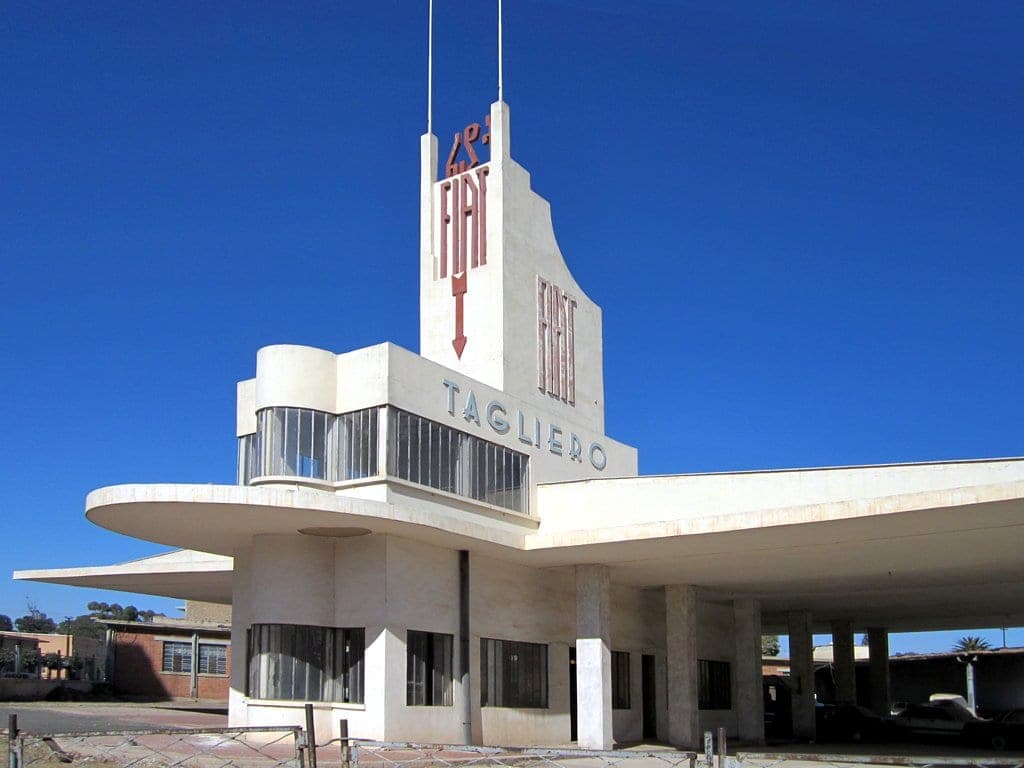
Asmara. Eritrea's capital rises on the highland edge, one of the highest capitals in the world by altitude (Wikipedia). Most of its centre was built in a single burst between 1935 and 1941, when Italian planners laid out an almost complete city of cinemas, cafés, villas and offices in rationalist, futurist and Art Deco styles; UNESCO inscribed it in 2017 as a modernist city of Africa (UNESCO). Its best-known building is the Fiat Tagliero service station of 1938, designed by Giuseppe Pettazzi in the shape of an aircraft, its two reinforced-concrete wings cantilevered some fifteen metres to either side without visible support (Wikipedia). Close by, the Cinema Impero of 1937 keeps its Art Deco frontage and much of its original interior.
 Asmara was inscribed in 2017 as a modernist city, built by Italian architects in the 1930s and left intact because the decades that followed brought no money to redevelop it. Photograph by Martin Schibbye, CC BY-SA 4.0, via Wikimedia Commons.
Massawa. The principal Red Sea port, built on coral islands linked by causeways, was for centuries a gateway for Ottoman and Egyptian authority on the coast, and its old town keeps coral-stone houses, mosques and merchant buildings from that era. Long called the Pearl of the Red Sea, Massawa was heavily damaged in the final years of the independence war and is being restored in stages.
Keren. Eritrea's second city, in the western highlands, is home mainly to Tigre and Bilen people and is known for its weekly market and for Mariam Dearit, a shrine to the Virgin Mary set inside a hollow baobab that draws pilgrims each year. The hills around it were the scene of the decisive Battle of Keren in 1941, when British and Commonwealth forces broke Italian resistance.
Assab. The southern port, on the Afar coast near the Bab-el-Mandeb strait, was Italy's first foothold in the region: an Italian shipping company acquired the bay of Assab in the 1880s before the wider colony was formed.
Eritrea's recorded past opens on the Red Sea. From the early centuries AD the port of Adulis, near modern Massawa, was the maritime outlet of the Kingdom of Aksum, shipping ivory, obsidian and gold to Rome, Egypt, Arabia and India (Wikipedia). Inland, the highland settlements of Qohaito and Matara flourished in the pre-Aksumite and Aksumite periods, leaving temple columns, tombs and an inscribed stele that still faces the rising sun. From the eighth century the Dahlak islands became the seat of a Muslim sultanate and a hub of Red Sea trade; the necropolis of Dahlak Kebir preserves more than two hundred Arabic funerary stelae in Kufic and Naskhi script, dated between 911 and 1539, among the oldest Islamic inscriptions in the region.
For much of the medieval and early-modern period the coast and the highlands followed separate rhythms: the Ottomans took Massawa in the sixteenth century and held the coast, at times through their Egyptian deputies, while the highlands looked toward the Christian kingdoms of the interior. Italy arrived through Assab and then Massawa, and on 1 January 1890 proclaimed its possessions the Colony of Eritrea. Italian engineers then built the mountain railway that climbed from Massawa to Asmara, reaching the capital in 1911, and in the 1930s raised the modernist city that survives today.
Italy's defeat in 1941 brought a decade of British military administration. In 1952 the United Nations federated Eritrea with Ethiopia; in 1962 the Ethiopian government dissolved the local assembly and annexed the territory outright, and a war of independence began that would last three decades (Encyclopaedia Britannica). It was won on the ground in 1991 by the Eritrean People's Liberation Front and confirmed by a referendum in April 1993, in which Eritreans voted overwhelmingly for independence; formal independence followed on 24 May 1993. The cost in lives was very high, and the memory of that sacrifice remains central to national life. Since independence the country has been governed as a one-party state under President Isaias Afwerki, and open-ended national service has contributed to substantial emigration.
The country's name is European in origin, from the Latin Mare Erythraeum and behind it the ancient Greek Erythra Thalassa, both meaning the Red Sea; Italy adopted it for the colony in 1890. The languages spoken within its borders are far older. Tigrinya, a Semitic language written in the Ge'ez fidel script, is the mother tongue of the highland majority and serves, with Arabic and English, as one of three working languages of government and schooling. Tigre, also Semitic, is spoken across the northern and western lowlands, while Arabic serves the Rashaida and acts as a common tongue among many Muslim communities. The remaining recognised languages reach across three families: Saho, Afar, Bilen and Hedareb (Beja) belong to the Cushitic group, and Kunama and Nara belong to the Nilo-Saharan family, a reminder that Eritrea sits where several of Africa's great language stocks meet. Ge'ez, no longer spoken, survives as the liturgical language of the Orthodox and Catholic churches.
Eritrean culture is most visible to outsiders in Asmara's architecture, but it lives most fully in daily ritual. The coffee ceremony, bun, is the heart of hospitality: green beans are roasted over coals in the room, ground by hand and brewed in a clay jebena to be poured in three rounds, often scented with incense and served with popcorn, a welcome that can fill an afternoon. Music carries memory in a similar register: across the highlands the krar, a bowl lyre, and the wata, a single-stringed bowed fiddle, accompany sung poetry and the shoulder-led guaila dances, while each community keeps its own songs and wedding customs.
Those nine peoples, the Tigrinya, Tigre, Saho, Afar, Bilen, Kunama, Nara, Hedareb and Rashaida, are the frame through which Eritreans describe their society, and long coexistence between them, and between Christian and Muslim neighbours, is a point of shared pride. The everyday meal is injera, a sour teff flatbread eaten by hand with stews such as the spiced zigni, seasoned with the berbere chilli blend; along the coast fish and Arabian flavours predominate, and everywhere the Italian decades left a lasting taste for pasta, macchiato and fresh bread. Dress for feast days is the white cotton zuria and netela for women and a white shawl for men, the same cloth, in a darker key, that families wear in mourning.
Eritrea is divided almost evenly between Christianity and Islam, and the two faiths have shared its towns for centuries. The larger Christian body is the Eritrean Orthodox Tewahedo Church, which became autocephalous in 1993 and keeps the ancient observances of the wider Tewahedo tradition: worship in Ge'ez, the ark-replica tabot at the centre of each church, long fasting seasons, and a monastic life rooted in highland houses such as Debre Bizen. Most Eritrean Muslims are Sunni, and Islam reached the Red Sea coast within the first generation of the faith; Massawa, the Dahlak islands and the lowland towns have been Muslim centres for well over a thousand years, and Arabic learning and Sufi orders are woven through their history.
Alongside these two majorities are smaller communities. The Eritrean Catholic Church, which follows the Ge'ez rite, grew out of the Italian period and remains influential in education; Lutheran and evangelical Protestant churches, known collectively as Kale Hiwet and P'ent'ay, have a long presence in the highlands, and the Kunama and some other groups preserve older indigenous beliefs. Official recognition is extended to four bodies: the Orthodox Church, Sunni Islam, the Catholic Church and the Lutheran Evangelical Church.
Mourning in Eritrea is a communal duty, organised quickly and shared widely, and the two great faiths carry it out in parallel. In Orthodox Christian practice the dead are buried soon after death, usually within a day, the funeral prayer sung over the body before burial in the churchyard; close kin then enter a period of intense mourning in which neighbours and relatives gather at the family home, a tent is often raised in the street to shelter the visitors, and black is worn for weeks or months. The calendar of remembrance is precise, with gatherings in the days after death, a major commemoration on the fortieth day, and a memorial feast, the tezkar, on the anniversary, when the family feeds a large gathering and gives a share to the church and to the poor for the sake of the departed.
Muslim Eritreans bury their dead before sunset where they can, after the body has been washed and wrapped in a plain shroud and prayed over, and lay it on its right side facing Mecca. The family then receives condolences, commonly for three days, with recitation of the Qur'an and shared meals, and marks later remembrances according to local custom; the emphasis falls on patience and on simplicity at the grave. In both traditions the same instinct holds, that grief must be carried by the whole community rather than left to the household alone, and that the presence of visitors, more than their words, is what counts.
Above these private losses sits a public one. Martyrs' Day, observed each year on 20 June, commemorates the tens of thousands who died in the long war of independence; on the eve, candlelight vigils are held at martyrs' cemeteries in Asmara, Keren, Massawa and other towns, and the day binds personal and national mourning into a single act of remembrance (Eritrea Ministry of Information).
Eritrean records are Italian, then British, then Ethiopian, and the most complete recent archive belongs to a diaspora.
Italian colonial administration from 1890 produced a substantial record, including the Asmara municipal registers and the paperwork of a modernist city built in six years, and much of it is in Rome as well as Asmara. The British administration from 1941, and the Ethiopian federation and annexation that followed, added their own layers.
Orthodox Tewahedo, Catholic and Lutheran church registers, and the Islamic court records of the coastal and lowland communities, are the vital records for most families.
The war of independence, from 1961 to 1991, was long and the EPLF kept its own records in the field, including the underground hospital and printing press at Nakfa. The Research and Documentation Centre in Asmara holds a great deal of it.
The absence is the present. Eritrea has had no implemented constitution, no elections and no free press for decades, and indefinite national service has driven a very large share of the young population out of the country. Several hundred thousand Eritreans are refugees, and their asylum files in Ethiopia, Sudan, Israel, Europe and North America are, for those families, the fullest record of who they are. Establishing an Eritrean's identity in an asylum system frequently comes down to knowledge of village, church and family that no document can confirm.
The Asmara UNESCO inscription of 2017 preserves the buildings. The record of the people is more scattered.
Eritrea's best-known conservation effort is Asmara itself. In preparation for the 2017 inscription the government created the Asmara Heritage Project, which inventoried several thousand historic buildings and drew up planning controls to protect the modernist core, work that brought a lived-in city onto the World Heritage List without emptying it (UNESCO). The country's tentative list holds its older sites, the port of Adulis, the Dahlak Kebir necropolis, and the highland ruins of Qohaito and Matara, several excavated in recent decades by joint Eritrean and international teams.
The National Museum of Eritrea, founded in Asmara in 1992, gathers the material record of this long past, from Aksumite and pre-Aksumite finds to medieval Dahlak stelae and the ethnography of the nine communities; it has occupied the former Governor's Palace and later a former convent school (Wikipedia). Preservation is constrained by limited resources and by the fragility of coastal sites such as Massawa, where salt, war damage and time all press on the old coral-stone town.
Eritrea's digital record is young but growing. The Asmara Heritage Project's digital inventory of the city's buildings, one of the fuller architectural databases for any African city, underpins its World Heritage management. Eritrean manuscripts in Ge'ez, closely related to the wider Ethiopian corpus, are represented in the online collections of the Hill Museum and Manuscript Library, whose digitised holdings of Ethiopian and Eritrean manuscripts are the largest in the world (HMML).
Much of the living archive is made by Eritreans themselves. The state outlet Shabait publishes histories, photographs and cultural features, and the large diaspora sustains a steady flow of Tigrinya and Tigre music, cooking, weddings and memorial services across social platforms, keeping languages and customs present far from home.
Eritrea's most far-reaching cultural force today is its diaspora. Decades of war and, more recently, emigration have scattered a population estimated in the high hundreds of thousands across Europe, North America, the Gulf and neighbouring African states, and these communities have carried Eritrean life with them. Orthodox parishes and mosques, coffee ceremonies, injera bakeries and Tigre music now anchor Eritrean neighbourhoods from Frankfurt to Melbourne. Diaspora associations raise funds, help fly bodies home for burial, and pass language and custom to a second generation, while remittances tie families abroad closely to the highlands. Annual community festivals in European and North American cities have become fixed points of the year for people determined to remember where they come from.
A modernist city, recognised and protected. Asmara's 2017 inscription made it one of the first African sites listed primarily for twentieth-century architecture, and the Asmara Heritage Project's building inventory gave the city the tools to keep its character intact.
The Fiat Tagliero, still standing. Giuseppe Pettazzi's aircraft-shaped service station of 1938 has held its fifteen-metre concrete wings aloft for more than eighty years and remains the emblem of Asmara's modernism.
The stelae of Dahlak, read again. The medieval funerary inscriptions of Dahlak Kebir, more than two hundred of them, have been catalogued by epigraphers, restoring names and dates to an island cemetery that once linked Eritrea to Arabia, Egypt and the wider Islamic world.
Asmara was inscribed in 2017 as a modernist city, built by Italian architects in the 1930s and left intact because the decades that followed brought no money to redevelop it. Photograph by Martin Schibbye, CC BY-SA 4.0, via Wikimedia Commons.
Massawa. The principal Red Sea port, built on coral islands linked by causeways, was for centuries a gateway for Ottoman and Egyptian authority on the coast, and its old town keeps coral-stone houses, mosques and merchant buildings from that era. Long called the Pearl of the Red Sea, Massawa was heavily damaged in the final years of the independence war and is being restored in stages.
Keren. Eritrea's second city, in the western highlands, is home mainly to Tigre and Bilen people and is known for its weekly market and for Mariam Dearit, a shrine to the Virgin Mary set inside a hollow baobab that draws pilgrims each year. The hills around it were the scene of the decisive Battle of Keren in 1941, when British and Commonwealth forces broke Italian resistance.
Assab. The southern port, on the Afar coast near the Bab-el-Mandeb strait, was Italy's first foothold in the region: an Italian shipping company acquired the bay of Assab in the 1880s before the wider colony was formed.
Eritrea's recorded past opens on the Red Sea. From the early centuries AD the port of Adulis, near modern Massawa, was the maritime outlet of the Kingdom of Aksum, shipping ivory, obsidian and gold to Rome, Egypt, Arabia and India (Wikipedia). Inland, the highland settlements of Qohaito and Matara flourished in the pre-Aksumite and Aksumite periods, leaving temple columns, tombs and an inscribed stele that still faces the rising sun. From the eighth century the Dahlak islands became the seat of a Muslim sultanate and a hub of Red Sea trade; the necropolis of Dahlak Kebir preserves more than two hundred Arabic funerary stelae in Kufic and Naskhi script, dated between 911 and 1539, among the oldest Islamic inscriptions in the region.
For much of the medieval and early-modern period the coast and the highlands followed separate rhythms: the Ottomans took Massawa in the sixteenth century and held the coast, at times through their Egyptian deputies, while the highlands looked toward the Christian kingdoms of the interior. Italy arrived through Assab and then Massawa, and on 1 January 1890 proclaimed its possessions the Colony of Eritrea. Italian engineers then built the mountain railway that climbed from Massawa to Asmara, reaching the capital in 1911, and in the 1930s raised the modernist city that survives today.
Italy's defeat in 1941 brought a decade of British military administration. In 1952 the United Nations federated Eritrea with Ethiopia; in 1962 the Ethiopian government dissolved the local assembly and annexed the territory outright, and a war of independence began that would last three decades (Encyclopaedia Britannica). It was won on the ground in 1991 by the Eritrean People's Liberation Front and confirmed by a referendum in April 1993, in which Eritreans voted overwhelmingly for independence; formal independence followed on 24 May 1993. The cost in lives was very high, and the memory of that sacrifice remains central to national life. Since independence the country has been governed as a one-party state under President Isaias Afwerki, and open-ended national service has contributed to substantial emigration.
The country's name is European in origin, from the Latin Mare Erythraeum and behind it the ancient Greek Erythra Thalassa, both meaning the Red Sea; Italy adopted it for the colony in 1890. The languages spoken within its borders are far older. Tigrinya, a Semitic language written in the Ge'ez fidel script, is the mother tongue of the highland majority and serves, with Arabic and English, as one of three working languages of government and schooling. Tigre, also Semitic, is spoken across the northern and western lowlands, while Arabic serves the Rashaida and acts as a common tongue among many Muslim communities. The remaining recognised languages reach across three families: Saho, Afar, Bilen and Hedareb (Beja) belong to the Cushitic group, and Kunama and Nara belong to the Nilo-Saharan family, a reminder that Eritrea sits where several of Africa's great language stocks meet. Ge'ez, no longer spoken, survives as the liturgical language of the Orthodox and Catholic churches.
Eritrean culture is most visible to outsiders in Asmara's architecture, but it lives most fully in daily ritual. The coffee ceremony, bun, is the heart of hospitality: green beans are roasted over coals in the room, ground by hand and brewed in a clay jebena to be poured in three rounds, often scented with incense and served with popcorn, a welcome that can fill an afternoon. Music carries memory in a similar register: across the highlands the krar, a bowl lyre, and the wata, a single-stringed bowed fiddle, accompany sung poetry and the shoulder-led guaila dances, while each community keeps its own songs and wedding customs.
Those nine peoples, the Tigrinya, Tigre, Saho, Afar, Bilen, Kunama, Nara, Hedareb and Rashaida, are the frame through which Eritreans describe their society, and long coexistence between them, and between Christian and Muslim neighbours, is a point of shared pride. The everyday meal is injera, a sour teff flatbread eaten by hand with stews such as the spiced zigni, seasoned with the berbere chilli blend; along the coast fish and Arabian flavours predominate, and everywhere the Italian decades left a lasting taste for pasta, macchiato and fresh bread. Dress for feast days is the white cotton zuria and netela for women and a white shawl for men, the same cloth, in a darker key, that families wear in mourning.
Eritrea is divided almost evenly between Christianity and Islam, and the two faiths have shared its towns for centuries. The larger Christian body is the Eritrean Orthodox Tewahedo Church, which became autocephalous in 1993 and keeps the ancient observances of the wider Tewahedo tradition: worship in Ge'ez, the ark-replica tabot at the centre of each church, long fasting seasons, and a monastic life rooted in highland houses such as Debre Bizen. Most Eritrean Muslims are Sunni, and Islam reached the Red Sea coast within the first generation of the faith; Massawa, the Dahlak islands and the lowland towns have been Muslim centres for well over a thousand years, and Arabic learning and Sufi orders are woven through their history.
Alongside these two majorities are smaller communities. The Eritrean Catholic Church, which follows the Ge'ez rite, grew out of the Italian period and remains influential in education; Lutheran and evangelical Protestant churches, known collectively as Kale Hiwet and P'ent'ay, have a long presence in the highlands, and the Kunama and some other groups preserve older indigenous beliefs. Official recognition is extended to four bodies: the Orthodox Church, Sunni Islam, the Catholic Church and the Lutheran Evangelical Church.
Mourning in Eritrea is a communal duty, organised quickly and shared widely, and the two great faiths carry it out in parallel. In Orthodox Christian practice the dead are buried soon after death, usually within a day, the funeral prayer sung over the body before burial in the churchyard; close kin then enter a period of intense mourning in which neighbours and relatives gather at the family home, a tent is often raised in the street to shelter the visitors, and black is worn for weeks or months. The calendar of remembrance is precise, with gatherings in the days after death, a major commemoration on the fortieth day, and a memorial feast, the tezkar, on the anniversary, when the family feeds a large gathering and gives a share to the church and to the poor for the sake of the departed.
Muslim Eritreans bury their dead before sunset where they can, after the body has been washed and wrapped in a plain shroud and prayed over, and lay it on its right side facing Mecca. The family then receives condolences, commonly for three days, with recitation of the Qur'an and shared meals, and marks later remembrances according to local custom; the emphasis falls on patience and on simplicity at the grave. In both traditions the same instinct holds, that grief must be carried by the whole community rather than left to the household alone, and that the presence of visitors, more than their words, is what counts.
Above these private losses sits a public one. Martyrs' Day, observed each year on 20 June, commemorates the tens of thousands who died in the long war of independence; on the eve, candlelight vigils are held at martyrs' cemeteries in Asmara, Keren, Massawa and other towns, and the day binds personal and national mourning into a single act of remembrance (Eritrea Ministry of Information).
Eritrean records are Italian, then British, then Ethiopian, and the most complete recent archive belongs to a diaspora.
Italian colonial administration from 1890 produced a substantial record, including the Asmara municipal registers and the paperwork of a modernist city built in six years, and much of it is in Rome as well as Asmara. The British administration from 1941, and the Ethiopian federation and annexation that followed, added their own layers.
Orthodox Tewahedo, Catholic and Lutheran church registers, and the Islamic court records of the coastal and lowland communities, are the vital records for most families.
The war of independence, from 1961 to 1991, was long and the EPLF kept its own records in the field, including the underground hospital and printing press at Nakfa. The Research and Documentation Centre in Asmara holds a great deal of it.
The absence is the present. Eritrea has had no implemented constitution, no elections and no free press for decades, and indefinite national service has driven a very large share of the young population out of the country. Several hundred thousand Eritreans are refugees, and their asylum files in Ethiopia, Sudan, Israel, Europe and North America are, for those families, the fullest record of who they are. Establishing an Eritrean's identity in an asylum system frequently comes down to knowledge of village, church and family that no document can confirm.
The Asmara UNESCO inscription of 2017 preserves the buildings. The record of the people is more scattered.
Eritrea's best-known conservation effort is Asmara itself. In preparation for the 2017 inscription the government created the Asmara Heritage Project, which inventoried several thousand historic buildings and drew up planning controls to protect the modernist core, work that brought a lived-in city onto the World Heritage List without emptying it (UNESCO). The country's tentative list holds its older sites, the port of Adulis, the Dahlak Kebir necropolis, and the highland ruins of Qohaito and Matara, several excavated in recent decades by joint Eritrean and international teams.
The National Museum of Eritrea, founded in Asmara in 1992, gathers the material record of this long past, from Aksumite and pre-Aksumite finds to medieval Dahlak stelae and the ethnography of the nine communities; it has occupied the former Governor's Palace and later a former convent school (Wikipedia). Preservation is constrained by limited resources and by the fragility of coastal sites such as Massawa, where salt, war damage and time all press on the old coral-stone town.
Eritrea's digital record is young but growing. The Asmara Heritage Project's digital inventory of the city's buildings, one of the fuller architectural databases for any African city, underpins its World Heritage management. Eritrean manuscripts in Ge'ez, closely related to the wider Ethiopian corpus, are represented in the online collections of the Hill Museum and Manuscript Library, whose digitised holdings of Ethiopian and Eritrean manuscripts are the largest in the world (HMML).
Much of the living archive is made by Eritreans themselves. The state outlet Shabait publishes histories, photographs and cultural features, and the large diaspora sustains a steady flow of Tigrinya and Tigre music, cooking, weddings and memorial services across social platforms, keeping languages and customs present far from home.
Eritrea's most far-reaching cultural force today is its diaspora. Decades of war and, more recently, emigration have scattered a population estimated in the high hundreds of thousands across Europe, North America, the Gulf and neighbouring African states, and these communities have carried Eritrean life with them. Orthodox parishes and mosques, coffee ceremonies, injera bakeries and Tigre music now anchor Eritrean neighbourhoods from Frankfurt to Melbourne. Diaspora associations raise funds, help fly bodies home for burial, and pass language and custom to a second generation, while remittances tie families abroad closely to the highlands. Annual community festivals in European and North American cities have become fixed points of the year for people determined to remember where they come from.
A modernist city, recognised and protected. Asmara's 2017 inscription made it one of the first African sites listed primarily for twentieth-century architecture, and the Asmara Heritage Project's building inventory gave the city the tools to keep its character intact.
The Fiat Tagliero, still standing. Giuseppe Pettazzi's aircraft-shaped service station of 1938 has held its fifteen-metre concrete wings aloft for more than eighty years and remains the emblem of Asmara's modernism.
The stelae of Dahlak, read again. The medieval funerary inscriptions of Dahlak Kebir, more than two hundred of them, have been catalogued by epigraphers, restoring names and dates to an island cemetery that once linked Eritrea to Arabia, Egypt and the wider Islamic world.
National Overview
Notable Cities
Historical Foundations
Linguistic and Etymological Roots
Cultural Identity
Religion and Spirituality
Remembrance and Mourning Traditions
Tracing a Family in Eritrea
Heritage Preservation Efforts
Digital Heritage
Contemporary Cultural Influences
Success Stories
References and resources
- UNESCO World Heritage Centre, Asmara: A Modernist City of Africa. Inscription record for the 2017 listing.
- UNESCO World Heritage Centre, Eritrea. State-party page with inscribed and tentative sites.
- Encyclopaedia Britannica, Eritrea. Geography, peoples, history and political background.
- Wikipedia, Asmara. The modernist city, its altitude and its architecture.
- Wikipedia, Fiat Tagliero Building. Pettazzi's 1938 futurist service station.
- Wikipedia, Adulis. The ancient Red Sea port and its Aksumite links.
- Wikipedia, Dahlak Archipelago. The islands, the sultanate and the necropolis.
- Wikipedia, National Museum of Eritrea. The national collection in Asmara.
- Eritrea Ministry of Information (Shabait), Martyrs' Day. The 20 June commemoration.