Heritage · Country
Latvia Culture and Heritage
Latvia is a country that sang itself into being and sang itself back to freedom, keeping more than a million folk verses, the finest Art Nouveau quarter in Europe, and the memory of a chain of two million hands stretched across the Baltic. This guide follows the dainas and the Song Celebration, the sober memory of occupation and loss, and the cemetery candles that Latvians light each year for their dead.Written to last.
By Confinity Heritage Editorial · Updated 2026-07-31 · 8-minute readQuiet tools, kept out of the way.
Few nations have carried their identity so completely in song. When the folklorist Krišjānis Barons spent the decades around 1900 sorting folk verses into a purpose-built cabinet of small drawers, he was gathering the memory of a people who had left almost no written record of their own through six centuries under foreign rule. His six volumes of Latvju dainas, published between 1894 and 1915, held nearly 218,000 songs, and the recorded corpus of dainas now numbers well over a million short verses, among the largest bodies of oral poetry on earth. Between the amber of the Baltic shore and the tens of thousands of voices at the Song and Dance Celebration runs a single conviction: that what matters is remembered aloud, together.
Latvia's memory is also a memory of loss. The twentieth century brought two occupations, the murder of almost the entire Latvian Jewish community, and the deportation of tens of thousands of citizens to Siberia. That those decades ended not in silence but in a revolution sung into being, and in a human chain of two million people across three countries in 1989, is the fact Latvians hold onto most firmly.
Latvia is a Baltic state of about 64,600 square kilometres on the eastern shore of the Baltic Sea, bordered by Estonia, Lithuania, Russia and Belarus, according to Encyclopaedia Britannica. It is a low country of forest, bog, lake and river, threaded by the Daugava, which flows to the sea at Riga. Four historical regions give it its inner map: Kurzeme (Courland) and Zemgale (Semigallia) in the west and centre, Vidzeme (part of old Livonia) in the north, and Latgale in the south-east, each with its own dialect, faith and character.
The population is around 1.8 million, roughly a third of it in the capital, Riga, the largest city in the Baltic states. Latvian is the sole official language, and a large Russian-speaking minority, a legacy of the Soviet decades, remains a defining feature of society. Latvia restored its independence in 1991, joined the European Union and NATO in 2004, and adopted the euro in 2014. Its national colours, a deep carmine red framing a band of white, form one of Europe's oldest recorded flags, traced by tradition to a thirteenth-century chronicle.
Riga. Founded in 1201 by the German bishop Albert of Buxhoeveden, Riga grew into a leading Hanseatic port on trade between central Europe and the East. Its medieval core, Vecrīga, keeps the Riga Cathedral (the Dome), the church of St Peter, the guild halls and the reconstructed House of the Blackheads. Beyond it, block after block of Jugendstil facades make up what UNESCO and most scholars regard as the finest collection of Art Nouveau architecture in Europe. The Freedom Monument of 1935, by Kārlis Zāle, rises between the old town and the boulevards.
 Riga holds one of the finest concentrations of art nouveau architecture anywhere, most of it built in a fifteen-year burst before 1914. Photograph by Steven1991, CC BY-SA 4.0, via Wikimedia Commons.
Daugavpils. Latvia's second city sits on the Daugava in the far south-east, in Latgale, the most multi-ethnic place in the country, with Russian, Polish and Belarusian communities alongside Latvians. Its vast nineteenth-century fortress, built by the Russian Empire, is among the best-preserved of its kind in northern Europe. The painter Mark Rothko was born here in 1903 to a Jewish family, and the Mark Rothko Art Centre, in the fortress arsenal, is the only place in Europe to display his work permanently.
Liepāja. A Baltic port on the west coast, Liepāja has a distinct maritime and musical character. Its northern district, Karosta, was built as a fortified naval base by the Russian Empire around 1900 and remains one of the most complete imperial military townscapes on the coast, and the city keeps its links to amber and to music.
Cēsis. In the wooded hills of Vidzeme above the Gauja valley, Cēsis is one of the best-preserved medieval towns in Latvia, and for centuries its castle was a principal stronghold of the Livonian Order, the branch of the Teutonic Knights that ruled much of present-day Latvia and Estonia. The Battle of Cēsis in 1919 was a decisive moment in the war of independence, and the town remains tied to the story of the national flag.
The ancestors of the Latvians came from two families of peoples: the Balts, an Indo-European group that included the Latgalians, Curonians, Selonians and Semigallians, and the Finnic Livonians, related to the Estonians and Finns, who gave their name to medieval Livonia. In the early thirteenth century German crusaders and merchants arrived, Riga was founded in 1201, and the region was conquered and Christianised as Terra Mariana, later a loose Livonian Confederation from which Riga's Hanseatic wealth grew.
Riga holds one of the finest concentrations of art nouveau architecture anywhere, most of it built in a fifteen-year burst before 1914. Photograph by Steven1991, CC BY-SA 4.0, via Wikimedia Commons.
Daugavpils. Latvia's second city sits on the Daugava in the far south-east, in Latgale, the most multi-ethnic place in the country, with Russian, Polish and Belarusian communities alongside Latvians. Its vast nineteenth-century fortress, built by the Russian Empire, is among the best-preserved of its kind in northern Europe. The painter Mark Rothko was born here in 1903 to a Jewish family, and the Mark Rothko Art Centre, in the fortress arsenal, is the only place in Europe to display his work permanently.
Liepāja. A Baltic port on the west coast, Liepāja has a distinct maritime and musical character. Its northern district, Karosta, was built as a fortified naval base by the Russian Empire around 1900 and remains one of the most complete imperial military townscapes on the coast, and the city keeps its links to amber and to music.
Cēsis. In the wooded hills of Vidzeme above the Gauja valley, Cēsis is one of the best-preserved medieval towns in Latvia, and for centuries its castle was a principal stronghold of the Livonian Order, the branch of the Teutonic Knights that ruled much of present-day Latvia and Estonia. The Battle of Cēsis in 1919 was a decisive moment in the war of independence, and the town remains tied to the story of the national flag.
The ancestors of the Latvians came from two families of peoples: the Balts, an Indo-European group that included the Latgalians, Curonians, Selonians and Semigallians, and the Finnic Livonians, related to the Estonians and Finns, who gave their name to medieval Livonia. In the early thirteenth century German crusaders and merchants arrived, Riga was founded in 1201, and the region was conquered and Christianised as Terra Mariana, later a loose Livonian Confederation from which Riga's Hanseatic wealth grew.
 Turaida was built for the bishop of Riga in 1214 on the site of a Liv stronghold, and the Livonians whose castle it replaced are now an extinct people whose language died in 2013. Photograph by Qasinka, CC0, via Wikimedia Commons.
For the following centuries a German-speaking nobility and clergy, the Baltic Germans, governed through their manors and town councils while the Latvian-speaking majority worked the land in serfdom. After the Livonian War the territory passed under Polish-Lithuanian and, in Vidzeme, Swedish rule, remembered as the milder "good Swedish times", before the Great Northern War and the partitions of Poland brought all the Latvian lands into the Russian Empire by 1800. Serfdom was abolished early in the nineteenth century, and the National Awakening that followed, led by the "Young Latvians" and collectors such as Barons, built a modern national identity out of language and folk song.
Independence was proclaimed on 18 November 1918, defended in a war that lasted into 1920, and given a democratic constitution in 1922. The Molotov-Ribbentrop Pact of 1939 assigned Latvia to the Soviet sphere. The Soviet Union occupied the country in June 1940 and annexed it that August; on 14 June 1941 it deported roughly 15,000 people, among them families, children and the elderly, to Siberia. Days later Nazi Germany invaded. During the German occupation of 1941 to 1944, almost the entire Jewish community of Latvia, some 66,000 to 70,000 people out of a prewar population of about 93,000, was murdered, according to the United States Holocaust Memorial Museum. In the largest single atrocity, the Rumbula massacre outside Riga on 30 November and 8 December 1941, around 25,000 Jews from the Riga Ghetto were killed over two days; others died at Salaspils, and Jews deported from Germany and elsewhere were killed on Latvian soil. When Soviet forces returned in 1944 and 1945, deportations resumed, and on 25 March 1949 about 42,000 people were sent to Siberia during the forced collectivisation of agriculture; armed resistance by "forest brothers" continued for years.
The end came peacefully. From 1987 the Singing Revolution gathered mass rallies and choral demonstrations across the Baltic, and on 23 August 1989, the fiftieth anniversary of the Molotov-Ribbentrop Pact, about two million people joined hands in the Baltic Way, an unbroken chain of roughly 600 kilometres from Tallinn through Riga to Vilnius. Latvia declared the restoration of its independence on 4 May 1990, confirmed it fully on 21 August 1991 after the failed Moscow coup, and was recognised by the Soviet Union that September.
Latvian is one of only two surviving Baltic languages, the other being Lithuanian, and the Baltic branch is among the most archaic in the Indo-European family, preserving features other languages have lost. Written Latvian dates from the sixteenth century, when Lutheran clergy first printed religious texts, and the literary standard took shape in the National Awakening. Latgalian, spoken in the Catholic south-east, is closely related and has its own written tradition. The name Latvija derives from the Latgalians (Latgaļi), whose name came to stand for the whole people, and entered common use only in the nineteenth century.
The Finnic layer of the country's speech survives in Livonian, a relative of Estonian and Finnish once spoken along the northern coast of Courland. Its last native speaker, Grizelda Kristiņa, died in 2013; yet it has not vanished, sustained now by descendants, scholars and a small circle of new learners who study it as a living link to the country's oldest inhabitants.
The dainas are the heart of Latvian culture. These short, usually four-line verses address love, work, the seasons, birth, marriage and death, and carry a pre-Christian view of the world governed by Dievs the sky god, Māra the earth mother, Laima of fate and Saule the sun. Krišjānis Barons systematised them in his Cabinet of Folksongs, a chest of small drawers holding nearly 218,000 slips of paper, inscribed on UNESCO's Memory of the World Register in 2001.
Song became national ceremony in the Latvian Song and Dance Celebration, first held in 1873 and staged roughly every five years since; tens of thousands of amateur singers and dancers converge on Riga for a week that closes with a mass choir performing as one, and UNESCO inscribed the Baltic song and dance celebrations of Estonia, Latvia and Lithuania on its list of intangible heritage in 2003. Alongside song, the country is known for the amber of its coast, a fossil resin traded south along the ancient amber road, and for crafts such as patterned woven mittens, the sign-covered Lielvārde belt, and the ceramics of Latgale. Riga's early twentieth-century Art Nouveau facades form a distinct chapter of European design.
Christianity in Latvia divides along regional lines. The Reformation reached the German-ruled towns early, and Lutheranism became the majority faith across Vidzeme and Kurzeme. Latgale, under Polish influence, remained Roman Catholic, and the basilica at Aglona is the country's principal Catholic shrine, drawing large pilgrimages each August for the Feast of the Assumption. The Orthodox Church, largely tied to the Russian-speaking population, forms the third main tradition, and a small Catholic community, the Suiti of western Kurzeme, preserves customs of its own.
Beneath the churches lies an older stratum of folk belief, reconstructed from the dainas and revived in the twentieth century as the dievturība movement. It survives most visibly in the calendar. Jāņi, the midsummer celebration around the solstice on the night of 23 to 24 June, is the great national festival, marked with oak-leaf wreaths, bonfires, cheese and the refrain of the līgo songs, while autumn was traditionally the veļu laiks, the "time of the souls", when the departed were believed to return to the living.
Latvian mourning blends Christian funerary practice with older habits of tending the dead. Cemeteries are kept as cultivated gardens, their plots tended through the year by the families who own them, which the Latvian Culture Canon records as a distinct cemetery culture. In ancient belief death was not a rupture but a passage to the aizsaule, the realm "beyond the sun", and the dead remained part of the family's care.
Two customs give this its clearest form. Kapusvētki, the cemetery festival, is a summer gathering whose date is fixed by each parish, when relatives clean and decorate the graves and assemble among the headstones for a service with a pastor and often a choir, a reunion of the living and the dead. In late autumn comes Svecīšu vakars, the evening of candles, when families light candles on the graves so that whole cemeteries glow in the dark. Riga's Brothers' Cemetery, the memorial to fallen Latvian soldiers by Kārlis Zāle, is among the most solemn of these places, and the grave of the "Rose of Turaida", the maiden Maija, is visited by couples as a symbol of fidelity.
The occupations have their own remembrance. The Museum of the Occupation of Latvia and the former state-security headquarters known as the Corner House keep the record of the Soviet and Nazi years, national days of mourning mark the deportations of 14 June and 25 March, and since 2016 a candle-lighting has been held each 30 November at the Freedom Monument in memory of those murdered at Rumbula.
Latvian records are digitised, free, and unusually good at the point where most Baltic research gets difficult.
Raduraksti, run by the National Archives, publishes scanned parish registers, revision lists and church books without charge. Lutheran, Catholic and Orthodox parishes kept registers from the seventeenth and eighteenth centuries, and the Russian revision lists between 1782 and 1858 name households in detail. Latvian peasants received hereditary surnames in a compressed period around 1826 in Courland and 1835 in Livonia, so before that a family is followed by farm and patronymic. The farm name is the constant.
Baltic German estate records are the other half of the archive. The manors kept lists of their people, and because the German-speaking landowning class ran the countryside for seven centuries, their papers, held in Riga and in Germany, document Latvian families who appear nowhere else.
Civil registration began in 1921, with Soviet ZAGS from 1940.
The deportations of 14 June 1941 and 25 March 1949 removed tens of thousands, and Latvia has published the lists, so families can find a name, a date and a destination. The occupation museum and the archives hold the files.
Riga's Jewish community, and the Latvian Jewish population generally, was almost entirely murdered in 1941; the community registers largely survive at the archives, which makes the names recoverable even where the people are not.
Latvia holds two UNESCO World Heritage Sites. The Historic Centre of Riga was inscribed in 1997 for its medieval Hanseatic core, nineteenth-century boulevards and Art Nouveau district. The Struve Geodetic Arc, inscribed in 2005 and shared among ten countries, includes two surviving Latvian points from the survey of the earth carried out between 1816 and 1855. On the intangible-heritage lists sit the Baltic Song and Dance Celebrations, inscribed jointly in 2003, and the Suiti cultural space, added in 2009 to the urgent-safeguarding list for its women's drone singing, dialect and Catholic traditions.
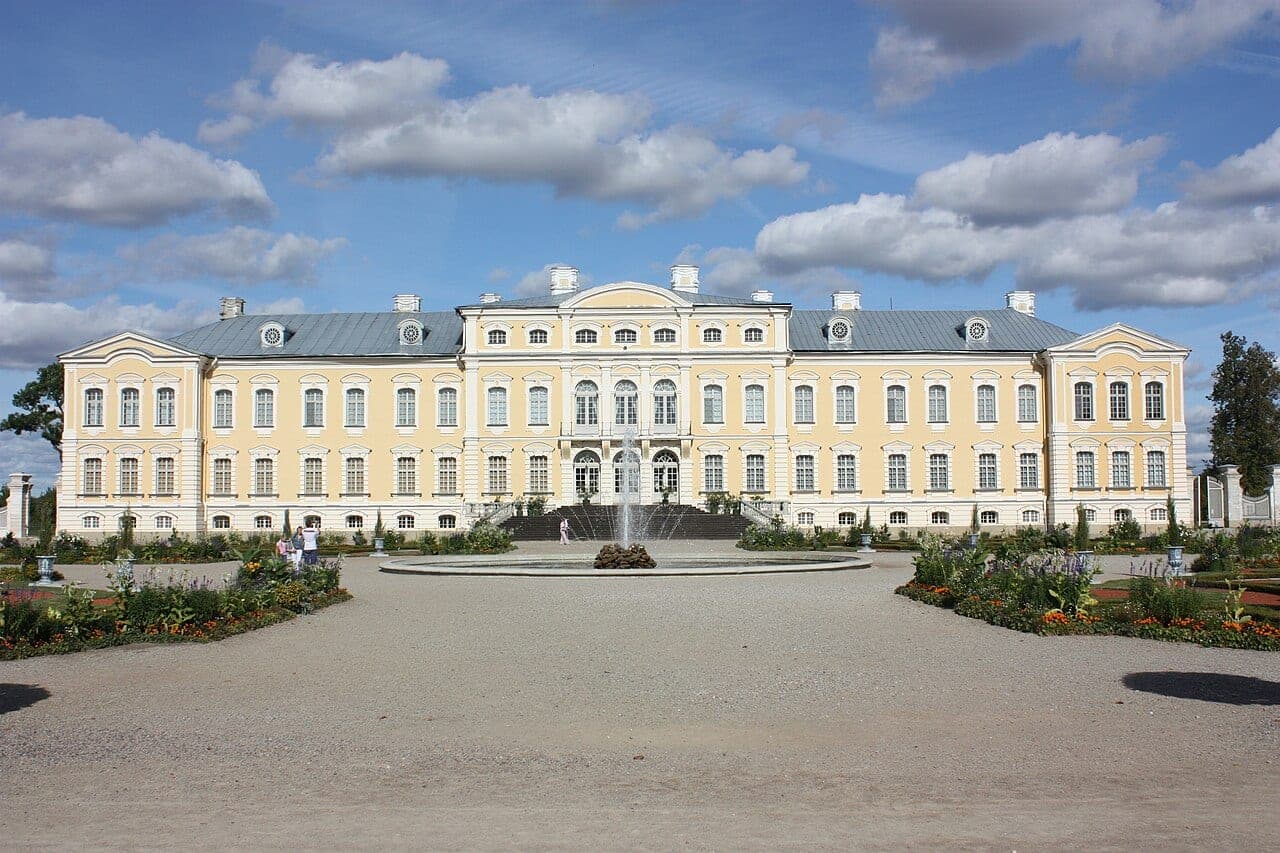
The National Cultural Heritage Board oversees monuments and sites, and the open-air Ethnographic Museum near Riga preserves farmsteads, churches and windmills from every region. The baroque Rundāle Palace, built by Bartolomeo Rastrelli for the Duke of Courland between 1736 and 1740 and again between 1763 and 1768, was restored across half a century under Imants Lancmanis into one of the finest palace museums in the Baltic, while the Turaida Museum Reserve in the Gauja valley protects its reconstructed medieval castle, church and landscape as the largest such monument in the country.
The National Library of Latvia, the "Castle of Light" (Gaismas pils) designed by the Latvian-American architect Gunnars Birkerts and opened in 2014, gave the country a new symbol for its book culture. Its opening consciously echoed the Baltic Way: in January 2014 some 14,000 people formed a human chain across the Daugava and passed books hand to hand from the old library to the new building, a "path of light" for a nation that had joined hands for freedom a quarter-century before.
Behind that symbol runs steady digital work. The Digital Library of Latvia gathers digitised newspapers, books and the "Zudusī Latvija" (Latvia That Has Disappeared) archive of vanished places, while the folklore repository at garamantas.lv is digitising the manuscript dainas, opening Barons's archive to readers and volunteers worldwide, and the national encyclopedia and state archives extend the record online for research and genealogy.
Latvia's contemporary reputation rests heavily on music. The choral tradition that carried the country through occupation still produces performers of international standing, among them the mezzo-soprano Elīna Garanča and the conductor Andris Nelsons, while the Riga-born violinist Gidon Kremer founded the chamber orchestra Kremerata Baltica to gather young Baltic musicians. Riga served as European Capital of Culture in 2014, and Latvian design, film and craft have grown in confidence since independence. Through the Soviet decades exile communities in the United States, Canada, Australia and Germany kept Latvian song festivals alive abroad, so that when independence returned the tradition had never been broken.
A cabinet of a million verses. Barons's Cabinet of Folksongs, decades of one man's ordering of paper slips, joined UNESCO's Memory of the World in 2001, and the dainas remain the foundation of Latvian identity.
A celebration unbroken. The Song and Dance Celebration has been held since 1873, surviving two occupations and continuing in exile, and now gathers tens of thousands of performers every five years.
Independence recovered by singing. The Singing Revolution and the Baltic Way of 1989, when two million people formed a chain across the three Baltic states, led to the peaceful restoration of independence in 1991.
A palace raised from ruin. Rundāle Palace, long neglected, was restored over half a century into one of the region's leading museums, its baroque interiors and gardens recovered room by room.
A language that refused to end. Livonian, whose last native speaker died in 2013, is carried forward by descendants, scholars and new learners as a living tie to the country's Finnic past.
Turaida was built for the bishop of Riga in 1214 on the site of a Liv stronghold, and the Livonians whose castle it replaced are now an extinct people whose language died in 2013. Photograph by Qasinka, CC0, via Wikimedia Commons.
For the following centuries a German-speaking nobility and clergy, the Baltic Germans, governed through their manors and town councils while the Latvian-speaking majority worked the land in serfdom. After the Livonian War the territory passed under Polish-Lithuanian and, in Vidzeme, Swedish rule, remembered as the milder "good Swedish times", before the Great Northern War and the partitions of Poland brought all the Latvian lands into the Russian Empire by 1800. Serfdom was abolished early in the nineteenth century, and the National Awakening that followed, led by the "Young Latvians" and collectors such as Barons, built a modern national identity out of language and folk song.
Independence was proclaimed on 18 November 1918, defended in a war that lasted into 1920, and given a democratic constitution in 1922. The Molotov-Ribbentrop Pact of 1939 assigned Latvia to the Soviet sphere. The Soviet Union occupied the country in June 1940 and annexed it that August; on 14 June 1941 it deported roughly 15,000 people, among them families, children and the elderly, to Siberia. Days later Nazi Germany invaded. During the German occupation of 1941 to 1944, almost the entire Jewish community of Latvia, some 66,000 to 70,000 people out of a prewar population of about 93,000, was murdered, according to the United States Holocaust Memorial Museum. In the largest single atrocity, the Rumbula massacre outside Riga on 30 November and 8 December 1941, around 25,000 Jews from the Riga Ghetto were killed over two days; others died at Salaspils, and Jews deported from Germany and elsewhere were killed on Latvian soil. When Soviet forces returned in 1944 and 1945, deportations resumed, and on 25 March 1949 about 42,000 people were sent to Siberia during the forced collectivisation of agriculture; armed resistance by "forest brothers" continued for years.
The end came peacefully. From 1987 the Singing Revolution gathered mass rallies and choral demonstrations across the Baltic, and on 23 August 1989, the fiftieth anniversary of the Molotov-Ribbentrop Pact, about two million people joined hands in the Baltic Way, an unbroken chain of roughly 600 kilometres from Tallinn through Riga to Vilnius. Latvia declared the restoration of its independence on 4 May 1990, confirmed it fully on 21 August 1991 after the failed Moscow coup, and was recognised by the Soviet Union that September.
Latvian is one of only two surviving Baltic languages, the other being Lithuanian, and the Baltic branch is among the most archaic in the Indo-European family, preserving features other languages have lost. Written Latvian dates from the sixteenth century, when Lutheran clergy first printed religious texts, and the literary standard took shape in the National Awakening. Latgalian, spoken in the Catholic south-east, is closely related and has its own written tradition. The name Latvija derives from the Latgalians (Latgaļi), whose name came to stand for the whole people, and entered common use only in the nineteenth century.
The Finnic layer of the country's speech survives in Livonian, a relative of Estonian and Finnish once spoken along the northern coast of Courland. Its last native speaker, Grizelda Kristiņa, died in 2013; yet it has not vanished, sustained now by descendants, scholars and a small circle of new learners who study it as a living link to the country's oldest inhabitants.
The dainas are the heart of Latvian culture. These short, usually four-line verses address love, work, the seasons, birth, marriage and death, and carry a pre-Christian view of the world governed by Dievs the sky god, Māra the earth mother, Laima of fate and Saule the sun. Krišjānis Barons systematised them in his Cabinet of Folksongs, a chest of small drawers holding nearly 218,000 slips of paper, inscribed on UNESCO's Memory of the World Register in 2001.
Song became national ceremony in the Latvian Song and Dance Celebration, first held in 1873 and staged roughly every five years since; tens of thousands of amateur singers and dancers converge on Riga for a week that closes with a mass choir performing as one, and UNESCO inscribed the Baltic song and dance celebrations of Estonia, Latvia and Lithuania on its list of intangible heritage in 2003. Alongside song, the country is known for the amber of its coast, a fossil resin traded south along the ancient amber road, and for crafts such as patterned woven mittens, the sign-covered Lielvārde belt, and the ceramics of Latgale. Riga's early twentieth-century Art Nouveau facades form a distinct chapter of European design.
Christianity in Latvia divides along regional lines. The Reformation reached the German-ruled towns early, and Lutheranism became the majority faith across Vidzeme and Kurzeme. Latgale, under Polish influence, remained Roman Catholic, and the basilica at Aglona is the country's principal Catholic shrine, drawing large pilgrimages each August for the Feast of the Assumption. The Orthodox Church, largely tied to the Russian-speaking population, forms the third main tradition, and a small Catholic community, the Suiti of western Kurzeme, preserves customs of its own.
Beneath the churches lies an older stratum of folk belief, reconstructed from the dainas and revived in the twentieth century as the dievturība movement. It survives most visibly in the calendar. Jāņi, the midsummer celebration around the solstice on the night of 23 to 24 June, is the great national festival, marked with oak-leaf wreaths, bonfires, cheese and the refrain of the līgo songs, while autumn was traditionally the veļu laiks, the "time of the souls", when the departed were believed to return to the living.
Latvian mourning blends Christian funerary practice with older habits of tending the dead. Cemeteries are kept as cultivated gardens, their plots tended through the year by the families who own them, which the Latvian Culture Canon records as a distinct cemetery culture. In ancient belief death was not a rupture but a passage to the aizsaule, the realm "beyond the sun", and the dead remained part of the family's care.
Two customs give this its clearest form. Kapusvētki, the cemetery festival, is a summer gathering whose date is fixed by each parish, when relatives clean and decorate the graves and assemble among the headstones for a service with a pastor and often a choir, a reunion of the living and the dead. In late autumn comes Svecīšu vakars, the evening of candles, when families light candles on the graves so that whole cemeteries glow in the dark. Riga's Brothers' Cemetery, the memorial to fallen Latvian soldiers by Kārlis Zāle, is among the most solemn of these places, and the grave of the "Rose of Turaida", the maiden Maija, is visited by couples as a symbol of fidelity.
The occupations have their own remembrance. The Museum of the Occupation of Latvia and the former state-security headquarters known as the Corner House keep the record of the Soviet and Nazi years, national days of mourning mark the deportations of 14 June and 25 March, and since 2016 a candle-lighting has been held each 30 November at the Freedom Monument in memory of those murdered at Rumbula.
Latvian records are digitised, free, and unusually good at the point where most Baltic research gets difficult.
Raduraksti, run by the National Archives, publishes scanned parish registers, revision lists and church books without charge. Lutheran, Catholic and Orthodox parishes kept registers from the seventeenth and eighteenth centuries, and the Russian revision lists between 1782 and 1858 name households in detail. Latvian peasants received hereditary surnames in a compressed period around 1826 in Courland and 1835 in Livonia, so before that a family is followed by farm and patronymic. The farm name is the constant.
Baltic German estate records are the other half of the archive. The manors kept lists of their people, and because the German-speaking landowning class ran the countryside for seven centuries, their papers, held in Riga and in Germany, document Latvian families who appear nowhere else.
Civil registration began in 1921, with Soviet ZAGS from 1940.
The deportations of 14 June 1941 and 25 March 1949 removed tens of thousands, and Latvia has published the lists, so families can find a name, a date and a destination. The occupation museum and the archives hold the files.
Riga's Jewish community, and the Latvian Jewish population generally, was almost entirely murdered in 1941; the community registers largely survive at the archives, which makes the names recoverable even where the people are not.
Latvia holds two UNESCO World Heritage Sites. The Historic Centre of Riga was inscribed in 1997 for its medieval Hanseatic core, nineteenth-century boulevards and Art Nouveau district. The Struve Geodetic Arc, inscribed in 2005 and shared among ten countries, includes two surviving Latvian points from the survey of the earth carried out between 1816 and 1855. On the intangible-heritage lists sit the Baltic Song and Dance Celebrations, inscribed jointly in 2003, and the Suiti cultural space, added in 2009 to the urgent-safeguarding list for its women's drone singing, dialect and Catholic traditions.
The National Cultural Heritage Board oversees monuments and sites, and the open-air Ethnographic Museum near Riga preserves farmsteads, churches and windmills from every region. The baroque Rundāle Palace, built by Bartolomeo Rastrelli for the Duke of Courland between 1736 and 1740 and again between 1763 and 1768, was restored across half a century under Imants Lancmanis into one of the finest palace museums in the Baltic, while the Turaida Museum Reserve in the Gauja valley protects its reconstructed medieval castle, church and landscape as the largest such monument in the country.
The National Library of Latvia, the "Castle of Light" (Gaismas pils) designed by the Latvian-American architect Gunnars Birkerts and opened in 2014, gave the country a new symbol for its book culture. Its opening consciously echoed the Baltic Way: in January 2014 some 14,000 people formed a human chain across the Daugava and passed books hand to hand from the old library to the new building, a "path of light" for a nation that had joined hands for freedom a quarter-century before.
Behind that symbol runs steady digital work. The Digital Library of Latvia gathers digitised newspapers, books and the "Zudusī Latvija" (Latvia That Has Disappeared) archive of vanished places, while the folklore repository at garamantas.lv is digitising the manuscript dainas, opening Barons's archive to readers and volunteers worldwide, and the national encyclopedia and state archives extend the record online for research and genealogy.
Latvia's contemporary reputation rests heavily on music. The choral tradition that carried the country through occupation still produces performers of international standing, among them the mezzo-soprano Elīna Garanča and the conductor Andris Nelsons, while the Riga-born violinist Gidon Kremer founded the chamber orchestra Kremerata Baltica to gather young Baltic musicians. Riga served as European Capital of Culture in 2014, and Latvian design, film and craft have grown in confidence since independence. Through the Soviet decades exile communities in the United States, Canada, Australia and Germany kept Latvian song festivals alive abroad, so that when independence returned the tradition had never been broken.
A cabinet of a million verses. Barons's Cabinet of Folksongs, decades of one man's ordering of paper slips, joined UNESCO's Memory of the World in 2001, and the dainas remain the foundation of Latvian identity.
A celebration unbroken. The Song and Dance Celebration has been held since 1873, surviving two occupations and continuing in exile, and now gathers tens of thousands of performers every five years.
Independence recovered by singing. The Singing Revolution and the Baltic Way of 1989, when two million people formed a chain across the three Baltic states, led to the peaceful restoration of independence in 1991.
A palace raised from ruin. Rundāle Palace, long neglected, was restored over half a century into one of the region's leading museums, its baroque interiors and gardens recovered room by room.
A language that refused to end. Livonian, whose last native speaker died in 2013, is carried forward by descendants, scholars and new learners as a living tie to the country's Finnic past.
National Overview
Notable Cities
Historical Foundations
Linguistic and Etymological Roots
Cultural Identity
Religion and Spirituality
Remembrance and Mourning Traditions
Tracing a Family in Latvia
Heritage Preservation Efforts
Digital Heritage
Contemporary Cultural Influences
Success Stories
References and resources
- UNESCO World Heritage Centre: Historic Centre of Riga. The 1997 inscription of the medieval core, boulevards and Art Nouveau district.
- UNESCO World Heritage Centre: Struve Geodetic Arc. The ten-country survey with two measuring points in Latvia.
- UNESCO Intangible Cultural Heritage: Baltic song and dance celebrations. The joint Estonian, Latvian and Lithuanian inscription of 2003.
- UNESCO Intangible Cultural Heritage: Suiti cultural space. The western Kurzeme community on the urgent-safeguarding list.
- UNESCO Memory of the World: Dainu skapis (Cabinet of Folksongs). Barons's collection, inscribed in 2001.
- United States Holocaust Memorial Museum: Latvia. The occupation, the Riga Ghetto and the murder of Latvia's Jews.
- Encyclopaedia Britannica: Latvia. Geography, history, and the Soviet occupation and independence.
- National Library of Latvia. The Castle of Light and the Digital Library of Latvia.
- Rundāle Palace Museum. The baroque residence by Rastrelli and its restoration.
- Latvian Culture Canon: Cemetery Culture and the Dainas. Folk song, cemetery custom and other canonical heritage.