Heritage · Country
Cuba Culture and Heritage
From the sea-facing forts of Old Havana to the son cubano born in the eastern hills, Cuba carries a heritage shaped by Spanish stone and African rhythm. This guide follows the island's cities, music and faiths, and the Catholic and Afro-Cuban customs by which Cuban families keep their dead close.Written to last.
By Confinity Heritage Editorial · Updated 2026-07-31 · 8-minute readQuiet tools, kept out of the way.
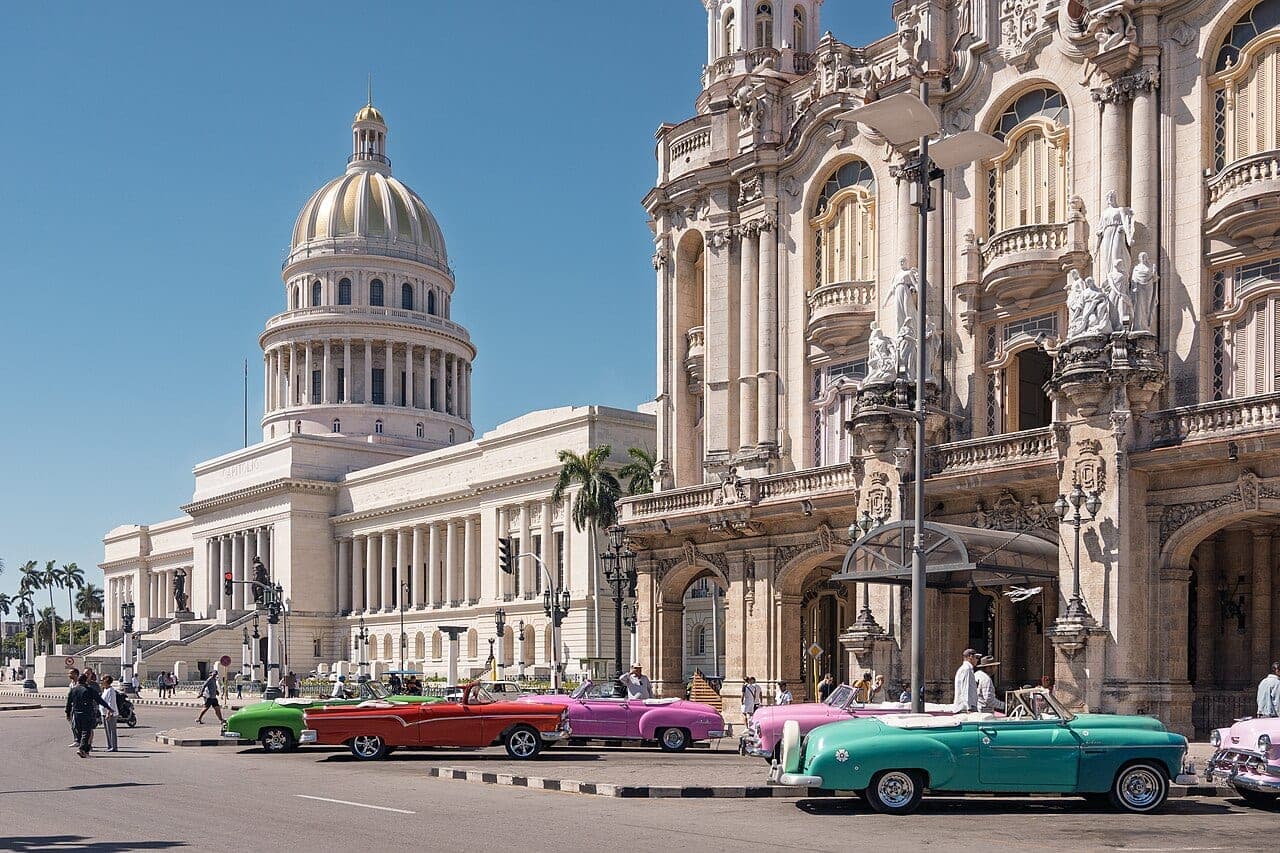
Cuba is the largest island in the Caribbean, and its heritage was formed where two worlds met and never fully dissolved into each other. Spanish settlers laid out plazas and raised sea-forts, cathedrals and colonnaded mansions; enslaved Africans, carried to the island in their hundreds of thousands to cut cane, brought drums, gods and a sense of rhythm that reshaped almost everything the colony would later call its own. Out of that meeting came the son and the rumba, the orishas of Santería and the marble angels of Havana's great cemetery, a culture in which the sacred and the everyday, the European and the African, are rarely far apart.
It gives particular attention to how Cubans remember their dead, in Catholic wakes and nine nights of prayer, in Afro-Cuban rites for the ancestors, and in cemeteries such as the Necrópolis de Cristóbal Colón, where a folk saint still draws a daily line of petitioners.
Cuba lies at the mouth of the Gulf of Mexico, a long, narrow archipelago whose main island curves for more than 1,200 kilometres between the Atlantic and the Caribbean Sea. Its roughly 110,000 square kilometres make it the largest nation in the Caribbean, a land of limestone hills, fertile red plains and the Sierra Maestra in the south-east, where Pico Turquino rises to about 1,974 metres, according to Encyclopaedia Britannica. Around 11 million people live on the island, most of them in cities, with the capital, Havana, home to more than two million.
The population descends mainly from Spanish settlers and from Africans brought in bondage, with smaller Chinese and other communities added over time, and that mixed ancestry underlies much of the island's culture. Spanish is the official language, Roman Catholicism the historic religion alongside widely practised Afro-Cuban traditions, and the country holds nine UNESCO World Heritage sites, seven of them cultural and two natural.
Havana. Founded in its present site in 1519 as San Cristóbal de La Habana, the capital became the fortified gateway between Spain and its American empire, the harbour where treasure fleets gathered before the Atlantic crossing. Old Havana and its fortification system were inscribed by UNESCO in 1982, taking in four historic squares, the Plaza de Armas, Plaza Vieja, Plaza de San Francisco and Plaza de la Catedral, along with the baroque cathedral, the seafront Malecón and the great Spanish castles that guarded the bay. The domed Capitolio and the 1950s American cars still working the streets give the city an unmistakable character.
 Plaza Vieja in Old Havana, restored building by building under the city historian's office, which funds the work from tourism revenue it is allowed to keep. Photograph by Velvet, CC BY-SA 4.0, via Wikimedia Commons.
Santiago de Cuba. The island's second city and its eastern capital, Santiago carries the strongest Afro-Caribbean and French-Haitian influence, heard in its carnival and in the son that grew up in the hills around it. The San Pedro de la Roca Castle, designed by the Italian engineer Juan Bautista Antonelli and inscribed by UNESCO in 1997, is among the best-preserved examples of Spanish-American military architecture. Nearby stand the Santa Ifigenia cemetery, resting place of national figures, and the sanctuary of the Virgin of Charity at El Cobre.
Trinidad. A sugar boom-town whose wealth froze it in time, Trinidad was inscribed together with the neighbouring Valley de los Ingenios (the Valley of the Sugar Mills) in 1988. Its cobbled streets, pastel houses and preserved plantation landscape record both the fortunes and the forced labour on which nineteenth-century sugar rested.
Cienfuegos. Settled by French immigrants from 1819, Cienfuegos was inscribed by UNESCO in 2005 as an outstanding example of nineteenth-century urban planning in the Americas, its neoclassical centre laid out on a regular grid around a broad main square.
Camagüey. Inscribed in 2008, the historic centre of Camagüey is known for its deliberately irregular street plan, a maze said to have been designed to confuse raiding pirates, and for the large clay tinajones that catch rainwater in its courtyards.
Before Europeans arrived, Cuba was home to Indigenous peoples including the agricultural Taíno and the earlier Guanahatabey and Ciboney. Christopher Columbus reached the island in October 1492, and Spanish settlement began in earnest when Diego Velázquez de Cuéllar led the conquest from 1511 and founded the first seven towns, among them Baracoa, Bayamo, Trinidad and Santiago de Cuba. Indigenous resistance was fierce but brief; the Taíno leader Hatuey was executed around 1512, and within a few decades disease, displacement and forced labour had devastated the native population.
Plaza Vieja in Old Havana, restored building by building under the city historian's office, which funds the work from tourism revenue it is allowed to keep. Photograph by Velvet, CC BY-SA 4.0, via Wikimedia Commons.
Santiago de Cuba. The island's second city and its eastern capital, Santiago carries the strongest Afro-Caribbean and French-Haitian influence, heard in its carnival and in the son that grew up in the hills around it. The San Pedro de la Roca Castle, designed by the Italian engineer Juan Bautista Antonelli and inscribed by UNESCO in 1997, is among the best-preserved examples of Spanish-American military architecture. Nearby stand the Santa Ifigenia cemetery, resting place of national figures, and the sanctuary of the Virgin of Charity at El Cobre.
Trinidad. A sugar boom-town whose wealth froze it in time, Trinidad was inscribed together with the neighbouring Valley de los Ingenios (the Valley of the Sugar Mills) in 1988. Its cobbled streets, pastel houses and preserved plantation landscape record both the fortunes and the forced labour on which nineteenth-century sugar rested.
Cienfuegos. Settled by French immigrants from 1819, Cienfuegos was inscribed by UNESCO in 2005 as an outstanding example of nineteenth-century urban planning in the Americas, its neoclassical centre laid out on a regular grid around a broad main square.
Camagüey. Inscribed in 2008, the historic centre of Camagüey is known for its deliberately irregular street plan, a maze said to have been designed to confuse raiding pirates, and for the large clay tinajones that catch rainwater in its courtyards.
Before Europeans arrived, Cuba was home to Indigenous peoples including the agricultural Taíno and the earlier Guanahatabey and Ciboney. Christopher Columbus reached the island in October 1492, and Spanish settlement began in earnest when Diego Velázquez de Cuéllar led the conquest from 1511 and founded the first seven towns, among them Baracoa, Bayamo, Trinidad and Santiago de Cuba. Indigenous resistance was fierce but brief; the Taíno leader Hatuey was executed around 1512, and within a few decades disease, displacement and forced labour had devastated the native population.
 Trinidad grew rich on sugar and enslaved labour, then stopped when the industry collapsed, which is why its streets are still the ones the planters walked. Photograph by DnTrotaMundos, CC BY 3.0, via Wikimedia Commons.
From the late eighteenth century sugar transformed the island into one of the world's leading producers, a boom built on the labour of hundreds of thousands of enslaved Africans; slavery was not fully abolished until 1886. The drive for independence produced a long armed struggle against Spain: the Ten Years' War of 1868–1878, launched when the planter Carlos Manuel de Céspedes proclaimed freedom for the island and his slaves, and then the War of Independence begun in 1895, according to Britannica. The writer and organiser José Martí, its foremost ideological leader, was killed in battle that same year, as the Library of Congress records.
United States intervention in 1898 ended Spanish rule, and after a period of American occupation the Republic of Cuba was established in 1902. The early republic was marked by close and often contested ties with the United States and by repeated political instability. The Cuban Revolution brought a change of government on 1 January 1959, when the forces led by Fidel Castro took power. In the decades that followed the island reorganised its economy and society along socialist lines and aligned internationally with the Soviet bloc, entering a period of severe economic hardship after that bloc's collapse in the early 1990s. Cuba's later history has continued to unfold through cycles of reform, shortage and migration.
The name Cuba comes from the language of the Taíno, though its precise meaning is uncertain; it is often traced to a word such as cubao, read as "where fertile land is abundant," or to coabana, "a great place," per the Wiktionary etymology. Taíno words survive throughout the wider Spanish and English vocabulary too, including hamaca (hammock), canoa (canoe), huracán (hurricane), barbacoa (barbecue) and tabaco.
Spanish is universally spoken, in the Caribbean variety that Cuba shares in broad terms with Puerto Rico and the Dominican Republic. Cuban Spanish is known for aspirating or dropping the syllable-final s, softening or omitting the d between vowels, a rapid delivery and a markedly musical intonation, features that reflect both Andalusian and Canary Island settlement and centuries of contact with West African languages. African-derived words entered daily speech, especially through religion and music, and Cuban usage carries a distinctive stock of idioms and affectionate turns of phrase that mark it out across the Spanish-speaking world.
Cuban culture is defined above all by the fusion of Spanish melody and song with African rhythm and percussion. The son, which grew up in the eastern highlands in the late nineteenth century and blends the Spanish guitar and canción with African call-and-response and clave-based percussion, became the root form of much that followed, according to Wikipedia. Rumba emerged separately in the yards and streets of Havana and Matanzas, drawing on African drumming and dance in its yambú, guaguancó and columbia styles, as noted by Wikipedia. The danzón, first composed by Miguel Faílde in Matanzas in 1879, refined the European-derived contradanza into an elegant salon dance, and later generations added the mambo and, in the 1950s, the cha-cha-chá.
These forms travelled. Cuban son and its offshoots fed directly into salsa, the genre codified in New York in the 1960s and 1970s and now danced worldwide, while at home the driving style known as timba keeps the tradition current. The island's other signatures reinforce the image: the hand-rolled cigar, made largely from tobacco grown in Pinar del Río and the Viñales region and long regarded among the finest in the world, per Wikipedia; and the vintage American cars, the almendrones named for their almond-round shape, that mechanics have improvised into service for more than half a century.
Cuban letters carry equal weight. José Martí was a major poet as well as a patriot, and his Versos Sencillos gave the words to "Guantanamera." Nicolás Guillén brought Afro-Cuban voice into national poetry, Alejo Carpentier helped define Latin American fiction through his idea of lo real maravilloso, and writers from José Lezama Lima to Guillermo Cabrera Infante extended the tradition. The painter Wifredo Lam fused Afro-Cuban imagery with European modernism.
Roman Catholicism arrived with the Spanish and remains the island's historic faith; its most beloved figure is the Virgin of Charity of El Cobre, patroness of Cuba, whose shrine near Santiago draws pilgrims and who is widely identified with the orisha Ochún. That identification points to the deeper feature of Cuban spirituality: the blending of Catholic and African belief.
Santería, also called Regla de Ocha or the Lucumí religion, developed among enslaved Yoruba and their descendants and reached its recognisable form in the late nineteenth century, according to Wikipedia. It teaches a remote creator, Olodumare, and a family of active spirits, the orishas, each governing forces of nature and aspects of human life; among them are Elegguá of the crossroads, Yemayá of the sea, Changó of thunder and Ochún of rivers and love. Because open African worship was forbidden under slavery, devotees paired each orisha with a Catholic saint, and that layering endures in home altars, drumming ceremonies and divination. Other African-derived traditions live alongside it: Palo Monte, of Central African Kongo origin; the Abakuá, a male society from the Cross River region whose rhythms shaped the rumba; and, in the east, a Vodú brought by Haitian migrants. Kardecian Spiritism threads through all of them. The annual pilgrimage each 17 December to the sanctuary of San Lázaro at El Rincón, where the saint is joined with the orisha Babalú Ayé, is among the island's largest acts of popular devotion.
Cuban mourning begins with the velorio, the wake, traditionally held through the night with family, neighbours, coffee and prayer before a burial that usually follows within a day. In the Catholic pattern the wake gives way to the novenario, nine consecutive evenings of the rosary said in the home of the deceased, and to memorial Masses that continue on the month's mind and the first anniversary, the cabo de año. Grief is communal rather than private, and the obligation to gather and pray is widely felt.
Afro-Cuban practice adds its own rites for the passage of the dead and the honouring of the ancestors, the egun. When an initiate of Santería dies, the community performs the itutu, a sequence of ceremonies that settles the person's spiritual affairs and separates the living from the departed, often followed after a set period by drumming for the dead. Ancestors are addressed at the household shrine, fed and consulted, kept as present members of the family in a way that mirrors the Catholic novena more closely than either tradition usually admits.
The island's cemeteries make its remembrance visible. The Necrópolis de Cristóbal Colón in Havana, founded in 1876, spreads across some fifty hectares of avenues, chapels and marble monuments, one of the most significant cemeteries in the Americas, per Wikipedia. Its most visited grave is that of Amelia Goyri, "La Milagrosa," who died in childbirth in 1901 and became a folk saint; petitioners still knock on her tomb with the brass ring, ask their favour, and leave without turning their back on her. In Santiago de Cuba, the Santa Ifigenia cemetery holds the mausoleum of José Martí, a site of national commemoration, along with the graves of other independence figures and of celebrated musicians.
Cuban records are deep and they are divided by 1959.
Catholic parish registers begin in the sixteenth century and are among the oldest in the Americas, kept separately in many parishes for Spaniards, for free people of colour and for the enslaved, which is grim and also useful: the separate books are the reason so many Afro-Cuban families can be traced at all. Civil registration began in 1885 and is held municipally.
The slave record is substantial. Cuba imported enslaved Africans in large numbers into the nineteenth century, and the registers of the trade, the plantation inventories and the papers of coartación, the arrangement by which an enslaved person could buy their freedom in instalments, survive in Havana and in Spain. Chinese indenture, which brought well over a hundred thousand workers from the 1840s, generated its own contract records.
Colonial administrative papers for Cuba are largely at the Archivo General de Indias in Seville, which is fully digitised and free.
Then the revolution. Around one and a half million people have left since 1959, and their arrival, parole and naturalisation records in the United States and Spain are often the fullest record of a Cuban family's twentieth century. Working across that break usually means combining an American immigration file with a Cuban parish book, and the practical difficulty is less about permission than about correspondence with parishes that have limited resources.
Cuba's most cited preservation success is the recovery of Old Havana. From the 1980s the Office of the City Historian, led for decades by Eusebio Leal Spengler, rebuilt the decaying colonial core through a model that reinvested tourism revenue directly into restoration, housing and social services, turning a crumbling quarter into a living, inhabited historic district rather than a museum piece.
The country's nine UNESCO World Heritage sites anchor the wider effort: Old Havana and its fortifications (1982); Trinidad and the Valley de los Ingenios (1988); the San Pedro de la Roca Castle at Santiago de Cuba (1997); the Viñales Valley (1999), a cultural landscape of limestone mogotes and traditional tobacco farming; the Archaeological Landscape of the First Coffee Plantations in the South-East (2000), preserving the ruins of scores of nineteenth-century cafetales; the historic centre of Cienfuegos (2005); and the historic centre of Camagüey (2008), all inscribed for cultural value. Two natural sites complete the list: Desembarco del Granma National Park, inscribed in 1999 for its exceptional marine limestone terraces, and Alejandro de Humboldt National Park, inscribed in 2001 as one of the most biologically diverse tropical island sites on earth. Preservation is constrained by limited funds and by frequent Atlantic hurricanes, which repeatedly test the island's aging colonial fabric.
Cuba's documentary memory has gained international recognition and a growing digital presence. The archive of José Martí, the José Martí Pérez Fonds, was inscribed on UNESCO's Memory of the World register in 2005, and the original negatives of the Noticiero ICAIC Latinoamericano newsreels, a visual record of decades of Latin American life, were added in 2009. The national film institute, ICAIC, has worked to conserve and digitise that footage.
The Office of the City Historian in Havana maintains archives and publications documenting the restoration of the old city, and EcuRed, a Cuban online encyclopedia launched in 2010, has assembled a large Spanish-language reference resource on the island's history and figures. Access has been shaped by the country's limited and costly internet connectivity, which has slowed digitisation even as demand grows among Cubans at home and in the diaspora.
The 1997 recording and the 1999 film Buena Vista Social Club returned a generation of veteran son musicians to world stages, while salsa, timba and the older forms remain staples of Latin dance floors everywhere. The large Cuban diaspora, concentrated in Florida, has carried music, cuisine and religious practice abroad across generations.
Cuban cinema has drawn international notice, with the 1993 film "Fresa y chocolate" reaching an Oscar nomination, and Cuban ballet retains a strong reputation worldwide; in literature, Leonardo Padura won the Princess of Asturias Award for Letters in 2015. Cuban cigars remain a global luxury, and the imagery of Havana, its architecture, its music and its classic cars, is among the most recognisable in the Caribbean.
The recovery of Old Havana. The self-financing restoration model built by the Office of the City Historian is widely studied as an example of urban heritage conservation that funds itself and keeps a historic quarter lived-in rather than emptied for tourism.
Buena Vista Social Club. By bringing elderly son musicians such as Compay Segundo, Ibrahim Ferrer and Omara Portuondo back into the studio and onto the concert stage in the late 1990s, the project rescued a body of Cuban music from obscurity and gave it a global second life.
Trinidad preserved whole. The end of the sugar boom left Trinidad and its valley of mills largely untouched, and careful stewardship has kept the town and its plantation landscape intact as a rare complete picture of nineteenth-century colonial Cuba.
Martí's archive recognised. The inscription of the José Martí Pérez Fonds on UNESCO's Memory of the World register secured the documentary legacy of the island's foremost national figure for future study and safekeeping.
Trinidad grew rich on sugar and enslaved labour, then stopped when the industry collapsed, which is why its streets are still the ones the planters walked. Photograph by DnTrotaMundos, CC BY 3.0, via Wikimedia Commons.
From the late eighteenth century sugar transformed the island into one of the world's leading producers, a boom built on the labour of hundreds of thousands of enslaved Africans; slavery was not fully abolished until 1886. The drive for independence produced a long armed struggle against Spain: the Ten Years' War of 1868–1878, launched when the planter Carlos Manuel de Céspedes proclaimed freedom for the island and his slaves, and then the War of Independence begun in 1895, according to Britannica. The writer and organiser José Martí, its foremost ideological leader, was killed in battle that same year, as the Library of Congress records.
United States intervention in 1898 ended Spanish rule, and after a period of American occupation the Republic of Cuba was established in 1902. The early republic was marked by close and often contested ties with the United States and by repeated political instability. The Cuban Revolution brought a change of government on 1 January 1959, when the forces led by Fidel Castro took power. In the decades that followed the island reorganised its economy and society along socialist lines and aligned internationally with the Soviet bloc, entering a period of severe economic hardship after that bloc's collapse in the early 1990s. Cuba's later history has continued to unfold through cycles of reform, shortage and migration.
The name Cuba comes from the language of the Taíno, though its precise meaning is uncertain; it is often traced to a word such as cubao, read as "where fertile land is abundant," or to coabana, "a great place," per the Wiktionary etymology. Taíno words survive throughout the wider Spanish and English vocabulary too, including hamaca (hammock), canoa (canoe), huracán (hurricane), barbacoa (barbecue) and tabaco.
Spanish is universally spoken, in the Caribbean variety that Cuba shares in broad terms with Puerto Rico and the Dominican Republic. Cuban Spanish is known for aspirating or dropping the syllable-final s, softening or omitting the d between vowels, a rapid delivery and a markedly musical intonation, features that reflect both Andalusian and Canary Island settlement and centuries of contact with West African languages. African-derived words entered daily speech, especially through religion and music, and Cuban usage carries a distinctive stock of idioms and affectionate turns of phrase that mark it out across the Spanish-speaking world.
Cuban culture is defined above all by the fusion of Spanish melody and song with African rhythm and percussion. The son, which grew up in the eastern highlands in the late nineteenth century and blends the Spanish guitar and canción with African call-and-response and clave-based percussion, became the root form of much that followed, according to Wikipedia. Rumba emerged separately in the yards and streets of Havana and Matanzas, drawing on African drumming and dance in its yambú, guaguancó and columbia styles, as noted by Wikipedia. The danzón, first composed by Miguel Faílde in Matanzas in 1879, refined the European-derived contradanza into an elegant salon dance, and later generations added the mambo and, in the 1950s, the cha-cha-chá.
These forms travelled. Cuban son and its offshoots fed directly into salsa, the genre codified in New York in the 1960s and 1970s and now danced worldwide, while at home the driving style known as timba keeps the tradition current. The island's other signatures reinforce the image: the hand-rolled cigar, made largely from tobacco grown in Pinar del Río and the Viñales region and long regarded among the finest in the world, per Wikipedia; and the vintage American cars, the almendrones named for their almond-round shape, that mechanics have improvised into service for more than half a century.
Cuban letters carry equal weight. José Martí was a major poet as well as a patriot, and his Versos Sencillos gave the words to "Guantanamera." Nicolás Guillén brought Afro-Cuban voice into national poetry, Alejo Carpentier helped define Latin American fiction through his idea of lo real maravilloso, and writers from José Lezama Lima to Guillermo Cabrera Infante extended the tradition. The painter Wifredo Lam fused Afro-Cuban imagery with European modernism.
Roman Catholicism arrived with the Spanish and remains the island's historic faith; its most beloved figure is the Virgin of Charity of El Cobre, patroness of Cuba, whose shrine near Santiago draws pilgrims and who is widely identified with the orisha Ochún. That identification points to the deeper feature of Cuban spirituality: the blending of Catholic and African belief.
Santería, also called Regla de Ocha or the Lucumí religion, developed among enslaved Yoruba and their descendants and reached its recognisable form in the late nineteenth century, according to Wikipedia. It teaches a remote creator, Olodumare, and a family of active spirits, the orishas, each governing forces of nature and aspects of human life; among them are Elegguá of the crossroads, Yemayá of the sea, Changó of thunder and Ochún of rivers and love. Because open African worship was forbidden under slavery, devotees paired each orisha with a Catholic saint, and that layering endures in home altars, drumming ceremonies and divination. Other African-derived traditions live alongside it: Palo Monte, of Central African Kongo origin; the Abakuá, a male society from the Cross River region whose rhythms shaped the rumba; and, in the east, a Vodú brought by Haitian migrants. Kardecian Spiritism threads through all of them. The annual pilgrimage each 17 December to the sanctuary of San Lázaro at El Rincón, where the saint is joined with the orisha Babalú Ayé, is among the island's largest acts of popular devotion.
Cuban mourning begins with the velorio, the wake, traditionally held through the night with family, neighbours, coffee and prayer before a burial that usually follows within a day. In the Catholic pattern the wake gives way to the novenario, nine consecutive evenings of the rosary said in the home of the deceased, and to memorial Masses that continue on the month's mind and the first anniversary, the cabo de año. Grief is communal rather than private, and the obligation to gather and pray is widely felt.
Afro-Cuban practice adds its own rites for the passage of the dead and the honouring of the ancestors, the egun. When an initiate of Santería dies, the community performs the itutu, a sequence of ceremonies that settles the person's spiritual affairs and separates the living from the departed, often followed after a set period by drumming for the dead. Ancestors are addressed at the household shrine, fed and consulted, kept as present members of the family in a way that mirrors the Catholic novena more closely than either tradition usually admits.
The island's cemeteries make its remembrance visible. The Necrópolis de Cristóbal Colón in Havana, founded in 1876, spreads across some fifty hectares of avenues, chapels and marble monuments, one of the most significant cemeteries in the Americas, per Wikipedia. Its most visited grave is that of Amelia Goyri, "La Milagrosa," who died in childbirth in 1901 and became a folk saint; petitioners still knock on her tomb with the brass ring, ask their favour, and leave without turning their back on her. In Santiago de Cuba, the Santa Ifigenia cemetery holds the mausoleum of José Martí, a site of national commemoration, along with the graves of other independence figures and of celebrated musicians.
Cuban records are deep and they are divided by 1959.
Catholic parish registers begin in the sixteenth century and are among the oldest in the Americas, kept separately in many parishes for Spaniards, for free people of colour and for the enslaved, which is grim and also useful: the separate books are the reason so many Afro-Cuban families can be traced at all. Civil registration began in 1885 and is held municipally.
The slave record is substantial. Cuba imported enslaved Africans in large numbers into the nineteenth century, and the registers of the trade, the plantation inventories and the papers of coartación, the arrangement by which an enslaved person could buy their freedom in instalments, survive in Havana and in Spain. Chinese indenture, which brought well over a hundred thousand workers from the 1840s, generated its own contract records.
Colonial administrative papers for Cuba are largely at the Archivo General de Indias in Seville, which is fully digitised and free.
Then the revolution. Around one and a half million people have left since 1959, and their arrival, parole and naturalisation records in the United States and Spain are often the fullest record of a Cuban family's twentieth century. Working across that break usually means combining an American immigration file with a Cuban parish book, and the practical difficulty is less about permission than about correspondence with parishes that have limited resources.
Cuba's most cited preservation success is the recovery of Old Havana. From the 1980s the Office of the City Historian, led for decades by Eusebio Leal Spengler, rebuilt the decaying colonial core through a model that reinvested tourism revenue directly into restoration, housing and social services, turning a crumbling quarter into a living, inhabited historic district rather than a museum piece.
The country's nine UNESCO World Heritage sites anchor the wider effort: Old Havana and its fortifications (1982); Trinidad and the Valley de los Ingenios (1988); the San Pedro de la Roca Castle at Santiago de Cuba (1997); the Viñales Valley (1999), a cultural landscape of limestone mogotes and traditional tobacco farming; the Archaeological Landscape of the First Coffee Plantations in the South-East (2000), preserving the ruins of scores of nineteenth-century cafetales; the historic centre of Cienfuegos (2005); and the historic centre of Camagüey (2008), all inscribed for cultural value. Two natural sites complete the list: Desembarco del Granma National Park, inscribed in 1999 for its exceptional marine limestone terraces, and Alejandro de Humboldt National Park, inscribed in 2001 as one of the most biologically diverse tropical island sites on earth. Preservation is constrained by limited funds and by frequent Atlantic hurricanes, which repeatedly test the island's aging colonial fabric.
Cuba's documentary memory has gained international recognition and a growing digital presence. The archive of José Martí, the José Martí Pérez Fonds, was inscribed on UNESCO's Memory of the World register in 2005, and the original negatives of the Noticiero ICAIC Latinoamericano newsreels, a visual record of decades of Latin American life, were added in 2009. The national film institute, ICAIC, has worked to conserve and digitise that footage.
The Office of the City Historian in Havana maintains archives and publications documenting the restoration of the old city, and EcuRed, a Cuban online encyclopedia launched in 2010, has assembled a large Spanish-language reference resource on the island's history and figures. Access has been shaped by the country's limited and costly internet connectivity, which has slowed digitisation even as demand grows among Cubans at home and in the diaspora.
The 1997 recording and the 1999 film Buena Vista Social Club returned a generation of veteran son musicians to world stages, while salsa, timba and the older forms remain staples of Latin dance floors everywhere. The large Cuban diaspora, concentrated in Florida, has carried music, cuisine and religious practice abroad across generations.
Cuban cinema has drawn international notice, with the 1993 film "Fresa y chocolate" reaching an Oscar nomination, and Cuban ballet retains a strong reputation worldwide; in literature, Leonardo Padura won the Princess of Asturias Award for Letters in 2015. Cuban cigars remain a global luxury, and the imagery of Havana, its architecture, its music and its classic cars, is among the most recognisable in the Caribbean.
The recovery of Old Havana. The self-financing restoration model built by the Office of the City Historian is widely studied as an example of urban heritage conservation that funds itself and keeps a historic quarter lived-in rather than emptied for tourism.
Buena Vista Social Club. By bringing elderly son musicians such as Compay Segundo, Ibrahim Ferrer and Omara Portuondo back into the studio and onto the concert stage in the late 1990s, the project rescued a body of Cuban music from obscurity and gave it a global second life.
Trinidad preserved whole. The end of the sugar boom left Trinidad and its valley of mills largely untouched, and careful stewardship has kept the town and its plantation landscape intact as a rare complete picture of nineteenth-century colonial Cuba.
Martí's archive recognised. The inscription of the José Martí Pérez Fonds on UNESCO's Memory of the World register secured the documentary legacy of the island's foremost national figure for future study and safekeeping.
National Overview
Notable Cities
Historical Foundations
Linguistic and Etymological Roots
Cultural Identity
Religion and Spirituality
Remembrance and Mourning Traditions
Tracing a Family in Cuba
Heritage Preservation Efforts
Digital Heritage
Contemporary Cultural Influences
Success Stories
References and resources
- UNESCO World Heritage Centre, Cuba. The state-party page listing all nine inscribed sites.
- Encyclopaedia Britannica, Cuba. Geography, population and historical background.
- Encyclopaedia Britannica, Cuban Independence Movement. The Ten Years' War and the War of Independence.
- Library of Congress, José Martí. The life and role of the independence leader.
- Wikipedia, Son cubano. Origins of the son and its Spanish and African elements.
- Wikipedia, Cuban rumba. The Havana and Matanzas rumba tradition.
- Wikipedia, Santería. The Regla de Ocha and the orishas.
- Wikipedia, Colon Cemetery, Havana. The Necrópolis de Cristóbal Colón and La Milagrosa.
- Wikipedia, Cuban cigar. Tobacco growing and cigar making on the island.
- UNESCO, Desembarco del Granma National Park. The natural World Heritage site inscribed in 1999.
- UNESCO Memory of the World. The register that includes the José Martí Pérez Fonds.