Heritage · Country
Faroe Islands Culture and Heritage
Eighteen basalt islands in the North Atlantic where someone burned barley three centuries before the Norse arrived, and where a written language was rebuilt in the 1840s out of ballads people had never stopped singing. A guide to Faroese heritage, from Kirkjubøur to the chain dance.Written to last.
By Confinity Heritage Editorial · Updated 2026-08-17 · 8-minute readQuiet tools, kept out of the way.
The Faroe Islands are eighteen slabs of layered basalt set in the North Atlantic between Norway, Iceland and Scotland, close enough together that most of them can be reached by tunnel or ferry within an hour, and steep enough that villages cling to whatever flat ground the sea and the ice left behind. Fifty-four thousand people live here, on 1,400 square kilometres of grass, cliff and rock, with no trees to speak of and no point more than five kilometres from salt water. The oldest human trace is a scatter of burnt barley grains in wind-blown sand on Sandoy, laid down some three centuries before any Norse ship arrived.
What the Faroes have to show for themselves is mostly not built. It is a body of ballads running to tens of thousands of stanzas, a ring dance still danced by ordinary people at weddings, a language that survived four hundred years without a settled spelling because it was sung rather than written, and a small number of very old buildings at Kirkjubøur that have never stopped being used.
Føroyar is a self-governing nation within the Kingdom of Denmark, with its own parliament, the Løgting, its own government, the Landsstýri, its own flag, currency notes and football team, and no membership of the European Union (Britannica). Faroese and Danish are both official, and Faroese is the language of daily life. Around 23,000 people live in the Tórshavn area, and the rest are spread across a hundred or so villages, many of them now joined by undersea road tunnels, including one opened in 2020 with a roundabout carved out under a fjord. Fish and farmed salmon account for the overwhelming bulk of exports. Sheep outnumber people, and have done since the islands were named for them.
Tórshavn. The capital takes its name from Thor and has been the meeting place of the islands since the assembly first gathered on Tinganes, the rocky spit dividing the two harbours. The old government offices still occupy the tarred red timber houses with turf roofs at the tip of the peninsula, so that the Faroese prime minister works in a building a visitor can walk past without noticing. Skansin, the fort above the eastern harbour, was built in 1580 against pirates and served as British headquarters during the Second World War. Tjóðsavnið, the national museum, sits north of the centre at Hoyvík with the old farm of Hoyvíksgarður preserved alongside it.
Klaksvík. The second town, on Borðoy in the northern islands, grew around fishing and remains the fleet's home port. Its Christianskirkjan of 1963 is one of the more remarkable churches in the Nordic countries: a modern stone hall in which a rowing boat used in a rescue off Mykines in 1918 hangs from the ceiling, and where the font is a granite basin roughly four thousand years old, brought from Denmark, that once held sacrificial blood.
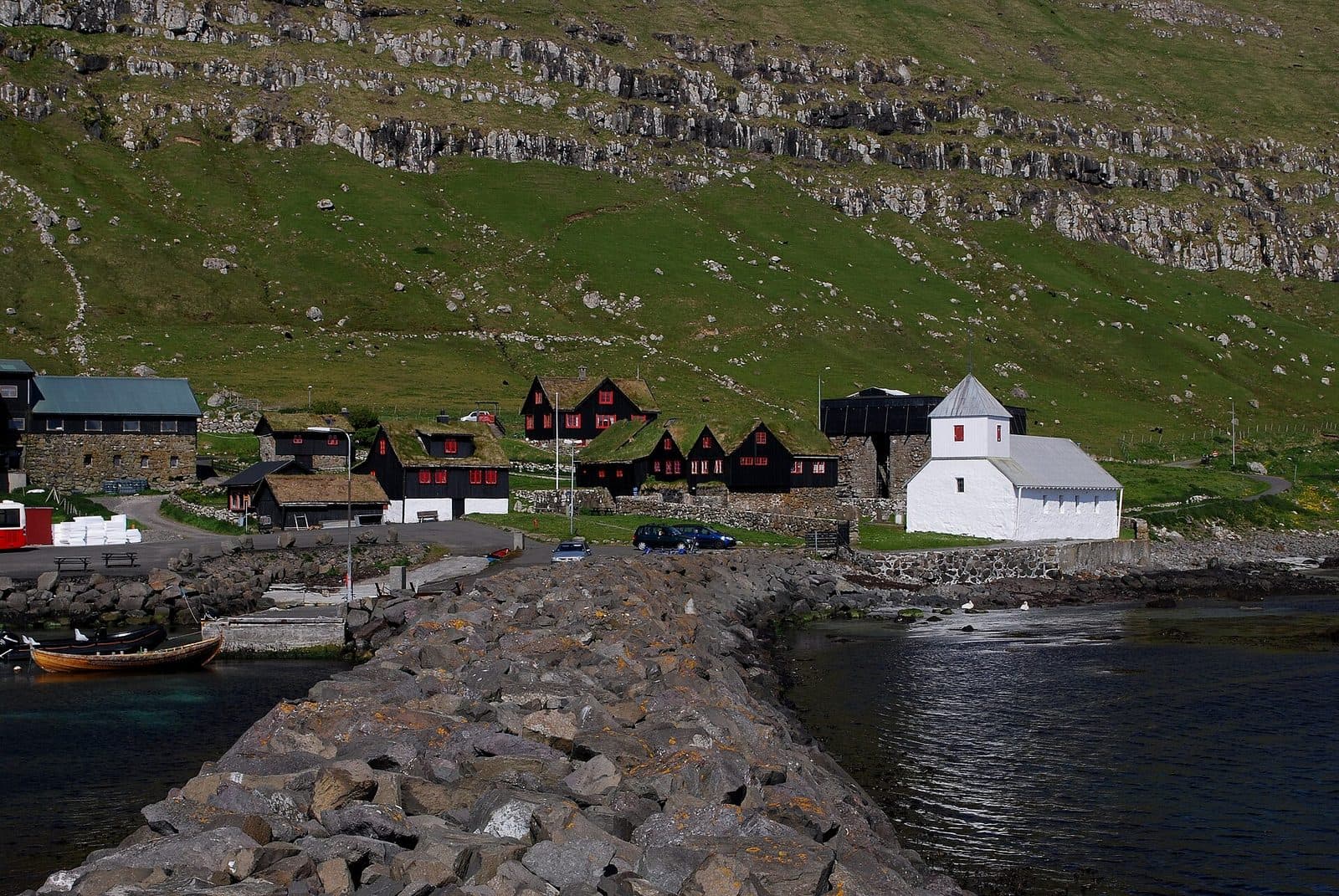
Kirkjubøur. A dozen people live in the old episcopal seat on the south coast of Streymoy, and the three buildings there carry more Faroese history than anywhere else. Saint Olav's Church, begun around 1111, is the only medieval church in the islands still in use. Beside it stand the roofless walls of the Magnus Cathedral, begun around 1300 under Bishop Erlendur and never finished. Behind both is Kirkjubøargarður, a turf-roofed timber farmhouse in which the Patursson family has lived for seventeen generations and which is argued to be among the oldest inhabited wooden houses anywhere.
The Norse were not first. Excavation at Á Sondum on Sandoy found two layers of peat ash containing carbonised barley, radiocarbon dated to the fourth to sixth centuries and again to the late sixth to eighth, several hundred years before the accepted date for Viking settlement; barley does not grow wild in the Faroes, so somebody carried it there and burned it (ScienceDirect). Written support comes from the Irish monk Dicuil, who recorded around 825 that islands north of Britain had been inhabited by hermits for a century until Norse raiders drove them off, leaving countless sheep behind.
 Kirkjubour was the bishop's seat of the medieval Faroes, and the farmhouse there is claimed as one of the oldest inhabited wooden houses in the world, lived in by the same family since the sixteenth century. Photograph by Vincent van Zeijst, CC BY-SA 3.0, via Wikimedia Commons.
Norse settlement proper began in the ninth century. Færeyinga saga, written in Iceland around 1200, gives the islands their founding story: the rivalry of Sigmundur Brestisson, who brought Christianity around the year 999 on the orders of the Norwegian king, and Tróndur í Gøtu, who resisted it. Faroese law was recorded early. Seyðabrævið, the Sheep Letter of 1298, is the oldest surviving Faroese document, a Norwegian royal ordinance setting out how sheep, land and stranded whales were to be divided, and parts of its logic still underlie Faroese common land today.
The islands passed with Norway into union with Denmark and stayed Danish when Norway did not. The Reformation reached them in 1538, closing the bishopric at Kirkjubøur and its school, and a royal trade monopoly ran from 1709 until 1856. The Løgting was abolished outright in 1816 and restored as a county council in 1852. On 12 April 1940, with Denmark occupied by Germany, British forces landed at Tórshavn, and the occupation that followed is remembered locally as a friendly one: Faroese ships ran fish to Britain at great cost in lives, and the British recognised the Faroese flag, Merkið, on 25 April 1940, still marked as Flag Day. A referendum in 1946 produced a narrow majority for independence, which Denmark annulled, and the Home Rule Act of 1948 settled the compromise the islands live under now.
Faroese is a West Nordic language descended from the Old Norse of the settlers, closest to Icelandic and to the western dialects of Norway. It very nearly disappeared from the page. After the Reformation, Danish became the language of church, court and school, and for roughly three centuries Faroese was spoken everywhere and written almost nowhere. It survived because people kept singing it: the ballads carried vocabulary, grammar and metre from one generation to the next without a single schoolbook.
The reconstruction began with Jens Christian Svabo, who collected ballads in the 1770s and 1780s and wrote them down phonetically, convinced he was recording a language about to die. It was completed by V. U. Hammershaimb, whose orthography of 1846 chose an etymological spelling deliberately close to Old Norse, so that written Faroese looks much like Icelandic on the page while sounding nothing like it aloud. Jakob Jakobsen proposed a phonetic alternative and lost the argument, and Hammershaimb's system is the one in use. The Christmas Meeting in Tórshavn in 1888 turned the language into a political movement; Faroese became the language of school instruction in 1938, of the church in 1939, and an official language in 1948. The name Føroyar most likely means sheep islands, from the Old Norse fær. Tórshavn is Thor's harbour, Kirkjubøur the church farm, and a great many village names still say plainly what the place was for.
The ballads, kvæði, are the central inheritance. Collectors gathered something on the order of 70,000 stanzas from oral tradition, assembled into the Corpus Carminum Færoensium begun by Svend Grundtvig and Jørgen Bloch and published across the twentieth century. The longest cycle, Sjúrðarkvæði, tells the story of Sigurd the dragon-slayer over hundreds of verses. What makes the Faroes unusual is that these are still danced. The Faroese chain dance uses no instruments at all: dancers link arms in a ring or a winding line, a skipari sings the verse, everyone answers the refrain, and the step is a simple two-forward, one-back that can be kept up for hours. The medieval chain dance died out across most of Europe. Here it kept going in village halls, and it is danced at weddings, at New Year, and above all at Ólavsøka, the national festival on 28 and 29 July, which opens the Løgting and ends near midnight with the whole crowd singing hymns in the street.
Food custom is shaped by a place with no grain and little fuel. Mutton and fish are hung to dry and ferment in a hjallur, a slatted wooden shed that lets the salt wind through, giving skerpikjøt and ræstur fiskur their taste and their smell. Turf roofs are still laid on new buildings as well as old.
The grindadráp, the pilot whale drive, belongs in the same food economy and is the most contested thing the Faroes do. Long-finned pilot whales sighted near shore are driven by boats into one of about two dozen approved bays and killed on the beach with a spinal lance, which has been the mandatory method since 2015; the hunt is non-commercial, supervised by police, restricted to trained and licensed participants, and the catch is divided in fixed shares among the participants and the local district and given out free (Wikipedia). Whale rights appear in the Sheep Letter of 1298, and the modern legal framework dates from 1932 and 1948. The catch averages around 700 animals a year. It draws sustained international criticism, sharply so after a single drive killed 1,428 white-sided dolphins in September 2021, after which the government set a provisional dolphin quota of 500. Faroese health authorities have separately advised since 2011 that pilot whale meat be eaten no more than once a month, and that the liver and kidneys be avoided altogether, because of mercury and PCB levels.
The Fólkakirkjan, the Church of the Faroe Islands, is Lutheran and became an independent national church in 2007 after centuries as part of the Church of Denmark. Roughly four fifths of Faroese belong to it. Alongside it, and unusually for a Nordic country, sits a large free-church population: the Scottish evangelist William Gibson Sloan began preaching here in the 1860s, and the Brethren assemblies he founded now account for close to a tenth of the population, with their own hymnody and their own strong presence in the villages.
Faroese Christianity is a singing religion. Unaccompanied hymn-singing in the old Kingo style, slow and heavily ornamented, was the normal parish sound for centuries and can still be heard at funerals and at Ólavsøka. Older belief survives mainly in the ballads and in place names, along with a body of folklore about the huldufólk, the hidden people said to live in the rocks, and about the seal woman of Mikladalur, whose story of a stolen sealskin and a curse on the men of the village is marked by a bronze statue set in the sea below the houses since 2014.
Faroese mourning is plain, communal and shaped by the fact that most families have lost someone to the sea. A death is announced through the village rather than through a notice; neighbours dig the grave; the funeral is held in the parish church with hymns sung by the congregation, often led by a forsangari, a precentor who gives out the line and is answered. Churchyards sit beside the church, walled against the wind, with low headstones and the water in view from almost all of them. Names repeat down the columns, because Faroese families have long given a child born after a death the name of the person who died, so a churchyard reads as a set of names circulating through a small population rather than a list of strangers.
The dominant public memory is of drowning. Faroese crews carried fish to Britain throughout the Second World War in unarmed wooden vessels, through minefields and submarine patrols, and the losses were severe for a population of fewer than 30,000: the trawler Nýggjaberg went down off Iceland on 28 March 1942 with 21 Faroese aboard, the worst single loss of the war for the islands, and the memorial in the Tórshavn town park carries the names of the fishermen killed. Village churches and harbour walls across the islands carry their own smaller lists. Klaksvík's hanging rescue boat is a votive object of the same kind: an ordinary working thing kept in a sacred space because of who it saved.
The ballads perform a related function. Many kvæði are, in effect, memorial poems about named local people and specific events, and singing them keeps particular names in circulation in the same way a headstone does. When Faroese speak about why the chain dance matters, they tend to reach for that idea rather than for anything about performance: the ring is how the community holds the names of its dead in its mouth.
The Faroes have records out of proportion to their size, because the population was small, literate and almost entirely accounted for.
Lutheran parish registers survive from the eighteenth century and the Danish census returns of 1801 and after name every inhabitant. Because Denmark administered the islands, the Danish National Archives hold a great deal alongside the Faroese national archive in Tórshavn, and much is digitised and free.
The Faroese genealogical tradition is a national habit rather than a specialist one. The population has hovered around fifty thousand for a long time, so the genealogical connections between families are close and generally known, and published parish genealogies covering whole districts across centuries exist for most of the islands. It is one of the few places where a stranger can ask about a surname and be told a lineage rather than a spelling.
Names work by patronymic and by farm, as in Iceland, until fixed surnames became normal in the nineteenth and twentieth centuries.
The sea is in the record too. The Faroes lost men to drowning at a rate few societies have matched, and the memorials, the loss lists and the church books record boats going down with a large share of a village's men on them. The ballad tradition, the kvæði that people still dance to, carries the older names, and the chain dance is one of the few living forms in Europe where the whole community sings a genealogy of heroes together.
The Faroe Islands have no UNESCO World Heritage Site, which makes their preservation work a national rather than an international affair. Tjóðsavnið, the National Museum, founded in 1898, is the antiquities authority as well as a museum, running archaeology, built heritage and the listing of historic buildings, and keeping the open-air farm at Hoyvíksgarður as a working example of the turf-roofed courtyard farm (Tjóðsavnið). Landsskjalasavnið, the national archives, holds the parish registers and administrative records, and Landsbókasavn Føroya, the national library, takes legal deposit of everything published in the islands.
The country's clearest restitution story concerns Kirkjubøur. During the church restoration of 1874, the medieval carved pew ends, sixteen panels of the apostles and other figures made in a west Norwegian workshop and among the finest Nordic woodcarving to survive, were removed to the National Museum in Copenhagen. They came back in 2002, by agreement between the Faroese and Danish authorities, and were shown in Tórshavn under the title Úr útlegd, out of exile (National Museum of the Faroe Islands). Conservation of the Magnus Cathedral ruin has been debated for a century, chiefly over whether to roof it, and Saint Olav's Church has been repeatedly restored while remaining a working parish church. The salt wind is the constant adversary: turf roofs need relaying, timber needs tarring, and Faroese preservation is closer to maintenance than to restoration.
For a country of 54,000, the Faroes have digitised well. The national archives have made parish registers and census returns available, which matters here more than in most places, because the population is small, the records are close to complete, and Faroese genealogy can often be traced continuously to the seventeenth century. That same completeness underpins FarGen, a project to sequence the genomes of the whole population, which is built explicitly on the islands' genealogical record. Snar.fo gathers Faroese dictionaries and reference works into one searchable portal, and Sprotin's dictionaries have carried Faroese into everyday digital use. Recordings of kvæði singing held by Tjóðsavnið and by broadcasters give researchers access to the sound of a tradition that was oral for a thousand years.
Two initiatives are worth naming for different reasons. Sheep View 360, run by the tourist board in 2016, strapped cameras to sheep because Google Street View had not come to the islands, and worked well enough that Google arrived with equipment shortly afterwards. Less playfully, a sustained national effort to build basic language technology for Faroese, a language with too few speakers to interest large companies, has produced the speech and text resources that keep it usable in software.
Faroese music travels furthest. Eivør Pálsdóttir sings in Faroese, English and Icelandic and has taken the ballad tradition into film and television scoring; Týr built a metal career on the kvæði; Teitur, Hamferð and a dense local scene fill the G! Festival on the beach at Gøta each summer. In literature, William Heinesen wrote in Danish and reportedly asked the Swedish Academy in 1981 not to consider him for the Nobel Prize, on the grounds that honouring his Danish-language work would discourage writing in Faroese, while Heðin Brú's novel of a father and son and a whale hunt was voted the Faroese book of the twentieth century. Koks, which won a Michelin star in 2017, built a kitchen around fermented mutton and dried fish. The football team's occasional upsets and the tunnel network have both done their share for the islands' visibility, and a scheme that closes parts of the country to tourists for a weekend each year while volunteers repair paths has become a small model for how a fragile place manages attention.
A written language was rebuilt from songs. Faroese survived three centuries without an orthography because it was carried in ballads, and Hammershaimb's 1846 spelling turned that oral inheritance back into a written language now used in school, church, law and software.
The medieval dance never stopped. The chain dance died out across Europe and continued here as ordinary social practice, which is why Faroese weddings and Ólavsøka still end with hundreds of people singing verses nobody wrote down until the 1770s.
The Kirkjubøur carvings came home. The pew ends taken to Copenhagen in 1874 were returned in 2002 and are displayed by the Faroese national museum in Tórshavn.
A complete record of a small people. Near-complete parish registers, an archive that has digitised them, and a population willing to be studied have given the Faroes a genealogical record most countries cannot match.
Kirkjubour was the bishop's seat of the medieval Faroes, and the farmhouse there is claimed as one of the oldest inhabited wooden houses in the world, lived in by the same family since the sixteenth century. Photograph by Vincent van Zeijst, CC BY-SA 3.0, via Wikimedia Commons.
Norse settlement proper began in the ninth century. Færeyinga saga, written in Iceland around 1200, gives the islands their founding story: the rivalry of Sigmundur Brestisson, who brought Christianity around the year 999 on the orders of the Norwegian king, and Tróndur í Gøtu, who resisted it. Faroese law was recorded early. Seyðabrævið, the Sheep Letter of 1298, is the oldest surviving Faroese document, a Norwegian royal ordinance setting out how sheep, land and stranded whales were to be divided, and parts of its logic still underlie Faroese common land today.
The islands passed with Norway into union with Denmark and stayed Danish when Norway did not. The Reformation reached them in 1538, closing the bishopric at Kirkjubøur and its school, and a royal trade monopoly ran from 1709 until 1856. The Løgting was abolished outright in 1816 and restored as a county council in 1852. On 12 April 1940, with Denmark occupied by Germany, British forces landed at Tórshavn, and the occupation that followed is remembered locally as a friendly one: Faroese ships ran fish to Britain at great cost in lives, and the British recognised the Faroese flag, Merkið, on 25 April 1940, still marked as Flag Day. A referendum in 1946 produced a narrow majority for independence, which Denmark annulled, and the Home Rule Act of 1948 settled the compromise the islands live under now.
Faroese is a West Nordic language descended from the Old Norse of the settlers, closest to Icelandic and to the western dialects of Norway. It very nearly disappeared from the page. After the Reformation, Danish became the language of church, court and school, and for roughly three centuries Faroese was spoken everywhere and written almost nowhere. It survived because people kept singing it: the ballads carried vocabulary, grammar and metre from one generation to the next without a single schoolbook.
The reconstruction began with Jens Christian Svabo, who collected ballads in the 1770s and 1780s and wrote them down phonetically, convinced he was recording a language about to die. It was completed by V. U. Hammershaimb, whose orthography of 1846 chose an etymological spelling deliberately close to Old Norse, so that written Faroese looks much like Icelandic on the page while sounding nothing like it aloud. Jakob Jakobsen proposed a phonetic alternative and lost the argument, and Hammershaimb's system is the one in use. The Christmas Meeting in Tórshavn in 1888 turned the language into a political movement; Faroese became the language of school instruction in 1938, of the church in 1939, and an official language in 1948. The name Føroyar most likely means sheep islands, from the Old Norse fær. Tórshavn is Thor's harbour, Kirkjubøur the church farm, and a great many village names still say plainly what the place was for.
The ballads, kvæði, are the central inheritance. Collectors gathered something on the order of 70,000 stanzas from oral tradition, assembled into the Corpus Carminum Færoensium begun by Svend Grundtvig and Jørgen Bloch and published across the twentieth century. The longest cycle, Sjúrðarkvæði, tells the story of Sigurd the dragon-slayer over hundreds of verses. What makes the Faroes unusual is that these are still danced. The Faroese chain dance uses no instruments at all: dancers link arms in a ring or a winding line, a skipari sings the verse, everyone answers the refrain, and the step is a simple two-forward, one-back that can be kept up for hours. The medieval chain dance died out across most of Europe. Here it kept going in village halls, and it is danced at weddings, at New Year, and above all at Ólavsøka, the national festival on 28 and 29 July, which opens the Løgting and ends near midnight with the whole crowd singing hymns in the street.
Food custom is shaped by a place with no grain and little fuel. Mutton and fish are hung to dry and ferment in a hjallur, a slatted wooden shed that lets the salt wind through, giving skerpikjøt and ræstur fiskur their taste and their smell. Turf roofs are still laid on new buildings as well as old.
The grindadráp, the pilot whale drive, belongs in the same food economy and is the most contested thing the Faroes do. Long-finned pilot whales sighted near shore are driven by boats into one of about two dozen approved bays and killed on the beach with a spinal lance, which has been the mandatory method since 2015; the hunt is non-commercial, supervised by police, restricted to trained and licensed participants, and the catch is divided in fixed shares among the participants and the local district and given out free (Wikipedia). Whale rights appear in the Sheep Letter of 1298, and the modern legal framework dates from 1932 and 1948. The catch averages around 700 animals a year. It draws sustained international criticism, sharply so after a single drive killed 1,428 white-sided dolphins in September 2021, after which the government set a provisional dolphin quota of 500. Faroese health authorities have separately advised since 2011 that pilot whale meat be eaten no more than once a month, and that the liver and kidneys be avoided altogether, because of mercury and PCB levels.
The Fólkakirkjan, the Church of the Faroe Islands, is Lutheran and became an independent national church in 2007 after centuries as part of the Church of Denmark. Roughly four fifths of Faroese belong to it. Alongside it, and unusually for a Nordic country, sits a large free-church population: the Scottish evangelist William Gibson Sloan began preaching here in the 1860s, and the Brethren assemblies he founded now account for close to a tenth of the population, with their own hymnody and their own strong presence in the villages.
Faroese Christianity is a singing religion. Unaccompanied hymn-singing in the old Kingo style, slow and heavily ornamented, was the normal parish sound for centuries and can still be heard at funerals and at Ólavsøka. Older belief survives mainly in the ballads and in place names, along with a body of folklore about the huldufólk, the hidden people said to live in the rocks, and about the seal woman of Mikladalur, whose story of a stolen sealskin and a curse on the men of the village is marked by a bronze statue set in the sea below the houses since 2014.
Faroese mourning is plain, communal and shaped by the fact that most families have lost someone to the sea. A death is announced through the village rather than through a notice; neighbours dig the grave; the funeral is held in the parish church with hymns sung by the congregation, often led by a forsangari, a precentor who gives out the line and is answered. Churchyards sit beside the church, walled against the wind, with low headstones and the water in view from almost all of them. Names repeat down the columns, because Faroese families have long given a child born after a death the name of the person who died, so a churchyard reads as a set of names circulating through a small population rather than a list of strangers.
The dominant public memory is of drowning. Faroese crews carried fish to Britain throughout the Second World War in unarmed wooden vessels, through minefields and submarine patrols, and the losses were severe for a population of fewer than 30,000: the trawler Nýggjaberg went down off Iceland on 28 March 1942 with 21 Faroese aboard, the worst single loss of the war for the islands, and the memorial in the Tórshavn town park carries the names of the fishermen killed. Village churches and harbour walls across the islands carry their own smaller lists. Klaksvík's hanging rescue boat is a votive object of the same kind: an ordinary working thing kept in a sacred space because of who it saved.
The ballads perform a related function. Many kvæði are, in effect, memorial poems about named local people and specific events, and singing them keeps particular names in circulation in the same way a headstone does. When Faroese speak about why the chain dance matters, they tend to reach for that idea rather than for anything about performance: the ring is how the community holds the names of its dead in its mouth.
The Faroes have records out of proportion to their size, because the population was small, literate and almost entirely accounted for.
Lutheran parish registers survive from the eighteenth century and the Danish census returns of 1801 and after name every inhabitant. Because Denmark administered the islands, the Danish National Archives hold a great deal alongside the Faroese national archive in Tórshavn, and much is digitised and free.
The Faroese genealogical tradition is a national habit rather than a specialist one. The population has hovered around fifty thousand for a long time, so the genealogical connections between families are close and generally known, and published parish genealogies covering whole districts across centuries exist for most of the islands. It is one of the few places where a stranger can ask about a surname and be told a lineage rather than a spelling.
Names work by patronymic and by farm, as in Iceland, until fixed surnames became normal in the nineteenth and twentieth centuries.
The sea is in the record too. The Faroes lost men to drowning at a rate few societies have matched, and the memorials, the loss lists and the church books record boats going down with a large share of a village's men on them. The ballad tradition, the kvæði that people still dance to, carries the older names, and the chain dance is one of the few living forms in Europe where the whole community sings a genealogy of heroes together.
The Faroe Islands have no UNESCO World Heritage Site, which makes their preservation work a national rather than an international affair. Tjóðsavnið, the National Museum, founded in 1898, is the antiquities authority as well as a museum, running archaeology, built heritage and the listing of historic buildings, and keeping the open-air farm at Hoyvíksgarður as a working example of the turf-roofed courtyard farm (Tjóðsavnið). Landsskjalasavnið, the national archives, holds the parish registers and administrative records, and Landsbókasavn Føroya, the national library, takes legal deposit of everything published in the islands.
The country's clearest restitution story concerns Kirkjubøur. During the church restoration of 1874, the medieval carved pew ends, sixteen panels of the apostles and other figures made in a west Norwegian workshop and among the finest Nordic woodcarving to survive, were removed to the National Museum in Copenhagen. They came back in 2002, by agreement between the Faroese and Danish authorities, and were shown in Tórshavn under the title Úr útlegd, out of exile (National Museum of the Faroe Islands). Conservation of the Magnus Cathedral ruin has been debated for a century, chiefly over whether to roof it, and Saint Olav's Church has been repeatedly restored while remaining a working parish church. The salt wind is the constant adversary: turf roofs need relaying, timber needs tarring, and Faroese preservation is closer to maintenance than to restoration.
For a country of 54,000, the Faroes have digitised well. The national archives have made parish registers and census returns available, which matters here more than in most places, because the population is small, the records are close to complete, and Faroese genealogy can often be traced continuously to the seventeenth century. That same completeness underpins FarGen, a project to sequence the genomes of the whole population, which is built explicitly on the islands' genealogical record. Snar.fo gathers Faroese dictionaries and reference works into one searchable portal, and Sprotin's dictionaries have carried Faroese into everyday digital use. Recordings of kvæði singing held by Tjóðsavnið and by broadcasters give researchers access to the sound of a tradition that was oral for a thousand years.
Two initiatives are worth naming for different reasons. Sheep View 360, run by the tourist board in 2016, strapped cameras to sheep because Google Street View had not come to the islands, and worked well enough that Google arrived with equipment shortly afterwards. Less playfully, a sustained national effort to build basic language technology for Faroese, a language with too few speakers to interest large companies, has produced the speech and text resources that keep it usable in software.
Faroese music travels furthest. Eivør Pálsdóttir sings in Faroese, English and Icelandic and has taken the ballad tradition into film and television scoring; Týr built a metal career on the kvæði; Teitur, Hamferð and a dense local scene fill the G! Festival on the beach at Gøta each summer. In literature, William Heinesen wrote in Danish and reportedly asked the Swedish Academy in 1981 not to consider him for the Nobel Prize, on the grounds that honouring his Danish-language work would discourage writing in Faroese, while Heðin Brú's novel of a father and son and a whale hunt was voted the Faroese book of the twentieth century. Koks, which won a Michelin star in 2017, built a kitchen around fermented mutton and dried fish. The football team's occasional upsets and the tunnel network have both done their share for the islands' visibility, and a scheme that closes parts of the country to tourists for a weekend each year while volunteers repair paths has become a small model for how a fragile place manages attention.
A written language was rebuilt from songs. Faroese survived three centuries without an orthography because it was carried in ballads, and Hammershaimb's 1846 spelling turned that oral inheritance back into a written language now used in school, church, law and software.
The medieval dance never stopped. The chain dance died out across Europe and continued here as ordinary social practice, which is why Faroese weddings and Ólavsøka still end with hundreds of people singing verses nobody wrote down until the 1770s.
The Kirkjubøur carvings came home. The pew ends taken to Copenhagen in 1874 were returned in 2002 and are displayed by the Faroese national museum in Tórshavn.
A complete record of a small people. Near-complete parish registers, an archive that has digitised them, and a population willing to be studied have given the Faroes a genealogical record most countries cannot match.
National Overview
Notable Cities
Historical Foundations
Linguistic and Etymological Roots
Cultural Identity
Religion and Spirituality
Remembrance and Mourning Traditions
Tracing a Family in Faroe Islands
Heritage Preservation Efforts
Digital Heritage
Contemporary Cultural Influences
Success Stories
References and resources
- Encyclopaedia Britannica, Faroe Islands: geography, government, the Løgting and home rule.
- Tjóðsavnið, National Museum of the Faroe Islands: archaeology, built heritage and the Hoyvíksgarður farm.
- National Museum of the Faroe Islands, Wikipedia: the Kirkjubøur pew ends and their 2002 return.
- Church et al., The Vikings were not the first colonizers of the Faroe Islands: the barley evidence from Á Sondum, Sandoy.
- Saint Olav's Church, Kirkjubøur, Wikipedia: the surviving medieval church and its furnishings.
- Faroese language, Wikipedia: Svabo, Hammershaimb, Jakobsen and the path to official status.
- Whaling in the Faroe Islands, Wikipedia: regulation, method, distribution, catch figures and the 2021 dolphin drive.
- British occupation of the Faroe Islands, Wikipedia: Operation Valentine, Flag Day and wartime shipping losses.
- Løgting, Wikipedia: the assembly at Tinganes, its abolition in 1816 and its restoration.
- Faroese dance, Wikipedia: the chain dance, the skipari and the kvæði repertoire.
- The Government of the Faroe Islands: constitutional position, language and cultural policy.
- Visit Faroe Islands, Kirkjubøur: the cathedral ruin, the church and Kirkjubøargarður.