Heritage · Country
Cocos Keeling Islands Culture and Heritage
Two coral atolls in the Indian Ocean, held for five generations as a family estate whose workers were paid in a currency spendable only at the company store. This is a guide to the heritage of about six hundred people, the Cocos Malay community and the 1984 vote that made them Australians.Written to last.
By Confinity Heritage Editorial · Updated 2026-08-17 · 8-minute readQuiet tools, kept out of the way.
There are about six hundred people on the Cocos (Keeling) Islands, and almost everything worth knowing about the place has happened to that small number. Two coral atolls sit alone in the eastern Indian Ocean, roughly 2,750 kilometres northwest of Perth and closer to Java than to any part of Australia, and for a century and a half they were the private property of one Scottish family who imported Malay workers to cut copra, paid them in a currency the family printed itself, and governed them without any law but their own.
That arrangement ended within living memory. In 1978 the Australian government bought out the family's holdings, and on 6 April 1984 the Cocos Malay community voted, under United Nations supervision, to become Australians. Almost everyone now on Home Island descends from the people who were brought there, and the language they speak, the graves they tend and the boats they build are the record of what those generations made out of a situation they did not choose.
The Cocos (Keeling) Islands are an Australian external territory of two atolls and about 14 square kilometres of land. South Keeling is a horseshoe of some twenty-six low coral islands around a shallow lagoon; North Keeling, a single ring of land twenty-four kilometres to the north, is uninhabited and protected as Pulu Keeling National Park (Parks Australia). Only two of the islands are settled. The 2021 census counted 593 residents, of whom 389 recorded Islam as their religion and 363 spoke Malay at home (Australian Bureau of Statistics). Nothing rises more than a few metres above the sea, there is no fresh water beyond the rain that collects in lenses under the sand, and the Australian dollar is legal tender in a place that once ran on a currency of its own. Local affairs are handled by the Shire of Cocos (Keeling) Islands, and a Commonwealth-appointed Administrator, shared with Christmas Island, represents the federal government (Britannica).
There are no cities. There are two settlements, and the distance between them is the central fact of Cocos social geography.
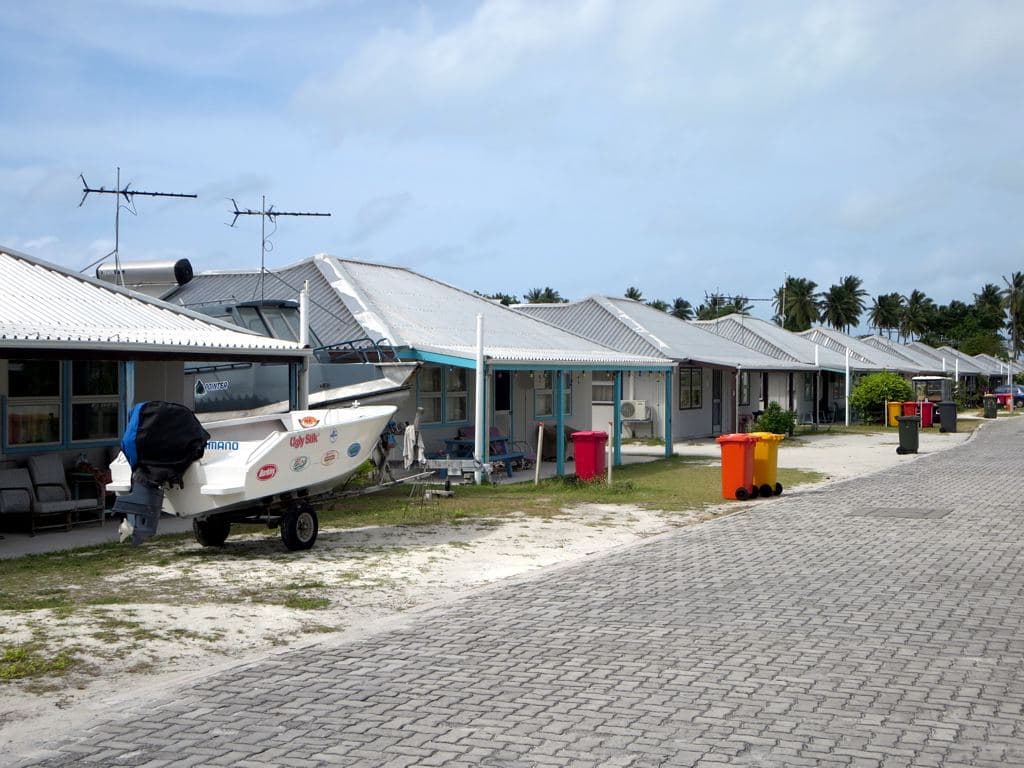
Home Island. Called Pulu Selma in Cocos Malay, Home Island is the Cocos Malay village and holds roughly five hundred of the territory's people. Houses run in low ranks along streets with names like Jalan Kembang Molok, jukong canoes rest on trailers in the yards, and the mosque, the school, the shire office and the museum sit within a few minutes' walk of one another. The Clunies-Ross family lived here too, in Oceania House, a brick residence completed in the 1890s from bricks carried out from Scotland as ballast, which still stands at the southern end of the island and is the most conspicuous survival of the estate years (Oceania House).
West Island. Across the lagoon, a ferry ride away, West Island holds the airport, the hospital, most government offices and a mainly non-Malay population of a hundred and fifty or so, largely public servants and contract staff posted from the mainland. The two islands share one shire council and one set of services while keeping distinct rhythms of life, language and religious observance, and much of Cocos administration consists of moving people, freight and decisions across the water between them (West Island).
Direction Island. Uninhabited now, Direction Island is where the submarine telegraph cables came ashore, and where the Emden's landing party was cutting the wires on the morning of 9 November 1914. A memorial and the remains of the cable station are still there.
The atolls were sighted in 1609 by William Keeling, a captain of the English East India Company, and stayed empty for another two centuries. In 1826 the English adventurer Alexander Hare arrived with a household of Malay servants and slaves; the following year John Clunies-Ross, a Shetland-born seafarer who had visited earlier with the intention of settling, brought his own family and workforce. Hare's establishment collapsed, his people transferred to Clunies-Ross, and the coconut plantation that would define the islands began.
What grew from it was unusual even by the standards of the nineteenth-century Indian Ocean. The Clunies-Ross family ran the islands as a private estate through five generations. Workers were recruited from across the Malay Archipelago, from Java, Sumatra, Bali and the peninsula, and from the Cape, and their descendants became a distinct people. Britain annexed the islands in 1857, and in 1886 Queen Victoria granted them in perpetuity to the Clunies-Ross family, whose head also held official standing as resident magistrate (Clunies-Ross family). Wages were paid in the Cocos rupee, a scrip the family issued in sheepskin, ivory and later plastic tokens, which had no value anywhere else on earth and could be spent only at the company store (Australia Post). Workers could not own land, could not leave without permission, and had no legal recourse against the estate. It is worth stating plainly what that adds up to: a closed labour system in which one family controlled work, housing, money, movement and law.
Two military episodes interrupted the arrangement. On 9 November 1914 the German cruiser SMS Emden put a landing party ashore on Direction Island to destroy the cable station; the operators got a signal away before the wires were cut, and HMAS Sydney arrived and drove the Emden aground on North Keeling. It was the first ship-to-ship victory by a vessel of the Royal Australian Navy, and the stranded landing party seized an old schooner and sailed away on an escape that eventually carried them to Ottoman territory (Battle of Cocos). In May 1942 a garrison of Ceylonese artillerymen mutinied on Horsburgh Island; three were executed, the only soldiers of the British Commonwealth put to death for mutiny during the Second World War (Cocos Islands Mutiny). Later in the war the RAF built an airstrip on West Island, and that runway is the reason the islands have air links today.
Sovereignty moved from Britain to Australia in 1955, but the estate continued. From the 1970s United Nations decolonisation committees visited and criticised the conditions on the islands in strong terms, and in 1978 the Australian government purchased the Clunies-Ross holdings for 6.25 million dollars under threat of compulsory acquisition, leaving the family only Oceania House and a small plot around it. Then came the vote. On 6 April 1984, in an Act of Self-Determination observed by a United Nations mission, the permanent residents chose among integration with Australia, free association and independence. Of 261 registered voters, 229 chose integration, and with it Australian citizenship, the federal franchise and access to the same services as any other Australian (ABC News). John Clunies-Ross, the fifth of the family to head the estate, had campaigned for independence and lost. The Australian government undertook at the same time to respect the community's religion, language and customs, a promise that has shaped every argument about the islands since.
The community speaks Cocos Malay, known to its speakers as Basa Pulu Kokos, "the language of the Cocos islands". Its base is a Malay variety close to the Betawi of Jakarta, carried out by the first workers and then held apart from the rest of the Malay world for a hundred and fifty years. What accumulated in that isolation is audible: words absorbed from the Scottish family who employed everyone, and from the shipping and store vocabulary of the estate. Speakers say esbok for an icebox, cimni for a chimney, kot for a coat, and jukong for the small sailing canoe that is the island's own craft (Cocos Malays). Standard Malay words survive in shapes standard Malay would not recognise. Cocos Malay is now taught alongside English in the Home Island school, and versions of it are also spoken by the several thousand descendants of Cocos families who were resettled in Sabah, in northern Borneo, in the 1950s.
The territory's names carry their own layers. Keeling comes from the East India Company captain who recorded the atolls in 1609, and Cocos from the coconut palms that covered them and paid for everything that happened afterwards; both names have been used for two centuries, and Australian usage keeps the compound form. Island names on the map are mostly Cocos Malay: Pulu Selma for Home Island, Pulu Panjang for West Island, Pulu Gangsa for the northern end of Home Island where the dead are buried.
Cocos Malay culture is an island version of a Malay Archipelago inheritance, kept by a group small enough that every practice depends on particular people. Boat building is the clearest example. The jukong, a slender timber sailing canoe developed on the atolls for lagoon work and fishing, is still built by hand from local and imported timber, and jukong races are held on the lagoon during the trade-wind season and after Ramadan, so that the craft survives as sport as well as transport (Culture of the Cocos (Keeling) Islands).
Performance keeps the same shape. The kuda kepang, a hobby-horse dance brought from Java in which dancers ride flat woven or hide horses to percussion, is performed at weddings and community celebrations, and its presence here is a direct thread back to the Javanese origins of part of the founding workforce. Music on the islands is largely Islamic devotional song alongside Malay social forms, and it has been studied as a distinct repertoire. Pandanus weaving, embroidery and the cooking of the atolls, heavy on fish, coconut and rice, complete a set of skills taught in households rather than institutions, and therefore vulnerable in a way that a museum collection is not.
The Cocos Malay community is Sunni Muslim, and Islam is the working religion of Home Island rather than a background affiliation. The mosque anchors the settlement, prayer times set the shape of the day, Friday observance is general, and the census figures give a plain measure of how far this extends: 389 of 593 people recorded Islam in 2021, with the non-Muslim minority concentrated on West Island.
Ramadan is the fixed point of the year. Fasting is widely kept, the evening meal draws households together, and Hari Raya Puasa, the festival that ends the month, is the largest event on the Cocos calendar, marked by visiting, food, new clothes, forgiveness asked and given between relatives, and by jukong racing in the days that follow. Hari Raya Haji is also observed. The undertaking Australia gave in 1984 to respect the community's religious practice is the reason Home Island keeps its own calendar of public observance and a degree of local control over how visitors move through the village.
Burial follows Muslim practice, and follows it on ground that is severely limited. The dead are washed, wrapped in white cloth and buried without a coffin, facing Mecca, within a day where that is possible, and the community's cemetery lies at Pulu Gangsa, at the northern end of Home Island, a low sandy strip among the palms where graves are marked with coral or timber headstones rather than monuments. On an atoll where the total land is a few square kilometres, where the water table sits close under the surface and where storm surge reaches further than it used to, a cemetery is a resource that has to be managed as carefully as fresh water. Older burial places elsewhere in the lagoon, including graves from the estate period, are known and remembered locally.
Mourning custom follows the Malay Muslim pattern. Prayers are said for the dead in the days after burial, commonly on the third, seventh, fortieth and hundredth days, with recitation of the Qur'an and a shared meal, and the household of the deceased is fed and visited by relatives throughout. Graves are visited before Ramadan and at Hari Raya, when families clean the plots at Pulu Gangsa and pray there, so that the festival which is the year's great gathering also brings the whole community back to its dead. Because almost everyone on Home Island is related to almost everyone else, a death is a matter for the settlement rather than for one family, and the ordinary work of remembrance is done in person.
The Cocos Islands were owned by one family for a century and a half, and the records are that family's.
Alexander Hare and then John Clunies-Ross settled the atolls in the 1820s, bringing workers from Java, Malacca, Sumatra, Bantam, Papua and elsewhere, some enslaved or indentured. Queen Victoria granted the islands to the Clunies-Ross family in perpetuity in 1886, and they ran them as a private estate: the workers were paid in Cocos rupees redeemable only at the company store, and could not leave without permission. The estate's records, and the Australian administrative files that followed, document that population, and they are held by the National Archives of Australia.
The Cocos Malay community that descends from those workers has its own genealogy, held within families, and speaks a distinct Malay creole.
Australia bought the islands in 1978 and compulsorily acquired the family's holdings in 1993. The United Nations supervised an act of self-determination in 1984, in which the Cocos Malays voted for integration with Australia.
The community's records since are Australian: civil registration, the school, the shire council.
The other Cocos archive is naval. The Emden was destroyed off Direction Island by HMAS Sydney in 1914, and the cable station on the atoll, part of the imperial telegraph network, kept its own operational records.
The main institution is the Pulu Cocos Museum on Home Island, also known as the Home Island Museum, established in 1987 in an 1880s plantation storage shed in explicit recognition that Cocos Malay culture needed formal keeping (Pulu Cocos Museum). Its holdings run from the machine used to press the Cocos rupee tokens and material from the Clunies-Ross estate to jukongs, domestic objects, and relics of the Emden action. It is staffed intermittently, and for much of the week visitors collect the key from the shire office, which is an honest measure of the scale involved.
Preservation elsewhere is a matter of law and landscape rather than buildings. Pulu Keeling National Park protects North Keeling and its seabird colonies, along with the wreck site of the Emden, and Oceania House, the cable station remains on Direction Island and the wartime infrastructure on West Island are recognised heritage places under Commonwealth listings. The harder work is intangible: language transmission, boat building, dance and burial practice all depend on a population of a few hundred, and every skill sits with a handful of practitioners. Oral history collection, school teaching of Cocos Malay and community-run events are the mechanisms in use, and their fragility is not a secret to anyone on Home Island.
For a territory this small, the internet does a disproportionate amount of the remembering. The Shire of Cocos (Keeling) Islands and the territory's tourism body publish community history, language notes and cultural material online, which puts a version of the Cocos Malay story in front of an audience far larger than the islands could ever host (Cocos Keeling Islands). Australian collecting institutions hold the documentary record: the National Archives keep the administrative files of the transfer, the buyout and the 1984 vote, the Australian War Memorial holds material from the Emden engagement and the wartime base, and Trove aggregates newspaper coverage running back to the nineteenth century.
Because the community is dispersed, with Cocos-descended families in Sabah and in Western Australia, social media carries much of the practical work of kinship, and recordings of religious song, weddings and jukong races circulate the same way. The gap in the digital record is the community's own voice in its own language: little Cocos Malay audio, oral history or written material is published in accessible form, and closing that gap is the most useful digital heritage project available to the islands.
Modern Cocos life sits between three worlds. It is legally Australian, with Australian schooling, health services, currency and elections. It is culturally Malay and religiously Muslim, with family links to Malaysia and Indonesia and a shared language with communities in Sabah. And it depends economically on a small tourism industry, on government employment and on air links to Perth, which makes the islands sensitive to decisions taken thousands of kilometres away.
The pressures are visible. A population of around six hundred cannot support secondary and tertiary education, so young people leave to study and some do not return, which thins the number of speakers and practitioners left behind. Defence interest in the territory's position has grown, and proposals to extend the West Island runway raise questions about scale and environmental limits that the community has to answer. Sea level rise and coastal erosion are not abstractions on land a few metres high. Against that, Cocos Malay identity has proved durable through a century and a half of estate rule and four decades of integration, and the shire, the mosque, the school and the museum are now run by its own people.
A community that chose its own status. The 1984 Act of Self-Determination, supervised by the United Nations, gave 261 registered voters a genuine choice among integration, free association and independence, and 229 chose integration with Australia. It ended a private jurisdiction that had lasted five generations.
A museum founded by the people it documents. The Pulu Cocos Museum opened in 1987, in a plantation-era shed, because the Home Island community judged that its own culture required formal preservation. It holds the press that struck the Cocos rupee in the place where that currency was spent.
A language still in use and still being taught. Cocos Malay survived a century and a half in which it had no official standing, and is now taught in the Home Island school alongside English, spoken at home by the clear majority of residents and shared with several thousand relatives in Sabah.
A boat that became a sport. The jukong, developed for lagoon fishing and transport, is still built by hand and raced in the trade-wind season and after Ramadan, which keeps a working craft alive as a public event rather than as a museum object.
National Overview
Notable Cities
Historical Foundations
Linguistic and Etymological Roots
Cultural Identity
Religion and Spirituality
Remembrance and Mourning Traditions
Tracing a Family in Cocos Keeling Islands
Heritage Preservation Efforts
Digital Heritage
Contemporary Cultural Influences
Success Stories
References and resources
- Encyclopaedia Britannica, Cocos Islands: geography, administration and the Clunies-Ross period.
- Australian Bureau of Statistics, 2021 Census QuickStats: population, religion and language at home.
- Clunies-Ross family, Wikipedia: five generations, the 1886 grant and the 1978 purchase.
- ABC News, Cocos Islanders changed their destiny: the 6 April 1984 vote and its result.
- 1984 status referendum, Wikipedia: registered voters, the United Nations mission and the outcome.
- ABC News, forty years of struggling to be heard: the community's assessment of integration.
- Australia Post Collectables, Currency of the Clunies-Ross Era: the Cocos rupee and the company store.
- Cocos Malays, Wikipedia: origins, Cocos Malay vocabulary and the Sabah diaspora.
- Culture of the Cocos (Keeling) Islands, Wikipedia: jukong building and racing, dance and community practice.
- Pulu Cocos Museum, Wikipedia: the 1987 founding, the 1880s shed and the collection.
- Battle of Cocos, Wikipedia: the Emden, HMAS Sydney and the cable station, 9 November 1914.
- Cocos Islands Mutiny, Wikipedia: the 1942 garrison mutiny and its consequences.
- Parks Australia, Pulu Keeling National Park: North Keeling, its seabirds and the protected wreck site.
- Cocos Keeling Islands, History, Culture and Language: community-facing account of Cocos Malay heritage.
- Shire of Cocos (Keeling) Islands: local government, services and community notices.