Heritage · Country
Brunei Culture and Heritage
For two centuries the sultans of Brunei ruled a sea empire that reached across Borneo and into the Philippines, and the memory of that age still shapes the abode of peace. From the thousand-year-old water village of Kampong Ayer to the gold-threaded jong sarat and the graded rites of Malay Muslim mourning, this is a guide to how one small sultanate keeps its heritage alive.Written to last.
By Confinity Heritage Editorial · Updated 2026-07-31 · 8-minute readQuiet tools, kept out of the way.
Brunei Darussalam, the "abode of peace," is a small state on the northern coast of Borneo whose modern quiet belies the reach it once commanded. For roughly two centuries, from the fifteenth into the seventeenth, the sultans of Brunei governed a maritime realm that touched most of the island and extended north into what is now the Philippines, controlling the flow of camphor, pepper, pearls and precious woods that moved through the South China Sea. Today the country occupies only a fraction of that former sphere, folded into two pieces of land on Borneo's coast, yet the memory of the golden age remains central to how Bruneians understand themselves. Heritage here is not a matter of ruins; it is carried in a living monarchy, a national philosophy and the daily rhythms of a Muslim Malay society.
That inheritance is unusually continuous. Kampong Ayer, the water village where people have lived on stilts above the Brunei River for more than a thousand years, is still inhabited and still a working part of the capital. The great mosques raised by the twentieth-century sultans anchor the skyline, the regalia of the court is preserved with care, and when a Bruneian dies the family follows Islamic funerary rites and Malay customs that draw the whole community into grief.
Brunei occupies about 5,765 square kilometres on the northwest coast of Borneo. It is bordered on every landward side by the Malaysian state of Sarawak, which also splits the country in two: the district of Temburong lies detached in the east, cut off by the Limbang valley that Sarawak annexed in 1890. The nation is divided into four districts, Brunei-Muara, Belait, Tutong and Temburong, and its population is a little over 450,000. The majority are Malay, alongside a long-established Chinese community and several indigenous peoples, among them the Kedayan, Tutong, Belait, Dusun, Bisaya and Murut, according to Encyclopaedia Britannica.
The country is a sultanate. Sultan Hassanal Bolkiah, the twenty-ninth of his line, has been head of state since 1967 and is among the longest-reigning living monarchs. Islam is the official religion, and the national philosophy of the Malay Islamic Monarchy binds faith, Malay custom and the crown into a single framework. The wealth of the modern state comes from oil and natural gas, discovered in the west in the twentieth century, which fund free education and healthcare and a largely tax-free economy. Since 2020 the Temburong Bridge has joined the two halves of the country directly.
Bandar Seri Begawan. The capital and only city of real size, Bandar Seri Begawan sits at the mouth of the Brunei River, wrapped around Kampong Ayer. Known simply as Brunei Town until 1970, it was renamed in honour of Sultan Omar Ali Saifuddien III, who had taken the title Seri Begawan after his abdication. The city holds the country's central landmarks: the Sultan Omar Ali Saifuddien and Jame' Asr Hassanil Bolkiah mosques, the Royal Regalia Museum and the Lapau, the gilded hall used for royal ceremonies.
 Kampong Ayer has been lived in for a thousand years and still houses thousands of people on the water, with its own schools, mosques and fire service. Photograph by Mstyslav Chernov, CC BY-SA 3.0, via Wikimedia Commons.
Kuala Belait. The main town of the Belait District in the far west, near the Sarawak border, Kuala Belait grew into the commercial centre of the oil belt in the twentieth century and remains the country's second town, the administrative anchor of its energy heartland.
Seria. A short distance along the coast, Seria is the birthplace of Brunei's modern fortunes: commercial oil was first struck here in 1929, and the town is still shaped by the industry. The Billionth Barrel Monument on its foreshore marks the volume drawn from the fields.
Tutong. The capital of the Tutong District lies on the Tutong River between the coast and the interior. It is one of the most ethnically mixed parts of the country, home to Tutong, Dusun and Kedayan communities, and it opens onto Tasek Merimbun, Brunei's largest natural lake and the first site ever designated an ASEAN Heritage Park.
Brunei began as a trading polity on the Borneo coast. Chinese records from the Song dynasty note a place called Boni or Puni that sent tribute and traded with the imperial court, and by the tenth century a settlement at the Brunei River estuary was already part of the commerce that linked China to the wider archipelago. The decisive turn came around 1400, when the ruler remembered as Awang Alak Betatar embraced Islam, took the name Sultan Muhammad Shah and founded the sultanate, drawing Brunei into the network of Muslim maritime trade, as Britannica records.
The golden age followed in the fifteenth to seventeenth centuries. Under the fifth sultan, Bolkiah, who reigned in the decades around 1485 to 1524, Brunei reached the height of its power, its authority extending along the coasts of Borneo, across the Sulu archipelago and north into Luzon, where Bolkiah is linked to the founding of a Muslim settlement at Manila. When Antonio Pigafetta, chronicler of Magellan's expedition, reached the capital in 1521, he described a wealthy court and a settlement built out over the water.
From the seventeenth century the empire contracted. Civil disputes, the arrival of European powers and the rise of rival states eroded Brunei's reach, and the nineteenth century brought heavy territorial losses. In 1841 the English adventurer James Brooke was installed as Rajah of Sarawak, and he and his successors, the White Rajahs, steadily absorbed Bruneian lands; the Brooke annexation of Limbang in 1890 divided the country into the two parts it retains today. To halt the process, Brunei accepted British protection in 1888 and a British Resident in 1906, whose advice the sultan was bound to follow except in matters of Malay custom and Islam, as Facts and Details records.
The discovery of commercial oil at Seria in 1929 by the British Malayan Petroleum Company, a forerunner of Brunei Shell, reversed the sultanate's long decline. A written constitution in 1959 restored internal self-government, and after decades as a protected state Brunei resumed full sovereignty on 1 January 1984, when Sultan Hassanal Bolkiah proclaimed the Malay Islamic Monarchy as the guiding philosophy of the independent nation.
Malay is the official language, used in government, education and public life, and written in both the Latin script (Rumi) and the Arabic-derived Jawi script that carries the country's older written heritage. English is widely used in commerce, law and higher education, a legacy of the protectorate era. In daily conversation most Bruneians speak Brunei Malay, a distinct colloquial variety, while indigenous communities keep their own tongues, among them Kedayan, Tutong, Belait, Dusun, Bisaya and Murut.
The country's name reaches back into legend and beyond it. Popular tradition holds that Awang Alak Betatar, arriving at the river estuary, exclaimed "Baru nah," roughly "that is it," and that the name Brunei grew from the phrase. Scholars trace it further, to the Sanskrit "varuna" or "varunai," meaning seafarers or lords of the sea, a fitting root for a maritime trading power, as the ASEAN Secretariat has noted. The second half of the full name, Negara Brunei Darussalam, joins the Malay word for country with the Arabic "dar al-salam," the abode of peace, a phrase that expresses the Islamic ideal at the heart of the modern state.
At the centre of Bruneian identity is Kampong Ayer, the water village that Pigafetta's account helped make famous as the "Venice of the East." People have lived above the Brunei River here for more than a thousand years, and it was the social and economic core of the empire. It remains a living settlement of thousands, its homes, mosques, schools and shops raised on stilts and linked by boardwalks and by the water taxis, the penambang, that ferry residents across the river, as Wikipedia records.
The court preserves a ceremonial culture of great formality. Its regalia includes the crown, the state weapons and the royal chariot, the usungan, carried in procession at coronations and jubilees. Craft traditions carry the same refinement into cloth and metal. Kain tenunan is the brocade woven on hand looms with gold and silver thread through fine cotton or silk; its most prized pattern, the jong sarat, is worn at weddings and state occasions, one of five designs grouped under the full-flower arrangement described by the Encyclopedia of Crafts in the Asia Pacific Region. Alongside weaving sits a long tradition of brass and silver work, from ceremonial cannons and gongs to the betel containers that once served as dowry and currency. The national cuisine centres on ambuyat, a glutinous sago-palm starch eaten with a two-pronged bamboo fork, dipped in a sour sauce called cacah and shared communally as a gesture of togetherness.
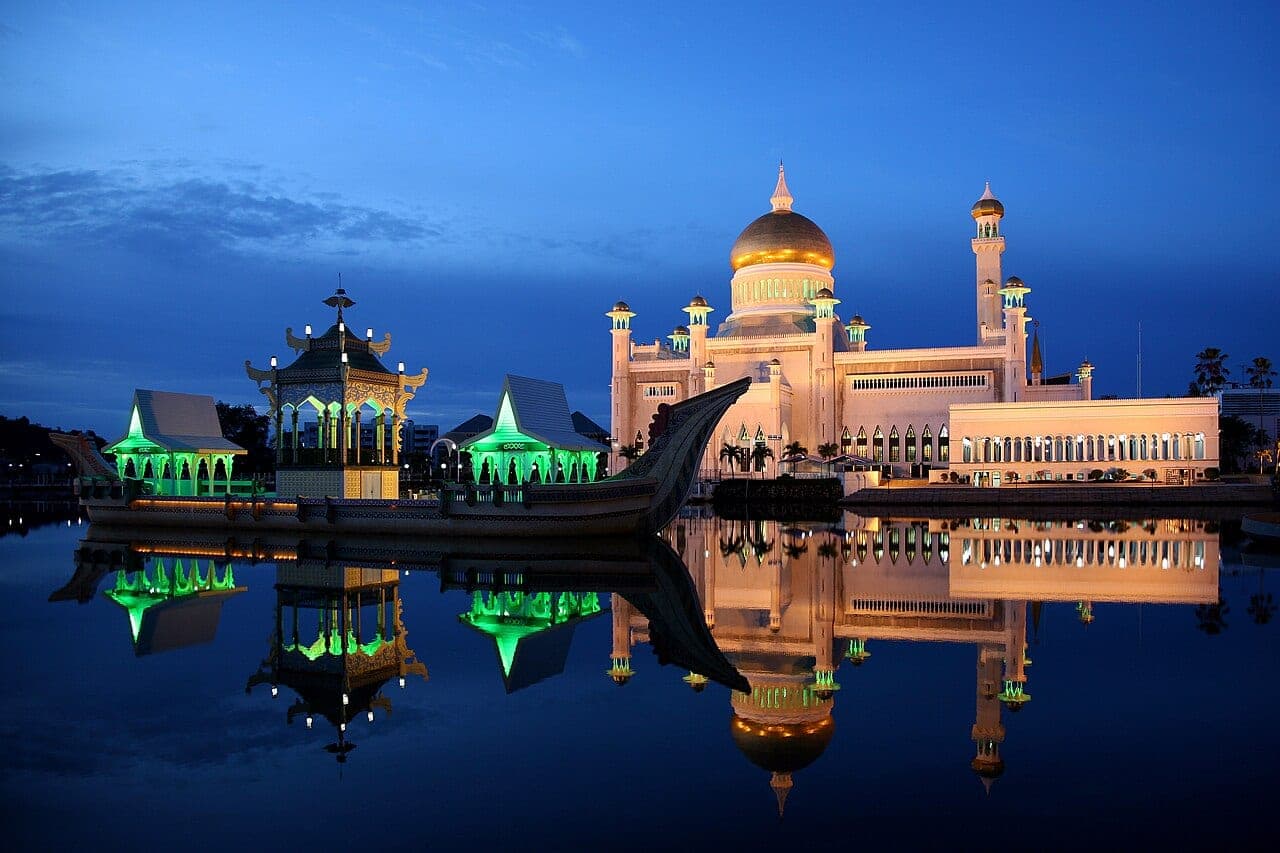
Islam is the state religion of Brunei, followed in the Sunni tradition of the Shafi'i school, and the sultan is its guardian. The faith shapes public life in a way few states match: the call to prayer marks the day, Friday is set aside for congregational worship, and the fasting month of Ramadan and the two festivals of Eid structure the year. The two national mosques give the faith monumental form. The Sultan Omar Ali Saifuddien Mosque, completed between 1954 and 1958 and named for the twenty-eighth sultan, rises beside a ceremonial lagoon in the capital, its dome sheathed in gold. The larger Jame' Asr Hassanil Bolkiah Mosque, inaugurated in 1994 to mark the current sultan's silver jubilee, carries the country's most numerous minarets and domes.
Binding faith, culture and crown together is the philosophy of Melayu Islam Beraja, the Malay Islamic Monarchy, proclaimed on the day of independence in 1984. It rests on three elements: Melayu, the Malay language, custom and way of life; Islam, the guiding faith of the Quran and the Hadith; and Beraja, the institution of the monarchy as the unifying authority. Other faiths are practised by minority communities, including Buddhism among many of the Chinese, Christianity, and older indigenous beliefs in the interior, while the philosophy frames the Malay Muslim majority as the foundation of national identity.
When a Bruneian Muslim dies, the community follows the Islamic rites shared across the Malay world, carried out with speed and care. The body is washed, the ritual cleansing known as memandikan performed by close family of the same sex, then wrapped in a plain white shroud, the kafan, scented with camphor and fragrant wood. A congregation gathers for the funeral prayer, the solat jenazah, led by an imam facing the qiblah, the direction of Mecca. Burial follows as soon as possible, ideally within the day, the body laid without a coffin on its right side and turned toward Mecca, as practices documented across the region describe.
Mourning is a communal act. Neighbours and relatives gather at the family home to offer condolences and practical help, in the spirit of shared labour that Malays call gotong-royong, so that the bereaved are never left to grieve alone. In the days that follow, the family holds the tahlil and doa arwah, gatherings for the recitation of Quranic verses and supplications for the soul of the departed, traditionally marked on the third, seventh, fortieth and hundredth days after death and often closed with a shared meal. Families return to the grave to pray, to clean the site and to sprinkle water and scatter fragrant flowers, a visitation known as ziarah kubur. In these graded returns, Bruneian remembrance takes a shape a platform like Confinity recognises: memory kept alive not in a single farewell but in a rhythm of gatherings that hold a life in the community's keeping long after the burial.
Brunei's records are Islamic, royal and, from the twentieth century, corporate.
The sultanate is one of the oldest continuously reigning houses in the world, and the court kept genealogies, the salsilah, tracing the ruling line and the noble families attached to it. Those, and the Batu Tarsilah, the inscribed genealogical stone recording the sultans, are the deep record. Sharia court registers of marriage, divorce and inheritance are the practical one, because Islamic inheritance requires naming the heirs precisely.
British influence from the treaty of 1888 and the Residency from 1906 produced an administrative archive, much of it now in London as well as Bandar Seri Begawan, and the Brunei Museums Department and the national archives hold the domestic series.
Oil changed the paperwork. The Seria field came in in 1929 and the company that worked it kept detailed employment records covering a large share of the working population, along with the housing and medical files that went with a company town.
The Kedayan, Tutong, Belait, Dusun and Murut communities, and the Iban across the Sarawak border, keep their own oral genealogies, and for those families the longhouse and the village are where the record is rather than any office. The 1962 revolt and the political detentions that followed left files that have not been fully opened, so recent Bruneian family history has a period that is documented but not accessible.
Much of Brunei's preservation work is directed at keeping its living heritage living. Kampong Ayer, for all its antiquity, is treated as an inhabited community rather than a relic, and its Cultural and Tourism Gallery documents centuries of history while the village itself continues to function. The nation's museums hold the tangible record: the Royal Regalia Museum, opened in 1992 for the sultan's silver jubilee, keeps the crown, the ceremonial weapons and the golden chariot of the court, as its Wikipedia entry describes, while the Brunei Museum and the Malay Technology Museum preserve the wider material culture.
Natural heritage is guarded with equal seriousness. Ulu Temburong National Park, protected since 1991 and reached only by longboat, preserves an expanse of unbroken lowland rainforest known as the green jewel of Brunei, where a canopy walkway lifts visitors into the treetops. In the Tutong District, Tasek Merimbun was designated the first ASEAN Heritage Park in 1984 and shelters rare species including the clouded leopard, the Bornean gibbon and a range of hornbills, according to the ASEAN Centre for Biodiversity. The Brunei History Centre and the Language and Literature Bureau sustain the documentary and linguistic side of this work.
For a heritage carried in Jawi manuscripts, oral memory and craft, digitisation has become a quiet form of insurance. The Language and Literature Bureau and the Brunei History Centre work to record and publish the country's written and genealogical heritage, and museum and tourism bodies maintain online catalogues and virtual introductions to landmarks such as Kampong Ayer and the Royal Regalia Museum. The official Brunei Tourism portal gathers the sites and stories of the four districts in one place, extending their reach to a diaspora and a wider public who cannot easily travel to see them. Each festival season, images of weaving, of the mosques and of court ceremony circulate through social media, an informal archive kept by Bruneians themselves.
Modern Bruneian culture moves between tradition and the region around it. Designers reinterpret the jong sarat and other tenunan patterns for contemporary dress, while cooks and food writers have carried ambuyat and the wider Bruneian table to a broader audience. The calendar still turns on royal and religious occasions, above all the sultan's birthday, which draws the whole population into public celebration. Through ASEAN and the cross-border BIMP-EAGA growth area, Brunei sits within a web of regional exchange, and its artists increasingly document and share their heritage online, presenting the culture of the abode of peace on its own terms.
A divided country rejoined. The Sultan Haji Omar Ali Saifuddien Bridge, opened in 2020 and running some thirty kilometres across Brunei Bay, is the longest bridge in Southeast Asia and connects the Temburong exclave directly to the rest of the nation, turning a journey once broken by two border crossings into a domestic drive, as regional coverage reported.
The first heritage park in the region. Tasek Merimbun in Tutong was named the very first ASEAN Heritage Park in 1984, a founding act in Southeast Asia's shared effort to protect its landscapes, and it remains the country's largest wildlife sanctuary.
The green jewel kept whole. Ulu Temburong National Park has preserved its rainforest intact since 1991, with access deliberately limited to longboat and canopy walkway so that research and low-impact visits coexist with an untouched interior.
A thousand-year village still alive. Kampong Ayer endures as an inhabited settlement rather than a museum piece, its cultural gallery telling the story of the empire's old capital while boardwalks, schools and mosques keep it a working part of Bandar Seri Begawan.
The loom kept turning. Through training at bodies such as the Brunei Arts and Handicraft Training Centre, the demanding art of kain tenunan and its jong sarat brocade has passed to new weavers, keeping a court craft in everyday use at weddings and ceremonies.
Kampong Ayer has been lived in for a thousand years and still houses thousands of people on the water, with its own schools, mosques and fire service. Photograph by Mstyslav Chernov, CC BY-SA 3.0, via Wikimedia Commons.
Kuala Belait. The main town of the Belait District in the far west, near the Sarawak border, Kuala Belait grew into the commercial centre of the oil belt in the twentieth century and remains the country's second town, the administrative anchor of its energy heartland.
Seria. A short distance along the coast, Seria is the birthplace of Brunei's modern fortunes: commercial oil was first struck here in 1929, and the town is still shaped by the industry. The Billionth Barrel Monument on its foreshore marks the volume drawn from the fields.
Tutong. The capital of the Tutong District lies on the Tutong River between the coast and the interior. It is one of the most ethnically mixed parts of the country, home to Tutong, Dusun and Kedayan communities, and it opens onto Tasek Merimbun, Brunei's largest natural lake and the first site ever designated an ASEAN Heritage Park.
Brunei began as a trading polity on the Borneo coast. Chinese records from the Song dynasty note a place called Boni or Puni that sent tribute and traded with the imperial court, and by the tenth century a settlement at the Brunei River estuary was already part of the commerce that linked China to the wider archipelago. The decisive turn came around 1400, when the ruler remembered as Awang Alak Betatar embraced Islam, took the name Sultan Muhammad Shah and founded the sultanate, drawing Brunei into the network of Muslim maritime trade, as Britannica records.
The golden age followed in the fifteenth to seventeenth centuries. Under the fifth sultan, Bolkiah, who reigned in the decades around 1485 to 1524, Brunei reached the height of its power, its authority extending along the coasts of Borneo, across the Sulu archipelago and north into Luzon, where Bolkiah is linked to the founding of a Muslim settlement at Manila. When Antonio Pigafetta, chronicler of Magellan's expedition, reached the capital in 1521, he described a wealthy court and a settlement built out over the water.
From the seventeenth century the empire contracted. Civil disputes, the arrival of European powers and the rise of rival states eroded Brunei's reach, and the nineteenth century brought heavy territorial losses. In 1841 the English adventurer James Brooke was installed as Rajah of Sarawak, and he and his successors, the White Rajahs, steadily absorbed Bruneian lands; the Brooke annexation of Limbang in 1890 divided the country into the two parts it retains today. To halt the process, Brunei accepted British protection in 1888 and a British Resident in 1906, whose advice the sultan was bound to follow except in matters of Malay custom and Islam, as Facts and Details records.
The discovery of commercial oil at Seria in 1929 by the British Malayan Petroleum Company, a forerunner of Brunei Shell, reversed the sultanate's long decline. A written constitution in 1959 restored internal self-government, and after decades as a protected state Brunei resumed full sovereignty on 1 January 1984, when Sultan Hassanal Bolkiah proclaimed the Malay Islamic Monarchy as the guiding philosophy of the independent nation.
Malay is the official language, used in government, education and public life, and written in both the Latin script (Rumi) and the Arabic-derived Jawi script that carries the country's older written heritage. English is widely used in commerce, law and higher education, a legacy of the protectorate era. In daily conversation most Bruneians speak Brunei Malay, a distinct colloquial variety, while indigenous communities keep their own tongues, among them Kedayan, Tutong, Belait, Dusun, Bisaya and Murut.
The country's name reaches back into legend and beyond it. Popular tradition holds that Awang Alak Betatar, arriving at the river estuary, exclaimed "Baru nah," roughly "that is it," and that the name Brunei grew from the phrase. Scholars trace it further, to the Sanskrit "varuna" or "varunai," meaning seafarers or lords of the sea, a fitting root for a maritime trading power, as the ASEAN Secretariat has noted. The second half of the full name, Negara Brunei Darussalam, joins the Malay word for country with the Arabic "dar al-salam," the abode of peace, a phrase that expresses the Islamic ideal at the heart of the modern state.
At the centre of Bruneian identity is Kampong Ayer, the water village that Pigafetta's account helped make famous as the "Venice of the East." People have lived above the Brunei River here for more than a thousand years, and it was the social and economic core of the empire. It remains a living settlement of thousands, its homes, mosques, schools and shops raised on stilts and linked by boardwalks and by the water taxis, the penambang, that ferry residents across the river, as Wikipedia records.
The court preserves a ceremonial culture of great formality. Its regalia includes the crown, the state weapons and the royal chariot, the usungan, carried in procession at coronations and jubilees. Craft traditions carry the same refinement into cloth and metal. Kain tenunan is the brocade woven on hand looms with gold and silver thread through fine cotton or silk; its most prized pattern, the jong sarat, is worn at weddings and state occasions, one of five designs grouped under the full-flower arrangement described by the Encyclopedia of Crafts in the Asia Pacific Region. Alongside weaving sits a long tradition of brass and silver work, from ceremonial cannons and gongs to the betel containers that once served as dowry and currency. The national cuisine centres on ambuyat, a glutinous sago-palm starch eaten with a two-pronged bamboo fork, dipped in a sour sauce called cacah and shared communally as a gesture of togetherness.
Islam is the state religion of Brunei, followed in the Sunni tradition of the Shafi'i school, and the sultan is its guardian. The faith shapes public life in a way few states match: the call to prayer marks the day, Friday is set aside for congregational worship, and the fasting month of Ramadan and the two festivals of Eid structure the year. The two national mosques give the faith monumental form. The Sultan Omar Ali Saifuddien Mosque, completed between 1954 and 1958 and named for the twenty-eighth sultan, rises beside a ceremonial lagoon in the capital, its dome sheathed in gold. The larger Jame' Asr Hassanil Bolkiah Mosque, inaugurated in 1994 to mark the current sultan's silver jubilee, carries the country's most numerous minarets and domes.
Binding faith, culture and crown together is the philosophy of Melayu Islam Beraja, the Malay Islamic Monarchy, proclaimed on the day of independence in 1984. It rests on three elements: Melayu, the Malay language, custom and way of life; Islam, the guiding faith of the Quran and the Hadith; and Beraja, the institution of the monarchy as the unifying authority. Other faiths are practised by minority communities, including Buddhism among many of the Chinese, Christianity, and older indigenous beliefs in the interior, while the philosophy frames the Malay Muslim majority as the foundation of national identity.
When a Bruneian Muslim dies, the community follows the Islamic rites shared across the Malay world, carried out with speed and care. The body is washed, the ritual cleansing known as memandikan performed by close family of the same sex, then wrapped in a plain white shroud, the kafan, scented with camphor and fragrant wood. A congregation gathers for the funeral prayer, the solat jenazah, led by an imam facing the qiblah, the direction of Mecca. Burial follows as soon as possible, ideally within the day, the body laid without a coffin on its right side and turned toward Mecca, as practices documented across the region describe.
Mourning is a communal act. Neighbours and relatives gather at the family home to offer condolences and practical help, in the spirit of shared labour that Malays call gotong-royong, so that the bereaved are never left to grieve alone. In the days that follow, the family holds the tahlil and doa arwah, gatherings for the recitation of Quranic verses and supplications for the soul of the departed, traditionally marked on the third, seventh, fortieth and hundredth days after death and often closed with a shared meal. Families return to the grave to pray, to clean the site and to sprinkle water and scatter fragrant flowers, a visitation known as ziarah kubur. In these graded returns, Bruneian remembrance takes a shape a platform like Confinity recognises: memory kept alive not in a single farewell but in a rhythm of gatherings that hold a life in the community's keeping long after the burial.
Brunei's records are Islamic, royal and, from the twentieth century, corporate.
The sultanate is one of the oldest continuously reigning houses in the world, and the court kept genealogies, the salsilah, tracing the ruling line and the noble families attached to it. Those, and the Batu Tarsilah, the inscribed genealogical stone recording the sultans, are the deep record. Sharia court registers of marriage, divorce and inheritance are the practical one, because Islamic inheritance requires naming the heirs precisely.
British influence from the treaty of 1888 and the Residency from 1906 produced an administrative archive, much of it now in London as well as Bandar Seri Begawan, and the Brunei Museums Department and the national archives hold the domestic series.
Oil changed the paperwork. The Seria field came in in 1929 and the company that worked it kept detailed employment records covering a large share of the working population, along with the housing and medical files that went with a company town.
The Kedayan, Tutong, Belait, Dusun and Murut communities, and the Iban across the Sarawak border, keep their own oral genealogies, and for those families the longhouse and the village are where the record is rather than any office. The 1962 revolt and the political detentions that followed left files that have not been fully opened, so recent Bruneian family history has a period that is documented but not accessible.
Much of Brunei's preservation work is directed at keeping its living heritage living. Kampong Ayer, for all its antiquity, is treated as an inhabited community rather than a relic, and its Cultural and Tourism Gallery documents centuries of history while the village itself continues to function. The nation's museums hold the tangible record: the Royal Regalia Museum, opened in 1992 for the sultan's silver jubilee, keeps the crown, the ceremonial weapons and the golden chariot of the court, as its Wikipedia entry describes, while the Brunei Museum and the Malay Technology Museum preserve the wider material culture.
Natural heritage is guarded with equal seriousness. Ulu Temburong National Park, protected since 1991 and reached only by longboat, preserves an expanse of unbroken lowland rainforest known as the green jewel of Brunei, where a canopy walkway lifts visitors into the treetops. In the Tutong District, Tasek Merimbun was designated the first ASEAN Heritage Park in 1984 and shelters rare species including the clouded leopard, the Bornean gibbon and a range of hornbills, according to the ASEAN Centre for Biodiversity. The Brunei History Centre and the Language and Literature Bureau sustain the documentary and linguistic side of this work.
For a heritage carried in Jawi manuscripts, oral memory and craft, digitisation has become a quiet form of insurance. The Language and Literature Bureau and the Brunei History Centre work to record and publish the country's written and genealogical heritage, and museum and tourism bodies maintain online catalogues and virtual introductions to landmarks such as Kampong Ayer and the Royal Regalia Museum. The official Brunei Tourism portal gathers the sites and stories of the four districts in one place, extending their reach to a diaspora and a wider public who cannot easily travel to see them. Each festival season, images of weaving, of the mosques and of court ceremony circulate through social media, an informal archive kept by Bruneians themselves.
Modern Bruneian culture moves between tradition and the region around it. Designers reinterpret the jong sarat and other tenunan patterns for contemporary dress, while cooks and food writers have carried ambuyat and the wider Bruneian table to a broader audience. The calendar still turns on royal and religious occasions, above all the sultan's birthday, which draws the whole population into public celebration. Through ASEAN and the cross-border BIMP-EAGA growth area, Brunei sits within a web of regional exchange, and its artists increasingly document and share their heritage online, presenting the culture of the abode of peace on its own terms.
A divided country rejoined. The Sultan Haji Omar Ali Saifuddien Bridge, opened in 2020 and running some thirty kilometres across Brunei Bay, is the longest bridge in Southeast Asia and connects the Temburong exclave directly to the rest of the nation, turning a journey once broken by two border crossings into a domestic drive, as regional coverage reported.
The first heritage park in the region. Tasek Merimbun in Tutong was named the very first ASEAN Heritage Park in 1984, a founding act in Southeast Asia's shared effort to protect its landscapes, and it remains the country's largest wildlife sanctuary.
The green jewel kept whole. Ulu Temburong National Park has preserved its rainforest intact since 1991, with access deliberately limited to longboat and canopy walkway so that research and low-impact visits coexist with an untouched interior.
A thousand-year village still alive. Kampong Ayer endures as an inhabited settlement rather than a museum piece, its cultural gallery telling the story of the empire's old capital while boardwalks, schools and mosques keep it a working part of Bandar Seri Begawan.
The loom kept turning. Through training at bodies such as the Brunei Arts and Handicraft Training Centre, the demanding art of kain tenunan and its jong sarat brocade has passed to new weavers, keeping a court craft in everyday use at weddings and ceremonies.
National Overview
Notable Cities
Historical Foundations
Linguistic and Etymological Roots
Cultural Identity
Religion and Spirituality
Remembrance and Mourning Traditions
Tracing a Family in Brunei
Heritage Preservation Efforts
Digital Heritage
Contemporary Cultural Influences
Success Stories
References and resources
- Encyclopaedia Britannica, Brunei. Geography, history, society and the founding of the sultanate.
- Wikipedia, Kampong Ayer. The history and present life of the water village.
- Wikipedia, Bolkiah. The golden-age sultan and the empire's height.
- Wikipedia, Omar Ali Saifuddien Mosque. The 1954 to 1958 national mosque and its design.
- Wikipedia, Melayu Islam Beraja. The Malay Islamic Monarchy national philosophy.
- Wikipedia, Royal Regalia Museum. The court regalia, chariot and ceremonial collections.
- Wikipedia, Ulu Temburong National Park. The protected lowland rainforest of Temburong.
- ASEAN Centre for Biodiversity, Tasek Merimbun Heritage Park. The first ASEAN Heritage Park and its wildlife.
- Encyclopedia of Crafts in the Asia Pacific Region, Kain Tenunan Brunei. The weaving tradition and the jong sarat design.
- Facts and Details, History of oil and natural gas in Brunei. The protectorate, the Seria discovery and the modern economy.
- Brunei Tourism official site. Landmarks, districts and cultural heritage of the abode of peace.