Heritage · Country
Singapore Culture and Heritage
A city that rebuilt itself within a single lifetime, Singapore holds four cultures, four faiths and four languages on one small island. This is a guide to its migrant quarters, its layered histories, and the many ways its communities remember their dead.Written to last.
By Confinity Heritage Editorial · Updated 2026-07-31 · 8-minute readQuiet tools, kept out of the way.
Few places have changed as completely, or as quickly, as Singapore. Within living memory it turned from a colonial port of warehouses and shophouses into a dense modern city of glass towers and reclaimed shoreline, and that speed has made remembering a deliberate act. Much of the old island now lies beneath expressways and housing estates; what survives does so because someone chose to keep it, from the shophouses of Chinatown to the graves of migrant pioneers on a wooded hill at the island's centre.
Singapore is also one of the most plural societies on earth, a meeting of Chinese, Malay, Indian and Eurasian communities, each with its own language, faith and way of mourning, on a single small island. The Malay world named the place first, British trade remade it in 1819, and a hard war and a harder separation shaped the republic that followed. To walk from the Sultan Mosque in Kampong Glam to the Sri Mariamman Temple in Chinatown is to read a region's history compressed into a few kilometres.
Singapore is a city-state at the southern tip of the Malay Peninsula, a single main island ringed by some sixty islets where the Strait of Malacca meets the South China Sea. It is small even among small countries: about 734 square kilometres, much of it added by land reclamation, and home to roughly 5.9 million people, among the most densely settled places anywhere.
The population is the country's defining feature. Official policy organises it around four groups, abbreviated CMIO: Chinese, about three-quarters of residents; Malays, roughly one in eight; Indians, about one in eleven; and a smaller category of Eurasians and others. The republic is a parliamentary democracy governed by the People's Action Party since self-government in 1959, and in six decades it has grown into a high-income financial centre and one of the busiest container ports in the world.
Singapore is a single city, so its cities are really the historic quarters into which the colonial authorities divided it. The 1822 town plan drawn up under Raffles gave each community its own ground, and those divisions still shape the centre.
Chinatown. South of the Singapore River, the original Chinese quarter is a dense grid of restored shophouses with ornamental tilework and covered five-foot-ways. It holds the Sri Mariamman Temple, the oldest Hindu temple in the country, the Thian Hock Keng temple built by Hokkien seafarers in thanks for a safe crossing, and the modern Buddha Tooth Relic Temple.
Kampong Glam. The old Malay and Arab quarter takes its name from the gelam tree and centres on the golden-domed Sultan Mosque, first raised in the 1820s for Sultan Hussein Shah and rebuilt in its present form a century later. The former royal palace, the Istana Kampong Gelam, now houses the Malay Heritage Centre, and the lanes off Arab Street keep its old textile and perfume trades.
Little India. Along Serangoon Road, the Indian quarter grew around cattle yards, brick kilns and Tamil labour. Its Sri Veeramakaliamman Temple, garland stalls, spice shops and annual Deepavali lights make it the heart of Tamil and wider South Asian life.
The civic district and the river. The colonial core around the Padang keeps the government buildings, St Andrew's Cathedral and the national museums, while Boat Quay and the Singapore River, once lined with warehouses, mark where the modern town began. Eastward, Katong and Joo Chiat preserve the terraces and cooking of the Peranakans.
The island's recorded life begins long before the British. In the fourteenth century a trading settlement stood here as Temasek, a Malay name usually read as "sea town", and the Malay Annals tell of a Palembang prince, Sang Nila Utama, who landed around 1299, saw a beast he took for a lion, and named his city Singapura, from the Sanskrit singa, lion, and pura, city. No lions have lived in the region, and the animal was most likely a tiger, but the name endured. The settlement passed through the Malacca and Johor sultanates before dwindling to a fishing community by the eighteenth century.
Modern Singapore dates from January 1819, when Sir Stamford Raffles of the British East India Company signed a treaty with the local Temenggong and with Sultan Hussein Shah of Johor for the right to establish a trading post. Raffles saw that the island lay roughly halfway between India and China on the Strait of Malacca, and declared it a free port open to ships of every nation (National Library Board). Migrants arrived at once, from southern China and India, the Malay archipelago and the Arab and Armenian trading networks, and by 1826 Singapore had joined Penang and Malacca as the Straits Settlements. It became a British crown colony in 1867.
The Second World War broke that order. On 15 February 1942 the British garrison surrendered to the Japanese army, and the island was renamed Syonan-to, "light of the south". The occupation that followed, from 1942 to 1945, was severe. In its first weeks the Japanese military carried out Sook Ching, a purge of the Chinese population in which men, chiefly those aged between eighteen and fifty, were summoned to screening centres and those judged hostile were taken away and killed; historians estimate the dead at between 25,000 and 50,000, far above the number the occupiers acknowledged (National Library Board). The Civilian War Memorial, with its four pillars for the island's four communities, marks these dead. Liberation came in September 1945.
Independence came in stages. Singapore won internal self-government in 1959, with Lee Kuan Yew as its first prime minister, and in September 1963 joined the new Federation of Malaysia. The union was uneasy, strained by disputes over taxation and by the place of a Chinese-majority state in a Malay-led federation, and after communal riots in 1964 it ended: on 9 August 1965 Singapore left Malaysia and became an independent republic, having belonged to the federation for less than two years. The transformation of a resource-poor island into a modern city-state followed within a generation.
Singapore has four official languages, mirroring its communities: English, Mandarin Chinese, Malay and Tamil. Malay holds the ceremonial title of national language, in recognition of the island's place in the Malay world, and the anthem, Majulah Singapura, is sung in it. English is the working language of government, business and school, and by the 2020 census it was the most common language spoken at home. Since the mid-1960s a bilingual education policy has taught English alongside a designated mother tongue, and the Speak Mandarin campaign has shifted Chinese Singaporeans from dialects like Hokkien and Teochew toward Mandarin.
Out of this contact grew Singlish, the colloquial creole that borrows grammar and vocabulary from Hokkien, Malay, Tamil and Cantonese and binds them with particles like lah and lor. Officially discouraged, it survives as a marker of local identity understood by almost everyone born on the island. The country's own name records its layered past: Temasek from the sea, and Singapura, the lion city of the founding legend, a Sanskrit-derived word that recalls the Indian influence on the early Malay states.
The oldest of Singapore's blended cultures is the Peranakan, or Straits Chinese, tradition, born of marriages between early Chinese traders and local Malay women in Malacca, Penang and Singapore. Its men are called Baba and its women Nyonya, and its household culture fuses Chinese ancestral practice with Malay dress, language and taste: the embroidered kebaya blouse, fine Nyonya porcelain, the Baba Malay patois, and a cuisine that marries Chinese ingredients with the spices and coconut of the region. The Peranakan Museum is devoted to this story, and smaller communities such as the Chitty Melaka and the Jawi Peranakan complete the picture.
For all Singaporeans, food is the common ground, and in 2020 the country's hawker culture was inscribed on the UNESCO Representative List of the Intangible Cultural Heritage of Humanity as a practice of community dining in a multicultural setting (UNESCO). The open-air hawker centre, where Hainanese chicken rice, Malay nasi lemak, Indian roti prata and Peranakan laksa are cooked side by side and eaten at shared tables, is the nearest thing the nation has to a village square. The festival calendar keeps the same plurality: Chinese New Year, the Muslim Hari Raya Puasa, the Hindu Deepavali and Thaipusam, the Buddhist Vesak Day and Christmas are all public holidays, widely shared across the communities.
By at least one measure Singapore is the most religiously diverse country in the world, a 2014 Pew Research Center study finding no other nation with so even a spread of faiths (Pew Research Center). The 2020 census recorded about 31 percent of residents as Buddhist, 19 percent as Christian, 16 percent as Muslim, 9 percent as Taoist and 5 percent as Hindu, with a fifth reporting no religion. The faiths map onto the communities: most Malays are Muslim, most Indians Hindu, and the Chinese majority is divided among Buddhism, Taoism, folk religion and Christianity.
That density of belief on so small an island has made religious harmony a matter of policy. The Maintenance of Religious Harmony Act lets the government restrain those who would stir religious conflict, and a Presidential Council for Religious Harmony advises on it. The everyday reality is gentler: on Telok Ayer Street, the immigrants' first landing point, a Hokkien temple, an Indian-Muslim shrine, a mosque and a Chinese Methodist church stand within a short walk of one another. The gilded Sultan Mosque, the Sri Mariamman Temple and the Armenian Church of 1835, the country's oldest Christian building, map the island's spiritual life.
Each community keeps its own way of parting with the dead. Chinese funerals, drawing on Taoist, Buddhist and folk practice, centre on a wake of several days, with incense and paper offerings sent to the next world, before burial or, far more often now, cremation. The dead are honoured again each spring at Qingming, the tomb-sweeping festival, when families clean the grave or columbarium niche and lay out food, and once more in the seventh lunar month, the Hungry Ghost Festival. Malay Muslim custom moves toward speed and simplicity: the body is washed, wrapped in white cloth and buried as soon as possible, laid on its right side to face Mecca, with a talkin recited at the graveside and the tahlil prayers gathered on set days afterward. Hindu rites likewise favour swift cremation, with Vedic prayers, the eldest son's part in the final rites, and the scattering of ashes in flowing water.
Land, in a country of some 734 square kilometres, presses on all these customs. Under a policy introduced in 1998, graves in the sole remaining public cemetery at Choa Chu Kang may lie undisturbed for only fifteen years before exhumation, and most Singaporeans are now cremated and their ashes placed in columbaria. Against that background the hill of Bukit Brown has become the island's most eloquent burial ground. Opened as a municipal Chinese cemetery in 1922 and closed to new burials in 1973, it holds around 100,000 graves and is often called the largest Chinese cemetery outside China. When part of it was cleared for a road around 2013, volunteers documented the threatened graves one stone at a time, and the World Monuments Fund placed Bukit Brown on its 2014 Watch list, turning a half-forgotten hillside into a live argument about how much of the past a fast-building city should keep.
Singapore's family records are unusually good for a country this young, because three separate systems overlapped here.
Civil registration under the British began in the nineteenth century and became comprehensive in the twentieth, and the Registry of Births and Deaths holds a continuous record. The National Archives of Singapore has digitised a great deal and publishes it free, including street directories, naturalisation papers and one of the largest oral history collections in Asia, which matters because so much of the migrant generation left no other written trace.
The Chinese record is the clan association. Immigrants organised by surname and by home district, and the associations they built ran temples, schools, cemeteries and burial societies, kept membership rolls, and maintained ancestral tablets that name the dead and their native place in China. For a Singaporean Chinese family, the association's records and the tablet are frequently the bridge back to a specific village in Fujian or Guangdong that no state record names.
Bukit Brown cemetery is the physical version of the same archive. Its tombstones record ancestral villages, and the volunteer documentation project that has recorded them since the plan to run a road through the site is one of the better examples anywhere of a community archiving a burial ground before it is lost.
For Malay, Indian and Peranakan families the sources are respectively the mosque and Syariah court records, the immigration and estate labour records, and the family's own papers, which Peranakan households often kept unusually well.
Singapore's flagship achievement is the Singapore Botanic Gardens, laid out on its present site in 1859 and inscribed in 2015 as the country's first UNESCO World Heritage Site, the first tropical botanic garden to be so honoured (UNESCO World Heritage Centre). The Gardens drove the region's rubber industry and remain a centre of orchid breeding. Conservation elsewhere came late: much of the old town was demolished in the rush to modernise, and only from 1989 did the Urban Redevelopment Authority begin systematically conserving the shophouse streets, gazetting the historic districts of Chinatown, Kampong Glam, Little India and Boat Quay.
 The Botanic Gardens are Singapore's only World Heritage site, and the rubber seedlings propagated here in the 1880s reshaped the economies of the whole region. Photograph by Basile Morin, CC BY-SA 4.0, via Wikimedia Commons.
The custodian of the wider heritage is the National Heritage Board, formed in 1993 to oversee the national collection, the country's museums and its gazetted national monuments. Its institutions read as a portrait of the plural nation: the National Museum of Singapore, whose building dates from 1887, alongside the Asian Civilisations Museum, the Peranakan Museum, the Indian Heritage Centre in Little India and the Malay Heritage Centre at Kampong Glam.
Singapore has moved its heritage online at scale. The National Heritage Board's Roots portal, launched in 2016, gathers the national collection, heritage trails, national monuments and intangible cultural heritage in one place, with well over 100,000 digitised artefacts open to the public. The National Archives of Singapore, administered since 2012 by the National Library Board, publishes its holdings through Archives Online, an open store of photographs, maps, government files and oral-history recordings, while the Library Board's own NewspaperSG, PictureSG and BookSG add newspapers and images across two centuries.
Community effort has extended the archive where the physical record was under threat: the volunteers at Bukit Brown published photographs, epitaphs and family histories of graves due for exhumation, so the record of the dead survived even where the graves did not.
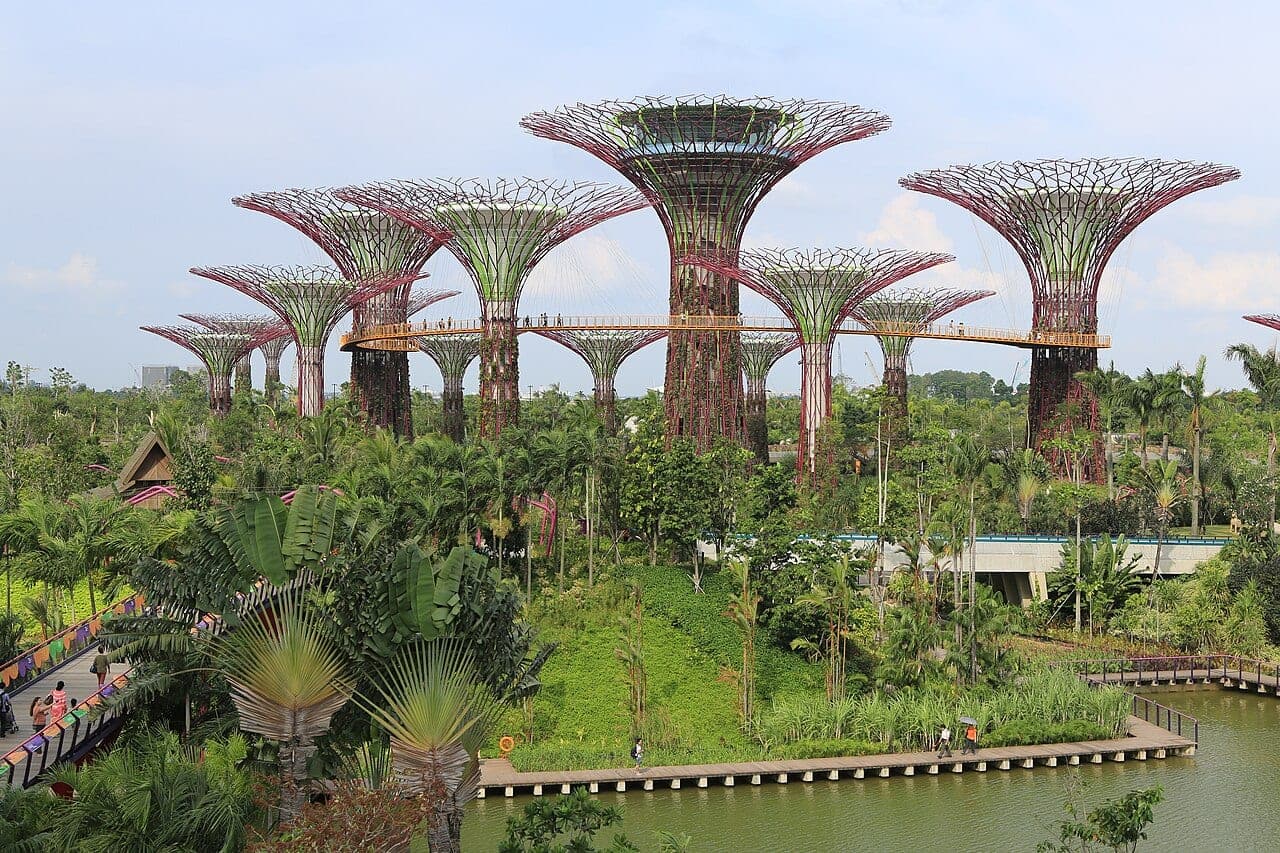
Singapore's culture now travels well beyond the island. Its cinema reached the world stage when Anthony Chen's Ilo Ilo won the Camera d'Or at Cannes in 2013, and the city's skyline and Peranakan interiors became a global image through the 2018 film Crazy Rich Asians. Its cooking, from chilli crab to Hainanese chicken rice, travels worldwide, and its architecture, from the Supertrees of Gardens by the Bay to Marina Bay Sands, has made the city itself a widely copied model. Singlish now circulates through film, music and the internet as a marker of a distinct identity.
A garden on the World Heritage list. In 2015 the Singapore Botanic Gardens became the country's first UNESCO World Heritage Site and the first tropical botanic garden so recognised.
Hawker culture recognised. In 2020 UNESCO inscribed Singapore's hawker culture on its Intangible Cultural Heritage list, affirming the open-air food centre as a shared institution.
The shophouse saved. After decades of demolition, the conservation programme begun in 1989 rescued the shophouse quarters of Chinatown, Kampong Glam and Little India.
A hillside documented. When development threatened Bukit Brown, volunteer researchers and the World Monuments Fund turned an overgrown cemetery into a documented heritage site and a national conversation.
Harmony as policy. With the most even spread of faiths of any country, Singapore has kept religious peace through law, dialogue and the everyday closeness of mosque, temple and church.
The Botanic Gardens are Singapore's only World Heritage site, and the rubber seedlings propagated here in the 1880s reshaped the economies of the whole region. Photograph by Basile Morin, CC BY-SA 4.0, via Wikimedia Commons.
The custodian of the wider heritage is the National Heritage Board, formed in 1993 to oversee the national collection, the country's museums and its gazetted national monuments. Its institutions read as a portrait of the plural nation: the National Museum of Singapore, whose building dates from 1887, alongside the Asian Civilisations Museum, the Peranakan Museum, the Indian Heritage Centre in Little India and the Malay Heritage Centre at Kampong Glam.
Singapore has moved its heritage online at scale. The National Heritage Board's Roots portal, launched in 2016, gathers the national collection, heritage trails, national monuments and intangible cultural heritage in one place, with well over 100,000 digitised artefacts open to the public. The National Archives of Singapore, administered since 2012 by the National Library Board, publishes its holdings through Archives Online, an open store of photographs, maps, government files and oral-history recordings, while the Library Board's own NewspaperSG, PictureSG and BookSG add newspapers and images across two centuries.
Community effort has extended the archive where the physical record was under threat: the volunteers at Bukit Brown published photographs, epitaphs and family histories of graves due for exhumation, so the record of the dead survived even where the graves did not.
Singapore's culture now travels well beyond the island. Its cinema reached the world stage when Anthony Chen's Ilo Ilo won the Camera d'Or at Cannes in 2013, and the city's skyline and Peranakan interiors became a global image through the 2018 film Crazy Rich Asians. Its cooking, from chilli crab to Hainanese chicken rice, travels worldwide, and its architecture, from the Supertrees of Gardens by the Bay to Marina Bay Sands, has made the city itself a widely copied model. Singlish now circulates through film, music and the internet as a marker of a distinct identity.
A garden on the World Heritage list. In 2015 the Singapore Botanic Gardens became the country's first UNESCO World Heritage Site and the first tropical botanic garden so recognised.
Hawker culture recognised. In 2020 UNESCO inscribed Singapore's hawker culture on its Intangible Cultural Heritage list, affirming the open-air food centre as a shared institution.
The shophouse saved. After decades of demolition, the conservation programme begun in 1989 rescued the shophouse quarters of Chinatown, Kampong Glam and Little India.
A hillside documented. When development threatened Bukit Brown, volunteer researchers and the World Monuments Fund turned an overgrown cemetery into a documented heritage site and a national conversation.
Harmony as policy. With the most even spread of faiths of any country, Singapore has kept religious peace through law, dialogue and the everyday closeness of mosque, temple and church.
National Overview
Notable Cities
Historical Foundations
Linguistic and Etymological Roots
Cultural Identity
Religion and Spirituality
Remembrance and Mourning Traditions
Tracing a Family in Singapore
Heritage Preservation Efforts
Digital Heritage
Contemporary Cultural Influences
Success Stories
References and resources
- UNESCO World Heritage Centre, Singapore Botanic Gardens: the 2015 inscription of the country's first World Heritage Site.
- UNESCO Intangible Cultural Heritage, Hawker culture in Singapore: the 2020 listing of communal hawker dining.
- National Heritage Board: the custodian of Singapore's museums, national monuments and national collection.
- Roots, the National Collection: the National Heritage Board's digital portal of artefacts, trails and monuments.
- National Archives of Singapore, Archives Online: photographs, records, maps and oral-history recordings.
- National Library Board, Operation Sook Ching: the 1942 purge and its estimated death toll.
- Roots, Bukit Brown Cemetery: the history of the cemetery placed on the 2014 World Monuments Watch.
- Pew Research Center, religious diversity in Singapore: Singapore as the world's most religiously diverse country.
- Encyclopaedia Britannica, Singapore: geography, history and society.