Heritage · Country
Cayman Islands Culture and Heritage
Columbus sighted three low islands in 1503 and named them for their turtles, and the people who settled them centuries later lived off the sea rather than the land. This is a guide to Caymanian heritage, from thatch rope and catboats to the white tombs standing in family yards.Written to last.
By Confinity Heritage Editorial · Updated 2026-08-17 · 8-minute readQuiet tools, kept out of the way.
On 10 May 1503, driven west by currents on his fourth voyage, Christopher Columbus came on two small, low islands so crowded with sea turtles that he called them Las Tortugas. He did not land, and nobody lived there. For nearly two more centuries the Caymans stayed a place ships called at to take turtles for meat and then left, and the name that stuck came from the marine crocodiles of the mangroves, recorded by Spanish sailors as caimanes.
Almost everything distinctive about Caymanian heritage follows from that late and thin beginning. There was no plantation economy here on the Jamaican scale, no coast of cane, and no wealth in the soil worth speaking of. What the islands had was the sea, so Caymanians became turtlers, shipbuilders, sailors and rope-makers, the men away for months at a time and the women running households, farms and a cottage industry in plaited palm. This is a guide to that inheritance across Grand Cayman, Cayman Brac and Little Cayman, and to how Caymanians bury and remember their dead.
The Cayman Islands are a British Overseas Territory of three islands on the submarine Cayman Ridge, south of Cuba and northwest of Jamaica, with a combined land area of about 264 square kilometres. Grand Cayman holds almost all the population and the capital, George Town; Cayman Brac, some 145 kilometres northeast, is dominated by the limestone Bluff that runs its length and rises to some 43 metres; Little Cayman, next door, has fewer than three hundred residents. The islands are flat, porous and riverless, ringed by reef and fringed by mangrove, and the ground is coral limestone that turns a hoe on the first stroke, one reason farming never took hold here. The population is roughly 85,000 and includes people of well over a hundred nationalities, the result of a change compressed into two generations (Britannica).
George Town. The capital takes its name from George III and grew around a shallow harbour on the western shore of Grand Cayman. The Old Courts Building on the waterfront, once courthouse, jail, church and dance hall, now houses the Cayman Islands National Museum, and the seafront Watler Cemetery holds the whitewashed family tombs described below.
Bodden Town. The original capital, on the south coast, named for the Bodden family, whose forebear Isaac Bodden was born on Grand Cayman around 1661 and is the first person recorded as born here. The Mission House and the Guard House above it keep the district's older layers.
West Bay and East End. West Bay, north of George Town, is the district most associated with rope-making, catboats and the older speech; East End faces the reef where the Wreck of the Ten Sail happened.
Stake Bay. The administrative centre of Cayman Brac, whose caves sheltered families through the 1932 storm.
After Columbus, the islands were visited but not settled. Sir Francis Drake put in during 1586 and his party reported eating the crocodiles they found. Through the seventeenth century the Caymans served buccaneers and turtle ships as a place to water and provision, and Spain ceded them, with Jamaica, under the Treaty of Madrid in 1670. Isaac Bodden was born here around 1661, grandson of a settler thought to have come with Oliver Cromwell's army at the taking of Jamaica in 1655, but settlement in any organised sense began only in the 1730s, with the first Crown land grants in 1734 (Cayman Resident). The population that resulted was mixed from the start: shipwrecked and deserting sailors, buccaneers who stayed, enslaved Africans brought from Jamaica, and free settlers arriving in small family groups.
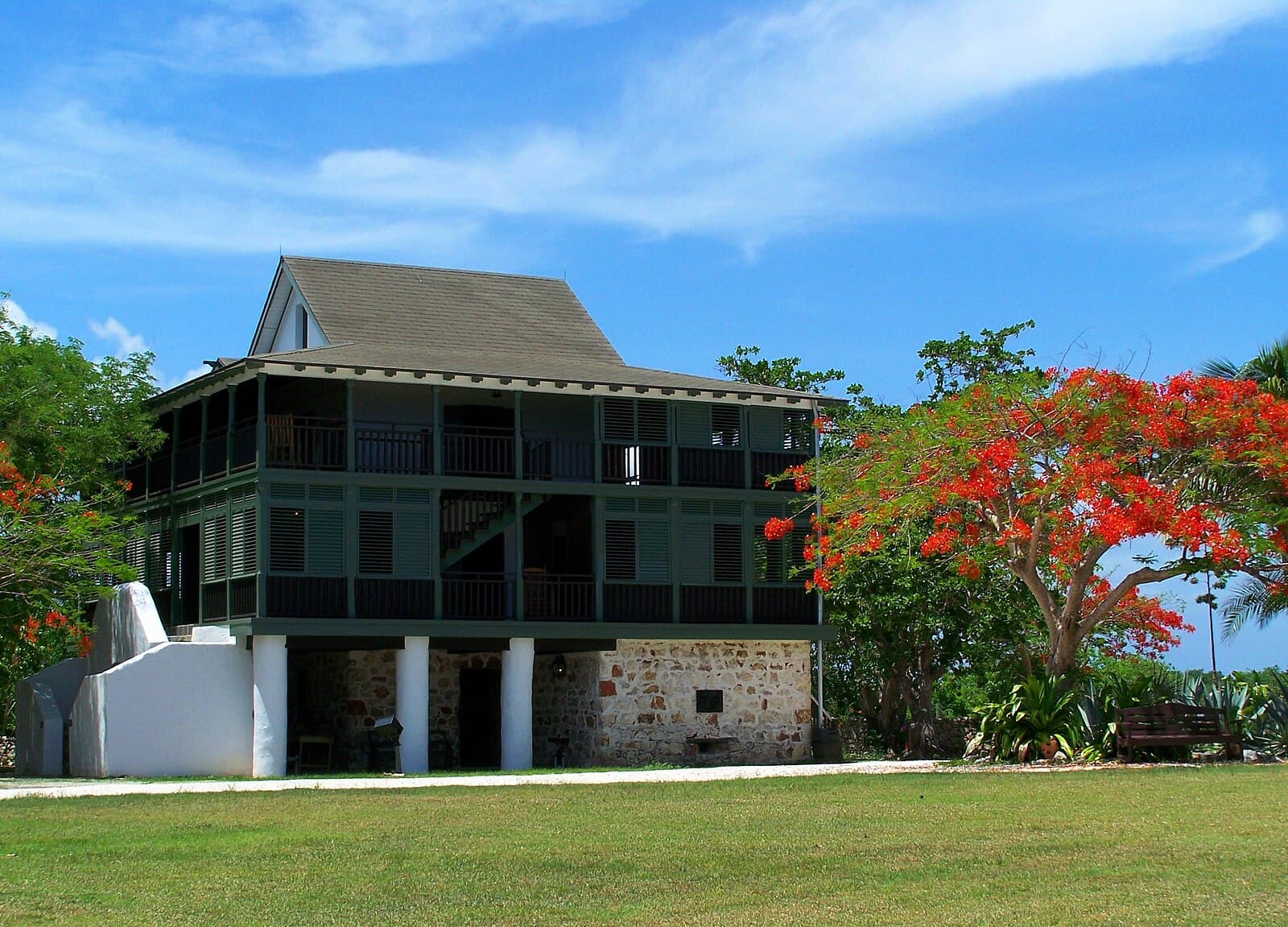
 Pedro St James is the oldest surviving building in the Cayman Islands, built with enslaved labour around 1780, and the meeting that led to the islands' first elected assembly was held here in 1831. Photograph by Lhb1239, CC BY-SA 3.0, via Wikimedia Commons.
The best-remembered event of the period happened on the reef off East End. On the night of 8 February 1794 several ships of a convoy bound for Britain under escort by the frigate HMS Convert sailed ahead against orders and struck the reef; Convert, trying to warn them off, was herself driven onto the coral, and daylight showed ten wrecked vessels. Caymanians put out through the surf and brought crews and passengers ashore. The Wreck of the Ten Sail became the national story, and with it the legend that a grateful George III exempted the islands from taxation forever, though no such grant appears in any record and historians treat it as folklore attached to a real rescue (Wikipedia).
Slavery existed here, and it was small. The first census, in 1802, counted 933 people on Grand Cayman, of whom 545 were enslaved, a proportion reflecting an economy of provision grounds, turtling voyages and household labour rather than sugar estates. Abolition took effect across the empire on 1 August 1834, and on 3 May 1835 a magistrate sent by the Governor of Jamaica held court at Pedro St James and read the emancipation proclamation to the assembled islanders (Pedro St James). Four years earlier, on 5 December 1831, a meeting at the same house had resolved to elect a representative assembly, and the five districts voted that month, which is why Pedro St James is called the birthplace of Caymanian democracy.
The islands were governed as a dependency of Jamaica for most of their modern history, and when Jamaica became independent in 1962 Caymanians chose to stay under the Crown. Two events since have marked the period more sharply than any constitutional change: the storm of 8 November 1932, which killed 108 people on Cayman Brac out of about two thousand and flattened nearly every building there, and Hurricane Ivan in September 2004.
Caymanian English is a distinct variety with a documented phonology rather than a loose accent. Its speakers place intonation on the last syllable of longer words, keep the broad vowel in bangle, and devoice the r in turn and sermon; the sound written w is regularly produced as v, so that when becomes ven, a feature attributed variously to Twi influence and to early modern English carried out by the first settlers. Subject pronouns do duty for possessives, so he and she stand where standard English would use his and hers, and determiners and prepositions drop out of sentences that stay perfectly clear to Caymanians. Its ingredients are Early Modern English, Guinea Coast Creole English and West African languages including Igbo and Twi, carried here by turtle fishers, buccaneers, enslaved Africans and deserters from Cromwell's Jamaican army (Wikipedia). The older forms are heard on Cayman Brac and Little Cayman and in West Bay, where people born before the 1970s keep vocabulary that has otherwise thinned out under North American media and a largely expatriate workforce.
The map records what mattered. Columbus's Las Tortugas gave way to Caymanas, from the Carib word for the marine crocodile, and George Town honours George III. Bodden Town carries a family name rather than a governor's, which is characteristic: the small stock of Caymanian surnames, Bodden, Ebanks, Watler, Scott, Jackson, Merren, descends from the handful of families who settled the islands, and nearly every old place name is a family, a landing, a reef or a hazard.
Caymanian identity was made at sea. The islands supplied turtle meat to passing ships from the earliest settlement, and once local nesting stocks were fished out the turtlers went further afield, sailing schooners several hundred miles southwest to the Miskito Cays off Nicaragua and returning with live turtles penned in the hold. Voyages lasted months, whole districts were emptied of men for a season, and a schooner's launch drew people from across the island (Cayman Islands National Museum). Boats were built on the beach from local mahogany and plopnut by families known through the region for their work, and the trade faded only in the mid twentieth century, when Caymanian seamen took better wages with the international shipping lines.
Out of that world came the catboat. Captain Daniel Jervis of Cayman Brac, dissatisfied with the heavy dugout canoes then used to work turtle nets from the schooners, built the first one in 1904; fourteen feet long, double-ended, rigged for sail and fitted for oars, it was light enough for two men to handle in a chop and quick enough to run down a turtle. He called her Terror. The design spread through all three islands and is raced and restored today by the Cayman Catboat Club (Cayman Compass).
Ashore, the work was rope. The silver thatch palm, Coccothrinax proctorii, grows nowhere else and is the national tree, and its unopened young leaves, the tops, were cut, dried, split and plaited into rope that held up in salt water better than most. Women and children made it at home while the men were away, and it was sold to Jamaica and Cuba for the shipping, fishing and sugar trades; in 1945 alone the islands exported well over a million fathoms (National Gallery of the Cayman Islands). Thatch also roofed and walled the houses well into the twentieth century. The kitchen keeps the same record: turtle stew, conch, fish rundown, cassava heavy cake baked slow under coals, and swanky, the lime and sugar drink taken to the fields.
The Caymans are strongly and openly Protestant, and church membership is a normal part of public identity rather than a private matter. Presbyterian missionaries from Jamaica arrived in the nineteenth century and did as much for schooling as for worship, using the Mission House at Bodden Town as a base; their successor body, the United Church in Jamaica and the Cayman Islands, remains one of the largest denominations, alongside the Church of God, Baptists, Seventh-day Adventists, Roman Catholics and newer congregations formed by Filipino, Jamaican and Honduran residents (National Trust for the Cayman Islands).
Religion here was practical as well as devotional. Congregations prayed for men at sea and carried the news when a schooner failed to come home, and the hymns Caymanians sing at funerals are the hymns of a seafaring people. Beneath the churches sits a body of belief in duppies, the restless dead, and in signs read from birds, weather and dreams, which older Caymanians describe with some reluctance and considerable precision.
Caymanian mourning starts in the house. A death is announced quickly, neighbours arrive within the hour, and the wake keeps the family company through the night with hymns, coffee, food brought by other households and talk about the dead. In the older practice the body stayed at home until burial, and burial came fast, usually within a day or two, which the climate required and the absence of undertakers made normal. Funerals fill the church and the yard outside it, and the district turns out whether related or not.
What Caymanians do with the grave afterwards is the most visually distinctive part of the tradition. Before there were public cemeteries each family buried its own, and from the eighteenth century onward families set aside a corner of their land for it, usually the strip between the road and the sea where the sand was soft enough to dig. The body goes into the sand; over it the family builds a tomb of coral rock, sometimes with red brick landed as ship's ballast, rendered with limestone daub and painted white. The finished form is a miniature house, roughly six feet by two and eighteen inches high, with a pitched roof and a full gable end, and a row of them side by side marks a family plot (CaymANNature). Relatives repaint them, decorate them with shells and flowers and keep them white, so that along the coast road you pass small clusters of them glowing against the sea grape, often within a few metres of the water and of the house whose family lies there (Cayman Compass).
Two absences shape Caymanian remembrance as much as the tombs. The first is the sea, which took men whose bodies never came home; a seafaring people of this size accumulates a long list of names with no grave attached, and the Seamen's Memorial in George Town, an old navigational beacon beside the ruins of Fort George with the names of 153 Caymanians inscribed around its base, exists because ordinary burial was so often impossible (Explore Cayman). The second is the 1932 storm, which killed 108 people on Cayman Brac in a single night and left survivors burying neighbours in ground washed clean of every landmark. Both explain why the small white tombs matter so much: on islands where the sea takes people without trace, a grave you can walk to, paint and stand beside is not a small thing.
The Cayman Islands were a dependency of Jamaica until 1962, which is where most of the older records are.
Settlement was late and small: the islands were largely uninhabited until the eighteenth century, and the founding population was a few hundred people, sailors, turtlers and shipwreck survivors, together with the enslaved people they brought. That means Caymanian genealogy is unusually tractable, because the number of founding families is small and the surnames, Bodden, Ebanks, Watler, Merren, Scott, are concentrated.
The slave registers of 1834, and the compensation records, name the enslaved population at emancipation, which numbered under a thousand. Anglican and Presbyterian church registers carry the vital events, and civil registration dates from the later nineteenth century, held by the General Registry. The Cayman Islands National Archive in George Town has run a substantial oral history programme and holds the administrative series, with the Jamaican and British material elsewhere.
The turtle fishery and the seafaring economy are the working record: Caymanian men crewed ships worldwide for generations, and the National Maritime Heritage collections document it. The 1932 hurricane, which killed over a hundred people on Cayman Brac and Little Cayman, is in the church and government records.
The modern population is mostly not Caymanian by descent. Financial services drew people from Jamaica, the Philippines, Britain, Canada and elsewhere, and status and residency law has made establishing Caymanian ancestry a matter of legal consequence.
The Cayman Islands National Museum occupies the Old Courts Building in George Town, among the oldest surviving structures in the territory, and opened in 1990 with collections covering natural history, seafaring, thatch work and daily life (Cayman Islands National Museum). The National Trust for the Cayman Islands, established by statute in the late 1980s, holds historic buildings and reserves across all three islands, among them the Mission House, Fort George and the Mastic Reserve (National Trust). Pedro St James at Savannah, built around 1780 with enslaved labour, was restored and opened as a heritage site in 1998, presenting the 1831 assembly meeting and the 1835 reading of emancipation in the rooms where they happened.
Hurricane Ivan tested all of it. In September 2004 the storm put much of Grand Cayman under water and damaged the overwhelming majority of its buildings. The National Museum closed for five years; mould took hold in the waterfront building, the offsite store flooded, and some 3,500 objects had to be rescued, cleaned and packed into a container while the museum was rebuilt (Cayman Compass). The Mission House was destroyed outright and afterwards rebuilt in traditional wattle, daub and timber, which turned the loss into an unplanned exercise in recovering how Caymanians used to build. Coastal graveyards lost tombs to the surge, and the rebuilding that followed replaced old timber and daub houses with concrete, so the storm cost the ordinary building stock as much as the monuments.
The most important preservation project in the islands is an archive of voices. The Cayman Islands National Archive runs the Memory Bank, an oral history programme begun in the early 1990s that has recorded hundreds of interviews with elders about turtling voyages, rope-making, the 1932 storm and household life, and has transcribed and indexed them with a glossary of the dialect words the speakers used (Cayman Islands National Archive). For a society whose knowledge was carried in speech rather than paper, it is the closest thing to a record of how the old life worked, and it caught a generation whose working lives predated the financial sector.
Around it sits a growing digital layer: the Archive's catalogue of records, including material copied from repositories in Jamaica and Britain; the National Museum's online exhibitions and maritime heritage trails; the National Gallery's video series, which films rope-makers, boat-builders and thatch-workers at their craft; and the digitised back files of the Cayman Compass.
The Cayman Islands are one of the largest offshore financial centres in the world, and the scale of that change inside a single lifetime is the central fact of contemporary Caymanian life. The framework was laid in a few statutes: a Companies Law in 1960, then in 1966 a Banks and Trust Companies Regulation Law, a Trusts Law and exchange control legislation, in a territory with no direct taxes on income, profits or capital gains. Investment funds followed in enormous numbers, and a very large share of the world's hedge fund assets is legally domiciled here (Cayman Resident).
What that has meant on the ground is harder to sum up than the balance sheets. The population rose from around ten thousand in 1970 to more than eighty thousand, most of the growth from immigration, and Caymanians are now a minority in their own labour force. Land values around Seven Mile Beach and George Town rose beyond the reach of the families who once farmed and fished there, old settlements have been built over, and the working knowledge of turtling, rope and thatch left the economy within about thirty years. Against that, the territory has invested deliberately in culture: the Cayman National Cultural Foundation runs the Harquail Theatre and the Gimistory storytelling festival, which brings tellers from across the Caribbean to perform in yards and on beaches, Cayfest gathers Caymanian artists each year, and heritage days, catboat races and thatch-plaiting are now taught rather than simply inherited. Whether that holds a distinct Caymanian identity in a place where most residents were born elsewhere is the question local writers and politicians return to most often.
A boat brought back. The catboat, obsolete once turtling ended, is restored and raced by the Cayman Catboat Club, keeping a design invented on Cayman Brac in 1904 in the water rather than in a museum case.
A generation recorded before it went. The National Archive's Memory Bank captured hundreds of oral histories from Caymanians whose working lives belonged to the age of schooners and thatch rope.
A house rebuilt honestly. After Hurricane Ivan destroyed the Mission House at Bodden Town, it was rebuilt in period wattle, daub and timber rather than concrete, recovering the technique as well as the building.
Democracy given an address. Pedro St James, derelict for decades, was restored and opened in 1998 as the site of the 1831 decision to elect an assembly and of the 1835 proclamation.
Pedro St James is the oldest surviving building in the Cayman Islands, built with enslaved labour around 1780, and the meeting that led to the islands' first elected assembly was held here in 1831. Photograph by Lhb1239, CC BY-SA 3.0, via Wikimedia Commons.
The best-remembered event of the period happened on the reef off East End. On the night of 8 February 1794 several ships of a convoy bound for Britain under escort by the frigate HMS Convert sailed ahead against orders and struck the reef; Convert, trying to warn them off, was herself driven onto the coral, and daylight showed ten wrecked vessels. Caymanians put out through the surf and brought crews and passengers ashore. The Wreck of the Ten Sail became the national story, and with it the legend that a grateful George III exempted the islands from taxation forever, though no such grant appears in any record and historians treat it as folklore attached to a real rescue (Wikipedia).
Slavery existed here, and it was small. The first census, in 1802, counted 933 people on Grand Cayman, of whom 545 were enslaved, a proportion reflecting an economy of provision grounds, turtling voyages and household labour rather than sugar estates. Abolition took effect across the empire on 1 August 1834, and on 3 May 1835 a magistrate sent by the Governor of Jamaica held court at Pedro St James and read the emancipation proclamation to the assembled islanders (Pedro St James). Four years earlier, on 5 December 1831, a meeting at the same house had resolved to elect a representative assembly, and the five districts voted that month, which is why Pedro St James is called the birthplace of Caymanian democracy.
The islands were governed as a dependency of Jamaica for most of their modern history, and when Jamaica became independent in 1962 Caymanians chose to stay under the Crown. Two events since have marked the period more sharply than any constitutional change: the storm of 8 November 1932, which killed 108 people on Cayman Brac out of about two thousand and flattened nearly every building there, and Hurricane Ivan in September 2004.
Caymanian English is a distinct variety with a documented phonology rather than a loose accent. Its speakers place intonation on the last syllable of longer words, keep the broad vowel in bangle, and devoice the r in turn and sermon; the sound written w is regularly produced as v, so that when becomes ven, a feature attributed variously to Twi influence and to early modern English carried out by the first settlers. Subject pronouns do duty for possessives, so he and she stand where standard English would use his and hers, and determiners and prepositions drop out of sentences that stay perfectly clear to Caymanians. Its ingredients are Early Modern English, Guinea Coast Creole English and West African languages including Igbo and Twi, carried here by turtle fishers, buccaneers, enslaved Africans and deserters from Cromwell's Jamaican army (Wikipedia). The older forms are heard on Cayman Brac and Little Cayman and in West Bay, where people born before the 1970s keep vocabulary that has otherwise thinned out under North American media and a largely expatriate workforce.
The map records what mattered. Columbus's Las Tortugas gave way to Caymanas, from the Carib word for the marine crocodile, and George Town honours George III. Bodden Town carries a family name rather than a governor's, which is characteristic: the small stock of Caymanian surnames, Bodden, Ebanks, Watler, Scott, Jackson, Merren, descends from the handful of families who settled the islands, and nearly every old place name is a family, a landing, a reef or a hazard.
Caymanian identity was made at sea. The islands supplied turtle meat to passing ships from the earliest settlement, and once local nesting stocks were fished out the turtlers went further afield, sailing schooners several hundred miles southwest to the Miskito Cays off Nicaragua and returning with live turtles penned in the hold. Voyages lasted months, whole districts were emptied of men for a season, and a schooner's launch drew people from across the island (Cayman Islands National Museum). Boats were built on the beach from local mahogany and plopnut by families known through the region for their work, and the trade faded only in the mid twentieth century, when Caymanian seamen took better wages with the international shipping lines.
Out of that world came the catboat. Captain Daniel Jervis of Cayman Brac, dissatisfied with the heavy dugout canoes then used to work turtle nets from the schooners, built the first one in 1904; fourteen feet long, double-ended, rigged for sail and fitted for oars, it was light enough for two men to handle in a chop and quick enough to run down a turtle. He called her Terror. The design spread through all three islands and is raced and restored today by the Cayman Catboat Club (Cayman Compass).
Ashore, the work was rope. The silver thatch palm, Coccothrinax proctorii, grows nowhere else and is the national tree, and its unopened young leaves, the tops, were cut, dried, split and plaited into rope that held up in salt water better than most. Women and children made it at home while the men were away, and it was sold to Jamaica and Cuba for the shipping, fishing and sugar trades; in 1945 alone the islands exported well over a million fathoms (National Gallery of the Cayman Islands). Thatch also roofed and walled the houses well into the twentieth century. The kitchen keeps the same record: turtle stew, conch, fish rundown, cassava heavy cake baked slow under coals, and swanky, the lime and sugar drink taken to the fields.
The Caymans are strongly and openly Protestant, and church membership is a normal part of public identity rather than a private matter. Presbyterian missionaries from Jamaica arrived in the nineteenth century and did as much for schooling as for worship, using the Mission House at Bodden Town as a base; their successor body, the United Church in Jamaica and the Cayman Islands, remains one of the largest denominations, alongside the Church of God, Baptists, Seventh-day Adventists, Roman Catholics and newer congregations formed by Filipino, Jamaican and Honduran residents (National Trust for the Cayman Islands).
Religion here was practical as well as devotional. Congregations prayed for men at sea and carried the news when a schooner failed to come home, and the hymns Caymanians sing at funerals are the hymns of a seafaring people. Beneath the churches sits a body of belief in duppies, the restless dead, and in signs read from birds, weather and dreams, which older Caymanians describe with some reluctance and considerable precision.
Caymanian mourning starts in the house. A death is announced quickly, neighbours arrive within the hour, and the wake keeps the family company through the night with hymns, coffee, food brought by other households and talk about the dead. In the older practice the body stayed at home until burial, and burial came fast, usually within a day or two, which the climate required and the absence of undertakers made normal. Funerals fill the church and the yard outside it, and the district turns out whether related or not.
What Caymanians do with the grave afterwards is the most visually distinctive part of the tradition. Before there were public cemeteries each family buried its own, and from the eighteenth century onward families set aside a corner of their land for it, usually the strip between the road and the sea where the sand was soft enough to dig. The body goes into the sand; over it the family builds a tomb of coral rock, sometimes with red brick landed as ship's ballast, rendered with limestone daub and painted white. The finished form is a miniature house, roughly six feet by two and eighteen inches high, with a pitched roof and a full gable end, and a row of them side by side marks a family plot (CaymANNature). Relatives repaint them, decorate them with shells and flowers and keep them white, so that along the coast road you pass small clusters of them glowing against the sea grape, often within a few metres of the water and of the house whose family lies there (Cayman Compass).
Two absences shape Caymanian remembrance as much as the tombs. The first is the sea, which took men whose bodies never came home; a seafaring people of this size accumulates a long list of names with no grave attached, and the Seamen's Memorial in George Town, an old navigational beacon beside the ruins of Fort George with the names of 153 Caymanians inscribed around its base, exists because ordinary burial was so often impossible (Explore Cayman). The second is the 1932 storm, which killed 108 people on Cayman Brac in a single night and left survivors burying neighbours in ground washed clean of every landmark. Both explain why the small white tombs matter so much: on islands where the sea takes people without trace, a grave you can walk to, paint and stand beside is not a small thing.
The Cayman Islands were a dependency of Jamaica until 1962, which is where most of the older records are.
Settlement was late and small: the islands were largely uninhabited until the eighteenth century, and the founding population was a few hundred people, sailors, turtlers and shipwreck survivors, together with the enslaved people they brought. That means Caymanian genealogy is unusually tractable, because the number of founding families is small and the surnames, Bodden, Ebanks, Watler, Merren, Scott, are concentrated.
The slave registers of 1834, and the compensation records, name the enslaved population at emancipation, which numbered under a thousand. Anglican and Presbyterian church registers carry the vital events, and civil registration dates from the later nineteenth century, held by the General Registry. The Cayman Islands National Archive in George Town has run a substantial oral history programme and holds the administrative series, with the Jamaican and British material elsewhere.
The turtle fishery and the seafaring economy are the working record: Caymanian men crewed ships worldwide for generations, and the National Maritime Heritage collections document it. The 1932 hurricane, which killed over a hundred people on Cayman Brac and Little Cayman, is in the church and government records.
The modern population is mostly not Caymanian by descent. Financial services drew people from Jamaica, the Philippines, Britain, Canada and elsewhere, and status and residency law has made establishing Caymanian ancestry a matter of legal consequence.
The Cayman Islands National Museum occupies the Old Courts Building in George Town, among the oldest surviving structures in the territory, and opened in 1990 with collections covering natural history, seafaring, thatch work and daily life (Cayman Islands National Museum). The National Trust for the Cayman Islands, established by statute in the late 1980s, holds historic buildings and reserves across all three islands, among them the Mission House, Fort George and the Mastic Reserve (National Trust). Pedro St James at Savannah, built around 1780 with enslaved labour, was restored and opened as a heritage site in 1998, presenting the 1831 assembly meeting and the 1835 reading of emancipation in the rooms where they happened.
Hurricane Ivan tested all of it. In September 2004 the storm put much of Grand Cayman under water and damaged the overwhelming majority of its buildings. The National Museum closed for five years; mould took hold in the waterfront building, the offsite store flooded, and some 3,500 objects had to be rescued, cleaned and packed into a container while the museum was rebuilt (Cayman Compass). The Mission House was destroyed outright and afterwards rebuilt in traditional wattle, daub and timber, which turned the loss into an unplanned exercise in recovering how Caymanians used to build. Coastal graveyards lost tombs to the surge, and the rebuilding that followed replaced old timber and daub houses with concrete, so the storm cost the ordinary building stock as much as the monuments.
The most important preservation project in the islands is an archive of voices. The Cayman Islands National Archive runs the Memory Bank, an oral history programme begun in the early 1990s that has recorded hundreds of interviews with elders about turtling voyages, rope-making, the 1932 storm and household life, and has transcribed and indexed them with a glossary of the dialect words the speakers used (Cayman Islands National Archive). For a society whose knowledge was carried in speech rather than paper, it is the closest thing to a record of how the old life worked, and it caught a generation whose working lives predated the financial sector.
Around it sits a growing digital layer: the Archive's catalogue of records, including material copied from repositories in Jamaica and Britain; the National Museum's online exhibitions and maritime heritage trails; the National Gallery's video series, which films rope-makers, boat-builders and thatch-workers at their craft; and the digitised back files of the Cayman Compass.
The Cayman Islands are one of the largest offshore financial centres in the world, and the scale of that change inside a single lifetime is the central fact of contemporary Caymanian life. The framework was laid in a few statutes: a Companies Law in 1960, then in 1966 a Banks and Trust Companies Regulation Law, a Trusts Law and exchange control legislation, in a territory with no direct taxes on income, profits or capital gains. Investment funds followed in enormous numbers, and a very large share of the world's hedge fund assets is legally domiciled here (Cayman Resident).
What that has meant on the ground is harder to sum up than the balance sheets. The population rose from around ten thousand in 1970 to more than eighty thousand, most of the growth from immigration, and Caymanians are now a minority in their own labour force. Land values around Seven Mile Beach and George Town rose beyond the reach of the families who once farmed and fished there, old settlements have been built over, and the working knowledge of turtling, rope and thatch left the economy within about thirty years. Against that, the territory has invested deliberately in culture: the Cayman National Cultural Foundation runs the Harquail Theatre and the Gimistory storytelling festival, which brings tellers from across the Caribbean to perform in yards and on beaches, Cayfest gathers Caymanian artists each year, and heritage days, catboat races and thatch-plaiting are now taught rather than simply inherited. Whether that holds a distinct Caymanian identity in a place where most residents were born elsewhere is the question local writers and politicians return to most often.
A boat brought back. The catboat, obsolete once turtling ended, is restored and raced by the Cayman Catboat Club, keeping a design invented on Cayman Brac in 1904 in the water rather than in a museum case.
A generation recorded before it went. The National Archive's Memory Bank captured hundreds of oral histories from Caymanians whose working lives belonged to the age of schooners and thatch rope.
A house rebuilt honestly. After Hurricane Ivan destroyed the Mission House at Bodden Town, it was rebuilt in period wattle, daub and timber rather than concrete, recovering the technique as well as the building.
Democracy given an address. Pedro St James, derelict for decades, was restored and opened in 1998 as the site of the 1831 decision to elect an assembly and of the 1835 proclamation.
National Overview
Notable Cities
Historical Foundations
Linguistic and Etymological Roots
Cultural Identity
Religion and Spirituality
Remembrance and Mourning Traditions
Tracing a Family in Cayman Islands
Heritage Preservation Efforts
Digital Heritage
Contemporary Cultural Influences
Success Stories
References and resources
- Encyclopaedia Britannica, Cayman Islands: geography and government.
- Wreck of the Ten Sail, Wikipedia: the 1794 disaster and the tax legend.
- Pedro St James, Our History: the 1831 assembly meeting and the 1835 proclamation.
- Cayman Islands English, Wikipedia: phonology and origins.
- Cayman Islands National Museum: the Old Courts Building and its collections.
- Cayman Compass, Cayman Catboats: Daniel Jervis and the design.
- National Gallery of the Cayman Islands, Silver Thatch Rope: the palm and the rope trade.
- CaymANNature, House-shaped Gravestones: how the white family tombs were built.
- Cayman Compass, Remembering Ivan: the 2004 damage to heritage sites.
- National Trust for the Cayman Islands: historic properties.
- Cayman Islands National Archive: the Memory Bank oral history programme.