Heritage · Country
El Salvador Culture and Heritage
A Maya farming village buried by ash around 600 AD and reopened fourteen centuries later gives El Salvador the most complete portrait of everyday life in ancient Mesoamerica. This guide follows the smallest country in Central America from its pyramids and coffee highlands to the quiet cemetery vigils of its Day of the Dead.Written to last.
By Confinity Heritage Editorial · Updated 2026-07-31 · 8-minute readQuiet tools, kept out of the way.
In 1976, workers levelling ground for grain silos west of San Salvador cut into a buried Maya village. Around 600 AD the nearby Loma Caldera vent had erupted without warning, sealing the settlement of Joya de Cerén under several metres of ash and preserving it as almost nothing else in the Americas has been preserved: sleeping mats, painted gourds, a field of manioc still standing in its furrows, beans left in a pot, the print of a hurried foot. Because the people appear to have fled in time, the village kept an ordinary evening intact, and researchers have since called it the Pompeii of the Americas.
El Salvador is the smallest country on the Central American mainland and the most densely settled, a band of volcanoes and coffee slopes between the Pacific and the interior highlands. Its heritage runs from Maya pyramids and a surviving Nahua language, through Spanish estates of indigo and coffee, to a period of civil conflict that still shapes how the country remembers its dead. This guide follows that inheritance across the land, its cities, its faith and its mourning customs.
El Salvador covers about 21,000 square kilometres yet holds some 6.3 million people, making it the most densely populated country in Central America. It is the only nation in the isthmus without a Caribbean coast; its whole shoreline faces the Pacific. Two ranges of young volcanoes cross the country, and the fertile ash they have laid down over millennia gives El Salvador both its farming wealth and its nickname, the land of volcanoes. Izalco, which rose from a field in the eighteenth century, sits beside the higher cone of Santa Ana, the country's tallest peak.
The republic is divided into fourteen departments, with the capital, San Salvador, and its metropolitan area holding a large share of the population. Spanish is the national language, and Roman Catholicism, long dominant, now shares the country with a fast-growing Protestant minority. The economy that shaped the modern landscape was built on export agriculture, first indigo, then coffee, and today rests heavily on services and on remittances sent home by Salvadorans abroad. Joya de Cerén, inscribed in 1993, is the country's single UNESCO World Heritage Site, but its wider heritage of pyramids, colonial towns and living craft traditions is far broader than that one listing suggests.
San Salvador. Founded by the Spanish in the 1520s and repeatedly rebuilt after earthquakes, the capital is the country's political, commercial and cultural centre. Its Metropolitan Cathedral holds the tomb of Archbishop Óscar Romero and draws pilgrims from across the Americas, while the Museo Nacional de Antropología and the Museo de Arte de El Salvador anchor the museum district of San Benito. The city sits beneath the San Salvador volcano, whose crater, El Boquerón, is now a national park.
Santa Ana. El Salvador's second city, set among the coffee estates of the western highlands, is known for its restored Teatro de Santa Ana, one of the finest neoclassical theatres in Central America, and its neo-Gothic cathedral. It serves as the gateway to the volcano that shares its name and to the archaeological zone of Chalchuapa nearby.
Suchitoto. A well-preserved colonial town of cobbled streets and whitewashed houses above Lake Suchitlán, Suchitoto has become the country's arts and heritage capital. Its church of Santa Lucía, its festivals of music and theatre, and the surrounding wetlands, an important bird habitat, make it a centre for cultural tourism. Its Nahuat name is often translated as the place of birds and flowers.
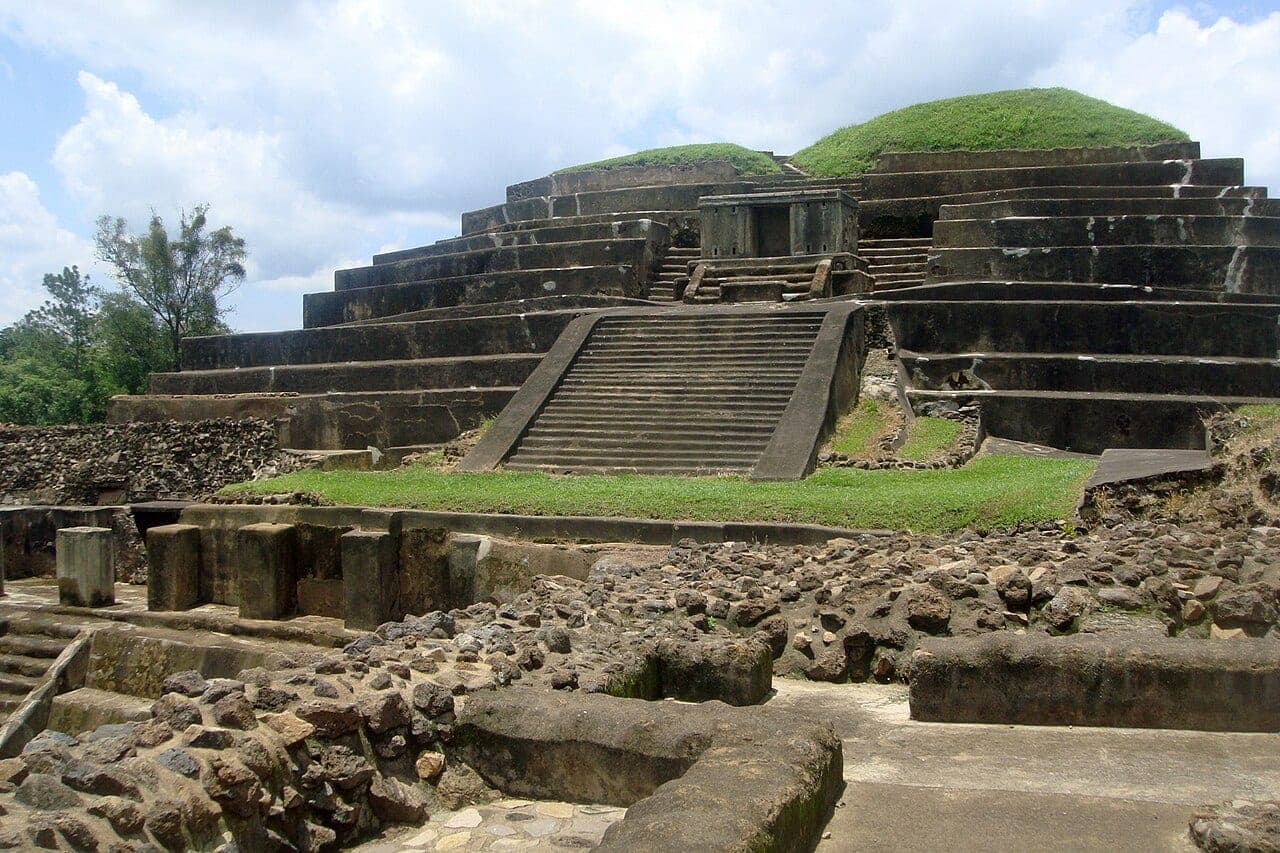
Chalchuapa. In the western department of Santa Ana, Chalchuapa holds the country's most important cluster of pre-Columbian ruins, including Tazumal, the tallest ancient pyramid in El Salvador, along with the sites of Casa Blanca and El Trapiche. Occupied for well over a thousand years, the zone links the Salvadoran highlands to the wider Maya world.
Human settlement in the region reaches back thousands of years, but the deep heritage on view today is Maya. In the Zapotitán Valley, Joya de Cerén preserves a commoners' farming village of about 600 AD, buried by the Loma Caldera eruption and reopened only in the twentieth century, its earthen buildings, kitchen gardens and household goods intact. Nearby, San Andrés grew into one of the valley's principal centres, occupied across many centuries, while at Chalchuapa the ceremonial complex of Tazumal was built and rebuilt from the Preclassic into the Postclassic era, its main pyramid reaching over twenty metres. The American archaeologist Stanley Boggs led the excavation and restoration of Tazumal from the 1940s.
 Joya de Ceren is a farming village buried by ash around AD 600 with the meals still in the pots. Nobody died there, so what survives is ordinary life rather than a catastrophe. Photograph by Mariordo, CC BY-SA 3.0, via Wikimedia Commons.
By the time Europeans arrived, much of central and western El Salvador was Cuzcatlán, the domain of the Pipil, a Nahua people who had migrated south from central Mexico centuries earlier and spoke Nahuat. To the east lived the Lenca and other groups. Spanish forces under Pedro de Alvarado entered in 1524 and met determined Pipil resistance; a first Villa de San Salvador, founded in 1525, was destroyed and refounded before the conquest held. Three centuries of colonial rule followed, during which indigo, a blue dye extracted from the añil plant, became the region's chief export and the source of many landed fortunes.
Independence from Spain came in 1821, and El Salvador joined the short-lived Federal Republic of Central America before the union dissolved by 1841 and the country became fully sovereign. In the later nineteenth century coffee replaced indigo as the dominant crop, concentrating land and wealth in few hands and drawing indigenous communal lands into private estates. Social strain broke into the open in 1932, when a peasant and worker uprising in the coffee zone, in which many Pipil took part, was crushed in mass killings later remembered as La Matanza; the repression accelerated the loss of indigenous dress and language across much of the country.
Deep inequality and political exclusion contributed to a civil war between the government and the Farabundo Martí National Liberation Front (FMLN) that ran from 1980 to 1992. As many as 75,000 people died, most of them civilians, and a United Nations Truth Commission established after the fighting documented grave human rights abuses. The war ended with the Chapultepec Peace Accords, signed in Mexico City on 16 January 1992, which demobilised the guerrillas, reformed the armed forces and brought the FMLN into electoral politics. Those years remain central to national memory, and their commemoration is treated here soberly rather than as spectacle.
Spanish is the everyday and official language of El Salvador, spoken in a Central American form that shares the regional use of vos for the familiar second person. Beneath it survives Nahuat, also called Pipil, the last living indigenous language in the country and a close relative, though a distinct one, of the Nahuatl of central Mexico. Its speakers are now very few and mostly elderly, concentrated in the town of Santo Domingo de Guzmán in Sonsonate, which is why revitalisation programmes carry unusual weight. Place names across the west keep the language alive on every map, from Cuzcatlán and Nahuizalco to Ahuachapán and Sonsonate.
The country's own name is among the most distinctive in the world. The Spanish province was dedicated to Jesus Christ under the title El Salvador, "the Savior," a shortening of a longer colonial style honouring the Savior of the world. The capital, San Salvador, carries the same dedication, so that El Salvador is often described as the only country named directly for Jesus. The nickname sometimes applied to its people, guanacos, and the affectionate use of Cuzcatlán, the older Pipil name of the land, sit alongside the Christian title in the national vocabulary.
The best-known route into Salvadoran culture is the Ruta de las Flores, a mountain road through the western coffee country that links a string of small towns famous for craft, food and flowers. Along it, Nahuizalco keeps indigenous wicker and reed weaving, Apaneca and Juayúa are known for coffee and weekend food fairs, and Concepción de Ataco is admired for its painted murals and cobbled lanes.
Craft towns elsewhere carry equal weight. In the northern mountains, La Palma is the home of the painter Fernando Llort, whose bright naïf style, built from simple images of village life, became a national visual signature reproduced on wood, seeds and ceramics across the country. Ilobasco, in Cabañas, is celebrated for red-clay pottery and for its sorpresas, tiny painted scenes hidden inside egg-shaped shells. Marimba music, played on a large wooden xylophone, remains the traditional sound of festivals and civic occasions. At the table, the pupusa, a thick hand-patted corn cake stuffed with cheese, beans or pork and served with cabbage relish and tomato sauce, was declared the national dish by the Legislative Assembly in 2005, with a national pupusa day each November.
Roman Catholicism arrived with the Spanish and long defined public life, expressed in patron-saint festivals, Holy Week processions and the great August feast of the Divine Savior of the World, the country's patron. In recent decades evangelical and Pentecostal churches have grown quickly, and a large share of Salvadorans now identify as Protestant, so that the religious landscape is genuinely plural while remaining strongly Christian.
At the emotional centre of Salvadoran Catholicism is Óscar Arnulfo Romero, archbishop of San Salvador, who became a prominent voice for the poor and for human rights before he was assassinated while saying Mass on 24 March 1980. Long revered by ordinary Salvadorans, he was beatified in 2015 and canonised by Pope Francis in Rome on 14 October 2018, becoming the country's first saint. His tomb in the Metropolitan Cathedral and the chapel where he died are places of continual visit, and his image is among the most widely displayed in the nation.
Salvadoran mourning follows the shape common to Catholic Latin America, adapted to local custom. A death is marked by a velorio, a wake often held through the night in the family home or a chapel, with coffee, prayer and the company of neighbours before a prompt burial. The nine evenings that follow bring the novenario, a rosary prayed each night in the house of the bereaved, and further Masses mark the ninth day, the fortieth day and the first anniversary, keeping the community close to the family through the year of grief.
Public remembrance gathers on 2 November, the Día de los Difuntos, when families visit cemeteries to clean, repaint and decorate graves with fresh flowers, especially marigolds, and to spend the day among their dead. The Salvadoran observance is generally quieter than the Mexican festival, without parades or painted faces, though one striking exception is the Calabiuza of Tonacatepeque, held on 1 November, in which townspeople dress as skeletons and as the characters of Cuzcatlecan folklore, the Siguanaba, the Cipitío and others, in a deliberately homegrown alternative to imported Halloween.
Remembrance in El Salvador also carries the weight of recent history. Families who lost relatives in the civil war often visit several cemeteries in different towns, and sites such as the memorial at El Mozote, where a wartime massacre is commemorated, have become places of national mourning. The Monumento a la Memoria y la Verdad in San Salvador lists thousands of names of the dead and disappeared. Above all, the memory of Archbishop Romero, honoured each 24 March, binds personal grief to the country's shared reckoning with those years, held in a spirit of remembrance rather than of blame.
Salvadoran research runs on parish books, and then it runs into the twentieth century.
Catholic registers of baptism, marriage and burial survive from the colonial period in most parishes and are the primary source before the state took over. Civil registration was established in the second half of the nineteenth century and is held municipally by the alcaldías rather than nationally, so a search starts by identifying the municipio.
Two events broke the record. In 1932 the government suppressed a peasant uprising in the western coffee districts, killing a large number of people, most of them Indigenous Pipil, in what is remembered as la matanza. It was not documented as it happened, the dead were buried without record, and the aftermath included the deliberate abandonment of Indigenous dress and language, which removed the other way a family's origins were visible.
Then the civil war of 1980 to 1992, which killed around 75,000 people and disappeared others, including children taken by the armed forces and given to new families. The association Pro-Búsqueda has spent three decades tracing those children as adults, using testimony, adoption paperwork and DNA, and has reunited hundreds of them with living relatives. It is one of the clearest examples anywhere of genealogy as a form of justice.
FamilySearch has digitised a large share of Salvadoran parish and civil registers, so the ordinary work of tracing a family back through the nineteenth century can be done free from anywhere.
El Salvador's flagship heritage asset is Joya de Cerén, inscribed on the UNESCO World Heritage List in 1993 as an exceptional record of daily pre-Columbian life, and to date the country's only World Heritage Site. It is managed alongside the neighbouring archaeological parks of San Andrés and, in the west, Tazumal at Chalchuapa, each with its own site museum, under the Ministry of Culture, which oversees the national network of museums and monuments.
The country's principal repository is the Museo Nacional de Antropología Dr. David J. Guzmán (MUNA) in San Salvador, founded in 1883 and housed since 2001 in a purpose-built home, whose permanent halls trace settlement, agriculture, craft, trade, burial customs and religion from the earliest cultures to the present. Alongside it, the Museo de Arte de El Salvador (MARTE) holds the national collection of modern art, and regional site museums, such as Casa Blanca at Chalchuapa with its indigo workshop, connect visitors to local heritage. Conservation is a continuing challenge in a country of frequent earthquakes and heavy rains, and periodic damage to fragile earthen structures keeps preservation work constant.
Digital tools are widening access to a heritage that is small in footprint but dense in meaning. The Ministry of Culture and the national museum publish collection information and visitor resources online, and the World Heritage listing for Joya de Cerén is documented in detail through UNESCO's own archive, bringing the site to audiences who may never reach the Zapotitán Valley. Salvadoran institutions and universities have also begun to record and photograph archaeological sites and museum objects.
The most distinctive digital effort surrounds the Nahuat language. Because its remaining speakers are so few, linguists and community programmes have produced dictionaries, teaching materials and recordings, and digital projects have made lessons, vocabulary and stories available to a new generation online. Preserving the sound of a language spoken by a handful of elders is, in its way, the most urgent act of digital remembrance the country undertakes.
El Salvador's culture today is shaped as much by its people abroad as at home. Decades of migration, intensified by the civil war, have created a large diaspora, especially in the United States, whose remittances support families and whose tastes carry Salvadoran food and festivals into North American cities. Salvadoran literature reaches far beyond the country's borders through poets and novelists such as Roque Dalton, Claribel Alegría and Manlio Argueta, whose work often turns on memory, exile and the land.
Within the country, the canonisation of Óscar Romero has given El Salvador a globally recognised figure of conscience, and his feast draws attention each year. The towns of the Ruta de las Flores and the surf and volcano landscapes of the Pacific coast have made tourism a growing part of national life. Through all of it, the themes of faith, family and remembrance run close to the surface.
A common village saved for the world. The chance discovery of Joya de Cerén in 1976 and its inscription by UNESCO in 1993 preserved the rarest of records, the ordinary life of a Maya farming community rather than its rulers, and made El Salvador the guardian of a site without equal in the Americas.
A saint for the people. The beatification in 2015 and the canonisation of Óscar Romero in 2018 gave lasting form to a devotion Salvadorans had kept for decades, turning a figure of the war years into a source of national pride and a place of pilgrimage.
Keeping Nahuat alive. Immersion classes for young children in Santo Domingo de Guzmán, together with dictionaries and digital lessons, have carried the country's last indigenous language to a new generation, an effort widely reported as a model for reviving critically endangered tongues.
A national dish and a living craft economy. The legal recognition of the pupusa in 2005 and the continued vitality of craft towns such as La Palma and Ilobasco show a heritage that supports livelihoods as well as identity, keeping traditional skills in daily use.
Joya de Ceren is a farming village buried by ash around AD 600 with the meals still in the pots. Nobody died there, so what survives is ordinary life rather than a catastrophe. Photograph by Mariordo, CC BY-SA 3.0, via Wikimedia Commons.
By the time Europeans arrived, much of central and western El Salvador was Cuzcatlán, the domain of the Pipil, a Nahua people who had migrated south from central Mexico centuries earlier and spoke Nahuat. To the east lived the Lenca and other groups. Spanish forces under Pedro de Alvarado entered in 1524 and met determined Pipil resistance; a first Villa de San Salvador, founded in 1525, was destroyed and refounded before the conquest held. Three centuries of colonial rule followed, during which indigo, a blue dye extracted from the añil plant, became the region's chief export and the source of many landed fortunes.
Independence from Spain came in 1821, and El Salvador joined the short-lived Federal Republic of Central America before the union dissolved by 1841 and the country became fully sovereign. In the later nineteenth century coffee replaced indigo as the dominant crop, concentrating land and wealth in few hands and drawing indigenous communal lands into private estates. Social strain broke into the open in 1932, when a peasant and worker uprising in the coffee zone, in which many Pipil took part, was crushed in mass killings later remembered as La Matanza; the repression accelerated the loss of indigenous dress and language across much of the country.
Deep inequality and political exclusion contributed to a civil war between the government and the Farabundo Martí National Liberation Front (FMLN) that ran from 1980 to 1992. As many as 75,000 people died, most of them civilians, and a United Nations Truth Commission established after the fighting documented grave human rights abuses. The war ended with the Chapultepec Peace Accords, signed in Mexico City on 16 January 1992, which demobilised the guerrillas, reformed the armed forces and brought the FMLN into electoral politics. Those years remain central to national memory, and their commemoration is treated here soberly rather than as spectacle.
Spanish is the everyday and official language of El Salvador, spoken in a Central American form that shares the regional use of vos for the familiar second person. Beneath it survives Nahuat, also called Pipil, the last living indigenous language in the country and a close relative, though a distinct one, of the Nahuatl of central Mexico. Its speakers are now very few and mostly elderly, concentrated in the town of Santo Domingo de Guzmán in Sonsonate, which is why revitalisation programmes carry unusual weight. Place names across the west keep the language alive on every map, from Cuzcatlán and Nahuizalco to Ahuachapán and Sonsonate.
The country's own name is among the most distinctive in the world. The Spanish province was dedicated to Jesus Christ under the title El Salvador, "the Savior," a shortening of a longer colonial style honouring the Savior of the world. The capital, San Salvador, carries the same dedication, so that El Salvador is often described as the only country named directly for Jesus. The nickname sometimes applied to its people, guanacos, and the affectionate use of Cuzcatlán, the older Pipil name of the land, sit alongside the Christian title in the national vocabulary.
The best-known route into Salvadoran culture is the Ruta de las Flores, a mountain road through the western coffee country that links a string of small towns famous for craft, food and flowers. Along it, Nahuizalco keeps indigenous wicker and reed weaving, Apaneca and Juayúa are known for coffee and weekend food fairs, and Concepción de Ataco is admired for its painted murals and cobbled lanes.
Craft towns elsewhere carry equal weight. In the northern mountains, La Palma is the home of the painter Fernando Llort, whose bright naïf style, built from simple images of village life, became a national visual signature reproduced on wood, seeds and ceramics across the country. Ilobasco, in Cabañas, is celebrated for red-clay pottery and for its sorpresas, tiny painted scenes hidden inside egg-shaped shells. Marimba music, played on a large wooden xylophone, remains the traditional sound of festivals and civic occasions. At the table, the pupusa, a thick hand-patted corn cake stuffed with cheese, beans or pork and served with cabbage relish and tomato sauce, was declared the national dish by the Legislative Assembly in 2005, with a national pupusa day each November.
Roman Catholicism arrived with the Spanish and long defined public life, expressed in patron-saint festivals, Holy Week processions and the great August feast of the Divine Savior of the World, the country's patron. In recent decades evangelical and Pentecostal churches have grown quickly, and a large share of Salvadorans now identify as Protestant, so that the religious landscape is genuinely plural while remaining strongly Christian.
At the emotional centre of Salvadoran Catholicism is Óscar Arnulfo Romero, archbishop of San Salvador, who became a prominent voice for the poor and for human rights before he was assassinated while saying Mass on 24 March 1980. Long revered by ordinary Salvadorans, he was beatified in 2015 and canonised by Pope Francis in Rome on 14 October 2018, becoming the country's first saint. His tomb in the Metropolitan Cathedral and the chapel where he died are places of continual visit, and his image is among the most widely displayed in the nation.
Salvadoran mourning follows the shape common to Catholic Latin America, adapted to local custom. A death is marked by a velorio, a wake often held through the night in the family home or a chapel, with coffee, prayer and the company of neighbours before a prompt burial. The nine evenings that follow bring the novenario, a rosary prayed each night in the house of the bereaved, and further Masses mark the ninth day, the fortieth day and the first anniversary, keeping the community close to the family through the year of grief.
Public remembrance gathers on 2 November, the Día de los Difuntos, when families visit cemeteries to clean, repaint and decorate graves with fresh flowers, especially marigolds, and to spend the day among their dead. The Salvadoran observance is generally quieter than the Mexican festival, without parades or painted faces, though one striking exception is the Calabiuza of Tonacatepeque, held on 1 November, in which townspeople dress as skeletons and as the characters of Cuzcatlecan folklore, the Siguanaba, the Cipitío and others, in a deliberately homegrown alternative to imported Halloween.
Remembrance in El Salvador also carries the weight of recent history. Families who lost relatives in the civil war often visit several cemeteries in different towns, and sites such as the memorial at El Mozote, where a wartime massacre is commemorated, have become places of national mourning. The Monumento a la Memoria y la Verdad in San Salvador lists thousands of names of the dead and disappeared. Above all, the memory of Archbishop Romero, honoured each 24 March, binds personal grief to the country's shared reckoning with those years, held in a spirit of remembrance rather than of blame.
Salvadoran research runs on parish books, and then it runs into the twentieth century.
Catholic registers of baptism, marriage and burial survive from the colonial period in most parishes and are the primary source before the state took over. Civil registration was established in the second half of the nineteenth century and is held municipally by the alcaldías rather than nationally, so a search starts by identifying the municipio.
Two events broke the record. In 1932 the government suppressed a peasant uprising in the western coffee districts, killing a large number of people, most of them Indigenous Pipil, in what is remembered as la matanza. It was not documented as it happened, the dead were buried without record, and the aftermath included the deliberate abandonment of Indigenous dress and language, which removed the other way a family's origins were visible.
Then the civil war of 1980 to 1992, which killed around 75,000 people and disappeared others, including children taken by the armed forces and given to new families. The association Pro-Búsqueda has spent three decades tracing those children as adults, using testimony, adoption paperwork and DNA, and has reunited hundreds of them with living relatives. It is one of the clearest examples anywhere of genealogy as a form of justice.
FamilySearch has digitised a large share of Salvadoran parish and civil registers, so the ordinary work of tracing a family back through the nineteenth century can be done free from anywhere.
El Salvador's flagship heritage asset is Joya de Cerén, inscribed on the UNESCO World Heritage List in 1993 as an exceptional record of daily pre-Columbian life, and to date the country's only World Heritage Site. It is managed alongside the neighbouring archaeological parks of San Andrés and, in the west, Tazumal at Chalchuapa, each with its own site museum, under the Ministry of Culture, which oversees the national network of museums and monuments.
The country's principal repository is the Museo Nacional de Antropología Dr. David J. Guzmán (MUNA) in San Salvador, founded in 1883 and housed since 2001 in a purpose-built home, whose permanent halls trace settlement, agriculture, craft, trade, burial customs and religion from the earliest cultures to the present. Alongside it, the Museo de Arte de El Salvador (MARTE) holds the national collection of modern art, and regional site museums, such as Casa Blanca at Chalchuapa with its indigo workshop, connect visitors to local heritage. Conservation is a continuing challenge in a country of frequent earthquakes and heavy rains, and periodic damage to fragile earthen structures keeps preservation work constant.
Digital tools are widening access to a heritage that is small in footprint but dense in meaning. The Ministry of Culture and the national museum publish collection information and visitor resources online, and the World Heritage listing for Joya de Cerén is documented in detail through UNESCO's own archive, bringing the site to audiences who may never reach the Zapotitán Valley. Salvadoran institutions and universities have also begun to record and photograph archaeological sites and museum objects.
The most distinctive digital effort surrounds the Nahuat language. Because its remaining speakers are so few, linguists and community programmes have produced dictionaries, teaching materials and recordings, and digital projects have made lessons, vocabulary and stories available to a new generation online. Preserving the sound of a language spoken by a handful of elders is, in its way, the most urgent act of digital remembrance the country undertakes.
El Salvador's culture today is shaped as much by its people abroad as at home. Decades of migration, intensified by the civil war, have created a large diaspora, especially in the United States, whose remittances support families and whose tastes carry Salvadoran food and festivals into North American cities. Salvadoran literature reaches far beyond the country's borders through poets and novelists such as Roque Dalton, Claribel Alegría and Manlio Argueta, whose work often turns on memory, exile and the land.
Within the country, the canonisation of Óscar Romero has given El Salvador a globally recognised figure of conscience, and his feast draws attention each year. The towns of the Ruta de las Flores and the surf and volcano landscapes of the Pacific coast have made tourism a growing part of national life. Through all of it, the themes of faith, family and remembrance run close to the surface.
A common village saved for the world. The chance discovery of Joya de Cerén in 1976 and its inscription by UNESCO in 1993 preserved the rarest of records, the ordinary life of a Maya farming community rather than its rulers, and made El Salvador the guardian of a site without equal in the Americas.
A saint for the people. The beatification in 2015 and the canonisation of Óscar Romero in 2018 gave lasting form to a devotion Salvadorans had kept for decades, turning a figure of the war years into a source of national pride and a place of pilgrimage.
Keeping Nahuat alive. Immersion classes for young children in Santo Domingo de Guzmán, together with dictionaries and digital lessons, have carried the country's last indigenous language to a new generation, an effort widely reported as a model for reviving critically endangered tongues.
A national dish and a living craft economy. The legal recognition of the pupusa in 2005 and the continued vitality of craft towns such as La Palma and Ilobasco show a heritage that supports livelihoods as well as identity, keeping traditional skills in daily use.
National Overview
Notable Cities
Historical Foundations
Linguistic and Etymological Roots
Cultural Identity
Religion and Spirituality
Remembrance and Mourning Traditions
Tracing a Family in El Salvador
Heritage Preservation Efforts
Digital Heritage
Contemporary Cultural Influences
Success Stories
References and resources
- UNESCO World Heritage Centre: Joya de Cerén Archaeological Site. The 1993 inscription and site documentation.
- Encyclopaedia Britannica: El Salvador. Geography, history and society.
- Encyclopaedia Britannica: St. Óscar Romero. The archbishop's life, assassination and canonisation.
- Encyclopaedia Britannica: Chapultepec Peace Accords. The 1992 settlement that ended the civil war.
- Wikipedia: Pipil people. The Nahua people of Cuzcatlán and the Nahuat language.
- Wikipedia: Tazumal. The Chalchuapa pyramid complex and its excavation.
- Cultural Survival: The Nahuat Pipil peoples of El Salvador. Indigenous identity and language revitalisation.
- Visit Centroamérica: Joya de Cerén and the Maya heritage. Regional heritage and the Ruta de las Flores context.