Heritage · Country
Flanders Culture and Heritage
In Bruges a walled courtyard of white houses carries the name of women who lived in community without ever taking vows; eighty kilometres south, buglers sound the Last Post under the Menin Gate every evening. A guide to Flemish heritage, from the cloth towns to a battlefield several nations share.Written to last.
By Confinity Heritage Editorial · Updated 2026-08-17 · 8-minute readQuiet tools, kept out of the way.
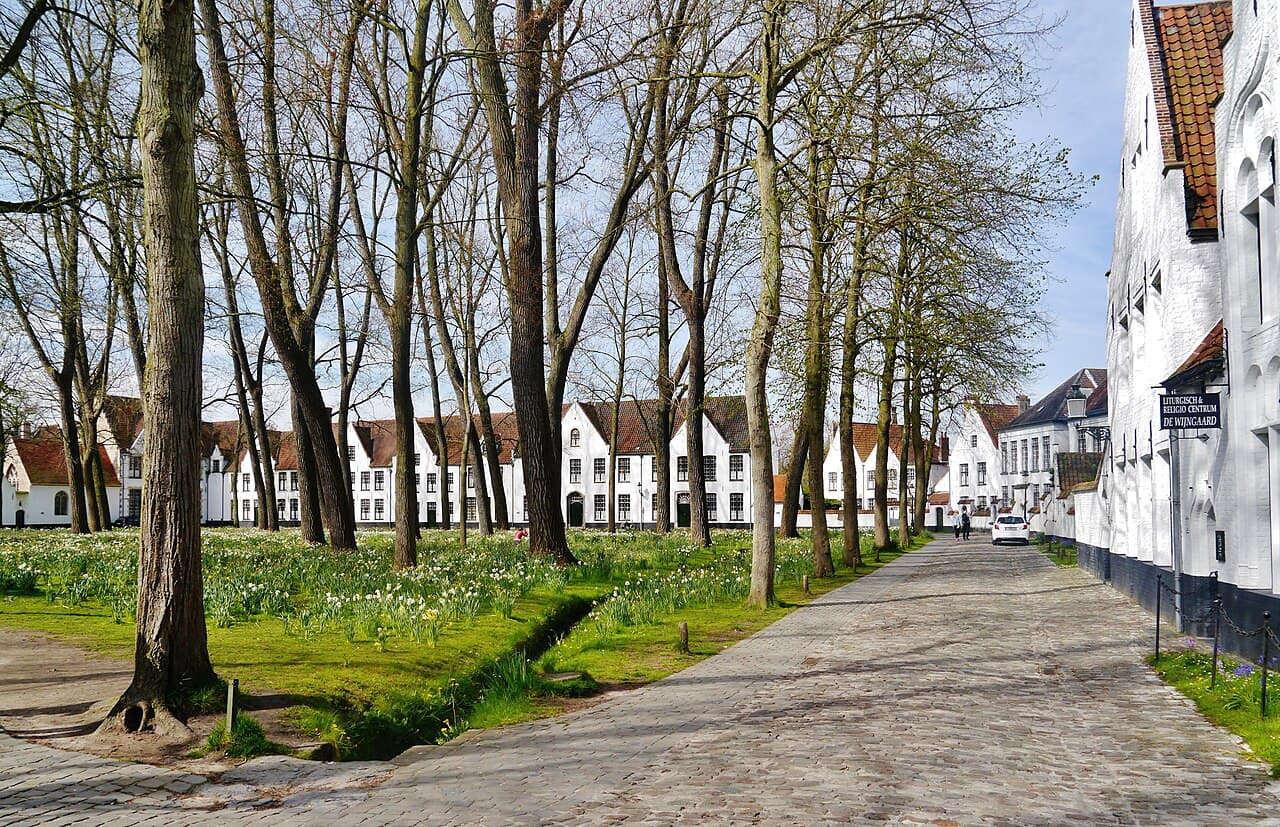
Go through the gate at Ten Wijngaerde in Bruges in April and you walk into a meadow of daffodils under poplars, ringed by whitewashed houses with stepped gables and green doors. The women who built this place in the thirteenth century took no permanent vows, kept their own property, and could leave when they chose and marry. They were beguines, and for seven hundred years Flanders held more of their walled courtyards than anywhere else on earth. The last to live the traditional life, Marcella Pattyn, blind from birth, died in Kortrijk in April 2013 aged 92.
Sixty kilometres south-west the ground carries a different memory. Around Ypres the fields are punctuated by walled rectangles of white headstones belonging to armies from Britain, Ireland, Canada, Australia, New Zealand, India, South Africa, France and Germany, and by a memorial arch carrying 54,395 names of men whose bodies were never found. Flanders is a place of white courtyards and white headstones, of belfries built by towns that bought their freedom, and of a language argued back into its own universities and courts.
Flanders is the northern region of Belgium, 13,626 square kilometres with 6,821,770 residents at the start of 2024, about 58 per cent of the Belgian population and a density near 500 people per square kilometre. The land is nearly flat: polders and dunes along a short North Sea coast, the sandy heath of the Kempen in the east, the low wooded ridges of the Flemish Ardennes in the south, and everywhere a grid of canals, motorways and towns that run into one another. Its five provinces are Antwerp, Limburg, East Flanders, West Flanders and Flemish Brabant, and Dutch is the official language. In Belgian law Flanders is both a Region, holding territory and economy, and a Community, holding culture and education for Dutch speakers; the two merged into one parliament and government, which sits in Brussels although Brussels lies outside the Flemish Region.
Bruges. The cloth city grew rich on English wool and Italian banking, lost its access to the sea, and slept through the centuries that would otherwise have rebuilt it. What survives is a medieval townscape almost intact, inscribed by UNESCO in 2000, with the belfry over the Markt, the Basilica of the Holy Blood and the beguinage at Ten Wijngaerde.
 The belfries of Flanders were built by towns rather than by lords or bishops, and they held the charters that recorded what the town had bought its freedom with. Photograph by Tim Adams, CC BY 3.0, via Wikimedia Commons.
Ghent. In the fourteenth century one of the largest cities north of the Alps and a byword for civic revolt, Ghent keeps the guild houses of the Graslei, the castle of the counts, and, in Saint Bavo's Cathedral, the Van Eyck altarpiece.
Antwerp. The Scheldt port was the commercial capital of sixteenth-century Europe and is Rubens's city. Its diamond district has handled the world's rough stones since the fifteenth century, and the trade grew up around Jewish, Armenian, Lebanese and Jain Indian dealers whose families still work the same streets behind the central station.
Leuven and Ypres. Leuven's Catholic university, founded in 1425, split along language lines in 1968. Ieper was shelled to powder between 1914 and 1918 and rebuilt from photographs.
The County of Flanders took shape in the ninth century as a fief of the French crown, while neighbouring Brabant and Limburg answered to the Holy Roman Empire. What made the region unusual was its towns. By 1300 the cloth cities of Flanders and Brabant were among the most urbanised places in Europe, importing English wool, weaving and dyeing it and selling it across the Continent, and their guilds held charters no French or German town of the period could match. When the French king tried to take direct control, Bruges rose against his garrison in May 1302 and a militia army of townsmen destroyed the French cavalry at Kortrijk on 11 July, the Battle of the Golden Spurs, now the Flemish Community's official holiday.
The dukes of Burgundy gathered the Low Countries in the fifteenth century and the Habsburgs inherited them. Then came the break that decided the shape of the modern country: after the Spanish recapture of Antwerp in 1585 the Dutch closed the Scheldt, Protestant merchants and craftsmen left for the north in tens of thousands, and the southern provinces stayed Catholic and Spanish while the north became a republic. Spanish, Austrian and French rule followed, then Belgian independence in 1830, in a state whose army, courts, administration and universities all ran in French.
Unwinding that took most of the twentieth century. Language laws fixed the border between Dutch-speaking and French-speaking Belgium in 1962 and 1963, and six state reforms between 1970 and 2014 turned a unitary kingdom into a federation of three regions and three language communities with real legislative powers. Brussels is its own bilingual region, separate from Flanders and from Wallonia, and belongs to neither.
The language of Flanders is Dutch, the same standard written language used in the Netherlands and governed jointly through the Dutch Language Union since 1980, though what people actually speak sits at several removes from it. Beneath the standard lie the old dialects of West Flanders, Brabant and Limburg, and between the two has grown a middle register linguists call tussentaal, drawing its sound and vocabulary mostly from Brabant. It is the language of Flemish television drama and of most informal talk, and it divides opinion sharply: some scholars read it as a young spoken standard finding its feet, while teachers and language columnists read it as an erosion of the standard that took a century of political effort to establish in Flanders at all.
That effort is the other half of the story. The Equality Law of 1898 made Dutch equal to French in Belgian legislation for the first time. Ghent University, founded in 1817 and teaching in French from 1835, became the object of a campaign begun by Lodewijk De Raet in 1903; the first Dutch courses opened in 1906, the German occupier reopened the institution as a Dutch-language university in 1916 in a move that tainted the cause for a generation, and only in 1930 did Belgian law make Ghent the first Dutch-language university in the country, with August Vermeylen as its rector. Leuven followed the same logic to a harder end: student agitation under the slogan Leuven Vlaams brought down the Vanden Boeynants government on 6 February 1968 and split the university, its French-speaking half moving south to a new town built for it at Louvain-la-Neuve.
Where the border runs through actual villages it still bites. Voeren, six villages moved from Liège province to Limburg in 1963, spent the 1980s in constitutional crisis over a mayor who would not sit a Dutch test, and the affair helped bring down a federal government in October 1987. Around Brussels, six municipalities of the Flemish periphery carry French-language facilities while remaining legally Dutch-speaking, an arrangement each community reads its own way. Place names record the frontier: villages ending in -gem, -kerke, -hout and -berg stop where French -court and -mont begin.
Flemish painting changed European art twice. In the 1420s Jan van Eyck and his brother Hubert built the Adoration of the Mystic Lamb for Saint Bavo's in Ghent, a polyptych 375 by 520 centimetres when open and finished in 1432, whose oil technique and observation of surfaces reset what a picture could do. Memling, Van der Weyden and Bruegel followed; Rubens made seventeenth-century Antwerp a capital of the Baroque. The altarpiece has been stolen more often than any painting in Europe. On the night of 10 April 1934 two panels were taken from the cathedral; the Saint John the Baptist came back as a gesture of good faith, a ransom demand of a million francs was refused, and the Just Judges has never been seen since. A Ghent broker named Arsène Goedertier, dying that November, told his lawyer that he alone knew where it was. A 1945 copy by Jef Van der Veken hangs in its place, and Ghent police still keep a detective on the file.
The calendar carries as much. On Ascension Day, Bruges walks the relic of the Holy Blood through the streets with some three thousand costumed townspeople, a procession recorded since the Middle Ages and inscribed by UNESCO in 2009. Dendermonde brings out the Ros Beiaard, the horse of the Charlemagne romances, and Mechelen its giants, both covered by a joint Belgian and French inscription of processional giants and dragons made in 2008. The carnival at Aalst went the other way. Inscribed in 2010, it produced floats in 2019 using antisemitic caricature; the city applied to have the listing withdrawn before the committee could act, and on 13 December 2019 UNESCO removed it, the first removal in the list's history. Binche's carnival, forty kilometres south in Wallonia, remains inscribed.
Flanders was Catholic for a thousand years and is now among the more secular parts of Europe, with baptisms, church funerals and Sunday attendance far below even 1970s levels and hundreds of parish churches repurposed, shared or closed. Mechelen remains the seat of the Belgian primate.
The distinctive Flemish contribution to religious life was the beguinage. From the late twelfth century, women in the towns of the Low Countries began living together in disciplined communities without entering an order: they kept their property, supported themselves by weaving, lacework and nursing, obeyed a rule while they stayed and were free to leave and marry. The great court beguinages that grew from this in the thirteenth century were small walled towns in their own right, with a gate that closed at night, a church, an infirmary, a brewery and rows of individual houses around a green. Church authorities were uneasy about women who were neither nuns nor wives, and the Counter-Reformation brought them under closer supervision, but the communities lasted into the twentieth century. Thirteen Flemish beguinages, among them Bruges, Leuven, Lier, Diest, Sint-Truiden, Turnhout and both Ghent houses, were inscribed together by UNESCO in 1998, and most are still lived in.
The ordinary Flemish way of remembering is domestic and printed. A death produces a doodsprentje, a memorial card with the photograph, the dates, a verse and the names of the surviving family, handed out at the funeral and kept in drawers and albums. Cremation now accounts for most funerals, and graves are held on concession from the municipality under the Flemish cemeteries decree of 2004, for terms families renew or let lapse, so a Flemish cemetery is a rolling record of who is still remembered. On 1 and 2 November the graveyards fill and the chrysanthemum trade takes its year's income in a week.
Above that sits the memory of 1914 to 1918, which Flanders keeps on behalf of half the world. The Ypres Salient was fought over for four years and the dead were left where the front had been. Tyne Cot, outside Passchendaele, holds 11,965 graves, of which 8,369 carry no name, and its curved rear wall lists 34,959 more men with no grave at all. The Menin Gate, unveiled on 24 July 1927, carries 54,395 names and stopped there only because the builders ran out of stone at an arbitrary cut-off of 15 August 1917. Since 2 July 1928 buglers of the Last Post Association, in the uniform of the Ypres fire brigade, have closed the road under the arch each evening at eight and sounded the Last Post; the ceremony moved to England under occupation and came back on 6 September 1944, days after Polish troops liberated the town. John McCrae wrote In Flanders Fields nearby in 1915, and its poppy became the emblem of remembrance across the English-speaking world. In September 2023 UNESCO inscribed the funerary and memory sites of the Western Front, so the cemeteries themselves are now World Heritage.
Flemish nationalism built a memorial of its own on the same ground. The IJzertoren at Diksmuide, raised between 1928 and 1930 over the graves of Flemish soldiers and carrying the letters AVV-VVK, "All for Flanders, Flanders for Christ", was blown up on the night of 15 March 1946 by two former resistance members; the rubble became a Peace Gate in 1950, and a second tower, 84 metres high and inscribed "No more war" on all four sides, was inaugurated in 1965. The IJzerbedevaart pilgrimage began in 1920 as a demand for peace and for Dutch in the army, and its history since is contested enough to be worth stating plainly. The German occupier ran the pilgrimages during the Second World War; Flemish nationalist organisations including the VNV and DeVlag collaborated; and postwar Belgian military justice opened more than 405,000 files, convicted some 53,000 people, pronounced 2,940 death sentences and carried out 242 executions between 1944 and 1950. Historians who have compared sentencing across the language border find the courts were about as severe in Wallonia as in Flanders, yet the conviction that Flanders had been punished as a people fixed itself in nationalist memory, and a general amnesty is still demanded and still refused. Diksmuide drew neo-Nazi visitors for years and radicals later split away to hold a rival gathering; the pilgrimage has recast itself around peace and tolerance.
Flemish records are among the most accessible in Europe, because the Belgian state archives digitised them and charge nothing.
Civil registration from 1796 and parish registers from the sixteenth century are online as images, along with the population registers that from 1846 tracked every household's moves with dates and destinations. That combination makes Flemish families traceable in a way few countries allow: you can follow a household from address to address across a century.
Records are in Dutch, in French for the Napoleonic and nineteenth-century administrative layers, and in Latin for the older church books, which is the practical obstacle rather than availability.
The cloth towns are the deep archive. Bruges, Ghent and Ypres kept municipal records from the medieval period, guild registers, orphan chamber accounts, and the poorterboeken listing new burghers, and the Ghent and Bruges city archives hold documents from the thirteenth century.
Two twentieth-century archives dominate. The Ypres Salient holds the graves and memorials of several nations; the Menin Gate names 54,395 men of the Commonwealth forces whose bodies were never found, and the Last Post has been sounded under it almost every evening since 1928. And the Dossin barracks at Mechelen, the assembly camp from which more than twenty-five thousand Jews and Roma were deported to Auschwitz, keeps the transport lists, which name every person on every train.
Heritage in Belgium is a regional competence, and the Flemish agency Onroerend Erfgoed runs listing, permitting and archaeology for the whole region, with an online inventory of protected monuments, townscapes, landscapes and archaeological zones. The thirteen beguinages were inscribed in 1998. The Belfries of Belgium and France followed in 1999 and were extended in 2005, and of the 56 towers on the list, 26 stand in Flanders, at Bruges, Ghent, Ypres, Dendermonde, Tielt, Veurne and elsewhere. These were never church towers: a commune that had won its charter built a belfry to hold it, along with the bell that called the militia and the clock that ran the day, and the height was an argument with the bishop and the lord.
The historic centre of Bruges was inscribed in 2000, the Plantin-Moretus printing house in Antwerp in 2005, and the Colonies of Benevolence at Wortel and Merksplas, nineteenth-century agricultural settlements built to resettle the poor, in 2021. Conservation science has its own showpiece: the Royal Institute for Cultural Heritage began work on the Ghent Altarpiece in October 2012, at a cost of about 2.2 million euros, and returned the restored lower panels to the cathedral in January 2020.
Flanders digitised early and put the results in public. Meemoo, the Flemish Institute for Archives, was formed in 2020 from three earlier bodies and preserves audiovisual material for more than 160 cultural, broadcast and government partners; its platform hetarchief.be lets anyone search descriptions of over a million items. The Onroerend Erfgoed inventory is online, and the federal State Archives have digitised the parish and civil registers on which Flemish family history rests.
Two projects show what this does for a single object and a single soldier. Closer to Van Eyck publishes the Ghent Altarpiece in gigapixel photography, in visible light, infrared and X-ray, so anyone can read the brushwork of 1432 up close. The In Flanders Fields Museum keeps a names list for the dead of the Salient, which turns an unreadable total back into individual men with regiments, dates and next of kin.
Flemish culture travels further than its size suggests. The Antwerp Six remade European fashion out of a port city in the 1980s, Flemish television drama exports steadily, and the comic-strip tradition of Willy Vandersteen remains a working industry. Bruges takes millions of visitors a year and argues, as Venice does, about what a preserved centre is for.
The political argument runs through all of it. The Flemish nationalist party N-VA takes confederalism as its programme, meaning a Belgium reduced to what the two large communities agree to share; Vlaams Belang seeks an independent Flanders. In the Flemish Parliament election of 9 June 2024 the two took 23.9 and 22.7 per cent of the vote, 31 seats each, and parties campaigning for neither confederalism nor independence took the rest, so a clear majority of Flemish voters chose parties that want Belgium to continue. N-VA's leader Bart De Wever became prime minister on 3 February 2025 at the head of a five-party federal coalition. Antwerp, Ghent and the Limburg towns are meanwhile among the most mixed places in Europe, and the language question that shaped Flemish heritage for a century now runs alongside a newer one about who else the word Flemish includes.
The beguinages kept as places to live. Thirteen walled courtyards inscribed together in 1998, most still occupied rather than dressed as museum sets, holding a form of religious life for women that existed almost nowhere else.
A university argued into its own language. From the first Dutch courses at Ghent in 1906 to the law of 1930, Flanders won the right to be educated at the highest level in the language it spoke.
The Mystic Lamb read at gigapixel. The Royal Institute for Cultural Heritage returned the restored panels to Saint Bavo's in 2020 and published the altarpiece online in visible, infrared and X-ray imaging.
A bugle call kept for nearly a century. Local volunteers have sounded the Last Post under the Menin Gate almost every evening since 1928, for the missing of armies that were never their own.
The belfries of Flanders were built by towns rather than by lords or bishops, and they held the charters that recorded what the town had bought its freedom with. Photograph by Tim Adams, CC BY 3.0, via Wikimedia Commons.
Ghent. In the fourteenth century one of the largest cities north of the Alps and a byword for civic revolt, Ghent keeps the guild houses of the Graslei, the castle of the counts, and, in Saint Bavo's Cathedral, the Van Eyck altarpiece.
Antwerp. The Scheldt port was the commercial capital of sixteenth-century Europe and is Rubens's city. Its diamond district has handled the world's rough stones since the fifteenth century, and the trade grew up around Jewish, Armenian, Lebanese and Jain Indian dealers whose families still work the same streets behind the central station.
Leuven and Ypres. Leuven's Catholic university, founded in 1425, split along language lines in 1968. Ieper was shelled to powder between 1914 and 1918 and rebuilt from photographs.
The County of Flanders took shape in the ninth century as a fief of the French crown, while neighbouring Brabant and Limburg answered to the Holy Roman Empire. What made the region unusual was its towns. By 1300 the cloth cities of Flanders and Brabant were among the most urbanised places in Europe, importing English wool, weaving and dyeing it and selling it across the Continent, and their guilds held charters no French or German town of the period could match. When the French king tried to take direct control, Bruges rose against his garrison in May 1302 and a militia army of townsmen destroyed the French cavalry at Kortrijk on 11 July, the Battle of the Golden Spurs, now the Flemish Community's official holiday.
The dukes of Burgundy gathered the Low Countries in the fifteenth century and the Habsburgs inherited them. Then came the break that decided the shape of the modern country: after the Spanish recapture of Antwerp in 1585 the Dutch closed the Scheldt, Protestant merchants and craftsmen left for the north in tens of thousands, and the southern provinces stayed Catholic and Spanish while the north became a republic. Spanish, Austrian and French rule followed, then Belgian independence in 1830, in a state whose army, courts, administration and universities all ran in French.
Unwinding that took most of the twentieth century. Language laws fixed the border between Dutch-speaking and French-speaking Belgium in 1962 and 1963, and six state reforms between 1970 and 2014 turned a unitary kingdom into a federation of three regions and three language communities with real legislative powers. Brussels is its own bilingual region, separate from Flanders and from Wallonia, and belongs to neither.
The language of Flanders is Dutch, the same standard written language used in the Netherlands and governed jointly through the Dutch Language Union since 1980, though what people actually speak sits at several removes from it. Beneath the standard lie the old dialects of West Flanders, Brabant and Limburg, and between the two has grown a middle register linguists call tussentaal, drawing its sound and vocabulary mostly from Brabant. It is the language of Flemish television drama and of most informal talk, and it divides opinion sharply: some scholars read it as a young spoken standard finding its feet, while teachers and language columnists read it as an erosion of the standard that took a century of political effort to establish in Flanders at all.
That effort is the other half of the story. The Equality Law of 1898 made Dutch equal to French in Belgian legislation for the first time. Ghent University, founded in 1817 and teaching in French from 1835, became the object of a campaign begun by Lodewijk De Raet in 1903; the first Dutch courses opened in 1906, the German occupier reopened the institution as a Dutch-language university in 1916 in a move that tainted the cause for a generation, and only in 1930 did Belgian law make Ghent the first Dutch-language university in the country, with August Vermeylen as its rector. Leuven followed the same logic to a harder end: student agitation under the slogan Leuven Vlaams brought down the Vanden Boeynants government on 6 February 1968 and split the university, its French-speaking half moving south to a new town built for it at Louvain-la-Neuve.
Where the border runs through actual villages it still bites. Voeren, six villages moved from Liège province to Limburg in 1963, spent the 1980s in constitutional crisis over a mayor who would not sit a Dutch test, and the affair helped bring down a federal government in October 1987. Around Brussels, six municipalities of the Flemish periphery carry French-language facilities while remaining legally Dutch-speaking, an arrangement each community reads its own way. Place names record the frontier: villages ending in -gem, -kerke, -hout and -berg stop where French -court and -mont begin.
Flemish painting changed European art twice. In the 1420s Jan van Eyck and his brother Hubert built the Adoration of the Mystic Lamb for Saint Bavo's in Ghent, a polyptych 375 by 520 centimetres when open and finished in 1432, whose oil technique and observation of surfaces reset what a picture could do. Memling, Van der Weyden and Bruegel followed; Rubens made seventeenth-century Antwerp a capital of the Baroque. The altarpiece has been stolen more often than any painting in Europe. On the night of 10 April 1934 two panels were taken from the cathedral; the Saint John the Baptist came back as a gesture of good faith, a ransom demand of a million francs was refused, and the Just Judges has never been seen since. A Ghent broker named Arsène Goedertier, dying that November, told his lawyer that he alone knew where it was. A 1945 copy by Jef Van der Veken hangs in its place, and Ghent police still keep a detective on the file.
The calendar carries as much. On Ascension Day, Bruges walks the relic of the Holy Blood through the streets with some three thousand costumed townspeople, a procession recorded since the Middle Ages and inscribed by UNESCO in 2009. Dendermonde brings out the Ros Beiaard, the horse of the Charlemagne romances, and Mechelen its giants, both covered by a joint Belgian and French inscription of processional giants and dragons made in 2008. The carnival at Aalst went the other way. Inscribed in 2010, it produced floats in 2019 using antisemitic caricature; the city applied to have the listing withdrawn before the committee could act, and on 13 December 2019 UNESCO removed it, the first removal in the list's history. Binche's carnival, forty kilometres south in Wallonia, remains inscribed.
Flanders was Catholic for a thousand years and is now among the more secular parts of Europe, with baptisms, church funerals and Sunday attendance far below even 1970s levels and hundreds of parish churches repurposed, shared or closed. Mechelen remains the seat of the Belgian primate.
The distinctive Flemish contribution to religious life was the beguinage. From the late twelfth century, women in the towns of the Low Countries began living together in disciplined communities without entering an order: they kept their property, supported themselves by weaving, lacework and nursing, obeyed a rule while they stayed and were free to leave and marry. The great court beguinages that grew from this in the thirteenth century were small walled towns in their own right, with a gate that closed at night, a church, an infirmary, a brewery and rows of individual houses around a green. Church authorities were uneasy about women who were neither nuns nor wives, and the Counter-Reformation brought them under closer supervision, but the communities lasted into the twentieth century. Thirteen Flemish beguinages, among them Bruges, Leuven, Lier, Diest, Sint-Truiden, Turnhout and both Ghent houses, were inscribed together by UNESCO in 1998, and most are still lived in.
The ordinary Flemish way of remembering is domestic and printed. A death produces a doodsprentje, a memorial card with the photograph, the dates, a verse and the names of the surviving family, handed out at the funeral and kept in drawers and albums. Cremation now accounts for most funerals, and graves are held on concession from the municipality under the Flemish cemeteries decree of 2004, for terms families renew or let lapse, so a Flemish cemetery is a rolling record of who is still remembered. On 1 and 2 November the graveyards fill and the chrysanthemum trade takes its year's income in a week.
Above that sits the memory of 1914 to 1918, which Flanders keeps on behalf of half the world. The Ypres Salient was fought over for four years and the dead were left where the front had been. Tyne Cot, outside Passchendaele, holds 11,965 graves, of which 8,369 carry no name, and its curved rear wall lists 34,959 more men with no grave at all. The Menin Gate, unveiled on 24 July 1927, carries 54,395 names and stopped there only because the builders ran out of stone at an arbitrary cut-off of 15 August 1917. Since 2 July 1928 buglers of the Last Post Association, in the uniform of the Ypres fire brigade, have closed the road under the arch each evening at eight and sounded the Last Post; the ceremony moved to England under occupation and came back on 6 September 1944, days after Polish troops liberated the town. John McCrae wrote In Flanders Fields nearby in 1915, and its poppy became the emblem of remembrance across the English-speaking world. In September 2023 UNESCO inscribed the funerary and memory sites of the Western Front, so the cemeteries themselves are now World Heritage.
Flemish nationalism built a memorial of its own on the same ground. The IJzertoren at Diksmuide, raised between 1928 and 1930 over the graves of Flemish soldiers and carrying the letters AVV-VVK, "All for Flanders, Flanders for Christ", was blown up on the night of 15 March 1946 by two former resistance members; the rubble became a Peace Gate in 1950, and a second tower, 84 metres high and inscribed "No more war" on all four sides, was inaugurated in 1965. The IJzerbedevaart pilgrimage began in 1920 as a demand for peace and for Dutch in the army, and its history since is contested enough to be worth stating plainly. The German occupier ran the pilgrimages during the Second World War; Flemish nationalist organisations including the VNV and DeVlag collaborated; and postwar Belgian military justice opened more than 405,000 files, convicted some 53,000 people, pronounced 2,940 death sentences and carried out 242 executions between 1944 and 1950. Historians who have compared sentencing across the language border find the courts were about as severe in Wallonia as in Flanders, yet the conviction that Flanders had been punished as a people fixed itself in nationalist memory, and a general amnesty is still demanded and still refused. Diksmuide drew neo-Nazi visitors for years and radicals later split away to hold a rival gathering; the pilgrimage has recast itself around peace and tolerance.
Flemish records are among the most accessible in Europe, because the Belgian state archives digitised them and charge nothing.
Civil registration from 1796 and parish registers from the sixteenth century are online as images, along with the population registers that from 1846 tracked every household's moves with dates and destinations. That combination makes Flemish families traceable in a way few countries allow: you can follow a household from address to address across a century.
Records are in Dutch, in French for the Napoleonic and nineteenth-century administrative layers, and in Latin for the older church books, which is the practical obstacle rather than availability.
The cloth towns are the deep archive. Bruges, Ghent and Ypres kept municipal records from the medieval period, guild registers, orphan chamber accounts, and the poorterboeken listing new burghers, and the Ghent and Bruges city archives hold documents from the thirteenth century.
Two twentieth-century archives dominate. The Ypres Salient holds the graves and memorials of several nations; the Menin Gate names 54,395 men of the Commonwealth forces whose bodies were never found, and the Last Post has been sounded under it almost every evening since 1928. And the Dossin barracks at Mechelen, the assembly camp from which more than twenty-five thousand Jews and Roma were deported to Auschwitz, keeps the transport lists, which name every person on every train.
Heritage in Belgium is a regional competence, and the Flemish agency Onroerend Erfgoed runs listing, permitting and archaeology for the whole region, with an online inventory of protected monuments, townscapes, landscapes and archaeological zones. The thirteen beguinages were inscribed in 1998. The Belfries of Belgium and France followed in 1999 and were extended in 2005, and of the 56 towers on the list, 26 stand in Flanders, at Bruges, Ghent, Ypres, Dendermonde, Tielt, Veurne and elsewhere. These were never church towers: a commune that had won its charter built a belfry to hold it, along with the bell that called the militia and the clock that ran the day, and the height was an argument with the bishop and the lord.
The historic centre of Bruges was inscribed in 2000, the Plantin-Moretus printing house in Antwerp in 2005, and the Colonies of Benevolence at Wortel and Merksplas, nineteenth-century agricultural settlements built to resettle the poor, in 2021. Conservation science has its own showpiece: the Royal Institute for Cultural Heritage began work on the Ghent Altarpiece in October 2012, at a cost of about 2.2 million euros, and returned the restored lower panels to the cathedral in January 2020.
Flanders digitised early and put the results in public. Meemoo, the Flemish Institute for Archives, was formed in 2020 from three earlier bodies and preserves audiovisual material for more than 160 cultural, broadcast and government partners; its platform hetarchief.be lets anyone search descriptions of over a million items. The Onroerend Erfgoed inventory is online, and the federal State Archives have digitised the parish and civil registers on which Flemish family history rests.
Two projects show what this does for a single object and a single soldier. Closer to Van Eyck publishes the Ghent Altarpiece in gigapixel photography, in visible light, infrared and X-ray, so anyone can read the brushwork of 1432 up close. The In Flanders Fields Museum keeps a names list for the dead of the Salient, which turns an unreadable total back into individual men with regiments, dates and next of kin.
Flemish culture travels further than its size suggests. The Antwerp Six remade European fashion out of a port city in the 1980s, Flemish television drama exports steadily, and the comic-strip tradition of Willy Vandersteen remains a working industry. Bruges takes millions of visitors a year and argues, as Venice does, about what a preserved centre is for.
The political argument runs through all of it. The Flemish nationalist party N-VA takes confederalism as its programme, meaning a Belgium reduced to what the two large communities agree to share; Vlaams Belang seeks an independent Flanders. In the Flemish Parliament election of 9 June 2024 the two took 23.9 and 22.7 per cent of the vote, 31 seats each, and parties campaigning for neither confederalism nor independence took the rest, so a clear majority of Flemish voters chose parties that want Belgium to continue. N-VA's leader Bart De Wever became prime minister on 3 February 2025 at the head of a five-party federal coalition. Antwerp, Ghent and the Limburg towns are meanwhile among the most mixed places in Europe, and the language question that shaped Flemish heritage for a century now runs alongside a newer one about who else the word Flemish includes.
The beguinages kept as places to live. Thirteen walled courtyards inscribed together in 1998, most still occupied rather than dressed as museum sets, holding a form of religious life for women that existed almost nowhere else.
A university argued into its own language. From the first Dutch courses at Ghent in 1906 to the law of 1930, Flanders won the right to be educated at the highest level in the language it spoke.
The Mystic Lamb read at gigapixel. The Royal Institute for Cultural Heritage returned the restored panels to Saint Bavo's in 2020 and published the altarpiece online in visible, infrared and X-ray imaging.
A bugle call kept for nearly a century. Local volunteers have sounded the Last Post under the Menin Gate almost every evening since 1928, for the missing of armies that were never their own.
National Overview
Notable Cities
Historical Foundations
Linguistic and Etymological Roots
Cultural Identity
Religion and Spirituality
Remembrance and Mourning Traditions
Tracing a Family in Flanders
Heritage Preservation Efforts
Digital Heritage
Contemporary Cultural Influences
Success Stories
References and resources
- UNESCO, Flemish Beguinages: inscribed 1998.
- UNESCO, Belfries of Belgium and France: 56 civic towers, 1999 and 2005.
- UNESCO, Historic Centre of Brugge: the medieval townscape, inscribed 2000.
- UNESCO, Funerary and memory sites of the First World War: inscribed 2023.
- UNESCO, Procession of the Holy Blood in Bruges: inscribed 2009.
- UNESCO, Processional giants and dragons: Dendermonde and Mechelen among them.
- Onroerend Erfgoed and its inventory.
- hetarchief.be: meemoo's search across a million archived items.
- Closer to Van Eyck: the altarpiece in gigapixel imaging.
- In Flanders Fields Museum: the Salient and its names list.
- Last Post Association: the volunteers at the Menin Gate.
- Encyclopaedia Britannica, Flanders: geography, history and institutions.