Heritage · Country
Aceh Culture and Heritage
At the northern tip of Sumatra, a sultanate that once sent envoys to Istanbul became the one Indonesian province applying Islamic criminal law, the site of a thirty-year separatist war ended by treaty in 2005, and the ground where tens of thousands of the 2004 tsunami dead lie in graves without names.Written to last.
By Confinity Heritage Editorial · Updated 2026-08-17 · 8-minute readQuiet tools, kept out of the way.
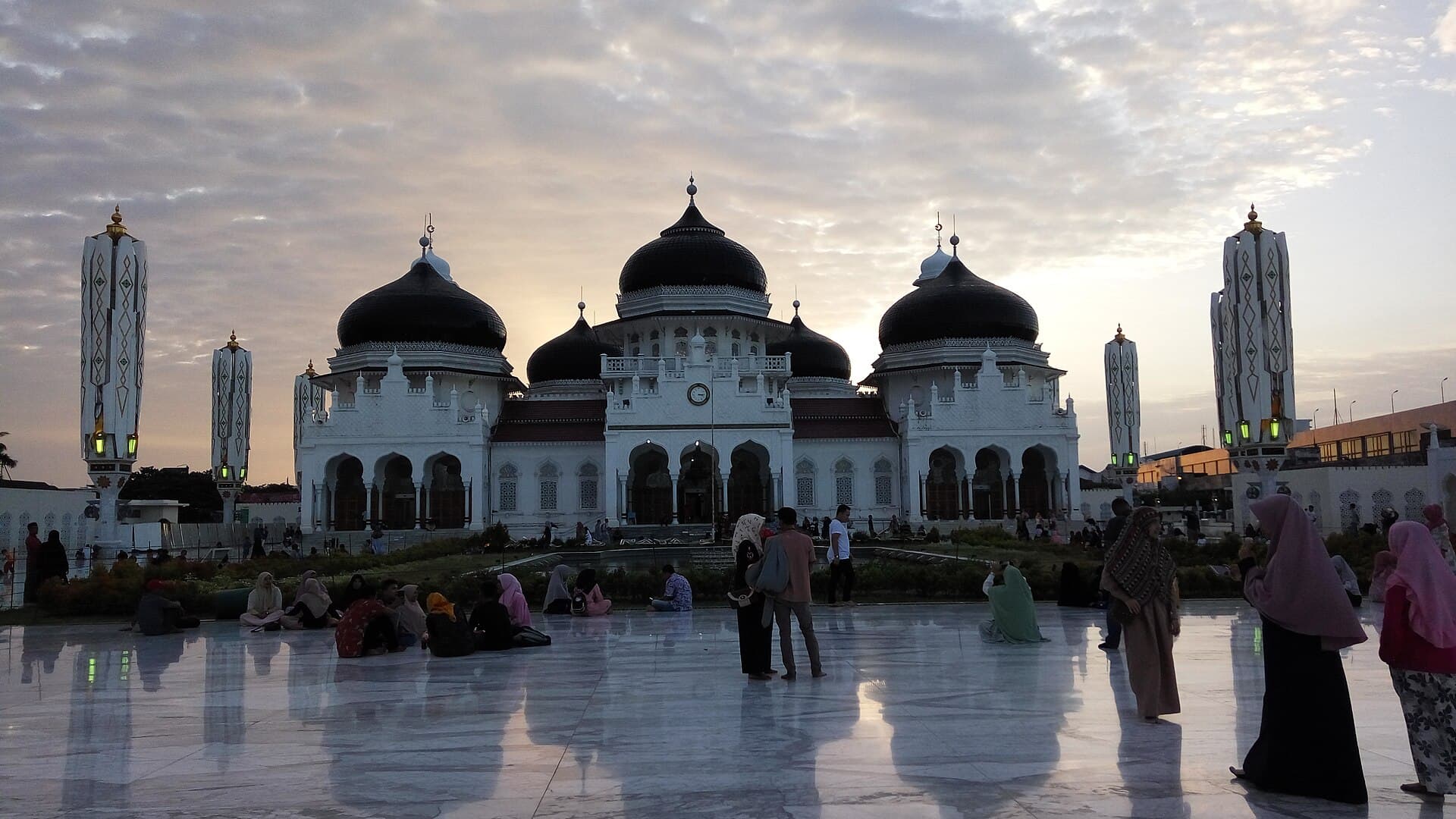
The Baiturrahman Grand Mosque in Banda Aceh has been burned once and flooded once. Dutch troops set its thatched roof alight in April 1873, in the opening weeks of a colonial war that would run for four decades, and the Dutch afterwards rebuilt it in white stone as a peace offering they hoped would buy quiet. On the morning of 26 December 2004 the sea came through the city, reached the mosque and stopped at its walls, and for weeks afterwards the building sheltered the living while the dead were carried past it in trucks.
Aceh is the northernmost province of Sumatra and the only part of Indonesia that applies Islamic criminal law. It was a sultanate whose envoys reached the Ottoman court, the harbour from which pilgrims sailed for Mecca, and the last territory in the archipelago to fall to the Dutch.
Aceh covers about 56,800 square kilometres at the northern end of Sumatra, where the Strait of Malacca meets the Indian Ocean, and held roughly 5.55 million people in 2024 (Wikipedia). Its capital is Banda Aceh; eighteen regencies and five cities run from the Gayo highlands of the interior to a long, exposed western coast. Almost all Acehnese are Muslim.
The province's autonomy goes beyond that of any other Indonesian region, and three national laws set the terms: Law 44 of 1999 on special status, Law 18 of 2001 on special autonomy, and Law 11 of 2006 on the Governing of Aceh, which put the 2005 peace agreement into Indonesian statute. Together they give Aceh its own sharia courts, a larger share of oil and gas revenue than any other province, the office of the Wali Nanggroe as custodian of Acehnese custom, and the sole right in Indonesia to register local political parties. That last provision is what allowed former rebels to become a governing party rather than a militia.
Banda Aceh. Long known as Kutaraja, the royal seat, the city holds the Baiturrahman mosque, the Gunongan pleasure-hill built by Iskandar Muda for his queen, the tombs of the sultans, and Museum Aceh, established in 1915 around a full-size rumoh Aceh, the raised timber house on stilts. It also holds the Kerkhof Peucut, the Dutch military cemetery where more than two thousand soldiers of the Aceh War lie, among them General Kohler, shot near the mosque in April 1873. Its coastal district of Ulee Lheue was among the areas most completely destroyed in 2004.
Sabang. On Weh Island off the northern tip, Sabang holds Kilometre Zero, the marker from which Indonesia measures itself.
Lhokseumawe and Sigli. Lhokseumawe grew around the Arun gas field, whose revenues became one of the grievances behind the separatist war; nearby lie the gravestones of Samudera Pasai, the first Islamic polity in the archipelago. Sigli, in Pidie, sits in the heartland of the dayah, the Acehnese religious boarding schools.
Takengon and Meulaboh. Takengon is the Gayo highland town on Lake Laut Tawar, centre of an arabica region whose beans sell worldwide under the Gayo name. Meulaboh, on the west coast, was the home town of the guerrilla leader Teuku Umar and among the places the tsunami erased entirely.
Islam reached the archipelago through this coast. Samudera Pasai was a Muslim sultanate by the thirteenth century, and Ibn Battuta stopped there in the 1340s and found a court already following Shafi'i law. Aceh Darussalam rose in its place under Ali Mughayat Syah, and by the reign of Iskandar Muda from 1607 to 1636 it controlled much of Sumatra's coast and part of the Malay peninsula, traded pepper across the Indian Ocean, and exchanged envoys and cannon with the Ottoman sultan. Between 1641 and 1699 four sultanas ruled in succession, an arrangement unusual in the Muslim world of the period.
The Anglo-Dutch treaty of 1871 removed the last British objection to Dutch expansion, and on 26 March 1873 the Netherlands declared war. The first expedition failed and its commander was killed. The second took the palace, but the sultanate did not surrender with it, and what followed was a guerrilla war fought village by village, prolonged by the ulama's ruling that resistance was a religious duty and by the war poem Hikayat Prang Sabi, recited before battle. The last sultan surrendered in 1903, organised resistance persisted past 1914, and the Aceh War became the longest and costliest colonial campaign the Dutch ever fought. Cut Nyak Dhien, Teuku Umar and Cut Meutia, who led in the field after their husbands were killed, are Indonesian national heroes today.
Aceh joined the Indonesian republic willingly in 1945 and funded the aircraft that flew its first air service. The relationship soured. A revolt under the religious leader Daud Beureueh ran from 1953 to 1962 and was settled by granting Aceh special-region status. Then, on 4 December 1976, Hasan di Tiro proclaimed the Free Aceh Movement, known by its Indonesian initials GAM, and a separatist war began that lasted twenty-nine years. From 1989 to 1998 Aceh was designated a military operations area, the period Acehnese call DOM, during which counter-insurgency units worked with little oversight; Komnas HAM, Indonesia's national human rights commission, and organisations including Human Rights Watch and Amnesty International have documented extrajudicial killings, torture, sexual violence and enforced disappearance from that period and from the martial law of 2003 and 2004 (Human Rights Watch). Estimates of the total dead run from about 15,000 upward, and most of them were civilians (Wikipedia).
Acehnese, called Bahsa Acèh by its speakers, is not a dialect of Indonesian and is not close to it. It belongs to the Chamic branch of Malayo-Polynesian, which puts its nearest relatives among the Cham languages of Vietnam and Cambodia, thousands of kilometres away across the South China Sea, a relationship that points to old maritime movement rather than overland spread (Wikipedia). Around three and a half million people speak it, and until the twentieth century it was written in Jawi, the Arabic script adapted for Malay.
Aceh is multilingual in its own right. Gayo, spoken by around seven per cent of the province, belongs to a separate Northwest Sumatran grouping; Alas, in the south-east, sits with the Batak languages; Tamiang Malay, Aneuk Jamee, Kluet and the Devayan and Sigulai of Simeulue each hold their own ground.
The province's name is of uncertain origin. Arabic, Chinese and European sources record medieval forms including Lambri, Ramni and Achin, and the modern spelling reached English by way of Dutch Atjeh. The name Acehnese use most about themselves is a title: Serambi Mekkah, the veranda of Mecca, earned because pilgrims from across the archipelago gathered here to sail and because Aceh's scholars were the region's channel to the wider Muslim world.
The best known Acehnese art form is the saman, a seated dance of the Gayo in which a line of performers claps, slaps chest and thigh, and sings in tightening rhythmic canon without any instrument. UNESCO placed it on the List of Intangible Cultural Heritage in Need of Urgent Safeguarding in 2011, noting that transmission was weakening as fewer young Gayo learned the verses (UNESCO). Alongside it stand the seudati, danced upright by men with sharp finger-snaps and stamping, and the rapai, a frame drum played in ensembles for hours at a time.
Acehnese material culture is exact and restrained. Weavers produce songket with gold-wrapped thread, and Gayo embroiderers work the kerawang patterns that edge ceremonial cloth. The rencong, the curved dagger carried at the waist, is shaped so that handle, blade and sheath together trace the Arabic letters of the bismillah, which makes the province's emblematic weapon also a written prayer. Houses were built as rumoh Aceh, raised on posts with a steep roof and no nails. The food carries the trade routes plainly: mie Aceh heavy with cardamom and cumin, curries thickened with coconut, and Gayo coffee.
Aceh is close to entirely Muslim and has been a centre of Islamic scholarship for six centuries. Teaching runs through the dayah, boarding schools led by a teungku where students spend years on classical Arabic texts, a network older than the Indonesian state and still influential in provincial politics. The province produced major writers of Malay-language Islam: the Sufi poet Hamzah Fansuri, Syamsuddin al-Sumatrani after him, the jurist Nuruddin ar-Raniri who condemned their doctrine and had their books burned, and Abdurrauf as-Singkili, known as Syiah Kuala, whose tomb outside Banda Aceh is still visited.
 The Dutch burned the original mosque in 1873 and then built this one as an apology that nobody had asked for. It survived the tsunami of 2004 and sheltered people who had lost everything. Photograph by C.J. Kleingrothe, public domain, via Wikimedia Commons.
Aceh is also the only part of Indonesia where Islamic criminal law is enforced by the state, and the arrangement should be set out precisely. The special autonomy law of 2001 granted the province power to legislate on sharia, and the assembly used it: qanun on Islamic dress in 2002 and on alcohol, gambling and khalwat, unlawful seclusion between unmarried people, in 2003, then the Qanun Jinayat of 2014, a criminal code that took effect in 2015 and widened the list of offences. Enforcement is shared between the national police and the Wilayatul Hisbah, and sentences include fines, imprisonment and caning. Indonesian and international human rights organisations have criticised both the code and its application: Human Rights Watch documented abuses in enforcement, including coercive interrogation and virginity testing, in a 2010 report, and called the 2014 code a violation of rights when it passed; Amnesty International and Komnas HAM have both described judicial caning as cruel, inhuman or degrading treatment. Provincial authorities defend the laws as the work of a democratically elected assembly acting inside the autonomy granted by national statute, and in 2018 the governor ordered caning carried out inside prison grounds rather than before crowds. This page records the legal basis and the criticism and leaves the argument there.
Acehnese funerals follow Islamic practice closely. The body is washed, shrouded and buried the same day where possible, facing the qibla, after the congregational funeral prayer. What follows is communal: kenduri, gatherings at the family house on successive nights through the first week and again at the fortieth and hundredth day, where neighbours eat and recite Surah Yasin and the tahlil. Graves are visited before Ramadan and after the two Eids, and families keep a low plot with a pair of upright stones, a carving tradition whose medieval form, the Batu Aceh, was exported by sea to Malay graveyards as far as Brunei.
None of that was possible for most of the people who died on 26 December 2004. The earthquake off western Sumatra sent waves into Banda Aceh within half an hour, and the province lost more people than anywhere else on earth that day. Figures vary with method and are better given as a range: Indonesian official counts recorded roughly 130,000 dead with tens of thousands more missing, and totals cited for Aceh reach beyond 170,000 once the missing are included (Wikipedia). Bodies were collected for weeks and buried in haste against disease amid the wreckage. At Siron, in Aceh Besar, some 46,000 people lie in one field. At Ulee Lheue, on the Banda Aceh shore, more than 14,000 lie in another. Almost none were identified, because there was no forensic capacity, no time, and often no surviving relative to ask.
That is the fact this page exists to hold. A family in Banda Aceh who lost a mother and two children does not have three graves. They have a lawn behind a stone gate, and they go there on 26 December and pray over everyone, because praying over everyone is the only way to include their own. The province marks the anniversary with a siren at the hour the wave arrived, mass prayers at Siron and Ulee Lheue, and a service at Baiturrahman. Twenty years on, survivors interviewed at the graves still speak first of not having found the bodies.
The war left a second class of unnamed dead. Families of people who disappeared during the DOM years and under martial law have spent decades asking where their relatives are buried. The Aceh Truth and Reconciliation Commission, the KKR Aceh, was created by provincial statute and began work in 2016; by 2021 it had taken roughly five thousand statements from victims and witnesses, and in December 2023 it published its findings report, Peulara Damèe. Its reparations recommendations have been acted on slowly, and for most families the question of where a father or a son lies has never been answered.
Acehnese records were destroyed twice, by a war and by a wave, and the second time the world was watching.
The Sultanate of Aceh kept a court archive, and Islamic scholarship here produced manuscripts in Malay and Arabic from the sixteenth century onward, held privately and in mosque and dayah collections. The Dutch war from 1873 to 1914 was long and destructive, and the colonial record that followed is split between Banda Aceh, Jakarta and The Hague.
The conflict between the Free Aceh Movement and the Indonesian state, from 1976 to 2005, killed something like fifteen thousand people, mostly civilians, and displaced many more. Documentation of it is partial and the truth commission established after the peace agreement has worked slowly.
Then 26 December 2004. The tsunami killed around 170,000 people in Aceh alone and destroyed Banda Aceh's administrative core, including civil registry offices and their books. Whole families died together, so there was often nobody left to report a death or claim an inheritance, and the identification of bodies was largely impossible; most were buried in mass graves. Reconstructing land title, which mattered enormously for rebuilding, had to be done through community mapping, with neighbours and village heads confirming boundaries that no surviving document recorded.
What survived is the manuscript tradition, in family hands, and the practice of the dayah, the religious schools, whose teacher-to-student chains, the sanad, are a genealogy of learning rather than of blood.
Aceh's protected heritage divides between what the sultanate left and what the disaster left. Museum Aceh, opened in 1915, holds royal regalia, weapons, textiles and the bronze bell Cakra Donya, a fifteenth-century gift linked to the voyages of Zheng He. The sultans' tombs, the Gunongan and the Kerkhof Peucut are maintained as cultural property, and the Samudera Pasai gravestones are protected as the earliest Islamic monuments in Indonesia.
The tsunami sites were preserved deliberately and fast. The Aceh Tsunami Museum, designed by Ridwan Kamil, who won the competition for it in 2007 with a scheme called the Rumoh Aceh Escape Hill, is both a museum and an evacuation building raised above flood level; visitors pass through a dark, narrow water-walled corridor into the Sumur Doa, a cylindrical well of light whose walls carry the names of victims. The PLTD Apung 1, a 2,600-tonne floating diesel power station carried kilometres inland and set down on top of two houses, was left where it landed and made a memorial park. At Lampulo, a twenty-five metre fishing boat that came to rest on a house roof, and on which fifty-nine people survived the water, has been kept in place with a walkway built to it.
Aceh holds no UNESCO World Heritage Site; its international recognition has come through intangible heritage and archives.
The documentary record of the disaster has been formally recognised. In 2017 the Indian Ocean Tsunami Archives, nominated jointly by the national archives of Indonesia and Sri Lanka, were inscribed on the UNESCO Memory of the World International Register, covering photographs, film, official records and the paperwork of relief and reconstruction (UNESCO). The Tsunami and Disaster Mitigation Research Centre at Syiah Kuala University holds a research repository of the same material.
Acehnese manuscripts have moved online through outside funding. Two projects under the British Library's Endangered Archives Programme, EAP229 and EAP329, surveyed and then photographed private collections held in family houses across Pidie and Aceh Besar, many of them damp, insect-damaged and unread for generations (Endangered Archives Programme). The gap that remains is the human one: there is no complete register of who died in 2004, and no database into which a family can enter a name and find where their relative is buried, because for the mass graves that information was never recorded.
Gayo coffee has made Aceh's name in places that know nothing else about it, and the diaspora in Malaysia keeps the language alive. The saman is now performed at national ceremonies and in mass displays of hundreds of dancers, which spreads it and flattens it at once, a tension UNESCO named on listing it. Acehnese writers and filmmakers have produced a substantial body of work about the conflict and the wave, and Banda Aceh receives a steady flow of visitors who come for the memorials and for disaster preparedness.
Aceh has also become the first landfall for Rohingya refugees crossing the Andaman Sea. Acehnese fishermen have repeatedly gone out to bring boats ashore, most visibly in 2015 and against instructions to push them back, and the rescues are remembered locally as an obligation owed by people who were themselves rescued. Later arrivals, particularly from 2023, met a more divided response, with some communities refusing landings and student groups protesting; officials and aid agencies have described the strain on villages hosting arrivals with little national support. Both parts of that record are recent, and both are Acehnese.
A war that actually ended. On 15 August 2005, in Helsinki, the Indonesian government and the Free Aceh Movement signed a memorandum of understanding brokered by the Crisis Management Initiative under the former Finnish president Martti Ahtisaari. GAM gave up independence for far-reaching self-government, an amnesty and the right to form local political parties; Indonesia withdrew its non-organic forces. The Aceh Monitoring Mission, staffed by the European Union and five ASEAN states, oversaw the handover and destruction of GAM weapons and the troop withdrawal, and closed in December 2006 (Wikipedia). Former combatants were reintegrated through a provincial agency, a former GAM negotiator was elected governor in 2006, and the peace has held for two decades. The disaster eight months earlier is widely credited with creating the conditions for it, by opening Aceh to outsiders and making the war look unaffordable to both sides.
A coastline rebuilt. A national reconstruction agency ran from 2005 to 2009, coordinating donors, government and communities to rebuild more than a hundred thousand houses and much of the province's infrastructure within four years.
A dance kept alive. The saman's inscription in 2011 brought funding and teaching programmes to Gayo villages, and the dance reaches children who would otherwise have met it only as a performance.
Against these sits a plain shortfall. The truth commission established in 2016 has worked slowly, its recommendations have been only partly acted on, and the families of the disappeared, like the families of the unidentified tsunami dead, are still waiting.
The Dutch burned the original mosque in 1873 and then built this one as an apology that nobody had asked for. It survived the tsunami of 2004 and sheltered people who had lost everything. Photograph by C.J. Kleingrothe, public domain, via Wikimedia Commons.
Aceh is also the only part of Indonesia where Islamic criminal law is enforced by the state, and the arrangement should be set out precisely. The special autonomy law of 2001 granted the province power to legislate on sharia, and the assembly used it: qanun on Islamic dress in 2002 and on alcohol, gambling and khalwat, unlawful seclusion between unmarried people, in 2003, then the Qanun Jinayat of 2014, a criminal code that took effect in 2015 and widened the list of offences. Enforcement is shared between the national police and the Wilayatul Hisbah, and sentences include fines, imprisonment and caning. Indonesian and international human rights organisations have criticised both the code and its application: Human Rights Watch documented abuses in enforcement, including coercive interrogation and virginity testing, in a 2010 report, and called the 2014 code a violation of rights when it passed; Amnesty International and Komnas HAM have both described judicial caning as cruel, inhuman or degrading treatment. Provincial authorities defend the laws as the work of a democratically elected assembly acting inside the autonomy granted by national statute, and in 2018 the governor ordered caning carried out inside prison grounds rather than before crowds. This page records the legal basis and the criticism and leaves the argument there.
Acehnese funerals follow Islamic practice closely. The body is washed, shrouded and buried the same day where possible, facing the qibla, after the congregational funeral prayer. What follows is communal: kenduri, gatherings at the family house on successive nights through the first week and again at the fortieth and hundredth day, where neighbours eat and recite Surah Yasin and the tahlil. Graves are visited before Ramadan and after the two Eids, and families keep a low plot with a pair of upright stones, a carving tradition whose medieval form, the Batu Aceh, was exported by sea to Malay graveyards as far as Brunei.
None of that was possible for most of the people who died on 26 December 2004. The earthquake off western Sumatra sent waves into Banda Aceh within half an hour, and the province lost more people than anywhere else on earth that day. Figures vary with method and are better given as a range: Indonesian official counts recorded roughly 130,000 dead with tens of thousands more missing, and totals cited for Aceh reach beyond 170,000 once the missing are included (Wikipedia). Bodies were collected for weeks and buried in haste against disease amid the wreckage. At Siron, in Aceh Besar, some 46,000 people lie in one field. At Ulee Lheue, on the Banda Aceh shore, more than 14,000 lie in another. Almost none were identified, because there was no forensic capacity, no time, and often no surviving relative to ask.
That is the fact this page exists to hold. A family in Banda Aceh who lost a mother and two children does not have three graves. They have a lawn behind a stone gate, and they go there on 26 December and pray over everyone, because praying over everyone is the only way to include their own. The province marks the anniversary with a siren at the hour the wave arrived, mass prayers at Siron and Ulee Lheue, and a service at Baiturrahman. Twenty years on, survivors interviewed at the graves still speak first of not having found the bodies.
The war left a second class of unnamed dead. Families of people who disappeared during the DOM years and under martial law have spent decades asking where their relatives are buried. The Aceh Truth and Reconciliation Commission, the KKR Aceh, was created by provincial statute and began work in 2016; by 2021 it had taken roughly five thousand statements from victims and witnesses, and in December 2023 it published its findings report, Peulara Damèe. Its reparations recommendations have been acted on slowly, and for most families the question of where a father or a son lies has never been answered.
Acehnese records were destroyed twice, by a war and by a wave, and the second time the world was watching.
The Sultanate of Aceh kept a court archive, and Islamic scholarship here produced manuscripts in Malay and Arabic from the sixteenth century onward, held privately and in mosque and dayah collections. The Dutch war from 1873 to 1914 was long and destructive, and the colonial record that followed is split between Banda Aceh, Jakarta and The Hague.
The conflict between the Free Aceh Movement and the Indonesian state, from 1976 to 2005, killed something like fifteen thousand people, mostly civilians, and displaced many more. Documentation of it is partial and the truth commission established after the peace agreement has worked slowly.
Then 26 December 2004. The tsunami killed around 170,000 people in Aceh alone and destroyed Banda Aceh's administrative core, including civil registry offices and their books. Whole families died together, so there was often nobody left to report a death or claim an inheritance, and the identification of bodies was largely impossible; most were buried in mass graves. Reconstructing land title, which mattered enormously for rebuilding, had to be done through community mapping, with neighbours and village heads confirming boundaries that no surviving document recorded.
What survived is the manuscript tradition, in family hands, and the practice of the dayah, the religious schools, whose teacher-to-student chains, the sanad, are a genealogy of learning rather than of blood.
Aceh's protected heritage divides between what the sultanate left and what the disaster left. Museum Aceh, opened in 1915, holds royal regalia, weapons, textiles and the bronze bell Cakra Donya, a fifteenth-century gift linked to the voyages of Zheng He. The sultans' tombs, the Gunongan and the Kerkhof Peucut are maintained as cultural property, and the Samudera Pasai gravestones are protected as the earliest Islamic monuments in Indonesia.
The tsunami sites were preserved deliberately and fast. The Aceh Tsunami Museum, designed by Ridwan Kamil, who won the competition for it in 2007 with a scheme called the Rumoh Aceh Escape Hill, is both a museum and an evacuation building raised above flood level; visitors pass through a dark, narrow water-walled corridor into the Sumur Doa, a cylindrical well of light whose walls carry the names of victims. The PLTD Apung 1, a 2,600-tonne floating diesel power station carried kilometres inland and set down on top of two houses, was left where it landed and made a memorial park. At Lampulo, a twenty-five metre fishing boat that came to rest on a house roof, and on which fifty-nine people survived the water, has been kept in place with a walkway built to it.
Aceh holds no UNESCO World Heritage Site; its international recognition has come through intangible heritage and archives.
The documentary record of the disaster has been formally recognised. In 2017 the Indian Ocean Tsunami Archives, nominated jointly by the national archives of Indonesia and Sri Lanka, were inscribed on the UNESCO Memory of the World International Register, covering photographs, film, official records and the paperwork of relief and reconstruction (UNESCO). The Tsunami and Disaster Mitigation Research Centre at Syiah Kuala University holds a research repository of the same material.
Acehnese manuscripts have moved online through outside funding. Two projects under the British Library's Endangered Archives Programme, EAP229 and EAP329, surveyed and then photographed private collections held in family houses across Pidie and Aceh Besar, many of them damp, insect-damaged and unread for generations (Endangered Archives Programme). The gap that remains is the human one: there is no complete register of who died in 2004, and no database into which a family can enter a name and find where their relative is buried, because for the mass graves that information was never recorded.
Gayo coffee has made Aceh's name in places that know nothing else about it, and the diaspora in Malaysia keeps the language alive. The saman is now performed at national ceremonies and in mass displays of hundreds of dancers, which spreads it and flattens it at once, a tension UNESCO named on listing it. Acehnese writers and filmmakers have produced a substantial body of work about the conflict and the wave, and Banda Aceh receives a steady flow of visitors who come for the memorials and for disaster preparedness.
Aceh has also become the first landfall for Rohingya refugees crossing the Andaman Sea. Acehnese fishermen have repeatedly gone out to bring boats ashore, most visibly in 2015 and against instructions to push them back, and the rescues are remembered locally as an obligation owed by people who were themselves rescued. Later arrivals, particularly from 2023, met a more divided response, with some communities refusing landings and student groups protesting; officials and aid agencies have described the strain on villages hosting arrivals with little national support. Both parts of that record are recent, and both are Acehnese.
A war that actually ended. On 15 August 2005, in Helsinki, the Indonesian government and the Free Aceh Movement signed a memorandum of understanding brokered by the Crisis Management Initiative under the former Finnish president Martti Ahtisaari. GAM gave up independence for far-reaching self-government, an amnesty and the right to form local political parties; Indonesia withdrew its non-organic forces. The Aceh Monitoring Mission, staffed by the European Union and five ASEAN states, oversaw the handover and destruction of GAM weapons and the troop withdrawal, and closed in December 2006 (Wikipedia). Former combatants were reintegrated through a provincial agency, a former GAM negotiator was elected governor in 2006, and the peace has held for two decades. The disaster eight months earlier is widely credited with creating the conditions for it, by opening Aceh to outsiders and making the war look unaffordable to both sides.
A coastline rebuilt. A national reconstruction agency ran from 2005 to 2009, coordinating donors, government and communities to rebuild more than a hundred thousand houses and much of the province's infrastructure within four years.
A dance kept alive. The saman's inscription in 2011 brought funding and teaching programmes to Gayo villages, and the dance reaches children who would otherwise have met it only as a performance.
Against these sits a plain shortfall. The truth commission established in 2016 has worked slowly, its recommendations have been only partly acted on, and the families of the disappeared, like the families of the unidentified tsunami dead, are still waiting.
National Overview
Notable Cities
Historical Foundations
Linguistic and Etymological Roots
Cultural Identity
Religion and Spirituality
Remembrance and Mourning Traditions
Tracing a Family in Aceh
Heritage Preservation Efforts
Digital Heritage
Contemporary Cultural Influences
Success Stories
References and resources
- Aceh, Wikipedia: autonomy laws, languages and tsunami casualty figures.
- Insurgency in Aceh, Wikipedia: the DOM period and casualty estimates.
- Helsinki Agreement (Aceh), Wikipedia: the memorandum of 15 August 2005.
- Human Rights Watch, Aceh's Forgotten Victims: the conflict-era rights record.
- Human Rights Watch, Policing Morality: abuses in sharia enforcement.
- UNESCO, Saman dance: the 2011 Urgent Safeguarding inscription.
- UNESCO Memory of the World, Indian Ocean Tsunami Archives: inscribed 2017.
- Endangered Archives Programme, EAP329: manuscript digitisation.
- Baiturrahman Grand Mosque, Wikipedia: the 1873 burning and the Dutch rebuilding.
- Encyclopaedia Britannica, Aceh.