Heritage · Country
Bali Culture and Heritage
Bali is one province of Indonesia and the only one where the majority religion is Hindu, and its heritage is kept less in buildings than in a calendar that tells four million people what to do on any given day. This is a guide to Balinese heritage, from an irrigation system UNESCO listed as a cultural landscape to a funeral that is loud on purpose.Written to last.
By Confinity Heritage Editorial · Updated 2026-08-20 · 8-minute readQuiet tools, kept out of the way.
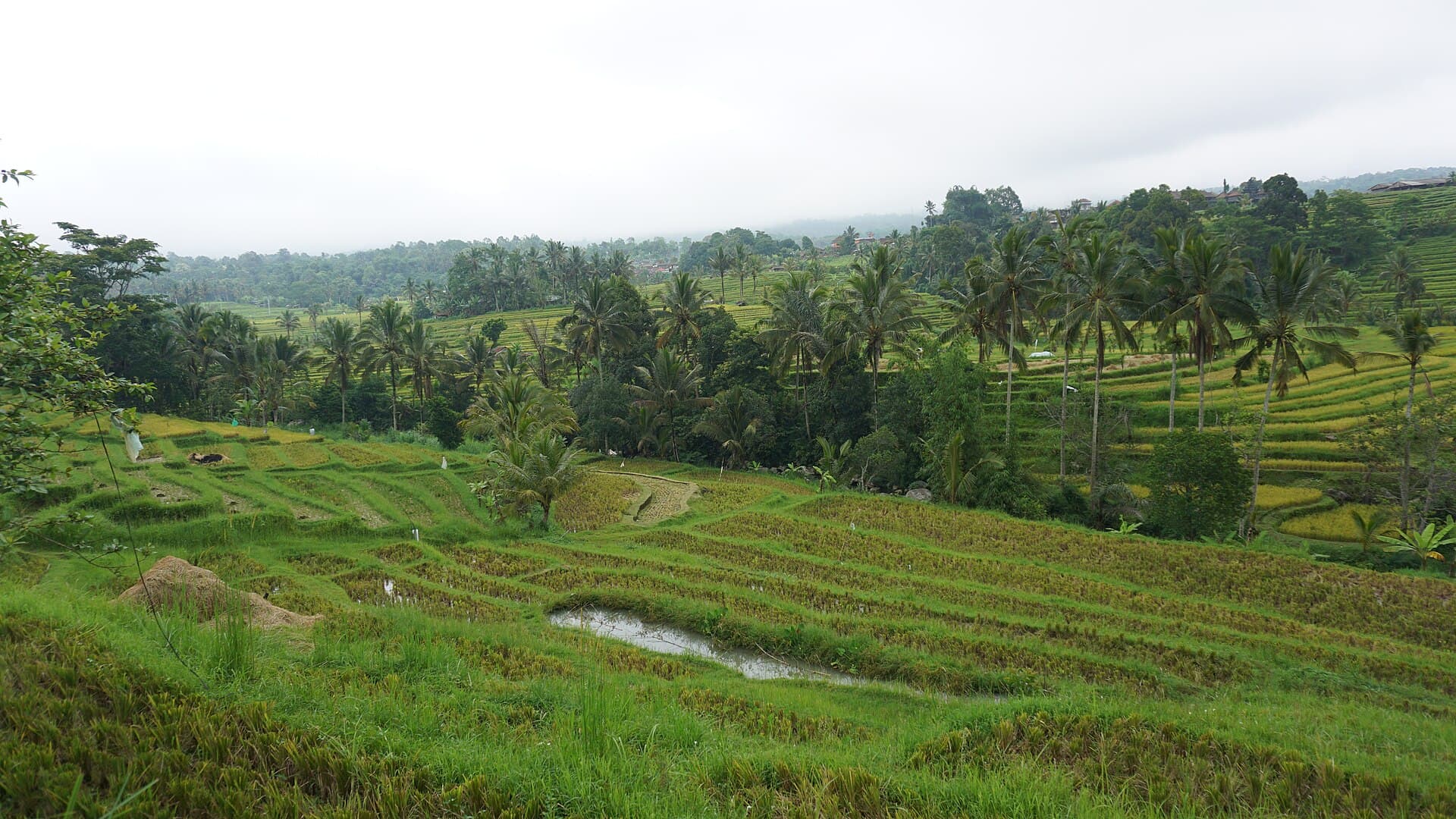
The terraces at Jatiluwih look like scenery and are in fact a committee. Every field in view draws water from a shared channel, and the order in which the water reaches them is decided by a subak, a farmers' association that has met in a water temple for a thousand years and settles who plants when. UNESCO inscribed this in 2012, and the interesting part of the listing is what it protects: not a monument, but a functioning system of rules that only exists while people keep following them.
That is the pattern across Balinese heritage. The most important things here are not objects that can be locked in a case. They are a calendar, a set of obligations to the dead, and a body of dance that is only correct when performed in the right place on the right day.
Bali is a province of Indonesia covering about 5,780 square kilometres, a little smaller than Northern Ireland, immediately east of Java across a narrow strait. The 2020 census counted roughly 4.3 million residents. A volcanic spine runs the length of the island, with Mount Agung at just over 3,000 metres, and the fertile southern slopes carry the rice terraces that most people picture when they hear the name.
The fact that shapes everything else is religious. Indonesia is the largest Muslim-majority country in the world, and Bali is the one province where the great majority, close to nine in ten residents, practise Hinduism. Balinese Hinduism, formally Agama Hindu Dharma, is not the Hinduism of India transplanted. It absorbed an older Austronesian ancestor cult and a layer of Buddhism, and it puts far more weight on ritual correctness and communal obligation than on personal doctrine. The administrative capital is Denpasar.
Denpasar. The provincial capital and by far the largest settlement, a working Indonesian city rather than a resort. The Bali Museum sits on the eastern side of the main square, founded under the Dutch administration and built as a compound demonstrating Balinese palace and temple architecture, and it holds the reference collection of masks, textiles and ritual objects.
Ubud. Inland among the ricefields, the seat of a minor royal house that spent the twentieth century patronising painters. The Museum Puri Lukisan, opened in 1956, was the first museum of modern Balinese art, and the surrounding villages still specialise by craft, one for stone, one for silver, one for woodcarving.
Singaraja. The northern port and the Dutch colonial capital until 1958, which is why the island's manuscript library ended up there rather than in the south. Its architecture carries Chinese and Arab traces from the old trading quarters, and it is the least visited of Bali's cities.
Klungkung. Once the seat of the Dewa Agung, the paramount ruler to whom the other Balinese kingdoms deferred. The Kertha Gosa, a raised open pavilion whose ceiling is painted with scenes of judgement and punishment after death, was the royal court of justice, and it is the clearest surviving statement of how the old order understood consequence.
Gianyar. The regency that holds Ubud and much of the archaeological heartland, including Goa Gajah, the rock-cut Elephant Cave, and Gunung Kawi, where ten memorial shrines are carved directly into the cliff faces of a river gorge.
Indic religion and writing reached Bali by the eighth century, and the island was periodically under Javanese authority thereafter. The decisive moment came in the sixteenth century, when the Hindu Majapahit empire of Java collapsed and Islam spread across the archipelago. Priests, artists and nobles of the Javanese court crossed to Bali, and the island became the last place where that court culture survived. Much of what is now called Balinese tradition dates from this absorption, which is why Balinese dance and literature carry Javanese forms that Java itself no longer performs.
The Dutch took the north in the mid nineteenth century and moved on the southern kingdoms sixty years later. What happened then still governs how Balinese talk about their own past. At Badung in September 1906, and at Klungkung in April 1908, the courts walked out of their palaces in white funeral dress and advanced on Dutch rifles rather than surrender. These were the puputan, meaning an ending or a finish. Several hundred to more than a thousand people died in each, including women and children, and the reports that reached Europe were damaging enough to push the Dutch into a policy of preserving Balinese culture as compensation, which had the odd effect of freezing certain practices under colonial supervision.
Two later catastrophes are less often mentioned to visitors. Mount Agung erupted in 1963, killing well over a thousand people and displacing tens of thousands, in the middle of the most important purification ceremony of the century. Then in 1965 and 1966, during the nationwide killings that followed the fall of Sukarno, Bali suffered proportionally among the worst violence in Indonesia; historians' estimates run to around 80,000 dead, a large share of the island's population at the time, and the dead were neighbours killed by neighbours. There was no official reckoning, and for decades no public memorial. That silence is itself part of the heritage picture, and it is the single largest gap in what the island commemorates.
Balinese, or Basa Bali, is an Austronesian language with roughly three million speakers, related to Javanese and Sasak rather than to Indonesian in any close way. Its most distinctive feature is a system of speech levels: a speaker chooses low, middle or high forms according to the relative caste and status of the person addressed, so that the same idea has several correct wordings and choosing the wrong one is a social error rather than a grammatical one.
The island has its own script, Aksara Bali, descended from the Brahmi family through Old Javanese. It was the writing system for the lontar, manuscripts incised with a stylus onto strips of prepared palm leaf, the ink rubbed in afterwards with soot. Lontar carry the ritual texts, the medical and legal literature, the genealogies and the astrological calendars, and because palm leaf decays in a tropical climate they survive only by being recopied, which means the tradition is a chain of scribes rather than a shelf of originals.
Balinese is not endangered by numbers, but it is losing ground where it matters. Indonesian is the language of school and administration, English is the language of the tourist economy, and the high registers and the script slip first, since these are the forms with the fewest daily uses. Balinese script is taught in schools and appears on street signs by provincial regulation, though critics note that decorative signage is easier to mandate than fluency.
Balinese life is organised by the banjar, the neighbourhood association that supplies the labour for every ceremony, and by the desa adat, the customary village, which is distinct from the administrative village and holds its own land, temples and law. These bodies decide who helps at a cremation, who plays in the gamelan, and who is excluded for failing their obligations. Membership is not optional in the way club membership is, and the sanction for withdrawal is serious.
 Tanah Lot sits on a rock cut off at high tide, and roughly a third of what visitors photograph is careful reconstruction after the base began to crumble. Photograph by Jakub Halun, CC BY-SA 4.0, via Wikimedia Commons.
Time runs on two calendars at once. The pawukon is a 210-day cycle of overlapping weeks, and it fixes Galungan, when ancestral spirits return to the family compounds and tall decorated bamboo poles called penjor are set outside every gate, and Kuningan ten days later, when they depart. The saka calendar, lunar and Indian in origin, fixes Nyepi, the new year, on which the whole island stops: no travel, no work, no fires or lights, and the airport closes for the day. The night before, villages parade huge papier-mache demons called ogoh-ogoh through the streets and burn them.
Dance and gamelan are the public face of this. In 2015 UNESCO inscribed three genres of traditional dance in Bali, covering nine forms across the sacred wali, the semi-sacred bebali and the balih-balihan performed for general audiences, among them the Rejang, the Baris Upacara, the Sanghyang Dedari, the Legong Keraton and the Gambuh dance drama. The category matters more than the choreography: a wali dance performed outside its ceremony is not the same thing, and the listing is unusual for recognising that distinction explicitly.
Balinese Hinduism is built around obligation rather than belief. The organising principle is Tri Hita Karana, the three causes of well-being, which names the three relationships a person must keep in balance: with the divine, with other people, and with the land. This is the philosophy the subak listing is named after, and it is not decorative language; it is the stated reason the water temples have authority over irrigation.
Tanah Lot sits on a rock cut off at high tide, and roughly a third of what visitors photograph is careful reconstruction after the base began to crumble. Photograph by Jakub Halun, CC BY-SA 4.0, via Wikimedia Commons.
Time runs on two calendars at once. The pawukon is a 210-day cycle of overlapping weeks, and it fixes Galungan, when ancestral spirits return to the family compounds and tall decorated bamboo poles called penjor are set outside every gate, and Kuningan ten days later, when they depart. The saka calendar, lunar and Indian in origin, fixes Nyepi, the new year, on which the whole island stops: no travel, no work, no fires or lights, and the airport closes for the day. The night before, villages parade huge papier-mache demons called ogoh-ogoh through the streets and burn them.
Dance and gamelan are the public face of this. In 2015 UNESCO inscribed three genres of traditional dance in Bali, covering nine forms across the sacred wali, the semi-sacred bebali and the balih-balihan performed for general audiences, among them the Rejang, the Baris Upacara, the Sanghyang Dedari, the Legong Keraton and the Gambuh dance drama. The category matters more than the choreography: a wali dance performed outside its ceremony is not the same thing, and the listing is unusual for recognising that distinction explicitly.
Balinese Hinduism is built around obligation rather than belief. The organising principle is Tri Hita Karana, the three causes of well-being, which names the three relationships a person must keep in balance: with the divine, with other people, and with the land. This is the philosophy the subak listing is named after, and it is not decorative language; it is the stated reason the water temples have authority over irrigation.
 Besakih is the mother temple, more than twenty temples on ascending terraces, and the lava of the 1963 eruption stopped just short of it. Photograph by CEphoto, Uwe Aranas, CC BY-SA 3.0, via Wikimedia Commons.
Every family compound has its own shrine, every village has at least three temples, and the island has thousands more. Pura Besakih on the slopes of Mount Agung is the mother temple, a complex of more than twenty temples on ascending terraces. Pura Ulun Danu Batur governs the crater lake that feeds the irrigation of a large part of the island, and its priesthood historically arbitrated water disputes. Tirta Empul, where a spring feeds bathing pools, is still used for melukat, a purification in which people move along a row of spouts in fixed order.
The dead are not gone. The ancestors are present, addressed, fed and consulted, and they return on schedule at Galungan. Priests come in two kinds, the pedanda of the brahmana caste and the pemangku who serve individual temples, and alongside them the balian, healers and diviners who are consulted about illness and misfortune and who often deliver messages from the dead. Caste exists in Bali, in a milder and more contested form than in India, and it governs marriage, priesthood and speech level more than occupation.
Balinese cremation, ngaben, is the most elaborate death ritual in Southeast Asia and it is not solemn. The purpose is to return the elements of the body to their sources and free the soul to move on toward rebirth or liberation, and because that is understood as a good outcome, the event is loud. A tower called a bade, sometimes many tiers high, carries the body to the cremation ground, shouldered by dozens of men from the banjar who deliberately spin and shake it at crossroads so the soul cannot find its way back to trouble the living. The body is transferred into a sarcophagus, a bull for the higher castes, and burned. Days later the ashes go to the sea or a river.
The cost of doing this properly is beyond most families, and the tradition has a practical answer. The body is buried temporarily in the village graveyard, sometimes for years, and then cremated in a ngaben massal, a mass cremation organised by the banjar for everyone who has been waiting, which brings the cost per family down to a manageable figure. A shared cremation is not a lesser version of the rite. For most families it is the normal version.
Cremation is not the end of the sequence. A second ceremony, the memukur or nyekah, follows to complete the purification of the soul, and only after that can the ancestor be enshrined in the family temple and receive offerings as one of the household's own. So the movement of a Balinese death is from person, to soul in transit, to named ancestor with a place in the compound, and the family's obligation continues rather than closing.
Two places break this pattern deliberately. Trunyan, an old Bali Aga village on Lake Batur whose people predate the Javanese influx, does not cremate: the dead are laid in the open under a tree said to neutralise the smell. And in Kuta, the memorial to the 202 people killed in the bombing of 12 October 2002 is a wall of names in twenty-one nationalities, a form of remembrance that is imported rather than Balinese, because the island's own tradition does not build monuments to the dead.
Balinese genealogy is caste, temple and the compound you were born in, and none of it is filed with the state.
A Balinese belongs to a dadia, a descent group with its own temple, and to a banjar, the neighbourhood association that organises everything from irrigation to cremation. The dadia temple holds the ancestors, and the family's obligation is to maintain it. Higher-caste families, the triwangsa, keep written genealogies, the babad, on lontar palm leaf, tracing descent from the Majapahit nobility who came from Java in the fourteenth century; those manuscripts are held by families and by the Gedong Kirtya library in Singaraja, which has been copying and preserving lontar since 1928.
The Dutch colonial record from the early twentieth century, and the Indonesian civil registration that followed, sit on top of that and rarely reach the substance.
The reason there is no grave to visit is ngaben. The body is cremated, the ashes go to the sea, and the soul is installed in the family temple, so the ancestor is present in the compound rather than in a cemetery. Poorer families bury temporarily and wait for a mass cremation organised by the banjar, sometimes years later.
The absence in the record is 1965 and 1966, when the killings on Bali were proportionally among the worst in Indonesia, tens of thousands dead in a few months, frequently within villages. There is no list, and for a long time there was no discussion.
The 2012 World Heritage inscription, the Cultural Landscape of Bali Province, covers about 19,500 hectares in five components, among them the Jatiluwih terraces, the Pakerisan watershed with its rock-cut monuments, the royal water temple Pura Taman Ayun and the lake temple Pura Ulun Danu Batur. It is a rare listing in that the protected thing is a management practice. UNESCO and its advisory bodies have since raised concerns about tourism pressure, land conversion and the difficulty of holding subak membership together when farming pays less than selling the field, and the province has faced repeated criticism that development approvals run ahead of the protection the listing implies.
Manuscript preservation runs on a separate track. The Gedong Kirtya library at Singaraja, established in 1928, holds the largest public collection of lontar, and provincial and university programmes copy, clean and now digitise them. The conservation problem is unusual: because a lontar must be physically recopied to survive, an unread manuscript is a dying one, and preservation depends on there being people who can still read the script and the Old Javanese in which much of it is written.
The provincial government has legislated on culture more actively than most Indonesian regions, regulating the use of Balinese script and dress on certain days and the use of Balinese in schools. There is a real argument in Bali about whether these rules protect the culture or merely stage it, and the argument is worth recording rather than resolving.
The lontar collections are being photographed and catalogued, with material from Gedong Kirtya and from private family collections appearing in online repositories built with Indonesian and overseas university partners, and a growing set of transliterations that make texts readable to people who cannot read the script. Progress is uneven and much of the corpus remains uncatalogued.
The 1965 and 1966 killings have their own digital record, built outside official channels. Oral history projects have recorded survivor and perpetrator testimony, and this material exists largely on university servers and in the archives of non-governmental organisations rather than in any Indonesian state collection, which is the practical shape of an unresolved history.
Balinese calendrical software is an unglamorous success. The pawukon and saka cycles are complicated enough that the printed calendar was once a specialist product, and now widely used applications compute the ceremonial day for any date, which has made the ritual calendar more accessible rather than less, and put it on the phones of Balinese living away from the island.
Bali's export is an idea of itself, and it has been for a century. Walter Spies and Rudolf Bonnet in the 1930s, the dancers who toured Europe in 1931, and Margaret Mead and Gregory Bateson's photographic fieldwork all built an image of Bali as an island where everyone is an artist. That image drives an economy that in a normal year brings well over ten million domestic and foreign visitors to a province of four million people.
The consequences are argued about locally in specific terms rather than general ones: agricultural land converted at a rate that shrinks the subak the World Heritage listing depends on, water tables drawn down by hotels in the south, and the fact that ceremonies are now sometimes scheduled around performance bookings. Against that, tourism income funds the temple rebuilding and the ceremonies themselves, and a family that can afford a proper ngaben often can because of it. Both things are true.
The 2002 bombing, and a second attack in 2005, produced a sustained economic collapse and an island-wide purification ceremony, and the response revealed how much of Bali's resilience is organised through the banjar rather than through the state. More recently the province has legislated against disrespectful behaviour at temples and introduced a levy on foreign arrivals, which is a heritage policy as much as a fiscal one.
A living system given World Heritage status. The 2012 inscription protects the subak as a working institution, water temples and farmers' councils included, rather than preserving the terraces as scenery.
Nine dances listed with their categories intact. The 2015 UNESCO inscription recorded the sacred, semi-sacred and secular genres separately, so the listing acknowledges that a temple dance moved to a hotel stage is a different thing.
Cremation made affordable without being diminished. The mass ngaben lets families who could never fund a tower ceremony give their dead the full rite, organised by the neighbourhood association rather than the state.
A manuscript library that survived the climate. Gedong Kirtya has held and recopied palm-leaf texts at Singaraja since 1928, and its collection is now being digitised alongside family holdings.
Besakih is the mother temple, more than twenty temples on ascending terraces, and the lava of the 1963 eruption stopped just short of it. Photograph by CEphoto, Uwe Aranas, CC BY-SA 3.0, via Wikimedia Commons.
Every family compound has its own shrine, every village has at least three temples, and the island has thousands more. Pura Besakih on the slopes of Mount Agung is the mother temple, a complex of more than twenty temples on ascending terraces. Pura Ulun Danu Batur governs the crater lake that feeds the irrigation of a large part of the island, and its priesthood historically arbitrated water disputes. Tirta Empul, where a spring feeds bathing pools, is still used for melukat, a purification in which people move along a row of spouts in fixed order.
The dead are not gone. The ancestors are present, addressed, fed and consulted, and they return on schedule at Galungan. Priests come in two kinds, the pedanda of the brahmana caste and the pemangku who serve individual temples, and alongside them the balian, healers and diviners who are consulted about illness and misfortune and who often deliver messages from the dead. Caste exists in Bali, in a milder and more contested form than in India, and it governs marriage, priesthood and speech level more than occupation.
Balinese cremation, ngaben, is the most elaborate death ritual in Southeast Asia and it is not solemn. The purpose is to return the elements of the body to their sources and free the soul to move on toward rebirth or liberation, and because that is understood as a good outcome, the event is loud. A tower called a bade, sometimes many tiers high, carries the body to the cremation ground, shouldered by dozens of men from the banjar who deliberately spin and shake it at crossroads so the soul cannot find its way back to trouble the living. The body is transferred into a sarcophagus, a bull for the higher castes, and burned. Days later the ashes go to the sea or a river.
The cost of doing this properly is beyond most families, and the tradition has a practical answer. The body is buried temporarily in the village graveyard, sometimes for years, and then cremated in a ngaben massal, a mass cremation organised by the banjar for everyone who has been waiting, which brings the cost per family down to a manageable figure. A shared cremation is not a lesser version of the rite. For most families it is the normal version.
Cremation is not the end of the sequence. A second ceremony, the memukur or nyekah, follows to complete the purification of the soul, and only after that can the ancestor be enshrined in the family temple and receive offerings as one of the household's own. So the movement of a Balinese death is from person, to soul in transit, to named ancestor with a place in the compound, and the family's obligation continues rather than closing.
Two places break this pattern deliberately. Trunyan, an old Bali Aga village on Lake Batur whose people predate the Javanese influx, does not cremate: the dead are laid in the open under a tree said to neutralise the smell. And in Kuta, the memorial to the 202 people killed in the bombing of 12 October 2002 is a wall of names in twenty-one nationalities, a form of remembrance that is imported rather than Balinese, because the island's own tradition does not build monuments to the dead.
Balinese genealogy is caste, temple and the compound you were born in, and none of it is filed with the state.
A Balinese belongs to a dadia, a descent group with its own temple, and to a banjar, the neighbourhood association that organises everything from irrigation to cremation. The dadia temple holds the ancestors, and the family's obligation is to maintain it. Higher-caste families, the triwangsa, keep written genealogies, the babad, on lontar palm leaf, tracing descent from the Majapahit nobility who came from Java in the fourteenth century; those manuscripts are held by families and by the Gedong Kirtya library in Singaraja, which has been copying and preserving lontar since 1928.
The Dutch colonial record from the early twentieth century, and the Indonesian civil registration that followed, sit on top of that and rarely reach the substance.
The reason there is no grave to visit is ngaben. The body is cremated, the ashes go to the sea, and the soul is installed in the family temple, so the ancestor is present in the compound rather than in a cemetery. Poorer families bury temporarily and wait for a mass cremation organised by the banjar, sometimes years later.
The absence in the record is 1965 and 1966, when the killings on Bali were proportionally among the worst in Indonesia, tens of thousands dead in a few months, frequently within villages. There is no list, and for a long time there was no discussion.
The 2012 World Heritage inscription, the Cultural Landscape of Bali Province, covers about 19,500 hectares in five components, among them the Jatiluwih terraces, the Pakerisan watershed with its rock-cut monuments, the royal water temple Pura Taman Ayun and the lake temple Pura Ulun Danu Batur. It is a rare listing in that the protected thing is a management practice. UNESCO and its advisory bodies have since raised concerns about tourism pressure, land conversion and the difficulty of holding subak membership together when farming pays less than selling the field, and the province has faced repeated criticism that development approvals run ahead of the protection the listing implies.
Manuscript preservation runs on a separate track. The Gedong Kirtya library at Singaraja, established in 1928, holds the largest public collection of lontar, and provincial and university programmes copy, clean and now digitise them. The conservation problem is unusual: because a lontar must be physically recopied to survive, an unread manuscript is a dying one, and preservation depends on there being people who can still read the script and the Old Javanese in which much of it is written.
The provincial government has legislated on culture more actively than most Indonesian regions, regulating the use of Balinese script and dress on certain days and the use of Balinese in schools. There is a real argument in Bali about whether these rules protect the culture or merely stage it, and the argument is worth recording rather than resolving.
The lontar collections are being photographed and catalogued, with material from Gedong Kirtya and from private family collections appearing in online repositories built with Indonesian and overseas university partners, and a growing set of transliterations that make texts readable to people who cannot read the script. Progress is uneven and much of the corpus remains uncatalogued.
The 1965 and 1966 killings have their own digital record, built outside official channels. Oral history projects have recorded survivor and perpetrator testimony, and this material exists largely on university servers and in the archives of non-governmental organisations rather than in any Indonesian state collection, which is the practical shape of an unresolved history.
Balinese calendrical software is an unglamorous success. The pawukon and saka cycles are complicated enough that the printed calendar was once a specialist product, and now widely used applications compute the ceremonial day for any date, which has made the ritual calendar more accessible rather than less, and put it on the phones of Balinese living away from the island.
Bali's export is an idea of itself, and it has been for a century. Walter Spies and Rudolf Bonnet in the 1930s, the dancers who toured Europe in 1931, and Margaret Mead and Gregory Bateson's photographic fieldwork all built an image of Bali as an island where everyone is an artist. That image drives an economy that in a normal year brings well over ten million domestic and foreign visitors to a province of four million people.
The consequences are argued about locally in specific terms rather than general ones: agricultural land converted at a rate that shrinks the subak the World Heritage listing depends on, water tables drawn down by hotels in the south, and the fact that ceremonies are now sometimes scheduled around performance bookings. Against that, tourism income funds the temple rebuilding and the ceremonies themselves, and a family that can afford a proper ngaben often can because of it. Both things are true.
The 2002 bombing, and a second attack in 2005, produced a sustained economic collapse and an island-wide purification ceremony, and the response revealed how much of Bali's resilience is organised through the banjar rather than through the state. More recently the province has legislated against disrespectful behaviour at temples and introduced a levy on foreign arrivals, which is a heritage policy as much as a fiscal one.
A living system given World Heritage status. The 2012 inscription protects the subak as a working institution, water temples and farmers' councils included, rather than preserving the terraces as scenery.
Nine dances listed with their categories intact. The 2015 UNESCO inscription recorded the sacred, semi-sacred and secular genres separately, so the listing acknowledges that a temple dance moved to a hotel stage is a different thing.
Cremation made affordable without being diminished. The mass ngaben lets families who could never fund a tower ceremony give their dead the full rite, organised by the neighbourhood association rather than the state.
A manuscript library that survived the climate. Gedong Kirtya has held and recopied palm-leaf texts at Singaraja since 1928, and its collection is now being digitised alongside family holdings.
National Overview
Notable Cities
Historical Foundations
Linguistic and Etymological Roots
Cultural Identity
Religion and Spirituality
Remembrance and Mourning Traditions
Tracing a Family in Bali
Heritage Preservation Efforts
Digital Heritage
Contemporary Cultural Influences
Success Stories
References and resources
- UNESCO, Cultural Landscape of Bali Province: the 2012 subak inscription and its five components.
- UNESCO, Three genres of traditional dance in Bali: the 2015 listing and the nine forms it covers.
- Ngaben, Wikipedia: the cremation sequence, the bade and the sarcophagus.
- Balinese Hinduism, Wikipedia: Tri Hita Karana, temples and priesthood.
- Balinese language, Wikipedia: speech levels, speaker numbers and script.
- Lontar, Wikipedia: palm-leaf manuscripts and the recopying tradition.
- Indonesian mass killings of 1965 to 1966, Wikipedia: the estimates for Bali and the absence of official reckoning.
- Dutch intervention in Bali, 1906, Wikipedia: the Badung puputan.
- 2002 Bali bombings, Wikipedia: the attack and the Kuta memorial.
- Bali, Wikipedia: geography, population and administration.