Heritage · University
Vilnius University: History and Overview
Founded as a Jesuit college in 1570 and raised to a university in 1579 by King Stephen Báthory and Pope Gregory XIII, Vilnius University is the oldest university in the Baltic states. Its Old Town ensemble of thirteen courtyards, arcades and frescoed halls survives as one of Europe's most complete historic university quarters.Written to last.
By Confinity Heritage Editorial · 2026-08-25 · 8-minute readQuiet tools, kept out of the way.
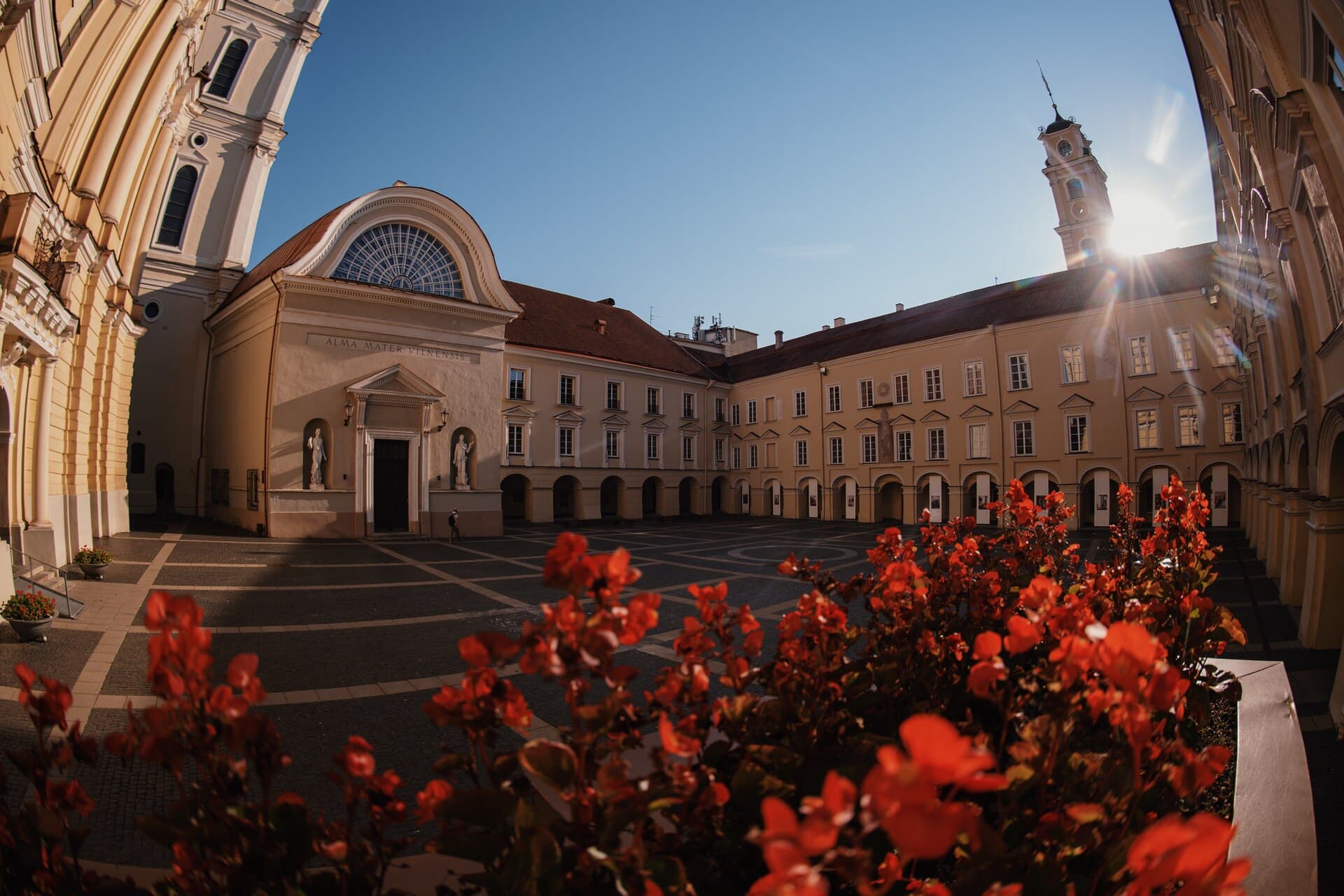
Vilnius University is the oldest university in the Baltic states and the intellectual heart of Lithuania's capital. It began as a Jesuit college in 1570 and was raised to a university nine years later by a charter of King Stephen Báthory, confirmed by a bull of Pope Gregory XIII in 1579. The institution that grew from those documents has taught in Latin, in Polish and in Lithuanian, has been closed by one empire and reopened by the states that followed it, and still occupies the same tangle of buildings in the Old Town where the Jesuits first held classes.
That quarter is the university's most remarkable possession. Behind unbroken street fronts on Universiteto and Pilies streets lies an ensemble of thirteen courtyards, linked by passages and arcades and overlooked by the Church of St. Johns and its bell tower, the tallest structure in the Old Town. Built out over four centuries, from Gothic cellars to a classical observatory, it is among the most complete historic university quarters to survive anywhere in Europe: a place where the institution's whole memory is legible in its walls.
The Jesuits arrived in Vilnius in 1569 at the invitation of Bishop Walerian Protasewicz, and opened a college the following year. In April 1579 Stephen Báthory, King of Poland and Grand Duke of Lithuania, granted the college the rights of an academy, and in October of that year Gregory XIII confirmed the elevation, creating the Academy and University of Vilnius. The Jesuit preacher Piotr Skarga served as its first rector. For the next two centuries the university was the great school of the Grand Duchy of Lithuania and of the Polish-Lithuanian Commonwealth, teaching philosophy, theology and later law and mathematics in Latin to students drawn from across the Commonwealth's vast territory.
Its heritage is therefore shared. The university belongs to the histories of both Lithuania and Poland, and each has reason to claim its golden ages: the baroque flowering of the seventeenth century, the Enlightenment reforms after the Jesuit order was suppressed in 1773, and the brilliant early nineteenth century, when the renamed Imperial University of Vilna grew into one of the largest universities in the Russian Empire. In that last era its students included the poet Adam Mickiewicz, and its professors the historian Joachim Lelewel; its lecture halls shaped the generation that would attempt to restore the partitioned Commonwealth.
That attempt cost the university its existence. After the November Uprising of 1830-31, Tsar Nicholas I closed the university by decree in 1832, a punishment aimed squarely at the rebellious loyalties of its students and staff. Only the medical and theological faculties limped on briefly under other names. For 87 years there was no university in Vilnius. It reopened in 1919 as the Polish-language Stefan Batory University, named for its founder king, and flourished between the wars. In 1939 the city passed to Lithuania and the university was reorganised as a Lithuanian institution; it endured the Soviet decades under close ideological control, marked its four hundredth anniversary in 1979, and since Lithuania's independence in 1990 has grown into a self-governing, Lithuanian-language university open to the world.
The historic ensemble fills a full block of the Old Town, between the Presidential Palace and Pilies Street. Its centre is the Grand Courtyard, a broad quadrangle enclosed by open arcades in three tiers, with the words Alma Mater Vilnensis set on a facade above the galleries. On its eastern side rises the Church of St. Johns, a Gothic foundation of the late fourteenth century given to the Jesuits in 1571 and rebuilt after fire in the eighteenth century with a soaring late baroque front by Johann Christoph Glaubitz. Its free-standing bell tower, about 68 metres high, dominates the skyline of the Old Town and carries an observation deck with the best close view of the city's roofscape.
North of the Grand Courtyard lies the Observatory Courtyard, named for the astronomical observatory founded in 1753, among the oldest university observatories in Europe. Its classical extension, decorated with a frieze of zodiac signs, was built for Marcin Poczobutt, the astronomer and rector who directed it through the late eighteenth century. The university library, founded with the college in 1570 and thus older than the university itself, keeps millions of volumes and a rare-book collection that includes one of the two known surviving copies of Martynas Mažvydas's Catechism of 1547, the first printed book in the Lithuanian language. Its frescoed halls, among them the nineteenth-century reading rooms painted with portraits of scholars, are part of the same continuous fabric.
Around this core the university operates as a full research institution, with faculties spanning the humanities, law, medicine, the sciences and economics, several of them housed on newer campuses, including a science centre in the Saulėtekis district. It is a member of the Coimbra Group of long-established European universities and of the Arqus alliance of European research universities.
Counting the courtyards is a Vilnius tradition: the usual figure is thirteen, each named for a figure in the university's history, from Skarga and the baroque poet Sarbievius to the historian Simonas Daukantas, the first to write a history of Lithuania in Lithuanian. One carries the name of Adam Mickiewicz, who entered the university in 1815 and studied there until 1819. With his friends he founded the Philomaths, a secret society of self-improvement that shaded into patriotic conspiracy. In 1823 the tsarist authorities under Senator Novosiltsev broke the society, arresting more than a hundred students and graduates; after a trial in 1824, Mickiewicz and other leading members were deported to the Russian interior.
Mickiewicz was held during the investigation in the Basilian monastery near the Gate of Dawn, and he later set the prison scenes of his great drama Dziady, part III, in a cell there. He never saw Vilnius again, and became the national poet of Poland while remaining a figure of devotion in Lithuania. A century later the same courtyards produced a second poet of European rank: Czesław Miłosz, who studied law at the interwar Stefan Batory University, and whose essays return again and again to the city of his youth. When he received the Nobel Prize in Literature in 1980, the university he had attended lay behind the Iron Curtain; he returned after independence and accepted an honorary doctorate there in 1992. Two poets, two languages, one set of courtyards: few universities carry so distilled a lesson in how a place can outlive the borders drawn across it.
The university's scholarly line begins with the Jesuit baroque: Maciej Kazimierz Sarbiewski, called Sarbievius, taught poetics there and won a European reputation as a Latin lyric poet, and Konstantinas Sirvydas compiled the first dictionary of the Lithuanian language in the early seventeenth century. The Enlightenment brought Poczobutt's astronomy and, in the early nineteenth century, a scientific school that included the brothers Jędrzej and Jan Śniadecki in chemistry and astronomy and Johann Peter Frank in medicine. Lelewel's history lectures drew crowds; Mickiewicz and his fellow poet Juliusz Słowacki, also a Vilnius student, carried the university into the centre of Polish Romanticism. In the twentieth century the Stefan Batory University fostered figures such as Miłosz, and the post-war Lithuanian university trained much of the country's academic, medical and political leadership, including signatories of the 1990 Act of Independence.
The university's story also runs parallel to two institutions worth reading alongside it. The Jagiellonian University in Kraków was its elder sibling within the Commonwealth, the model of a royal university that Báthory's charter followed; the University of Tartu, founded in 1632, is its nearest Baltic peer, another old university that survived the empires that closed and reshaped it.
Vilnius University is Lithuania's largest university and its highest ranked, placing first in the country and within the leading few hundred institutions in the major international tables. Around twenty thousand students study across its faculties, joined by a growing international enrolment drawn by English-language programmes in medicine, science and business. Since Lithuania joined the European Union in 2004 the university has renewed its historic buildings, expanded its research campuses and rebuilt the international ties that the twentieth century cut, a quiet renaissance for an institution that spent much of that century either closed or constrained.
The historic ensemble stands on Universiteto Street in the Old Town, beside the Presidential Palace. The courtyards, the Church of St. Johns and the bell tower are open to visitors for a modest ticket, and the climb, or lift, up the tower is rewarded with the finest view over the Old Town's roofs. The library's ornamented halls can be seen on guided tours, which should be booked ahead. In term the marked routes are the ones to follow, since lectures are going on behind most of the doors; the Basilian monastery, where the Philomaths were held, lies a short walk south near the Gate of Dawn.