Heritage · University
Waseda University: History and Overview
Founded in 1882 by the statesman Okuma Shigenobu, Waseda University grew from a small private school into one of Japan's great universities, built on the creed of independence of learning. Its campus keeps the Okuma Auditorium, Japan's only comprehensive theatre museum, and the library where Haruki Murakami has deposited his manuscripts and records.Written to last.
By Confinity Heritage Editorial · 2026-08-24 · 8-minute readQuiet tools, kept out of the way.
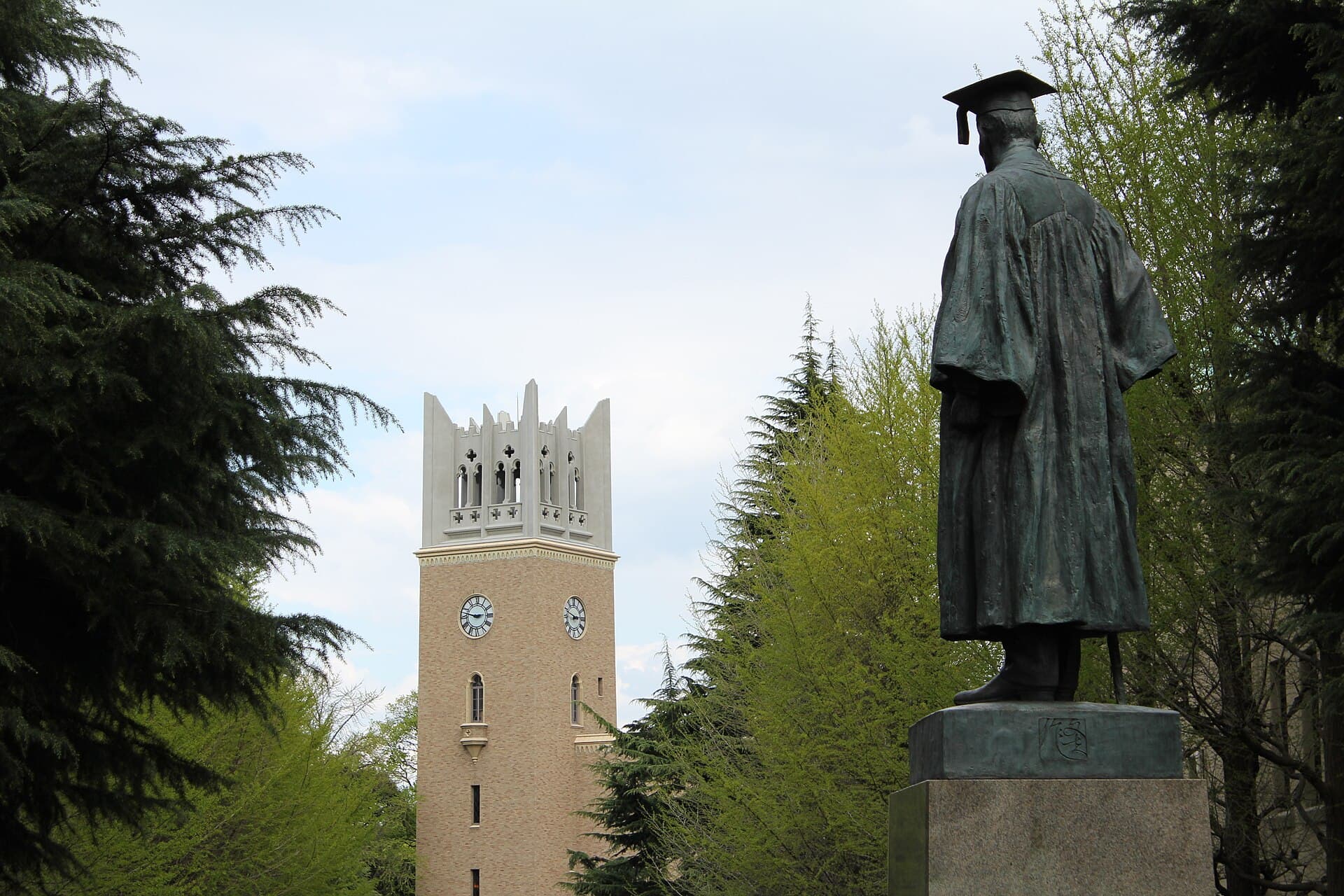
Waseda University stands in the north of Tokyo's Shinjuku ward, in Japan's capital, on ground that was still half rice field when the statesman Okuma Shigenobu opened a small private school there in 1882. The school was called the Tokyo Senmon Gakko, and it carried a pointed idea for its time: that scholarship should stand on its own feet, independent of the state. In Meiji Japan, where the government built universities to train its own officials, a private academy teaching politics and economics in the Japanese language was close to an act of opposition. The school took the name of its district, Waseda, in 1902, and grew into one of the country's largest and most admired universities.
For a place concerned with memory, Waseda is a remarkable keeper of it. Its campus holds the auditorium and bronze statue that preserve its founder's presence, the only comprehensive theatre museum in Japan, and, since 2021, a library in which a living novelist has chosen to archive himself: the Waseda International House of Literature, which keeps the manuscripts and record collection of Haruki Murakami, the university's most widely read graduate.
Okuma Shigenobu was a samurai's son from Saga who rose through the new Meiji government to run its finances, and who was forced out of power in the political crisis of 1881. Out of office, he founded a political party and, a year later, a school. The Tokyo Senmon Gakko opened on 21 October 1882 in the village of Waseda, then a suburb northwest of the city, offering courses in political economy, law and physical science. Okuma kept a deliberate distance from its daily running so that the school would not be dismissed as a party academy, but the government's suspicion of it lingered for years all the same. He went on to serve twice as prime minister of Japan, in 1898 and again from 1914 to 1916.
The school renamed itself Waseda University in 1902, on its twentieth anniversary, and in 1913 it set down the founding principles that Okuma had taught from the beginning: independence of learning, the practical application of scholarship, and the making of good citizens. The first of these, gakumon no dokuritsu, remains the university's motto and its spine. Where the imperial universities answered to the ministries that funded them, Waseda claimed the right to inquire freely, and the claim shaped the kind of graduates it produced, journalists, novelists and party politicians rather than career bureaucrats. When Okuma died in 1922, the public funeral held for him drew mourners in the hundreds of thousands, a measure of what the founder and his school had come to mean.
The war years cut deep. Waseda's baseball rivalry with Keio University, the other great private university of Tokyo, had run since 1903, and the Sokeisen, the Waseda versus Keio game, had become one of the most loved fixtures in Japanese sport. In October 1943, with the student exemption from conscription abolished, the two universities played a farewell game at Waseda's Totsuka ground for the students leaving for the front. At its end the two cheering sections sang each other's school songs. Many of the players and spectators did not return, and the game is still remembered in Japan as the last Sokeisen. Air raids in 1945 burned much of the surrounding district, but the university rebuilt quickly after the war and resumed its place in national life.
The centre of the main campus is the Okuma Auditorium, a Tudor Gothic hall finished in 1927 and designed within the university's own school of architecture. Its clock tower rises 125 shaku, about 38 metres, a number chosen in honour of Okuma's cheerful theory that a human life properly cared for should last 125 years. Its bells have marked time over the campus for a century, and the building was designated an Important Cultural Property of Japan in 2007. In front of it stands the bronze statue of Okuma in academic gown, cast in 1932, before which generations of students have posed on their first day and their last. Together the statue and the auditorium form the image most associated with the university.
A short walk away stands a building unlike anything else in the country. The Tsubouchi Memorial Theatre Museum, opened in 1928, honours Tsubouchi Shoyo, the Waseda professor and man of letters who completed the first translation of Shakespeare's complete works into Japanese. Its facade is modelled on the Fortune Playhouse of Elizabethan London, and its collections, from kabuki prints and noh masks to scripts, costumes and stage photographs, run to around a million items covering the theatre of Japan and the world. It remains Japan's only comprehensive museum of the performing arts, and it makes Waseda an unavoidable address for anyone studying the stage.
Around these landmarks the university operates at great scale. Waseda teaches nearly fifty thousand students across thirteen undergraduate schools and more than twenty graduate schools, spanning political science and economics, law, letters, science and engineering, commerce, education and international liberal studies. Its campuses spread through the Waseda and Toyama neighbourhoods and beyond, and its central library holds one of the largest academic collections in Japan. The contrast with the University of Tokyo, the state's own flagship a few kilometres south, has organised Japanese higher education for more than a century: the imperial foundation trained the government, and Waseda, with Keio, built the private counterweight.
In October 2021 the university opened the Waseda International House of Literature, known to nearly everyone as the Murakami Library. Haruki Murakami entered Waseda in 1968, studied drama in the literature department, and graduated in 1975 after the long interruption in which he opened a jazz cafe and began to write. Half a century later he chose his university as the keeper of his record: his manuscripts and drafts, his correspondence, the translations of his novels in some fifty languages, and the collection of records he has gathered across a lifetime of listening.
The architect Kengo Kuma rebuilt an ordinary campus building to hold it, wrapping the entrance in a wooden lattice and carrying visitors down a staircase framed by a tunnel of bookshelves. Inside are reading rooms open to the public, a listening lounge where Murakami's jazz and classical records are played on vinyl, a reproduction of the study in which he writes, and a cafe run by students. What makes the place singular is its timing. Most literary archives are assembled after a writer's death, from whatever survives. Here a living novelist is depositing his memory in real time, at the institution where his adult life began, and scholars and readers can walk through it while the work it documents is still being written.
Waseda's founding purpose was public life, and its graduates have led it. Seven prime ministers of Japan studied at the university, among them Ishibashi Tanzan, Obuchi Keizo, Fukuda Yasuo and Noda Yoshihiko. Its writers begin with the magazine Waseda Bungaku, founded by Tsubouchi in 1891 and still publishing, and reach their widest audience in Murakami. In business, Tadashi Yanai, the founder of Uniqlo, took his degree at Waseda in 1971.
The university's international tradition is nearly as old as the school itself. From the early 1900s Waseda taught large numbers of students from China at a time when Tokyo was a gathering place for that country's reformers, and Li Dazhao, later a founder of the Chinese Communist Party, studied political economy there in the 1910s. That early openness has carried forward: Waseda today enrols thousands of students from abroad and is regularly counted among the most international campuses in Japan.
Waseda remains, with Keio, one of the two private universities against which the rest of Japan's private sector is measured, and admission to it is a national ambition. The university runs degree programmes taught in English alongside its Japanese curriculum, maintains partnerships with several hundred universities abroad, and pursues research across the sciences, social sciences and humanities. The Sokeisen still fills the Jingu stadium twice a year, and the crowd still sings. The founder's creed has proved durable: an institution built to keep scholarship independent of the state has outlasted the governments of its first century and educated a fair share of the people who led the ones that followed.
The main campus lies in the Waseda district of Shinjuku ward, a few minutes from Waseda Station on the Tokyo Metro Tozai line, and visitors are free to walk its grounds, see the Okuma statue and stand before the auditorium. The Tsubouchi Memorial Theatre Museum is open to the public, and the Waseda International House of Literature admits visitors as well; entry to the latter can be managed by timed reservation, so booking ahead through the official site is advisable. Classes and examination periods deserve a wide berth; the Okuma auditorium forecourt, the theatre museum and the Murakami Library are the parts arranged for people who have come to look.