Heritage · University
Uppsala University: History and Overview
Founded in 1477, Uppsala University is the oldest university in Sweden and the Nordic countries. Carl Linnaeus taught here and built the binomial system that gave every living thing a durable name, and the university library keeps the Codex Argenteus, the sixth-century Silver Bible that preserves the Gothic language almost single-handedly.Written to last.
By Confinity Heritage Editorial · 2026-08-24 · 8-minute readQuiet tools, kept out of the way.
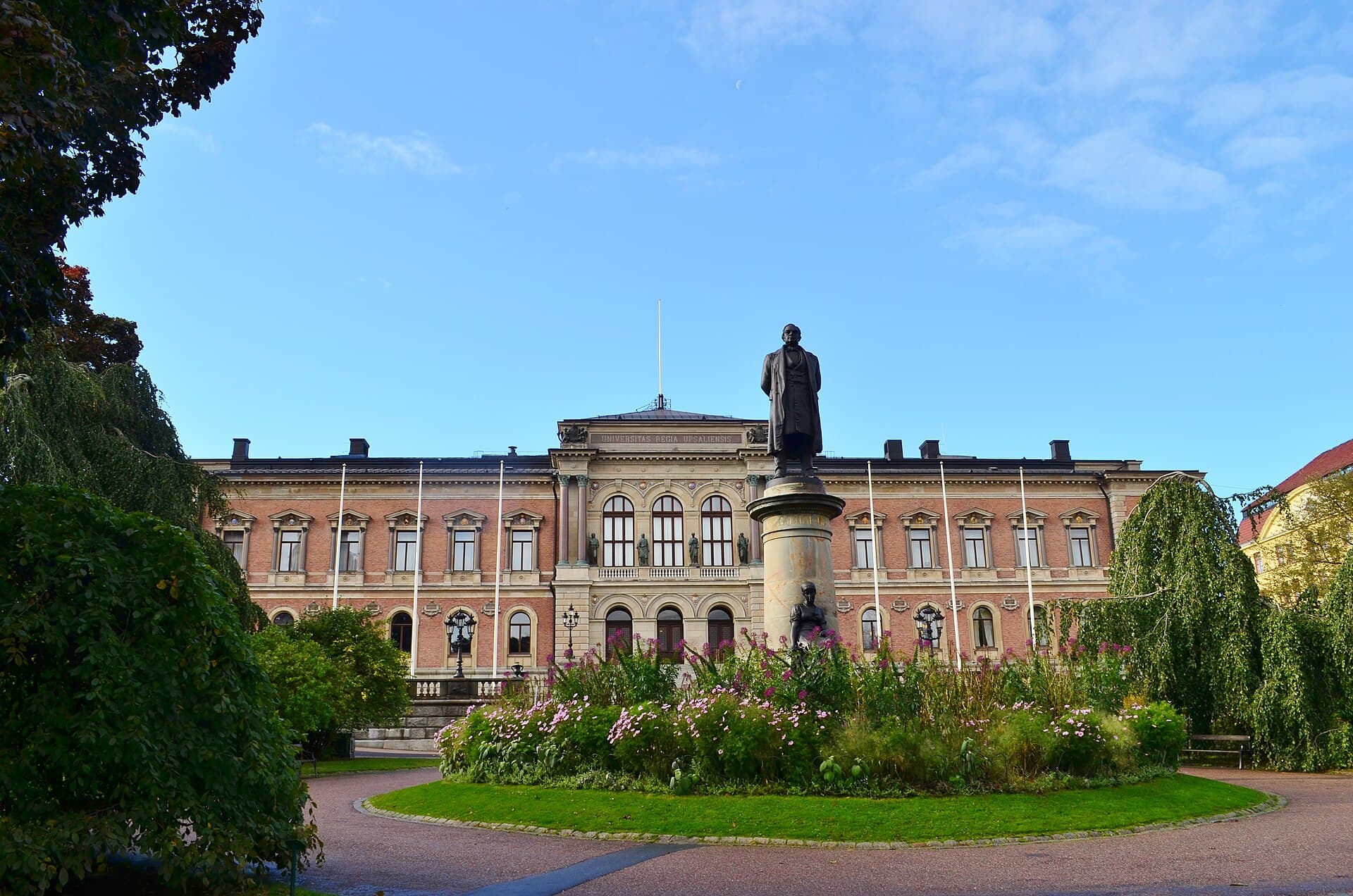
Uppsala University is the oldest university in Sweden and in all of the Nordic countries, founded in 1477 by papal permission in a small cathedral town north of Stockholm. For five and a half centuries it has shared that town with the largest cathedral in Scandinavia, and the two institutions have grown into each other: archbishops founded the university, kings endowed it, and the scholars it produced now lie under the cathedral floor beside the monarchs.
Few universities anywhere hold their memory in such concrete forms. The man who invented the modern system for naming living things taught here, and his garden still grows to his own published plan. The university library keeps a sixth-century book written in silver ink on purple parchment, the principal surviving witness to an entire language that died a thousand years ago.
The university was founded in 1477, when Pope Sixtus IV issued a bull authorising a studium generale at Uppsala at the request of Archbishop Jakob Ulvsson, with the backing of the Swedish regent Sten Sture the Elder. It was the first university in the Nordic countries, two years ahead of Copenhagen. The turbulence of the Reformation nearly ended it. Teaching dwindled through the middle of the sixteenth century as the Swedish crown broke with Rome, and the university was revived only after the Uppsala Synod of 1593 settled the country's Lutheran confession and made a Protestant seat of learning a matter of state interest.
The decisive endowment came from a king. In the 1620s Gustavus Adolphus granted the university a large part of his personal inheritance, more than three hundred farms whose revenues put the institution on a permanent footing. Sweden's rise to great-power status in the seventeenth century pulled Uppsala up with it, as the expanding state looked to it for clergymen, judges and administrators.
The eighteenth century turned a provincial Lutheran academy into a scientific centre of European rank, with Anders Celsius in astronomy, Carl Linnaeus in botany and medicine, and a stream of students who carried Uppsala's methods abroad. Women were admitted to study from 1873, and the modern university has spread far beyond the old core by the cathedral, adding a second campus on the island of Gotland in 2013.
The historic heart of the university stands on the ridge beside Uppsala Cathedral. The oldest surviving building is the Gustavianum, completed in the 1620s and named for Gustavus Adolphus. In the 1660s the polymath Olof Rudbeck the Elder, a professor of medicine who had earlier mapped the lymphatic system, crowned it with a cupola and built inside the dome a steeply raked anatomical theatre, where students stood in tight wooden galleries to watch dissections by daylight. The theatre survives intact, and the Gustavianum now serves as the university museum, holding the anatomical theatre, the Augsburg art cabinet and collections of scientific instruments and antiquities.
Facing the cathedral across a small square is the university main building of 1887, a richly decorated hall building whose inscription promises that to think freely is great, but to think rightly is greater. Up the hill stands Carolina Rediviva, the main university library, completed in 1841, with more than five million volumes and one of the great manuscript collections of northern Europe. Nearby are the botanical garden below Uppsala Castle and, down in the town grid, the restored Linnaean Garden.
Academically, Uppsala is a full-spectrum research university organised in three disciplinary domains covering the humanities and social sciences, medicine and pharmacy, and science and technology, with nine faculties among them. Around 50,000 students study there each year, and the university counts eight Nobel laureates among its professors and alumni.
Uppsala's most distinctive claim on the world's memory rests on a professor and a book. The professor is Carl Linnaeus, who arrived as a poor medical student in 1728 and held the chair of medicine and botany from 1741 until his death in 1778. In Species Plantarum of 1753 and the later editions of Systema Naturae, he fixed the binomial system of naming, in which every species carries a two-word Latin name, genus and species, that stays attached to it across languages and centuries. It is one of the most durable acts of naming ever performed: biology still runs on his system, and thousands of species descriptions still cite him simply as L.
Linnaeus taught from a garden as much as a lecture hall. The Linnaean Garden in central Uppsala, which he rebuilt as prefect of the university's botanical garden, has been restored to the plan he published in 1745, so that its beds today follow his own arrangement of the plant world. From this garden he sent out his students, the so-called apostles, on voyages across the globe: Daniel Solander sailed with James Cook, Pehr Kalm botanised in North America, Carl Peter Thunberg reached Japan. Several of them died on the journeys, but the specimens and names they sent home wove Uppsala into the first worldwide inventory of life. Linnaeus is buried in Uppsala Cathedral, a few minutes' walk from his garden.
The book is the Codex Argenteus, the Silver Bible, written in silver and gold ink on purple-stained parchment in Ostrogothic Italy early in the sixth century. It carries the Gospels in the Gothic translation made by Bishop Wulfila in the fourth century, and because so little else in Gothic survives, this single manuscript is the primary source for the entire Gothic language. Its journey to Uppsala was anything but scholarly: kept in the imperial collections in Prague, it was seized by Swedish forces in 1648, in the last year of the Thirty Years' War, and in 1669 the chancellor Magnus Gabriel De la Gardie gave it to the university, bound in a silver cover made for the occasion. Of the original 336 leaves, 187 are in Carolina Rediviva; a 188th, astonishingly, surfaced in the cathedral of Speyer in Germany in 1970. A dead language survives in the world chiefly because this one book was kept, and Uppsala has kept it for three and a half centuries.
The scientific roll extends well beyond Linnaeus. Anders Celsius, professor of astronomy, founded the Uppsala observatory and in 1742 proposed the hundred-degree temperature scale that now bears his name, its two fixed points reversed into the familiar form shortly after his death. A century later Anders Jonas Ångström, professor of physics, helped found spectroscopy through his study of the solar spectrum, and the unit used to measure wavelengths of light is named after him. Jöns Jacob Berzelius, one of the founders of modern chemistry and later a central figure at the Karolinska Institute in Stockholm, took his medical degree at Uppsala in 1802.
Eight Nobel laureates have been professors or students here, among them the chemist The Svedberg, the biochemist Arne Tiselius, the physicist Manne Siegbahn and his son Kai Siegbahn, who shared the physics prize in 1981 for electron spectroscopy, as well as Dag Hammarskjöld, the United Nations Secretary-General awarded the Peace Prize posthumously in 1961, who grew up in Uppsala Castle and studied at the university. Alumni in other fields include the film director Ingmar Bergman and, from the deeper past, Olof Rudbeck, Emanuel Swedenborg and a long line of Sweden's archbishops, prime ministers and judges.
Modern Uppsala regularly places among the top universities in continental Europe and within the top hundred or so worldwide in the major rankings, and it is a member of the Coimbra Group of long-established European universities. Its research strengths run from materials science and pharmacology to peace and conflict research, and its teaching runs from ancient languages to engineering physics.
Student life keeps forms found nowhere else. The thirteen student nations, regional societies dating from the 1630s, are the oldest surviving system of their kind, each with its own house, choir, pub and scholarships; membership was compulsory until 2010 and most students still join. The year turns on the last of April, Walpurgis Eve, when tens of thousands gather below Carolina Rediviva to don the white student cap at three in the afternoon, and homemade rafts, many of them elaborately absurd, run the rapids of the Fyris river through the middle of town.
Uppsala lies about seventy kilometres north of Stockholm, less than forty minutes by train, and the historic university quarter is compact and walkable. The Gustavianum museum, with Rudbeck's anatomical theatre under the cupola, reopened in 2024 after renovation and is the natural first stop. The Codex Argenteus is displayed in the exhibition hall of Carolina Rediviva, and the Linnaean Garden and Linnaeus's house are open through the growing season, with the garden planted to his 1745 plan. Uppsala Cathedral, free to enter, holds the tombs of Gustav Vasa and Linnaeus. Visitors who can choose their date should consider the last of April, when the whole town turns out for Walpurgis, or avoid it for the same reason.