Heritage · University
The Karolinska Institute: History and the Nobel Assembly
Founded in 1810 to train army surgeons after Sweden's losses in the Finnish War, the Karolinska Institute in Stockholm grew into one of the world's leading medical universities. Under Alfred Nobel's will, its Nobel Assembly of fifty professors selects the Nobel Prize in Physiology or Medicine each year, announced every October at Nobel Forum.Written to last.
By Confinity Heritage Editorial · 2026-08-24 · 8-minute readQuiet tools, kept out of the way.
The Karolinska Institute, Karolinska Institutet in Swedish, is Sweden's medical university and one of the largest and most respected in the world. It teaches and studies medicine alone: no law school, no humanities faculty, no engineering wing, only the sciences of health and disease. That single focus, held for more than two centuries, has made a school founded to patch up soldiers into an institution that shapes what medicine knows.
It also holds a duty unlike any other university's. Each October, in a low brick building on the Solna campus called Nobel Forum, the Nobel Assembly at the Karolinska Institute announces the Nobel Prize in Physiology or Medicine. Alfred Nobel's will placed that decision here in 1895, and the institute has carried it since the first prize in 1901. A university built to train surgeons became, by a benefactor's trust, the place where medicine formally remembers its breakthroughs.
The institute was born from defeat. In the Finnish War of 1808 and 1809 Sweden lost Finland to Russia, and the army's losses owed as much to wounds badly treated and epidemics in the field as to battle itself. The shortage of trained surgeons was plain, and in December 1810 the state founded an academy in Stockholm for the education of skilled army surgeons. From the beginning it was a practical school, teaching anatomy, surgery and field medicine.
It did not remain a trade school for long. The chemist Jöns Jacob Berzelius, one of the founding figures of modern chemistry, held a professorship at the young institute and set a standard of laboratory science that pulled the school toward research. In 1817 the name Karolinska was added, recalling the karoliner, the soldiers of Sweden's Carolean kings, and fixing the military origin into its title. Through the nineteenth century the institute pressed for parity with the old universities of Uppsala and Lund, and by 1861 it had won the right to grant the same medical degrees. When Alfred Nobel drew up his will in 1895, he knew the institute's standing well enough to entrust it with the prize in physiology or medicine, and the first award followed in 1901, to Emil von Behring for serum therapy against diphtheria.
The twentieth century brought scale. In the 1940s the institute moved from central Stockholm to a purpose-built campus in Solna, beside the Karolinska Hospital, and from the 1970s a second campus grew at Flemingsberg in the south of the city around Huddinge Hospital.
The 2010s added a chapter the institute records candidly. The surgeon Paolo Macchiarini, recruited in 2010, implanted synthetic tracheas in patients at Karolinska University Hospital; the patients fared catastrophically, investigations found scientific misconduct in his published work, and the scandal forced the vice-chancellor's resignation in 2016 and an external inquiry. Swedish courts later convicted Macchiarini of assault against patients, and the institute tightened its rules on recruitment, ethical review and the boundary between research and clinical care.
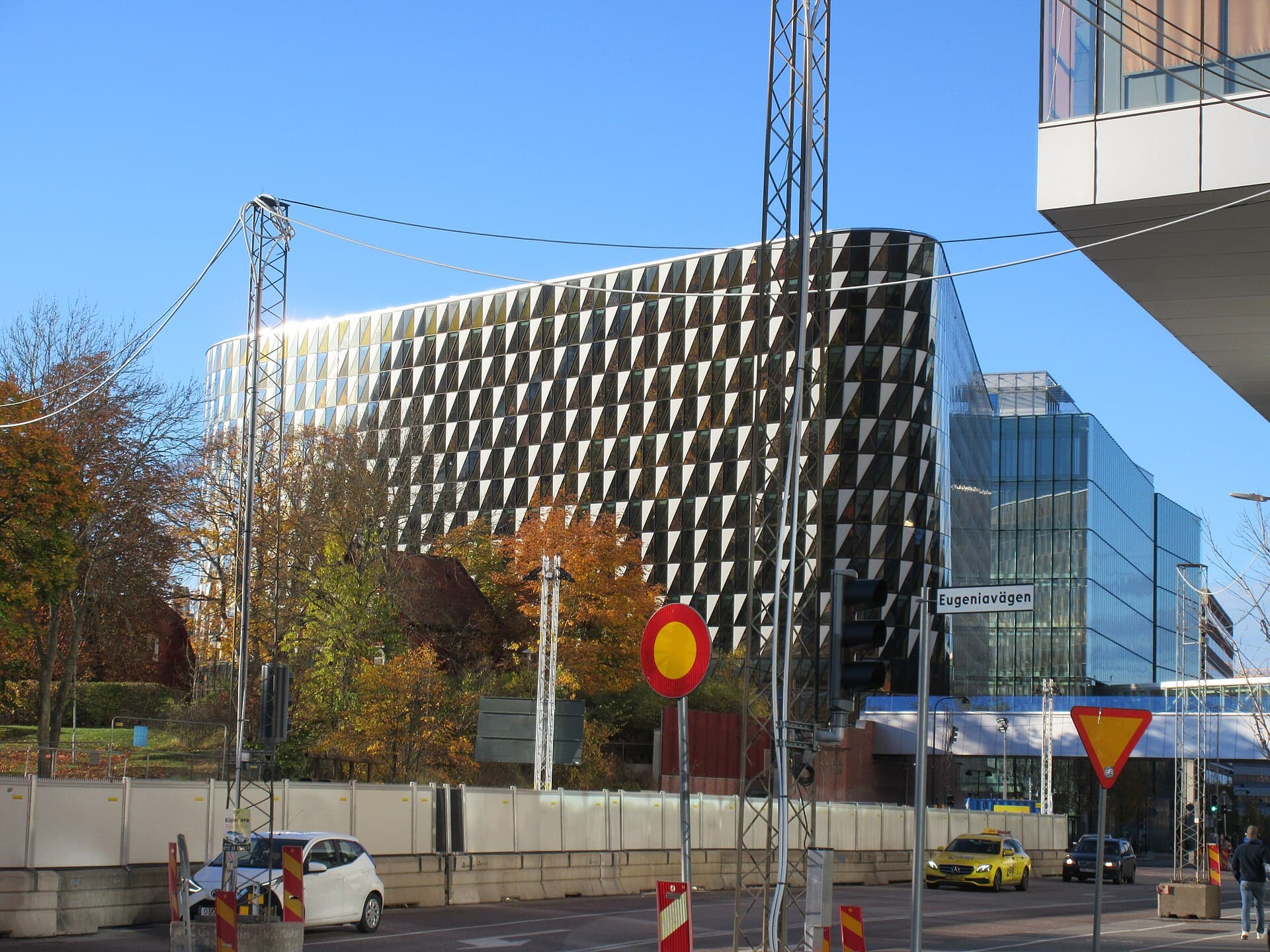
The Solna campus, north of central Stockholm, is the institute's historic heart: brick laboratory buildings from the 1940s set among newer research houses along Solnavägen, directly across from Karolinska University Hospital. Its most visible landmark is Aula Medica, the lecture and conference hall completed in 2013, whose glass facade of triangular panes leans out over the street. Each December the new laureates in physiology or medicine deliver their Nobel lectures in its auditorium.
The Flemingsberg campus at Huddinge, in Stockholm's southern suburbs, hosts much of the institute's teaching, from dentistry to biosciences, alongside the southern site of the university hospital. Between the two campuses the institute runs as a single faculty of medicine organised into departments rather than separate schools. Around six thousand students follow its programmes in medicine, biomedicine, nursing, dentistry, psychology and public health, alongside more than two thousand doctoral students, one of the largest graduate schools in medical science anywhere. The partnership with Karolinska University Hospital, formed by a 2004 merger of the Solna and Huddinge hospitals, ties nearly every part of the institute's research to working wards and clinics.
Alfred Nobel's will, signed in Paris in November 1895, directed that one part of his fortune reward "the most important discovery" in physiology or medicine, and named the Karolinska Institute in Stockholm to choose the winner. The task has been carried out every prize year since 1901 by what is now the Nobel Assembly, a body of fifty professors of the institute. Since 1977 the Assembly has been constituted as legally independent of the university itself, so that its deliberations stay outside Sweden's public records laws and the secrecy Nobel expected can be kept.
The work runs on an annual rhythm. Each autumn the Assembly's working organ, the Nobel Committee, sends invitations to thousands of qualified nominators around the world: medical professors, past laureates, members of academies. Nominations close at the end of January, and through spring and summer the committee reads, investigates and reports, narrowing hundreds of candidacies to a shortlist. The nomination files stay sealed for fifty years, so a scientist may be weighed for decades without ever knowing it. On the morning of the announcement, usually the first Monday of October, the full Assembly meets at Nobel Forum, takes its final vote, and telephones the new laureates before facing the world's press.
Medicine produces discoveries continuously and forgets its own history quickly; the Assembly's job is to read the whole record of the science, decide which findings changed it, and enter them into a permanent public register. The choice is fallible and sometimes argued with, but the archive it has built, from insulin and penicillin to DNA and immunotherapy, is the closest thing medicine has to an official memory. Fifty readers in a brick hall in Solna keep it.
The institute's own scientists appear in that register. Hugo Theorell won the 1955 prize for his work on oxidation enzymes, Ragnar Granit shared the 1967 prize for uncovering how the eye turns light into nerve signals, and Ulf von Euler shared the 1970 prize for identifying noradrenaline as the transmitter of the sympathetic nerves. In 1982 two Karolinska professors, Sune Bergström and Bengt Samuelsson, shared the prize with John Vane for unravelling the prostaglandins, the short-lived signalling molecules behind pain, fever and inflammation. Tomas Lindahl, a doctoral graduate of the institute, won the 2015 Nobel Prize in Chemistry for showing how cells repair DNA.
The 2022 prize closed a family circle and opened a deeper archive. The Assembly awarded it to Svante Pääbo, son of Sune Bergström, for recovering the genomes of extinct hominins: his teams sequenced the Neanderthal genome from fragments of ancient bone, identified the unknown Denisovans from a finger bone in a Siberian cave, and showed that most people alive today carry a measurable trace of those vanished relatives in their own DNA. It was a prize for reading the oldest record humans possess, the memory written in the genome itself, and the professors of a two-century-old medical school judged it the discovery that mattered.
The institute also keeps a physical memory of its science. The Hagströmer Medical Library, named for the anatomist Anders Johan Hagströmer and assembled in 1997 from the historical collections of the institute and the Swedish Society of Medicine, holds tens of thousands of rare medical books and manuscripts spanning five centuries. Among them is a first edition of Andreas Vesalius's De humani corporis fabrica of 1543, the illustrated anatomy that rebuilt the study of the human body on observation, together with early works of surgery, pharmacy and natural history that trace how medicine learned what it knows.
The Karolinska Institute stands among the leading medical universities in the international rankings and conducts the largest share of academic medical research in Sweden, from neuroscience and cell therapy to global health and epidemiology. Roughly five thousand staff work across the two campuses. Its role in Nobel week sets the rhythm of its public year: the October announcement at Nobel Forum, the December lectures at Aula Medica, and the ceremony in Stockholm on 10 December, the anniversary of Nobel's death.
Both campuses are open working environments, and visitors can walk the Solna campus freely, passing Nobel Forum and the leaning glass front of Aula Medica along Solnavägen. Solna lies a short bus or cycle ride north of central Stockholm, and Flemingsberg is reached by commuter train. The Hagströmer Medical Library receives visitors through arranged guided tours and public events. Nobel Forum is not generally open to the public, but in the first week of October the announcement of the prize is streamed live, and anyone can watch the doors open and the year's discovery read into medicine's record.
History
Campus and academics
The Nobel Assembly
Scholarship
The institute today
Visiting
References and resources
- Karolinska Institutet: About KI (official)
- The Hagströmer Medical Library (official)
- The Nobel Assembly at Karolinska Institutet (official)
- Nobel Prize in Physiology or Medicine (nobelprize.org)
- Full text of Alfred Nobel's will (nobelprize.org)
- Britannica: Karolinska Institute
- Wikipedia: Karolinska Institute