Heritage · University
University of Peradeniya: History and Overview
The University of Peradeniya grew out of the Ceylon Medical College of 1870 and the Ceylon University College of 1921, joined as the University of Ceylon in 1942 and moved to a valley below the Hantana hills through the 1950s. Its low colonnaded buildings, set beside the Mahaweli river and the Royal Botanic Gardens, are widely described as one of the most beautiful university campuses in Asia. It was here that Ediriweera Sarachchandra rebuilt modern Sinhala drama out of a village folk tradition with his 1956 play Maname.Written to last.
By Confinity Heritage Editorial · 2026-08-25 · 8-minute readQuiet tools, kept out of the way.
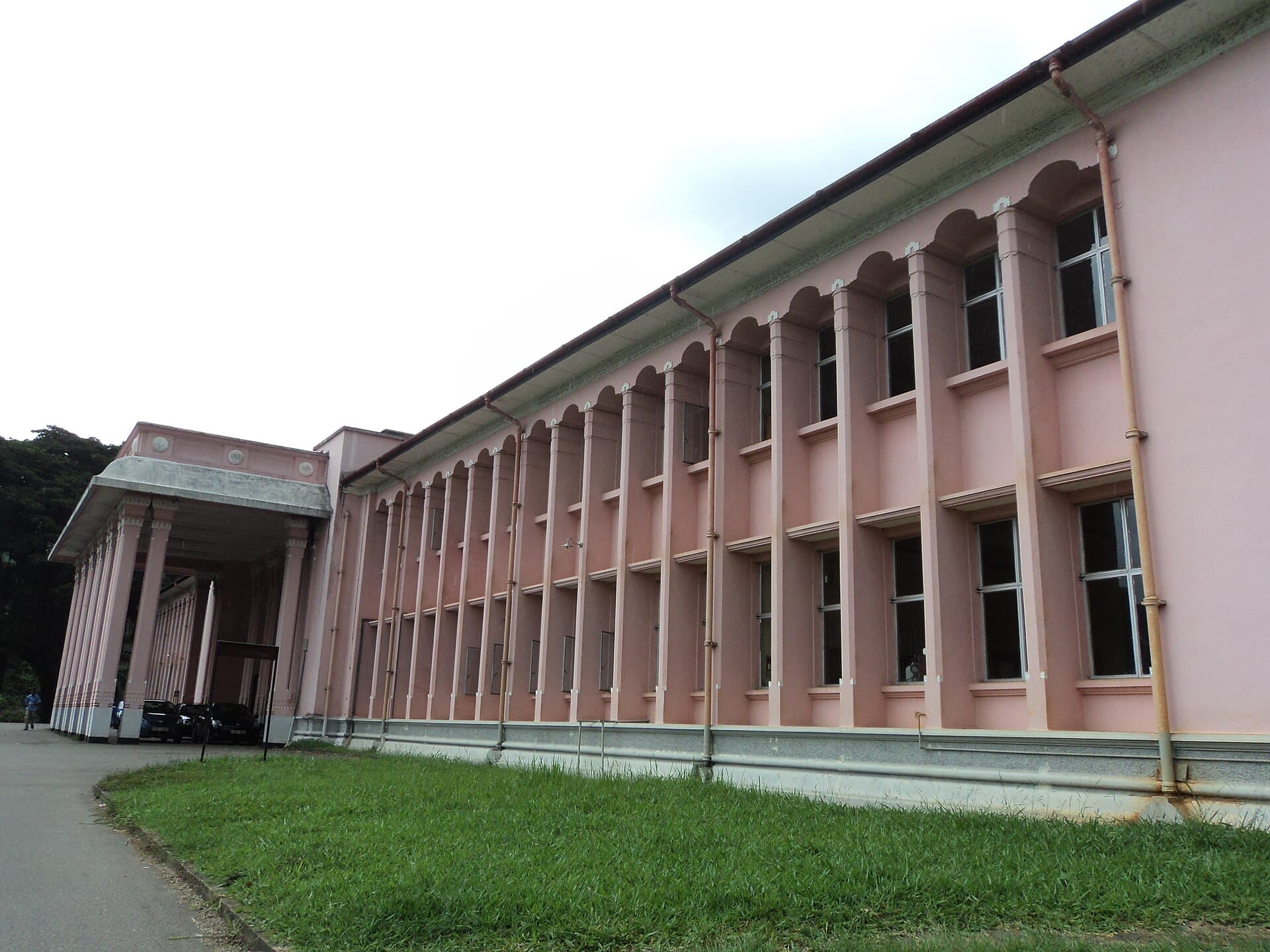
The University of Peradeniya occupies a valley in the hill country of Sri Lanka, a few kilometres west of Kandy, where the Mahaweli river runs below the lower slopes of the Hantana range. Its buildings are long and low, set among lawns and flowering trees, with deep colonnaded verandas and walls washed in pale colours that borrow from older Sinhalese building as much as from anything the British brought. The site covers roughly 700 hectares, of which only about 130 are built on. It is commonly described as one of the most beautiful university campuses in Asia, and Sir Ivor Jennings, the first vice-chancellor, said that "no University in the world would have such a setting".
What happened inside those buildings matters more than how they look: in the 1950s and 1960s a group of teachers and students at Peradeniya went back to a village performance tradition that had nearly gone out of use, took it seriously as a source, and built a modern Sinhala theatre and a new Sinhala fiction out of it. The country acquired a national theatre made from its own inherited forms rather than an imported one.
The university counts its descent from two colonial foundations in Colombo. The first was the Ceylon Medical College, opened in 1870 under Governor Sir Hercules Robinson, which began formal training in Western medicine on the island. The second was the Ceylon University College, founded on 1 January 1921, which taught arts and science but could not award degrees in its own name: its students sat the external examinations of the University of London and took London degrees. That separation of teaching from examining was the standard colonial arrangement across British South Asia, the model on which the University of Calcutta had been founded in 1857.
Agitation for a degree-granting university of Ceylon's own ran through the 1920s and 1930s and succeeded on 1 July 1942, when the two colleges were merged into the University of Ceylon, the island's first university, with Ivor Jennings as vice-chancellor. From the start the intention was to move it out of Colombo to a residential campus in the hills. The first students reached Peradeniya in 1949, the campus was formally established in 1952, and Prince Philip opened the university there on 20 April 1954 in the presence of Queen Elizabeth II. Teaching shifted faculty by faculty across the decade that followed; the engineering faculty, founded in 1950, did not arrive until 1964.
The layout was drawn up in consultation with the planners Patrick Abercrombie and Clifford Holliday and carried out by the Sri Lankan architect Shirley de Alwis, who set the buildings low against the contours. In 1972 the separate institutions were folded into a single University of Sri Lanka and Peradeniya became one of its campuses; in 1978 that structure was undone and the University of Peradeniya became independent again under its present name.
The Mahaweli, the longest river in the country, cuts the campus in two. The engineering faculty stands on one bank and the rest of the university on the other, linked by the Akbar bridge. The administrative centre is the Senate building, raised on 130 granite columns in a manner that recalls the ruined palaces of Polonnaruwa. Halls of residence, staff bungalows and playing fields are scattered through the grounds, making Peradeniya the largest residential university in the country.
Nine faculties teach here: medicine, agriculture, arts, science, engineering, dental sciences, veterinary medicine and animal science, management, and allied health sciences, along with four postgraduate institutes. Several were the first of their kind in Sri Lanka, and the professional stream is the university's national function, training a substantial share of the country's doctors, dentists, veterinary surgeons, agricultural scientists and engineers on this one site.
Just downstream lies the Royal Botanic Gardens, Peradeniya, which the university treats as a neighbour and a teaching collection. The gardens occupy 147 acres on a loop of the river, were laid out from 1821 under Alexander Moon and formally established in 1843, and now hold more than four thousand plant species. They were the working centre of colonial botany in Ceylon, where crops carried from elsewhere in the empire were trialled before being planted across the island. The agricultural and biological sciences at Peradeniya grew up beside that older tradition.
Ediriweera Sarachchandra joined the Department of Sinhala at Peradeniya in 1951, and the department's centre of gravity moved with him. Where Sinhala studies had meant the history of the language and its classical texts, by the middle of the decade modern fiction, poetry and theatre had become the main subject, and the university created a special chair for him in recognition of the change. He was made emeritus professor in 1982.
The problem he set himself was where a modern Sinhala theatre could come from. The available answers were imported: European naturalism, or the Indian-influenced musical drama of the Colombo stage. Sarachchandra looked instead at nadagam, a village form of sung and danced folk drama that had almost died out, studied its conventions and rebuilt them for a proscenium stage. The result was Maname, first performed on 3 November 1956 at the Lionel Wendt Theatre in Colombo. Its plot comes from the Chulla Dhanuddara Jataka, one of the Buddhist birth stories, and the play is generally regarded as the beginning of modern Sinhala drama. It has been staged more or less continuously ever since, and Sinhabahu, which followed in 1961, is usually counted his finest work.
Maname opened months after the general election of 1956 that brought S. W. R. D. Bandaranaike to power and made Sinhala the sole official language, so a theatre assembled from village material arrived while the country was arguing about what its own culture consisted of. Around Sarachchandra at Peradeniya gathered the writers and poets whom critics later grouped as the Peradeniya school. Siri Gunasinghe, who taught there, published the collection Mas Lea Nati Ata in that same year and introduced free verse to Sinhala poetry with it; his novel Hewanella, in 1960, was the first in Sinhala written in a stream of consciousness manner. Gunadasa Amarasekara, a dental surgeon by training and a graduate of the University of Ceylon, carried the same impulse into fiction.
The label was not a compliment when it was coined. Opponents used "Peradeniya school" to mean writers who had learned their modernism in Europe and were applying it to Sinhala from inside an institution they regarded as still colonial in outlook. That charge has been argued over ever since. What is not in dispute is the direction the work took: back into a tradition a village audience already knew, on the assumption that it was serious enough to build on.
Peradeniya's graduates are spread through Sri Lankan public life and universities abroad. Gananath Obeyesekere took a degree in English here in 1955 and became one of the most widely read anthropologists of South Asia and of Buddhism, holding a chair at Princeton. Lakshman Kadirgamar read law in Colombo and then at Peradeniya, graduating in 1953, and served as Sri Lanka's foreign minister until his assassination in 2005. Malik Peiris entered the medical faculty at Peradeniya in 1967 and later returned to set up its department of virology; in 2003, working in Hong Kong, he was part of the team that identified the coronavirus responsible for SARS.
The university teaches over 12,500 students from across the country in 59 degree programmes, and confers more than 2,500 bachelor's degrees and around 500 postgraduate degrees a year. It is placed consistently among Sri Lanka's leading universities.
Its recent history includes long interruptions: universities across the country were closed for extended periods during the insurrection of 1971 and again during the second insurrection of the late 1980s, when teaching was suspended for months at a time and campuses, Peradeniya among them, saw staff and students killed. Regular operation resumed in the 1990s, and the years since the civil war ended in 2009 have brought growth in student numbers and postgraduate provision.
Peradeniya is about six kilometres from Kandy and easily reached by bus or three-wheeler. The roads through the grounds are public, so the campus can be walked or driven without arrangement, and the Senate building, the river and the Akbar bridge are visible from them. Most visitors combine it with the Royal Botanic Gardens next door, which charge admission and take a couple of hours to walk. This is a working residential university rather than an attraction, so teaching buildings, halls and libraries are not generally open to visitors.