Heritage · University
The University of Melbourne: History and Overview
Founded in 1853, when Melbourne itself was barely eighteen years old, the University of Melbourne grew out of a gold-rush boomtown's ambition to be more than a goldfield port. It was secular by statute from the start, admitted women from 1880, and today ranks first among Australian universities, keeping collections that run from Percy Grainger's self-curated museum to 65,000 years of Indigenous art.Written to last.
By Confinity Heritage Editorial · 2026-08-24 · 8-minute readQuiet tools, kept out of the way.
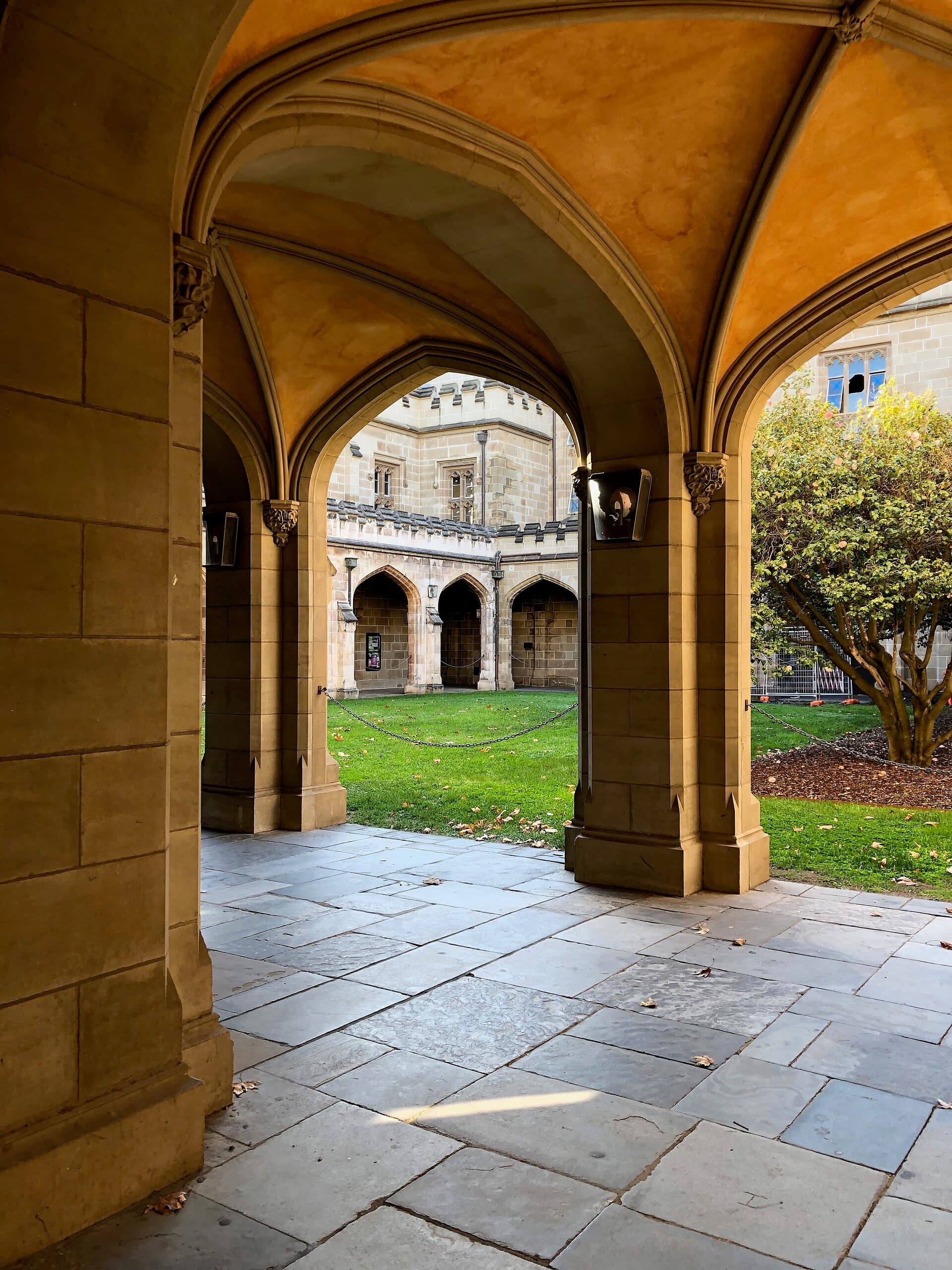
The University of Melbourne was founded by a city younger than many of its own students. Melbourne had existed for barely eighteen years when the colony of Victoria passed the act establishing a university in January 1853, and the gold rushes that paid for it were younger still. Ships crowded the bay, canvas towns spread at the diggings, and in the middle of the boom the colonists set aside land on a rise north of the city grid for cloisters, professors and a library. The university's motto, Postera crescam laude, taken from Horace, translates as "I shall grow in the esteem of future generations". For a place built on the proceeds of a stampede, it was a bet on permanence, and it has largely been won.
For an archive concerned with memory, Melbourne holds one of the strangest and most affecting memory objects any university keeps: the Grainger Museum, a small curved brick building that the composer Percy Grainger designed, funded and filled as a museum of his own life, down to his concert clothes and his letters. The university around it has its own long record of firsts, including a founding statute that kept clergy off its council and lecture theatres that opened to women decades before Oxford or Cambridge granted them degrees.
The Melbourne University Act received assent on 22 January 1853, and the judge Redmond Barry, later famous as the man who sentenced the bushranger Ned Kelly, became the university's first chancellor and held the office until his death in 1880. Classes began in 1855 in the newly built quadrangle with four professors and sixteen students, a modest opening for an institution serving a colony whose population was multiplying around it. Melbourne itself, founded in 1835 on the lands of the Kulin Nations, was then transforming from a pastoral settlement into one of the richest cities of the age, and the university was part of a deliberate campaign of civic furnishing that also produced the public library and the museum.
The founding act made a choice that set Melbourne apart from the ancient universities it otherwise imitated. Where entry to Oxford and Cambridge was still governed by religious tests in the 1850s, Melbourne was secular by statute: the act barred ministers of religion from sitting on the governing council, and no religious test was applied to students or professors. Faith was not banished from the precinct altogether. It was housed next door, in the affiliated residential colleges that the denominations were invited to build along the university's northern edge, an arrangement that let a secular university and church foundations live side by side for a century and a half.
The other early opening came in 1880, when the university admitted its first women students, among the earlier universities in the British Empire to do so. Bella Guerin took her Bachelor of Arts in 1883 and became the first woman to graduate from any Australian university. By the early twentieth century women were studying medicine and law at Melbourne while the older English universities still withheld full degrees from them.
The heart of the Parkville campus is the Old Quadrangle, the university's first building, begun in 1854 to the designs of Francis Maloney White and opened for those first sixteen students in 1855. Its arcaded cloisters and Gothic windows were a conscious quotation of Oxbridge, raised in a colony where almost nothing else was more than a generation old, and the Old Quad remains the ceremonial centre of the university. Around it the campus accumulated in layers: the System Garden planted in the 1850s for teaching botany, grand Victorian additions, and the concrete and glass of the post-war decades, including the Baillieu Library, the main humanities library, opened in 1959.
Along College Crescent, the curving road on the campus's northern rim, stand the residential colleges that the founding settlement invited: Trinity, the first, opened by the Anglicans in 1872, then Ormond, Queen's, Newman, whose 1918 buildings carry the hand of Walter Burley Griffin, and their neighbours. The colleges keep their own chapels, dining halls and traditions, and their gowned formal dinners are the closest Australia comes to the collegiate life of the older world.
Academically, the university's defining modern decision came in 2008 with the Melbourne Model. The reform swept away most direct-entry professional degrees and replaced them with a small set of broad undergraduate programs, arts, science, commerce, biomedicine and their peers, followed by graduate schools for law, medicine, engineering, teaching and architecture, on the pattern of North American universities. The change was contested at the time, inside the university and beyond it, as a break with a century of Australian practice. It has since become the institution's signature, and the strategy that produced it borrowed its name, Growing Esteem, from the old motto.
Percy Grainger, born in Melbourne in 1882, became one of the most famous pianists and composers of his era, the arranger of Country Gardens and a pioneering collector of English folk song. In the 1930s, at the height of his fame and living in America, he began building a museum of himself at the university of his home city. He paid for it, helped design its curved brick form, and spent years filling it: manuscripts and letters, his experimental "free music" machines, photographs, paintings, and dozens of items of his own clothing, from concert dress to the towelling outfits he designed and wore. He even offered his skeleton for display after his death, an offer the university declined. The Grainger Museum opened in 1938 and is regarded as the only purpose-built autobiographical museum in Australia.
What makes the building affecting is not vanity but method. Grainger believed a life could only be understood whole, with its failures, obsessions and private corners kept alongside the public triumphs, and he curated his archive accordingly, labelling and annotating his own past for people he would never meet. A musician who spent his career interpreting other people's memory, in folk songs gathered from elderly singers, ended by arranging his own life as an exhibit. The museum still stands on Royal Parade, run by the university, and remains one of the most unusual acts of self-archiving anywhere.
Melbourne's scientific record runs deep in medicine. Macfarlane Burnet, a Victorian country boy who took his medical degree at Melbourne, spent his career at the affiliated Walter and Eliza Hall Institute and shared the Nobel Prize in 1960 for predicting acquired immunological tolerance, a foundation of transplant medicine. Peter Doherty, who shared the 1996 Nobel Prize for discovering how killer T cells recognise infected cells, has been a laureate professor at Melbourne for decades, and the Doherty Institute that bears his name, a joint venture with the Royal Melbourne Hospital, was the first laboratory outside China to isolate and share the virus that causes COVID-19, in January 2020. Elizabeth Blackburn, who later won the 2009 Nobel Prize for the discovery of telomerase, took her undergraduate and master's degrees in biochemistry at Melbourne.
The university's most tangible invention is the bionic ear. Graeme Clark, professor of otolaryngology, led the team that developed the multi-channel cochlear implant, and in 1978 the first device was implanted in a Melbourne patient, Rod Saunders. Commercialised as Cochlear, the implant has restored hearing to hundreds of thousands of people and is counted among Australia's great inventions.
Melbourne is consistently ranked first among Australian universities, holding the top national position in the Times Higher Education world rankings for more than a decade, and it teaches one of the largest student bodies in Australia, more than fifty thousand strong, with graduate students an unusually large share under the Melbourne Model. Its cultural collections have lately been the site of a public reckoning: the Ian Potter Museum of Art reopened in 2025 with 65,000 Years: A Short History of Australian Art, an exhibition led by Marcia Langton that placed First Nations art at the centre of the national story and examined the university's own collecting history without flinching. At the Southbank campus, the Wilin Centre for Indigenous Arts and Cultural Development supports Indigenous artists across music, theatre and film. The university acknowledges that its campuses stand on the unceded lands of the Kulin Nations, in the city its Traditional Owners know as Narrm.
The Parkville campus lies just north of Melbourne's city centre, a short tram ride up Swanston Street, and the grounds are open to walk through. The Old Quad's cloisters and exhibition spaces welcome visitors, the System Garden offers a quiet green pocket among the science buildings, and both the Grainger Museum on Royal Parade and the Potter Museum of Art are open to the public. College Crescent is worth the detour for the Victorian and Griffin-era college buildings. Because this is a working university of considerable size, term time brings crowds at lunch hour, and the quietest visits come in the mid-morning or during semester breaks.