Heritage · University
The University of Sydney: History and Overview
Founded in 1850 as Australia's first university, the University of Sydney was established as a secular institution open to students on merit alone. Its sandstone Main Quadrangle, the jacaranda that flowers there each spring, and the 1965 Freedom Ride organized by its students all belong to the story of a young nation learning to remember itself.Written to last.
By Confinity Heritage Editorial · 2026-08-24 · 8-minute readQuiet tools, kept out of the way.
The University of Sydney is the oldest university in Australia, founded in 1850 in a colony that was barely sixty years past its beginnings as a penal settlement. In a society sorted by birth, where many families carried convict ancestry like a sealed record, the university was established as a secular institution with no religious test, open to any student who could pass its examinations. William Charles Wentworth, the colonial statesman who carried the founding act through the New South Wales Legislative Council, argued that the door should stand open to the child of every class, so that talent born anywhere in the colony might rise to its highest offices.
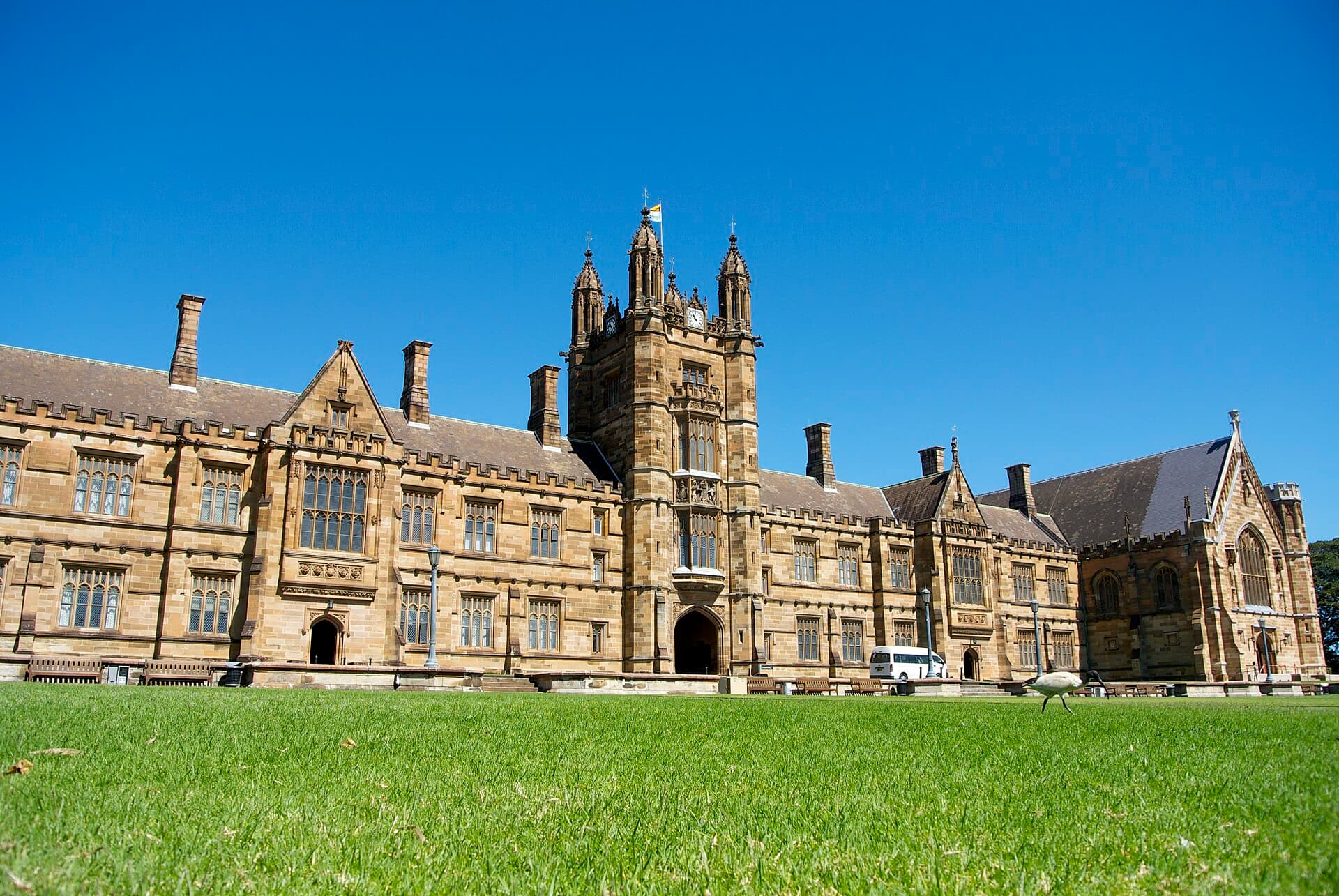
The university's sandstone Main Quadrangle, with its Gothic revival clocktower and the jacaranda that flowers violet across the lawn each spring, has become one of the most photographed places in the country. The deeper inheritance is the founding idea itself, tested and widened over 175 years: by the women admitted in 1881, by the Aboriginal students who forced the nation to look at itself in 1965, and by the collections and libraries that keep the record of it all.
The University of Sydney Act received assent on 1 October 1850, and teaching began in 1852 with three professors and a first intake of about two dozen students. Wentworth wanted a university belonging to no church, admitting students on merit rather than creed, in contrast to the Oxford and Cambridge of the day, which still barred non-Anglicans from degrees. A royal charter of 1858 recognized Sydney degrees as equal in rank to those of the universities of the United Kingdom.
In 1855 the government granted the university land at Grose Farm, a ridge above Parramatta Road, and the colonial architect Edmund Blacket began the Gothic revival buildings that became the Main Quadrangle. The University of Melbourne, founded three years after Sydney, grew up alongside it, and the two have kept a friendly rivalry ever since.
The founding promise widened in 1881, when the university admitted women to all degrees on the same terms as men, decades ahead of Oxford or Cambridge and among the earliest such decisions in the British Empire. The first two women graduated in 1885. Through the twentieth century the university grew from a small colonial college into a major research institution, expanding across the neighbouring Darlington site as Australian higher education widened after the Second World War.
The heart of the Camperdown campus is the Main Quadrangle, begun by Blacket in the 1850s and completed in stages over the following seventy years. Its grandest room, the Great Hall, opened in 1859, a ceremonial hall in honey-coloured Sydney sandstone that deliberately echoed the medieval halls of England, a young institution borrowing the architecture of age. The clocktower above the main entrance anchors the university's most familiar view, framed by lawns where graduations spill out in gowns every winter and spring.
In the quadrangle's southeastern corner stood the campus's best-loved living thing, a jacaranda planted in 1928 that flowered into a canopy of violet-blue each November. Generations of students repeated the superstition that anyone who had not begun studying by the time the jacaranda bloomed was already too late to pass their exams. When the tree died in October 2016, at the age of 88, the loss was reported like the passing of a public figure. The university had prepared for the day: a genetic clone, grafted years earlier, was planted in the same corner in 2017, paired with a native Illawarra flame tree in the opposite corner in acknowledgment of the land's Aboriginal custodians.
The university's libraries centre on Fisher Library, named for Thomas Fisher, a Sydney bootmaker and the son of convicts, whose bequest in the 1880s endowed it. It has grown into one of the largest academic libraries in the Southern Hemisphere, a fitting monument in a university founded on the idea that a convict's child deserved the whole of learning. Around it, the modern university teaches across the sciences, engineering, medicine and health, law, arts and social sciences, architecture, music and business.
In February 1965, a bus carrying about thirty University of Sydney students set out on a two-week tour of country New South Wales. They called themselves Student Action for Aborigines, and their leader was Charles Perkins, an Arrernte and Kalkadoon man who had come to the university as a mature-age student after a career in professional soccer, one of very few Aboriginal students then enrolled anywhere in the country.
The Freedom Ride, named after the American civil rights journeys that inspired it, drove into towns where segregation was ordinary and unremarked. In Walgett the students picketed a Returned Services League club that refused entry to Aboriginal ex-servicemen. In Moree they stood at the municipal swimming baths, which barred Aboriginal children, and escorted those children through the gates. The confrontations were hostile; outside Walgett the students' bus was run off the road. But journalists were travelling with them, and the photographs and reports put scenes most urban Australians had never seen onto front pages and television screens. Historians count the ride among the events that shifted public opinion ahead of the 1967 referendum, in which more than ninety per cent of Australians voted to amend the Constitution's treatment of Aboriginal people.
The following year Perkins took his Bachelor of Arts, becoming the first Aboriginal man to graduate from an Australian university. He went on to lead the federal Department of Aboriginal Affairs, the first Aboriginal Australian to head a Commonwealth government department. The university now remembers him deliberately: the Charles Perkins Centre, a major medical research institute opened on the Camperdown campus in 2014, carries his name, and an annual Charles Perkins Oration keeps the argument of 1965 in the university's present tense. It is a rare thing for an institution to hold up, as its proudest memory, the moment its own students held a mirror to the nation.
The university's scientific tradition is anchored by John Cornforth, who won the Nobel Prize in Chemistry in 1975 for unravelling the stereochemistry of enzyme-catalysed reactions. Cornforth's story began in its Sydney laboratories in the 1930s, where he studied organic chemistry while progressively losing his hearing to otosclerosis; he was profoundly deaf by his early twenties and worked for the rest of his life without hearing a lecture. He graduated with first-class honours and won an 1851 Exhibition scholarship to Oxford alongside a fellow Sydney chemist, Rita Harradence, who had won the other of the two awarded that year; they married and collaborated for decades, Harradence often serving as his ear on the world.
The university is also a keeper of collections. Sir Charles Nicholson, an early chancellor, gave his Egyptian, Greek and Cypriot antiquities to the university in 1860, founding the Nicholson Museum, the oldest university museum collection in Australia. The Macleay family's vast natural history collections, rich in specimens from the age of colonial science, joined it in the nineteenth century. In 2020 both were brought together with the university's art collection in the Chau Chak Wing Museum, a purpose-built home at the campus entrance. Its most charming resident is a colossal LEGO model of Pompeii, more than 190,000 bricks, which shares the galleries with mummies and marble as a reminder that memory institutions are allowed to smile.
The University of Sydney is one of the largest universities in Australia, with a student body of around 70,000, and a founding member of the Group of Eight research universities. It places consistently within the upper ranks of the international league tables, and the years under vice-chancellor Michael Spence, from 2008 to 2020, saw it grow into a global institution drawing international students in large numbers.
Its research now reaches from the medical work of the Charles Perkins Centre to the Sydney Nanoscience Hub, a purpose-built laboratory complex opened in 2016 whose vibration-isolated floors house the university's quantum science programs. Physicists there work on the control of quantum systems and the long road toward useful quantum computing, a fitting occupation for an institution founded on a bet about the future.
The Camperdown campus sits just southwest of central Sydney, and its grounds are open to walk through. The Main Quadrangle is freely accessible outside ceremonies, and the jacaranda draws photographers through its flowering in late October and November. The Chau Chak Wing Museum stands near the main entrance and is open to the public with free general admission. Lecture rooms are in session most of the year, but the lawns, the cloisters and the Chau Chak Wing Museum are open to anyone, which is what the founders said the place was for.