Heritage · University
University of St Andrews: History and Overview
Founded between 1410 and 1413, the University of St Andrews is Scotland's first university and the third oldest in the English-speaking world. Its students still wear scarlet gowns on the harbour pier, step around the initials of a martyr set in the cobbles, and study in a town that was among the first on earth to be systematically photographed.Written to last.
By Confinity Heritage Editorial · 2026-08-24 · 8-minute readQuiet tools, kept out of the way.
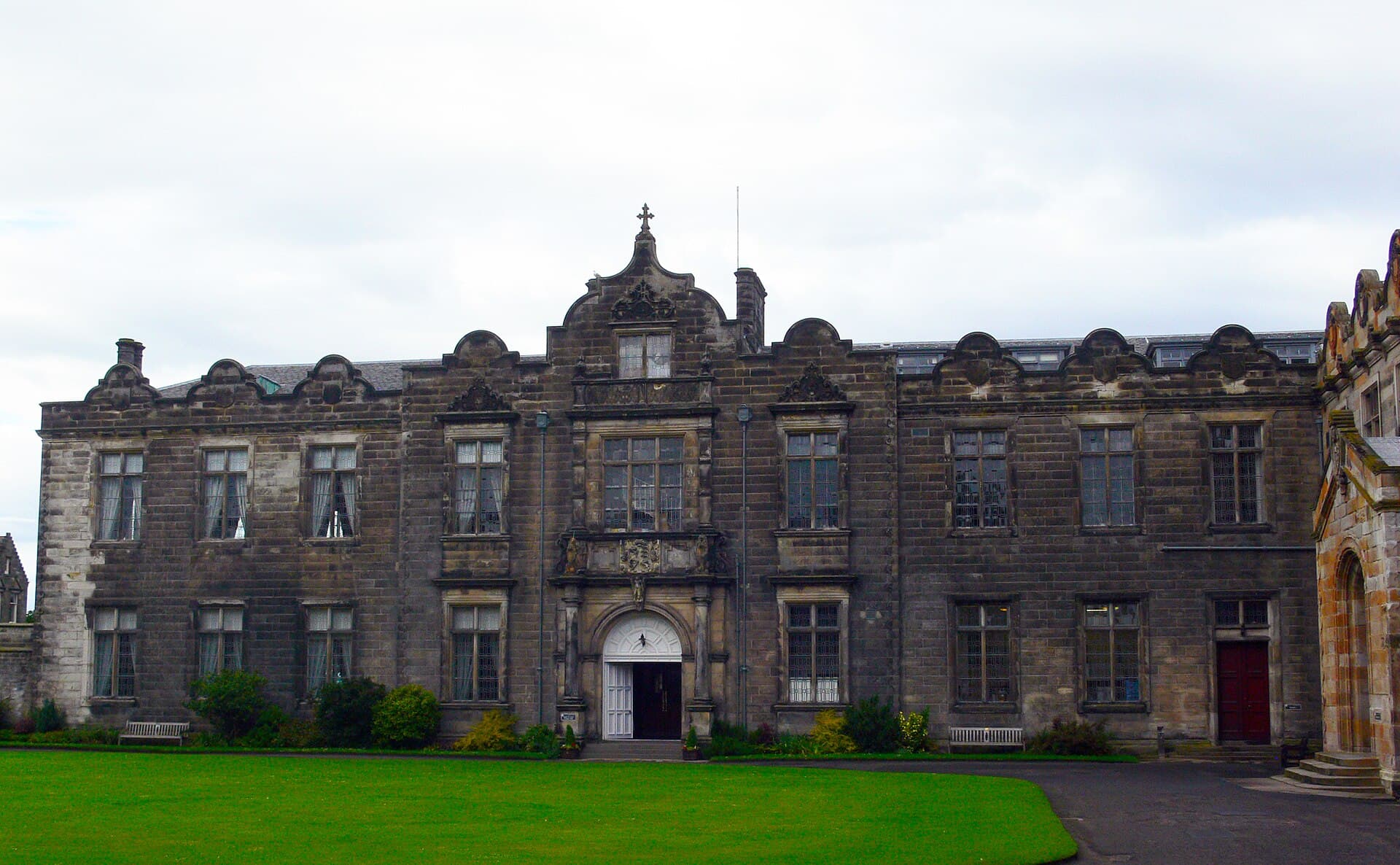
The University of St Andrews is the oldest university in Scotland and the third oldest in the English-speaking world, younger only than Oxford and Cambridge. It sits in a small grey town on the Fife coast of the United Kingdom, where the medieval street plan still runs down to a ruined cathedral and a harbour pier, and where town and university have been folded into one another for six centuries.
St Andrews keeps its memory in unusual materials: in cloth, in the scarlet gowns undergraduates have worn for centuries; in stone, in a set of initials laid into the cobbles where a young reformer was burned in 1528; and in silver salts, because this small town became one of the birthplaces of photography and one of the first places on earth to be systematically recorded by the camera.
The university began as a society of masters, many of them trained in Paris, who started teaching in the town in 1410. Bishop Henry Wardlaw granted the school a charter of privileges in 1412, but a medieval university needed papal authority to award degrees, and the politics of obtaining it explain the odd shape of the founding date. Europe was then split by the Great Schism, with rival popes in Rome and Avignon, and Scotland stood among the last countries loyal to the Avignon line. So the bulls that raised St Andrews to full university status were issued in August 1413 by Benedict XIII, the Avignon claimant, from his refuge at Peñíscola on the Spanish coast. Scotland's first university owes its confirmation to a pope whom most of Europe had already refused.
The colleges came in the century that followed. St Salvator's College was founded in 1450 by Bishop James Kennedy, and its chapel, with the tall tower that still commands North Street, remains the university's ceremonial heart; Kennedy's elaborate tomb stands inside it. St Leonard's College followed in 1512, and St Mary's College was founded in 1537 on South Street, where its quadrangle still houses the school of divinity, the purpose it has served since the sixteenth century. St Salvator's and St Leonard's were merged in 1747 to form the United College, which together with St Mary's makes up the historic structure of the university today.
The Reformation cut through the town and the university alike. In 1528 Patrick Hamilton, a young scholar who had brought Lutheran ideas back from the continent, was burned at the stake outside St Salvator's Chapel; the fire was badly made and he took hours to die. His initials, PH, are set into the cobbles on the spot, and the martyrdom opened the long upheaval that John Knox, himself a St Andrews student and later a preacher in the town, would carry to its conclusion. The university that emerged was Protestant, poorer, and for two centuries often precarious, before its nineteenth-century revival.
Women reached St Andrews early by Scottish standards. From 1877 the university offered the LLA, the Lady Literate in Arts, a distance scheme that let women study university subjects and sit examinations decades before they could enrol; thousands took it across Britain and beyond. Women were admitted to matriculate alongside men in 1892, and Agnes Forbes Blackadder became the first female graduate in 1895.
The university has no walled campus. Its quadrangles, libraries and residence halls are threaded through the three medieval streets of the town, so that walking from a lecture to the sea takes a few minutes and passes buildings from five centuries. The finest of the quadrangles is St Salvator's, entered from North Street beneath the chapel tower; St Mary's on South Street is quieter, with a thorn tree said to have been planted by Mary, Queen of Scots. The modern North Haugh site on the edge of town holds the sciences.
Academically the university is organised into four faculties covering arts, divinity, medicine and science, and it teaches roughly ten thousand students, a high proportion of them from outside the United Kingdom. Golf frames the town on its west side: the Old Course, the most famous course in the game, runs beside the streets, and students hold playing privileges on the town's links.
The traditions are unusually alive. Undergraduates wear scarlet wool gowns on formal occasions and on the pier walk, a procession along the stone harbour pier after Sunday chapel that has become the university's best-known image. Every student is folded into an academic family: older students become academic parents to new arrivals, passing down advice, dinners and the accumulated lore of the place, a small machinery for handing memory between generations. The bond is sealed on Raisin Weekend in November, when academic children owe their parents a gift once paid in raisins, receive absurd Latin receipts, and end the festivities in a mass foam fight in St Salvator's Quad. And at dawn on the first of May, students run into the North Sea for the May Dip, which by tradition washes away academic bad luck.
Two of the ways St Andrews remembers deserve a closer look.
The first is underfoot. The initials PH in the cobbles of North Street, outside the gate of St Salvator's, mark where Patrick Hamilton burned in 1528. Students do not step on them. The superstition holds that a student who treads on the initials will fail their degree, and the only cure is the May Dip's cold plunge. Watch the pavement on a term-time morning and you will see walkers part slightly around a patch of stone, a five-hundred-year-old death still shaping how people cross a street: memory kept not in an archive but in a habit.
The second is in the university's photographic collection. In the 1840s, in the first years after photography's invention, St Andrews became one of its cradles. Sir David Brewster, the physicist then serving as principal of the United College, corresponded with William Henry Fox Talbot and learned the calotype process; because Talbot's English patent did not run in Scotland, the circle around Brewster could experiment freely. The local physician John Adamson made one of the earliest calotype portraits taken in Scotland, and his younger brother Robert went to Edinburgh to form the partnership of Hill and Adamson, whose thousands of calotypes from the 1840s stand among the first great bodies of work in the medium. The circle turned its cameras on its own town, so St Andrews, its fishers, its ruins and its scholars, became one of the first communities on earth to be systematically photographed. The university's photographic collection, built on that foundation, now runs to around a million images and ranks among the oldest anywhere: a town that began recording itself almost as soon as recording light became possible, and never stopped.
The university's roll of scholars begins early. John Napier, who invented logarithms, matriculated at St Salvator's in 1563. James Wilson, educated at St Andrews in the eighteenth century, emigrated to America, signed the Declaration of Independence and helped draft the United States Constitution; Benjamin Franklin received an honorary doctorate from the university in 1759 and was ever afterwards Dr Franklin. In the sciences, Brewster's work on optics and polarised light was done partly in the town, and Sir James Black, whose invention of beta blockers earned the Nobel Prize in Physiology or Medicine in 1988, took his medical degree at St Andrews. Among Scotland's ancient universities it shared the same reforming and Enlightenment currents as its younger peer the University of Edinburgh, and the two remain linked rivals at the head of Scottish scholarship.
St Andrews now stands at the top of British higher education by most domestic measures. In 2022 The Times and The Sunday Times Good University Guide ranked it first in the UK, the first time any university other than Oxford or Cambridge had held that top place, and it has stayed at or near the summit of the principal UK league tables since. Its research strengths run from marine science and photonics to philosophy, divinity and international relations, and its student body is among the most international in Britain.
One line of recent history did more than any league table for its fame: Prince William and Catherine Middleton met there as art history students in 2001, and their marriage fixed St Andrews in the public imagination as the university where futures, not only degrees, are made.
St Andrews is about an hour and a half from Edinburgh, reached by train to Leuchars and a short bus ride. The town is compact and best walked: St Salvator's tower and quadrangle on North Street, St Mary's quadrangle on South Street, the cathedral ruins at the east end, and the pier beyond them where the red gowns process on Sundays in term. Look down as well as up; the PH initials lie in the cobbles outside St Salvator's, and visitors are free to step around them in solidarity. The Wardlaw Museum on the Scores tells the university's story and shows items from its collections, including the early photographic holdings, and the Old Course is a few minutes' walk west. The quads and the chapel absorb visitors easily; the teaching buildings behind them would rather not.