Heritage · University
Kyiv-Mohyla Academy: History and Overview
Founded as the Kyiv Brotherhood School in 1615 and remade by Metropolitan Petro Mohyla in 1632, the Kyiv-Mohyla Academy became the leading centre of Orthodox learning in eastern Europe. Russian imperial authorities closed it in 1817; it was refounded on the same Podil ground in 1991 and took students again in 1992, after a gap of 174 years.Written to last.
By Confinity Heritage Editorial · 2026-08-25 · 8-minute readQuiet tools, kept out of the way.
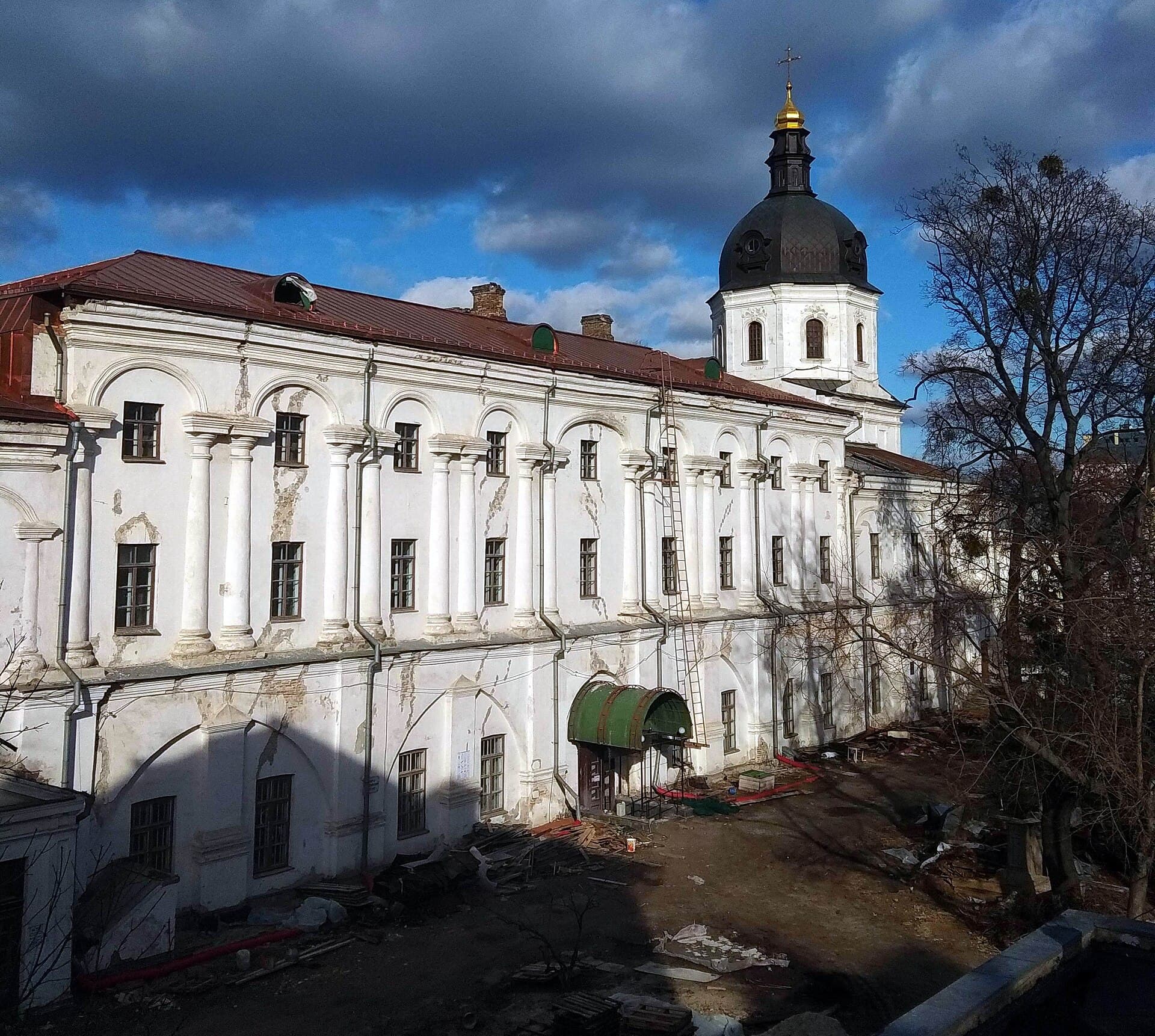
The National University of Kyiv-Mohyla Academy stands in Podil, the old riverside quarter of Kyiv, on ground that has held a school since 1615. The founding gift came from Halshka Hulevychivna, a noblewoman who left her Podil estate for a monastery, a hospital and a school open to children of every rank; the university keeps 15 October 1615 as its founding day. What grew from that bequest became the first institution of higher learning in Ukraine and, for most of two centuries, the chief school of the Orthodox world west of Moscow.
It is also the one institution in this collection whose line was cut clean through. In 1817 the Russian imperial authorities closed the academy and put a seminary in its place, and nothing of it taught again for 174 years. The university on the site now dates its charter to 1991 and its first students to 1992.
The Kyiv Brotherhood School opened in 1615 under the Kyiv Epiphany Brotherhood. Its transformation came seventeen years later, when Petro Mohyla, then archimandrite of the Kyiv Pechersk Lavra and soon Metropolitan of Kyiv, merged it with the rival school he ran at the Lavra. The result took his name as the Kyiv-Mohyla Collegium, and in 1635 it received a royal privilege from Wladyslaw IV of Poland.
Mohyla built it on the Western collegiate model. Latin was the main language of instruction, with Greek and Church Slavonic holding an important place beside it and Polish the working language of the Commonwealth around it. Students were streamed through grammar, rhetoric and philosophy including theology; by the eighteenth century the course ran twelve years across eight classes and had widened to mathematics, drawing and the French, German, Russian and Hebrew languages.
The title of academy came in three stages: the Treaty of Hadiach granted it in 1658, Tsar Ivan V recognised the status in 1694, and Peter I confirmed it in 1701. Under Hetman Ivan Mazepa, who paid for a new academic building, a theology class opened in 1689 and the academy drew students from the lands of present-day Ukraine, Russia, Poland, Belarus, Romania, Serbia, Bulgaria and Greece. In 1744 its register showed 722 students from secular families against 380 from the clergy. Decline was administrative first: the Brotherhood Monastery's properties were secularised in 1786, leaving the academy on government money, and its teaching was Russified thereafter.
The campus runs from Kontraktova Square down toward the Dnipro. Its centre is the old academic building, called the Mazepa building after its financier, a single-storey brick range in the Ukrainian Baroque style built in 1703-1704, its classrooms opening onto an arcaded gallery along the front. A second floor and the Church of the Annunciation at its eastern end were added between 1735 and 1740 under Metropolitan Rafail Zaborovsky, to a design by Johann Gottfried Schaedel. It now holds the ceremonial hall, the contemporary art centre and the research library, and has spent recent years under restoration, so the arcade is usually seen behind scaffolding and sheeting.
Around it stand the house associated with Hulevychivna, the first home of the Brotherhood School, and the bursa, the old student dormitory facing the river. The Epiphany Cathedral of the Brotherhood Monastery is not among them: it was destroyed with explosives in 1935.
In 1817 the Holy Synod resolved to close the Kyiv-Mohyla Academy, with the assent of Tsar Alexander I. A theological seminary opened in its place, and two years later, in 1819, that seminary was renamed the Kyiv Theological Academy, a purely clerical body whose doors were open only to the children of serving clergy. Alumni petitioned the tsar to convert the academy into a university instead, and failed. When the empire did give Kyiv a modern university it founded a new one, Saint Vladimir University, opened in 1834 under Nicholas I, rather than restore what it had shut. The school that had trained a large share of the educated class of the region simply stopped.
The site stayed in use, which makes the gap easier to see rather than harder. Soviet authorities closed the Theological Academy in turn after 1917 and plundered its library, and the premises went to the Kyiv Higher Naval Political School, which trained political officers for the Soviet navy. A mosaic from that period, showing a warship and quotations from Lenin, is still fixed to one of the walls; when the university came back it left it there.
The gap ran 174 years. In 1991, as Ukraine became independent, the Verkhovna Rada issued a decree reviving the academy on its Podil ground, achieved largely through the campaigning of the literary scholar Viacheslav Briukhovetsky, who became its first president. The first cohort matriculated on 24 August 1992, the first anniversary of independence, and the first six graduates took their degrees in June 1995.
Most institutions in this collection argue that continuity is what makes a university: an unbroken teaching line, a library never dispersed, appointments running back to a charter. Kyiv-Mohyla cannot make that argument, and the break in it is disputed openly, including by its own historians. It offers a different one. Vilnius University was closed by tsarist decree in 1832 and reopened after 87 years; Kyiv-Mohyla waited twice as long and came back anyway. What survived the ban was not the faculty or the endowment but the memory of what had stood there: the record of who had studied at it, and the argument that Ukraine had once had a school of its own and could have one again. The premises went to a naval academy. The idea did not.
The philosopher and poet Hryhorii Skovoroda, born in 1722 and dead in 1794, is the name most attached to the old academy. He studied there in spells across two decades, from 1734 to 1741, again in 1744-1745 and once more in 1751-1753, and never took a degree. He left to teach and travel on foot, wrote fables, verse and liturgical music, and held that a person's task was to find the calling their nature fitted them for. Ukraine has since put him on the 500 hryvnia note, with the academy's building on the reverse, and the university's postal address is 2 Skovorody Street.
Mikhail Lomonosov, who founded Moscow University, is generally held to have studied at the Kyiv academy briefly around 1735, after three years in Moscow, though the length of his stay is poorly documented. The clearer roll is of public life: the hetmans Ivan Mazepa, Pylyp Orlyk and Pavlo Polubotok, the imperial chancellor Alexander Bezborodko, and the composer Artemy Vedel. Feofan Prokopovych, rector from 1711 to 1716, drafted and carried through Peter the Great's reform of the Russian church.
NaUKMA is one of the smallest and most selective universities in Ukraine, with roughly four thousand students and about 180 academic staff across six faculties covering computer sciences, economics, humanities, law, natural sciences and social sciences. It teaches on a liberal arts principle, was the first Ukrainian institution to rebuild its degrees on the North American bachelor and master model, and has taught in Ukrainian and English since the 1990s, when that was an unusual choice. It works with 120 universities in 35 countries.
Its civic role is a matter of record. In 2004 its students and academics were among the first to protest the falsified presidential election, the campus served as a base for Orange Revolution activists, and a museum of those events was later opened there. Serhiy Kvit was rector from 2007 to 2014, served as Ukraine's Minister of Education and Science from 2014 to 2016, and returned as president in 2022.
Teaching has continued since the full-scale invasion of 2022, and the buildings have been damaged in the process. After the Russian attack on Kyiv of 24 May 2026 the university reported that five academic buildings, the Antonovych Library, the NaUKMA Museum and the Culture and Arts Centre had been damaged, put initial repairs at about 1.5 million hryvnia, and said its community continues to study and work.
The campus sits at Kontraktova Square, on the blue line of the Kyiv metro, and the streets through it are public, so the old academic building, the bursa and the Hulevychivna house can be seen on a short walk between the square and the river. Access to the interiors depends on the restoration work and on whether the museum and the Culture and Arts Centre are running exhibitions, listed on the university's English news page. The Church of St Nicholas of Prytysk and the funicular up to the upper town are minutes away.
Travel is constrained. Ukrainian airspace has been closed to civil aviation since February 2022, so arrival is overland, usually by rail from Poland, Hungary, Slovakia or Moldova, and air raid alerts in Kyiv mean moving to a shelter or the metro. The British and American governments both advise against travel to Ukraine. Check current advice and the university's own notices before planning a visit.