Heritage · University
University of Edinburgh: History and Overview
Founded in 1582 by Edinburgh's town council under a charter from King James VI, the University of Edinburgh grew into the intellectual engine of the Scottish Enlightenment. Its lecture rooms and medical school shaped figures from David Hume and Joseph Black to Charles Darwin and James Clerk Maxwell.Written to last.
By Confinity Heritage Editorial · Updated 2026-07-31 · 8-minute readQuiet tools, kept out of the way.
The University of Edinburgh began in 1582 as the Tounis College, the town's own college, chartered by King James VI and set up by the burgh council of Edinburgh rather than by a bishop or a pope (University of Edinburgh). That civic origin set it apart from the older Scottish foundations at St Andrews, Glasgow, and Aberdeen, and it shaped a school that would be answerable to a city and, in time, to the wider world of learning. Teaching opened the following year, in October 1583, and the institution has never stopped since.
This archive keeps the memory of that long teaching life: the men and women who passed through its classes, the ideas that were argued into being on its benches, and the buildings that still hold their names. To remember Edinburgh is to remember a place where philosophy, medicine, geology, and physics were reshaped within a few streets, and where the record of a single college became part of the common inheritance of modern thought.
The foundation charter was granted by James VI in 1582, and the college admitted its first students in 1583 under Robert Rollock, who served as its first regent and later as principal (Britannica). For its early decades it was known simply as the town's college; after the king visited in 1617 it took the name King James's College, and only gradually did the title University of Edinburgh settle into common use (University of Edinburgh).
Growth came steadily rather than all at once. The faculties took shape across the early 18th century, with law organised in 1707, arts in 1708, and, most consequentially, medicine in 1726 (Wikipedia). The medical faculty was modelled in part on Leiden, and its founding proved to be one of the decisive events in the university's history, drawing students from across Britain, Europe, and the American colonies.
By the middle of the 18th century Edinburgh had become the working centre of the Scottish Enlightenment, the remarkable flowering of philosophy, science, economics, and letters that ran through Scotland's cities in the decades around 1750 (Britannica: Scottish Enlightenment). The university did not act alone in this. The city's clubs, printers, and learned societies mattered too. But the college supplied the professors, the anatomy theatres, and the classrooms where much of that thought was tested and taught, and its reputation carried the ideas of the Enlightenment far beyond Scotland.
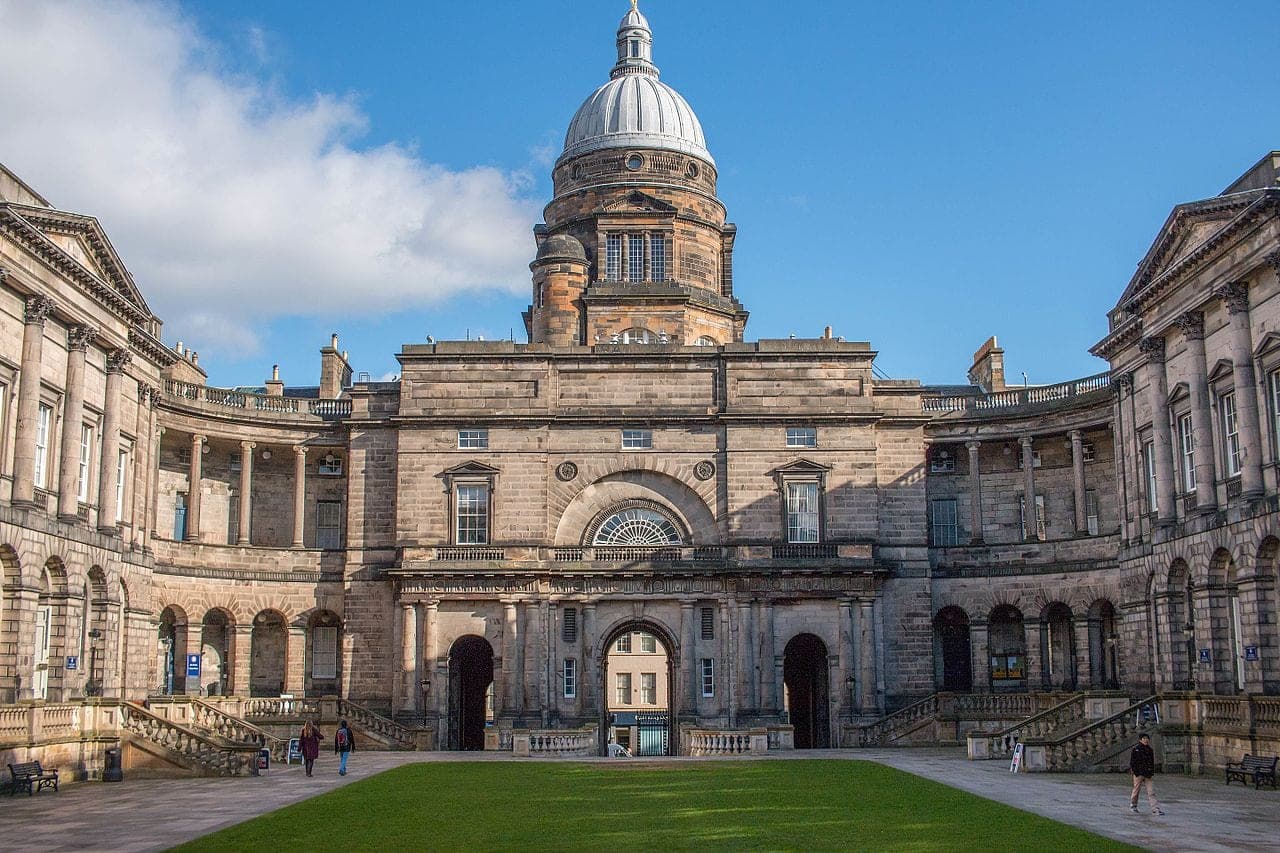
The university's most recognisable building is the Old College on South Bridge, whose foundation stone was laid in 1789 to a design by Robert Adam, the leading neoclassical architect of his day (Old College). Adam died in 1792, and construction stalled through the years of the Napoleonic Wars. William Henry Playfair was appointed architect in 1817 and reworked the scheme, combining Adam's planned courts into a single large quadrangle that was largely complete by 1827. The dome that now crowns the building was not part of the finished work of that era; it was added in 1887 to a design by Sir Robert Rowand Anderson, restoring an idea Adam had proposed but that cost had cut. Playfair went on to shape much of the city's neoclassical face, and his hand is felt across the university and the wider Edinburgh skyline.
 Robert Adam began Old College in 1789 and died before much of it stood; William Playfair finished it forty years later, and the dome was added only in 1887. Photograph by dun_deagh, CC BY-SA 2.0, via Wikimedia Commons.
The medical school gave the institution much of its early fame. Through the 18th and 19th centuries the anatomy and clinical teaching at Edinburgh set a pattern that other schools copied, and the city's infirmary and lecture rooms trained generations of physicians and surgeons (Britannica). That teaching tradition still anchors the modern College of Medicine and Veterinary Medicine.
Today the university is organised into three colleges: Arts, Humanities and Social Sciences; Science and Engineering; and Medicine and Veterinary Medicine. Its buildings are spread across the city rather than gathered on a single enclosed campus. The central cluster sits around George Square and Bristo Square, close to the Meadows, where mid-20th-century expansion added the main university library, opened in 1967 to a design by Basil Spence, alongside teaching towers for the arts and social sciences. Much of the science and engineering work is carried out at the King's Buildings site to the south of the city, while the historic core around Old College holds law and the university's ceremonial rooms.
The roll of thinkers tied to Edinburgh is among the most concentrated of any university. The philosopher David Hume enrolled at the college as a young man in the 1720s, though he left without taking a degree, and he remained bound to the city's intellectual life for the rest of his career; he was twice passed over for a professorship, in part because of his religious scepticism (Britannica: Scottish Enlightenment). Adam Smith, the founder of modern economics, was educated at Glasgow and Oxford rather than Edinburgh, but he delivered influential public lectures in the city between 1748 and 1751 and moved within its circle of literati, and he is remembered as one of the Enlightenment figures whose work the city carried outward.
Within the university's own walls, the chemist Joseph Black held the chair of medicine and chemistry and made his name through the discovery of what he called fixed air, now known as carbon dioxide, and through his work on latent and specific heat (Wikipedia). His teacher and colleague William Cullen shaped the early medical faculty, while James Hutton, often called the founder of modern geology, was a product of the same Edinburgh intellectual world and had studied medicine at the university.
The student rolls of the following century are just as striking. Charles Darwin came to Edinburgh in 1825 to study medicine, found the surgery of the day unbearable, and left in 1827 before turning to the natural history that would define him (Wikipedia). The physicist James Clerk Maxwell, whose equations unified electricity, magnetism, and light, studied at Edinburgh from 1847 to 1850 before going on to Cambridge. Arthur Conan Doyle trained as a doctor at the university and graduated in 1881; his teacher Joseph Bell, famed for diagnosing patients from small observed details, became the model for Sherlock Holmes. Alexander Graham Bell, inventor of the telephone, was born in Edinburgh in 1847 and attended the university before his family emigrated, and the writers Robert Louis Stevenson and Sir Walter Scott both studied there as well.
The connection to discovery continues into the present. Peter Higgs spent much of his career as a professor at Edinburgh, where he predicted the particle that carries his name, and he shared the Nobel Prize in Physics in 2013 after the Higgs boson was confirmed at CERN. Counting staff, alumni, and honorary figures, the university is associated with around twenty Nobel laureates (Wikipedia). Its graduates also include political leaders, among them the former UK prime minister Gordon Brown, who took his doctorate there.
One set of names on the matriculation roll waited a hundred and fifty years to be answered. Sophia Jex-Blake applied to read medicine in March 1869 and was turned down by the University Court, which would not rearrange its classes for a single applicant. She advertised for company in The Scotsman, a second application went in on behalf of a group, and on 2 November 1869 the women signed the roll, the first women to matriculate at any British university (Edinburgh Seven). The seven who saw the campaign through were Jex-Blake, Isabel Thorne, Edith Pechey, Matilda Chaplin, Helen Evans, Mary Anderson Marshall and Emily Bovell.
They all passed the first examinations, four of them with honours in both subjects. When Pechey came top of the first-time candidates in chemistry, the Hope Scholarship that fell to her was handed instead to men who had scored below her. Their classes were segregated and charged at higher fees, sympathetic staff withdrew, and on 18 November 1870 several hundred people blocked Nicholson Street and shut the gates of Surgeons' Hall against the women as they arrived to sit anatomy. They were pelted with mud, a student inside opened the gates for them, and when the paper was over they refused the offer of a side door and left by the front.
In 1873 the Court of Session upheld the university's right to refuse them degrees and held that they should never have been admitted. Five took MDs abroad, in Bern or Paris; Jex-Blake returned to practise in Edinburgh as the city's first woman doctor. A commemorative plaque went up in 2015, and on 6 July 2019 the medical school conferred the MBChB on all seven posthumously, the certificates collected at the ceremony by seven of its current students (University of Edinburgh).
Edinburgh remains one of the largest and most heavily funded universities in the United Kingdom. It enrolled roughly 39,000 students in the 2024/25 year, which made it the fourth-largest UK university by student numbers, and it held one of the largest university endowments in the country (Wikipedia). It is a member of the Russell Group of research-intensive British universities and is consistently placed within the top tier of global rankings by the main international tables. Its research spans informatics and artificial intelligence, regenerative medicine, physics and astronomy, and the humanities, and it continues to draw a large international student body to the city that shaped so much of modern learning.
The Old College quadrangle on South Bridge is open to the public and is the natural place to begin. Inside it sit the Talbot Rice Gallery, the university's public art gallery, and the Playfair Library Hall, a long neoclassical room that ranks among the finest interiors in Scotland and is used for concerts and events. The wider central campus around George Square and Bristo Square is only a short walk away and borders the Meadows, a large public park. Libraries, laboratories and teaching rooms are in daily use, so access to some buildings is limited in term. Edinburgh's other landmarks, from the Castle to the National Museum of Scotland, lie within easy reach of the university's central buildings.
Robert Adam began Old College in 1789 and died before much of it stood; William Playfair finished it forty years later, and the dome was added only in 1887. Photograph by dun_deagh, CC BY-SA 2.0, via Wikimedia Commons.
The medical school gave the institution much of its early fame. Through the 18th and 19th centuries the anatomy and clinical teaching at Edinburgh set a pattern that other schools copied, and the city's infirmary and lecture rooms trained generations of physicians and surgeons (Britannica). That teaching tradition still anchors the modern College of Medicine and Veterinary Medicine.
Today the university is organised into three colleges: Arts, Humanities and Social Sciences; Science and Engineering; and Medicine and Veterinary Medicine. Its buildings are spread across the city rather than gathered on a single enclosed campus. The central cluster sits around George Square and Bristo Square, close to the Meadows, where mid-20th-century expansion added the main university library, opened in 1967 to a design by Basil Spence, alongside teaching towers for the arts and social sciences. Much of the science and engineering work is carried out at the King's Buildings site to the south of the city, while the historic core around Old College holds law and the university's ceremonial rooms.
The roll of thinkers tied to Edinburgh is among the most concentrated of any university. The philosopher David Hume enrolled at the college as a young man in the 1720s, though he left without taking a degree, and he remained bound to the city's intellectual life for the rest of his career; he was twice passed over for a professorship, in part because of his religious scepticism (Britannica: Scottish Enlightenment). Adam Smith, the founder of modern economics, was educated at Glasgow and Oxford rather than Edinburgh, but he delivered influential public lectures in the city between 1748 and 1751 and moved within its circle of literati, and he is remembered as one of the Enlightenment figures whose work the city carried outward.
Within the university's own walls, the chemist Joseph Black held the chair of medicine and chemistry and made his name through the discovery of what he called fixed air, now known as carbon dioxide, and through his work on latent and specific heat (Wikipedia). His teacher and colleague William Cullen shaped the early medical faculty, while James Hutton, often called the founder of modern geology, was a product of the same Edinburgh intellectual world and had studied medicine at the university.
The student rolls of the following century are just as striking. Charles Darwin came to Edinburgh in 1825 to study medicine, found the surgery of the day unbearable, and left in 1827 before turning to the natural history that would define him (Wikipedia). The physicist James Clerk Maxwell, whose equations unified electricity, magnetism, and light, studied at Edinburgh from 1847 to 1850 before going on to Cambridge. Arthur Conan Doyle trained as a doctor at the university and graduated in 1881; his teacher Joseph Bell, famed for diagnosing patients from small observed details, became the model for Sherlock Holmes. Alexander Graham Bell, inventor of the telephone, was born in Edinburgh in 1847 and attended the university before his family emigrated, and the writers Robert Louis Stevenson and Sir Walter Scott both studied there as well.
The connection to discovery continues into the present. Peter Higgs spent much of his career as a professor at Edinburgh, where he predicted the particle that carries his name, and he shared the Nobel Prize in Physics in 2013 after the Higgs boson was confirmed at CERN. Counting staff, alumni, and honorary figures, the university is associated with around twenty Nobel laureates (Wikipedia). Its graduates also include political leaders, among them the former UK prime minister Gordon Brown, who took his doctorate there.
One set of names on the matriculation roll waited a hundred and fifty years to be answered. Sophia Jex-Blake applied to read medicine in March 1869 and was turned down by the University Court, which would not rearrange its classes for a single applicant. She advertised for company in The Scotsman, a second application went in on behalf of a group, and on 2 November 1869 the women signed the roll, the first women to matriculate at any British university (Edinburgh Seven). The seven who saw the campaign through were Jex-Blake, Isabel Thorne, Edith Pechey, Matilda Chaplin, Helen Evans, Mary Anderson Marshall and Emily Bovell.
They all passed the first examinations, four of them with honours in both subjects. When Pechey came top of the first-time candidates in chemistry, the Hope Scholarship that fell to her was handed instead to men who had scored below her. Their classes were segregated and charged at higher fees, sympathetic staff withdrew, and on 18 November 1870 several hundred people blocked Nicholson Street and shut the gates of Surgeons' Hall against the women as they arrived to sit anatomy. They were pelted with mud, a student inside opened the gates for them, and when the paper was over they refused the offer of a side door and left by the front.
In 1873 the Court of Session upheld the university's right to refuse them degrees and held that they should never have been admitted. Five took MDs abroad, in Bern or Paris; Jex-Blake returned to practise in Edinburgh as the city's first woman doctor. A commemorative plaque went up in 2015, and on 6 July 2019 the medical school conferred the MBChB on all seven posthumously, the certificates collected at the ceremony by seven of its current students (University of Edinburgh).
Edinburgh remains one of the largest and most heavily funded universities in the United Kingdom. It enrolled roughly 39,000 students in the 2024/25 year, which made it the fourth-largest UK university by student numbers, and it held one of the largest university endowments in the country (Wikipedia). It is a member of the Russell Group of research-intensive British universities and is consistently placed within the top tier of global rankings by the main international tables. Its research spans informatics and artificial intelligence, regenerative medicine, physics and astronomy, and the humanities, and it continues to draw a large international student body to the city that shaped so much of modern learning.
The Old College quadrangle on South Bridge is open to the public and is the natural place to begin. Inside it sit the Talbot Rice Gallery, the university's public art gallery, and the Playfair Library Hall, a long neoclassical room that ranks among the finest interiors in Scotland and is used for concerts and events. The wider central campus around George Square and Bristo Square is only a short walk away and borders the Meadows, a large public park. Libraries, laboratories and teaching rooms are in daily use, so access to some buildings is limited in term. Edinburgh's other landmarks, from the Castle to the National Museum of Scotland, lie within easy reach of the university's central buildings.
History
Campus and academics