Heritage · University
National University of Singapore: History and Overview
Founded in 1905 as a medical school with 23 students in a converted asylum building, the National University of Singapore grew through mergers and renamings into Asia's most highly ranked university. Its Kent Ridge campus stands on a Second World War battlefield, and its museums keep Singapore's oldest natural history collections.Written to last.
By Confinity Heritage Editorial · 2026-08-23 · 8-minute readQuiet tools, kept out of the way.
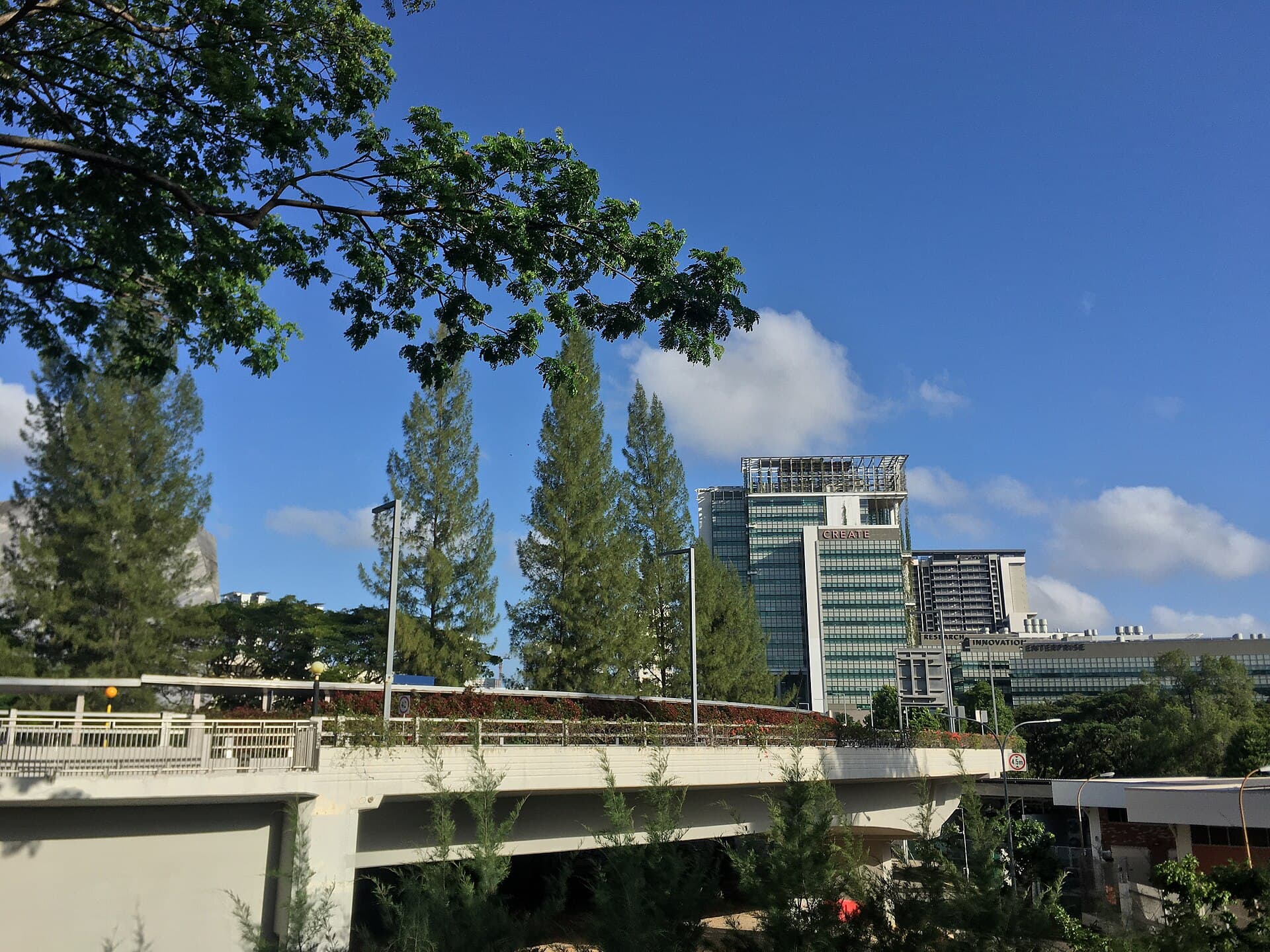
The National University of Singapore is the oldest and largest university in Singapore, and by most international measures the leading university in Asia. Its main campus spreads across Kent Ridge in the island's southwest, a green spine of hill above the container port, with older outposts at Bukit Timah and Outram that mark earlier chapters of its life. Around forty thousand students study there, in fields that run from medicine and law to computing, engineering, music and public policy.
The university's history is Singapore's history in miniature. It began as a colonial medical school paid for by local merchants, grew alongside the port city that built it, split when Singapore and Malaysia went their separate ways, and absorbed a Chinese-language university whose founding had been a community effort down to the donations of trishaw riders. Each merger and renaming that produced the present institution tracks a turn in the country's own story, which makes the university an unusually good place to read that story whole.
The institution dates its founding to 1905, when the colonial government agreed to establish the Straits Settlements and Federated Malay States Government Medical School after a petition from the local communities. The campaign was led by Tan Jiak Kim, a Straits Chinese merchant who headed a group of business and community leaders in raising the endowment the government had set as its condition. The school opened with 23 students in a building at Sepoy Lines that had previously served as an asylum, a modest start for what would become a national university. In 1912 it received an endowment from the King Edward VII Memorial Fund and took the late king's name, and in 1921 it was raised in status to the King Edward VII College of Medicine.
Higher education beyond medicine arrived in 1928 with the opening of Raffles College, a college of arts and sciences established to commemorate the centenary of Stamford Raffles's founding of modern Singapore. The two colleges ran in parallel through the difficult decades that followed, including the Japanese occupation, and in 1949 they merged to form the University of Malaya, then the sole university for the whole of British Malaya. As Malaya moved toward independence the university divided itself between its two homes, and in 1962 the Singapore division became an independent national institution, the University of Singapore.
A second thread ran alongside it. In the 1950s Singapore's Chinese community, led by the businessman Tan Lark Sye, founded Nanyang University in Jurong as the first university outside China to teach in the Chinese language. The Hokkien clan association gave the land, and contributions came from every level of society; the fundraising drives in which trishaw riders donated a day's fares became part of Singapore folklore. Nanyang University graduated its first students in 1960, but by the late 1970s the government judged that a small country could not sustain two separate universities teaching in different languages. In 1980 Nanyang University and the University of Singapore were merged to form the National University of Singapore, uniting the colonial-founded and community-founded lines of Singapore's university history in a single institution.
The Kent Ridge campus, occupied in stages through the 1970s and completed around the time of the 1980 merger, stands on ground with its own weight of memory. The ridge was the scene of the Battle of Pasir Panjang in February 1942, where the Malay Regiment made its final stand against the invading Japanese army in the last days before Singapore fell. Opium Hill, or Bukit Chandu, where Lieutenant Adnan Saidi and his men fought to the end, lies just beyond the campus edge, and the Reflections at Bukit Chandu museum keeps that story a short walk from the university's gates. A campus given over to the country's future sits, deliberately or not, on one of the places where its wartime past is most concentrated.
The university's academic range is broad. The medical school, the direct descendant of the 1905 founding, remains among the most respected in Asia, and since 2005 the university has also run the Duke-NUS Medical School at Outram in partnership with Duke University. Law occupies the leafy former Raffles College grounds at Bukit Timah. Engineering and computing are among the largest and most internationally cited faculties, and the NUS Overseas Colleges programme, begun in 2001, sends undergraduates to work in startups in Silicon Valley and other entrepreneurial hubs while studying at partner universities. From 2011 the university also operated Yale-NUS College, a liberal arts college founded with Yale University; it admitted its final intake in 2021 and closed in 2025 when its last class graduated, its approach absorbed into the university's own NUS College.
The most visible addition of recent decades is University Town, opened in 2011 on a former golf course across a bridge from the main campus. UTown, as it is known, gathered residential colleges, teaching spaces and an education resource centre around a green, and gave the university something it had not had before: a campus heart designed for living as much as lecturing.
For an institution so identified with the new, the university is also the keeper of some of Singapore's oldest collections. The Lee Kong Chian Natural History Museum, opened at Kent Ridge in 2015, descends from the natural history collections of the Raffles Library and Museum, begun in the middle of the nineteenth century. When the National Museum turned its focus to art and human history in the early 1970s, the zoological collections passed to the university, which held them for decades as a research collection with no public gallery and, at low points, no certain home. The opening of the purpose-built museum, funded in large part by a gift from the Lee Foundation, secured for Singapore a natural history record that might otherwise have been dispersed abroad. Its holdings run to hundreds of thousands of specimens from Singapore and Southeast Asia, displayed beneath the mounted skeletons of three diplodocid sauropods.
The NUS Museum at University Cultural Centre serves the same custodial role for art, with collections of Chinese painting and ceramics, South and Southeast Asian art, and the archive of the Singapore sculptor Ng Eng Teng. Between them the two museums make the university one of Singapore's significant memory institutions as well as its largest school.
The university's graduates thread through the public life of two countries. Benjamin Sheares, an obstetrician trained at the King Edward VII College of Medicine, became the second president of Singapore; Mahathir Mohamad, later the longest-serving prime minister of Malaysia, studied medicine on the Singapore campus in the years before the university divided. Goh Chok Tong, Singapore's second prime minister, read economics at the University of Singapore, and Halimah Yacob, the country's first woman president, took her law degree there. The diplomats Tommy Koh and Kishore Mahbubani, both closely associated with Singapore's voice in international affairs, are graduates, and Mahbubani later led the university's Lee Kuan Yew School of Public Policy.
As a research institution the university publishes at a volume and quality matched by few in the region, with particular strength in engineering, computer science, materials science and tropical medicine, and it has been central to Singapore's deliberate build-up of research capacity since the 1990s.
The National University of Singapore is consistently ranked first in Asia and among the leading universities in the world; the QS World University Rankings have placed it as high as eighth globally. Its enrolment of around forty thousand is spread across faculties and schools covering the sciences, humanities, design, medicine, dentistry, law, business, computing and music, and its research partnerships extend to universities and industry across Asia, Europe and North America. The Yale-NUS closure aside, the direction of recent years has been expansion: new colleges, interdisciplinary common curricula and continuing education for alumni returning in mid-career.
Kent Ridge is an open campus, reachable by the Kent Ridge MRT station and threaded by an internal shuttle bus. The Lee Kong Chian Natural History Museum is the main public attraction; entry is ticketed and booking ahead is sensible at weekends. The NUS Museum is free to enter, and University Town's green and cafes are open to anyone who wants to see the university's modern face. Visitors with an interest in the ridge's wartime history can pair a campus walk with Reflections at Bukit Chandu and the Kent Ridge Park canopy walk nearby. Teaching buildings and residences are for students and staff. The Baba House, the university museums and the Kent Ridge greenery are what an afternoon visitor actually comes for.