Heritage · University
University of Glasgow: History and Overview
Founded in 1451 by papal bull, the University of Glasgow is the fourth-oldest university in the English-speaking world and one of Scotland's four ancient universities. Adam Smith taught moral philosophy here, James Watt reworked the steam engine in its workshops, and Lord Kelvin ran its natural philosophy laboratory for fifty-three years.Written to last.
By Confinity Heritage Editorial · 2026-08-24 · 8-minute readQuiet tools, kept out of the way.
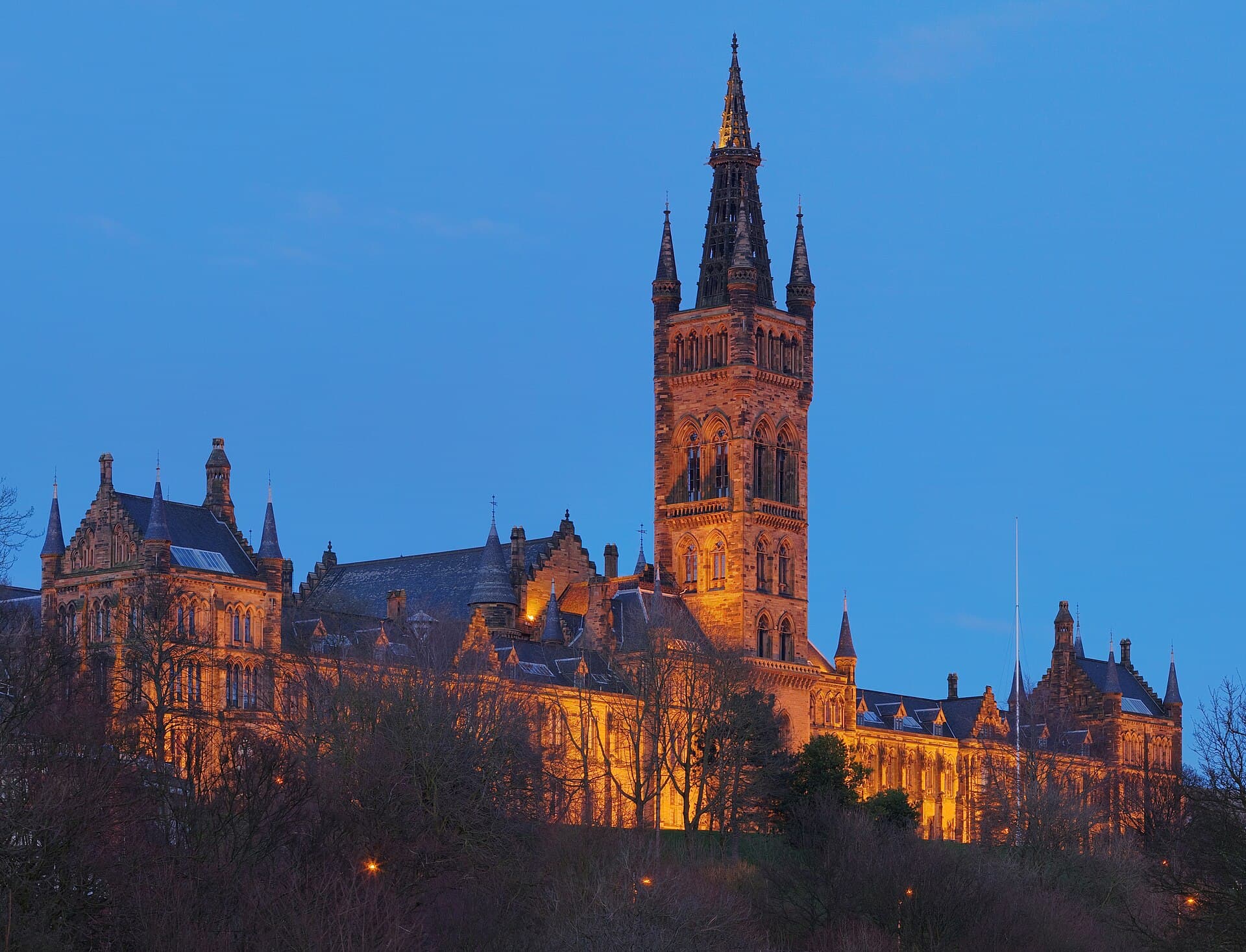
The University of Glasgow was founded in 1451, when Pope Nicholas V issued a papal bull authorising a place of general study in the city at the request of King James II and William Turnbull, Bishop of Glasgow. That makes it the fourth-oldest university in the English-speaking world and one of the four ancient universities of Scotland, in the United Kingdom, alongside the University of St Andrews, Aberdeen and the University of Edinburgh. For its first four centuries it lived in the medieval heart of the city; since 1870 it has occupied Gilmorehill in the west end, beneath the tower of one of the great Gothic revival buildings of Britain.
Few universities can claim a more direct hand in shaping the modern world. Adam Smith studied and taught moral philosophy here, Joseph Black identified latent heat here, and James Watt, the university's instrument maker, conceived the improvement to the steam engine that set the Industrial Revolution running. A century later William Thomson, Lord Kelvin, held the chair of natural philosophy for fifty-three years and gave temperature its absolute scale.
The founding bull of 1451 modelled the new university on Bologna, and teaching began in the cathedral precinct before the college settled on the High Street, in what was then the centre of Glasgow. The Old College grew there over four centuries into a complex of courtyards and crow-stepped ranges, educating the city's clergy, lawyers and physicians through the Reformation, the Union of 1707 and the commercial rise of the Clyde.
The eighteenth century was the university's first great age. Francis Hutcheson, professor of moral philosophy from 1730, lectured in English rather than Latin and argued for the moral sense that humans carry into their judgements, teaching that helped open the Scottish Enlightenment. Among his students was Adam Smith, who entered the college in 1737 at the age of fourteen, returned in 1751 as professor of logic and took the chair of moral philosophy the following year. His Glasgow lectures on jurisprudence and political economy fed directly into The Wealth of Nations, and he later described his thirteen years as a Glasgow professor as the happiest and most honourable period of his life. In the same decades Joseph Black, lecturing on chemistry and medicine, carried out the experiments through which he identified latent heat, the hidden energy a substance absorbs as it melts or boils without changing temperature.
By the mid nineteenth century the High Street had become one of the most crowded and insanitary districts in the city, and the college sold its ancient site to a railway company. In 1870 the university moved west to Gilmorehill, overlooking the River Kelvin, into a vast new building designed by George Gilbert Scott. Fragments of the old college travelled with it: the Lion and Unicorn Staircase of 1690 was taken down stone by stone and rebuilt against the new chapel range. Women were admitted to degrees in 1892, after years of teaching through Queen Margaret College, and in 1894 Marion Gilchrist graduated in medicine, the first woman to take a medical degree from a Scottish university.
The Gilbert Scott Building dominates Gilmorehill and much of the city's western skyline. Scott designed it in a Gothic revival manner flavoured with Scottish baronial detail, and it is often described as the largest Gothic revival building in Britain after the Palace of Westminster. Scott died before the work was finished; his son John Oldrid Scott completed the open stone spire in 1891, lifting the tower to roughly 85 metres above the hill. Between the building's two quadrangles run the cloisters, a forest of polished columns supporting the Bute Hall above, the great ceremonial hall completed in 1884 with funds from the Marquess of Bute. Graduations are held there still, and the cloisters are a favourite of film crews and of visitors who note, lightly but persistently, how much the place looks like Hogwarts.
Around this Victorian core the university spreads through the west end, past the domed Reading Room and along University Avenue, with Kelvingrove Park below and the tenements and cafes of Byres Road a short walk away. A second campus on the site of the old Western Infirmary has been built out over the past decade. Academically the university is organised into four colleges covering arts and humanities; medical, veterinary and life sciences; science and engineering; and social sciences, and it teaches more than thirty thousand students, one of the largest communities of any university in Scotland.
Glasgow is the university where steam and temperature learned their names, and the story begins with a repair job. James Watt was a young instrument maker who, unable to open a shop under the rules of the city's trade guilds, was given a workshop inside the college in 1757 with the title of mathematical instrument maker to the university. Among the apparatus in his care was a working model of a Newcomen steam engine used for teaching natural philosophy. Asked to repair it in the winter of 1763-64, Watt found that the model wasted almost all of its steam, because each stroke required the cylinder to be cooled to condense the steam and then reheated. He worried at the problem for months, talking it over with Joseph Black, whose latent heat explained where the energy was going. Then, on a Sunday walk across Glasgow Green in May 1765, the answer came to him: condense the steam in a separate vessel, and the cylinder could stay hot. The separate condenser transformed the steam engine from a mine pump into the power source of the Industrial Revolution, and the little Newcomen model that provoked it survives in the university's collections.
A century later the university built the second act. William Thomson, later Lord Kelvin, was elected professor of natural philosophy in 1846 at the age of twenty-two and held the chair until 1899, fifty-three years in a single post. At Glasgow he proposed the absolute temperature scale that now bears his name, worked out much of the science of thermodynamics with colleagues across Britain, and served as the electrical brain behind the transatlantic telegraph cable, whose success in 1866 earned him his knighthood. He set his students to work on real measurements in rooms attached to his classroom, creating one of the first physics teaching laboratories in a British university. When he died in 1907 he was buried in Westminster Abbey, next to the grave of Isaac Newton.
The university's roll reaches well beyond its two most famous workshops. Henry Campbell-Bannerman, Prime Minister from 1905 to 1908, studied at Glasgow before going on to Cambridge. John Logie Baird, who gave the first public demonstration of television in 1926, studied at the university before the First World War interrupted his course. William Ramsay, who discovered the noble gases and won the Nobel Prize in Chemistry in 1904, was a Glasgow graduate, and Frederick Soddy carried out much of the work on isotopes that earned his 1921 Nobel Prize while a lecturer in the university's chemistry department. John Boyd Orr, a graduate who pioneered the science of nutrition, received the Nobel Peace Prize in 1949 and later served as the university's chancellor. The surgeon Joseph Lister developed antiseptic surgery while professor at Glasgow in the 1860s, working in the wards of the Royal Infirmary.
The university also keeps one of Britain's great memory institutions. The Hunterian, opened in 1807 from the bequest of the anatomist and collector William Hunter, is Scotland's oldest public museum. Its collections run from Roman finds and anatomical specimens to instruments used by Watt and Kelvin, including the model Newcomen engine, and its art gallery holds one of the largest collections of work by James McNeill Whistler in the world, together with the reassembled interiors of Charles Rennie Mackintosh's Glasgow home.
Glasgow is a member of the Russell Group of research-intensive British universities and regularly places within the top 100 of the major international rankings. Its research strengths run from precision medicine and quantum technology to Scottish history and law, and its James Watt School of Engineering keeps the instrument maker's name on the letterhead. The university remains woven into the life of the west end, its tower visible from Kelvingrove Park, the river and much of the city beyond.
The Gilmorehill campus is open to walk through, and the cloisters, the quadrangles and the view from University Avenue cost nothing to see. The Hunterian Museum and the Hunterian Art Gallery are open to the public, and the Mackintosh House is a ticketed highlight of the gallery. Guided campus tours run regularly from the visitor centre in the main building, and Kelvingrove Park and its art gallery sit directly below the hill. The cloisters, the hill and the Hunterian are the public parts; term and examination weeks turn the rest of it into somebody's workplace.