Heritage · University
University of Geneva: History and Overview
Founded in 1559 by Jean Calvin as the Académie de Genève, the University of Geneva grew from a Reformation seminary into Switzerland's second-largest university. It is where Ferdinand de Saussure taught the lectures that became modern linguistics, and where the astronomers who found the first exoplanet around a sun-like star did their work.Written to last.
By Confinity Heritage Editorial · 2026-08-24 · 8-minute readQuiet tools, kept out of the way.
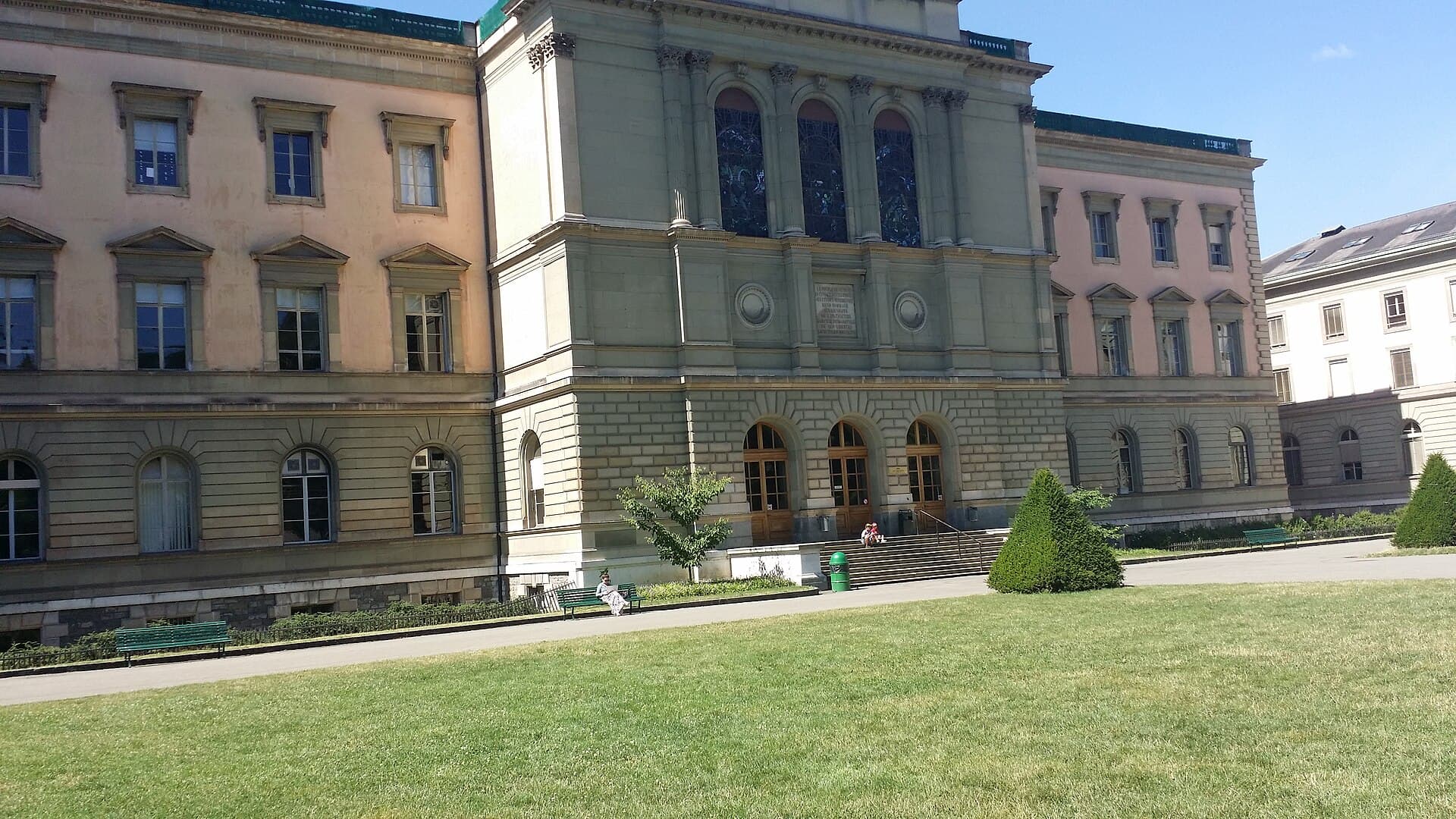
The University of Geneva began as a school for preachers and became a school for the world. Jean Calvin founded it in 1559 as the Académie de Genève, a seminary whose graduates carried the Reformed faith across Europe, and for three centuries it remained the intellectual engine of the city sometimes called the Protestant Rome. In 1873 it was secularized and renamed a university, and it has since grown into the second-largest university in Switzerland, a French-speaking institution of nine faculties set in the middle of the most international small city on earth.
Its history holds two stories that belong in any archive of how knowledge survives. The first is the strangest publication in modern scholarship: the founding book of linguistics, assembled after its author's death from notes his students took as he spoke, because he had thrown his own away. The second happened at the university's observatory in 1995, when two of its astronomers detected the first planet ever found orbiting a star like our sun. One institution kept a voice alive through other people's notebooks and then heard, in the wobble of a distant star, the signature of another world.
Calvin opened the Academy in June 1559, in the years when Geneva had become the organizing centre of the Reformed branch of the Reformation. Its purpose was practical: to train pastors rigorously enough to send them out into hostile territory, and its graduates went to France, the Netherlands, Scotland and beyond, carrying Genevan theology into churches across the continent. Calvin's colleague and successor Theodore Beza served as the Academy's first rector, and the school's early prestige drew students from every corner of Protestant Europe. Jean-Jacques Rousseau was born in the city in 1712, though the Academy of his day had little use for its most famous freethinker.
Through the eighteenth and nineteenth centuries the Academy's teaching widened from theology into law, letters and the sciences, following the city's own drift from citadel of doctrine to hub of ideas. The decisive break came in 1873, when the addition of a faculty of medicine completed its transformation into a secular institution and the Academy formally became the University of Geneva. By the century's end its lecture halls were open to women, and its medical and science faculties drew students from across Europe, many of them women shut out of universities at home, with a large contingent from the Russian Empire. The seminary built to export a creed had become a university that imported the world.
The university's historic home is Uni Bastions, a long neoclassical building completed in the early 1870s in the Parc des Bastions, a green strip laid out along the line of the city's old fortifications at the foot of the Old Town. It now houses humanities teaching and the ceremonial life of the university. Set into the rampart wall facing it stands the Reformation Wall, the international monument begun in 1909 for the 400th anniversary of Calvin's birth and the 350th of the Academy: four figures in stone, Guillaume Farel, Calvin, Beza and John Knox, watching over the institution the second of them founded.
The modern university has long since outgrown the park. Its nine faculties span science, medicine, law, theology, humanities, social sciences, economics and management, psychology and education, and translation and interpreting, spread across several campuses in the city, from the medical centre beside the cantonal hospital to the Uni Mail complex for the social sciences. Around 19,000 students study there, drawn from roughly 150 nationalities, a proportion of international students that few universities in Europe match. Teaching is mainly in French, with a growing layer of English-language graduate programmes, and research strength runs from particle physics and astronomy to international law and global health.
Ferdinand de Saussure, born in Geneva to one of the city's old scholarly families, returned in 1891 after a brilliant decade in Leipzig and Paris to a professorship at the university, where he taught Sanskrit and the historical grammar of Indo-European languages. Between 1907 and 1911 he gave three courses on a subject no one had taught before, the general nature of language itself: language as a system of signs, meaning as a web of differences, the arbitrary bond between a word and what it names. He published almost nothing of it. When he died in 1913, his colleagues Charles Bally and Albert Sechehaye went looking for the manuscript of the lectures and found that Saussure had destroyed the rough drafts of his own notes, often as soon as a lecture was delivered.
So they rebuilt the book from the only record that existed: the notebooks of the students who had listened. Working with the notes of Albert Riedlinger and other auditors, Bally and Sechehaye reconstructed the three courses into a single text and published it in 1916 as the Course in General Linguistics. It became the founding document of modern linguistics and one of the most influential books of the twentieth century, shaping structuralism and semiotics far beyond the study of language. And it exists only as a memory of a memory. The most consequential linguistics book of its century is not what Saussure wrote; it is what his students heard, written down in the moment because they sensed it mattered. Few episodes in the history of scholarship state the case for keeping a record so plainly.
The university's other signal discovery came from listening of a different kind. In 1995, Michel Mayor, a professor at the Geneva Observatory, and Didier Queloz, then his doctoral student, detected a rhythmic wobble in the light of the star 51 Pegasi, about 50 light-years away. The cause was 51 Pegasi b, a giant planet racing around its star every four days: the first planet ever confirmed in orbit around a sun-like star beyond our own. The 1995 announcement opened the field of exoplanet science, which has since catalogued thousands of worlds, and in 2019 the two shared the Nobel Prize in Physics for the discovery. The university that reconstructed a voice from notebooks also found the first other world.
Jean Piaget stands with Saussure among the university's great names. A professor at Geneva for most of his career, he spent five decades observing how children build their understanding of the world, stage by stage, and became the century's most influential theorist of how knowledge and memory develop in the young mind. He directed the International Bureau of Education in the city and founded his centre for genetic epistemology at the university, and the Archives Jean Piaget in Geneva keep his papers and continue the study of his work.
The university counts a number of Nobel laureates among its professors, alumni and researchers, in fields from physics to medicine to the peace prize work of the institutions around it. Its physicists have long worked alongside CERN, the European particle physics laboratory established on the Franco-Swiss border outside the city in 1954, and its faculties of law and social science feed the ecosystem of international organizations that defines the city: the International Committee of the Red Cross, founded in 1863 by a group of Genevans that included Henry Dunant; the League of Nations, which made Geneva its seat in 1920; and the United Nations office that succeeded it at the Palais des Nations. The Graduate Institute of International and Development Studies, established in 1927, grew up beside the university in the same soil. In the Swiss system, where the federal institutes such as ETH Zurich anchor the engineering pole, Geneva holds the humanist and international one.
Today the University of Geneva is Switzerland's second-largest university and its leading French-language research institution. Its Global Studies Institute gathers the university's teaching on international relations and global affairs, and its programmes in international law, humanitarian studies and diplomacy trade daily with the organizations across town. Research runs from the astronomy department that still leads exoplanet searches to genetics, quantum science, climate studies and the digital humanities. The student body remains among the most international in Europe, and the university describes its mission in terms Calvin would half recognize: forming people in Geneva to be sent out into the world.
The Parc des Bastions is open to everyone, free, and is one of the pleasantest places in Geneva to spend an hour: the Uni Bastions building along one side, the Reformation Wall set into the rampart opposite, chess players at the oversized boards between them. The wall's motto, Post Tenebras Lux, after darkness light, is the old motto of the Reformation and of Geneva itself. From the park it is a short climb into the Old Town to St Pierre Cathedral, where Calvin preached, and a short walk down to the lake. The other campuses are working academic buildings rather than visitor sites, but at the Bastions, monument and academy face to face, the institution's whole story can be read in a single glance.