Heritage · University
University of Otago: History and Overview
Founded in 1869 by the Otago Provincial Council, the University of Otago in Dunedin is New Zealand's first university, built by a Scottish settlement barely two decades old. Its bluestone clocktower stands on the Leith, and its Dunedin Study has followed every baby born in the city across a single year for more than fifty years.Written to last.
By Confinity Heritage Editorial · 2026-08-24 · 8-minute readQuiet tools, kept out of the way.
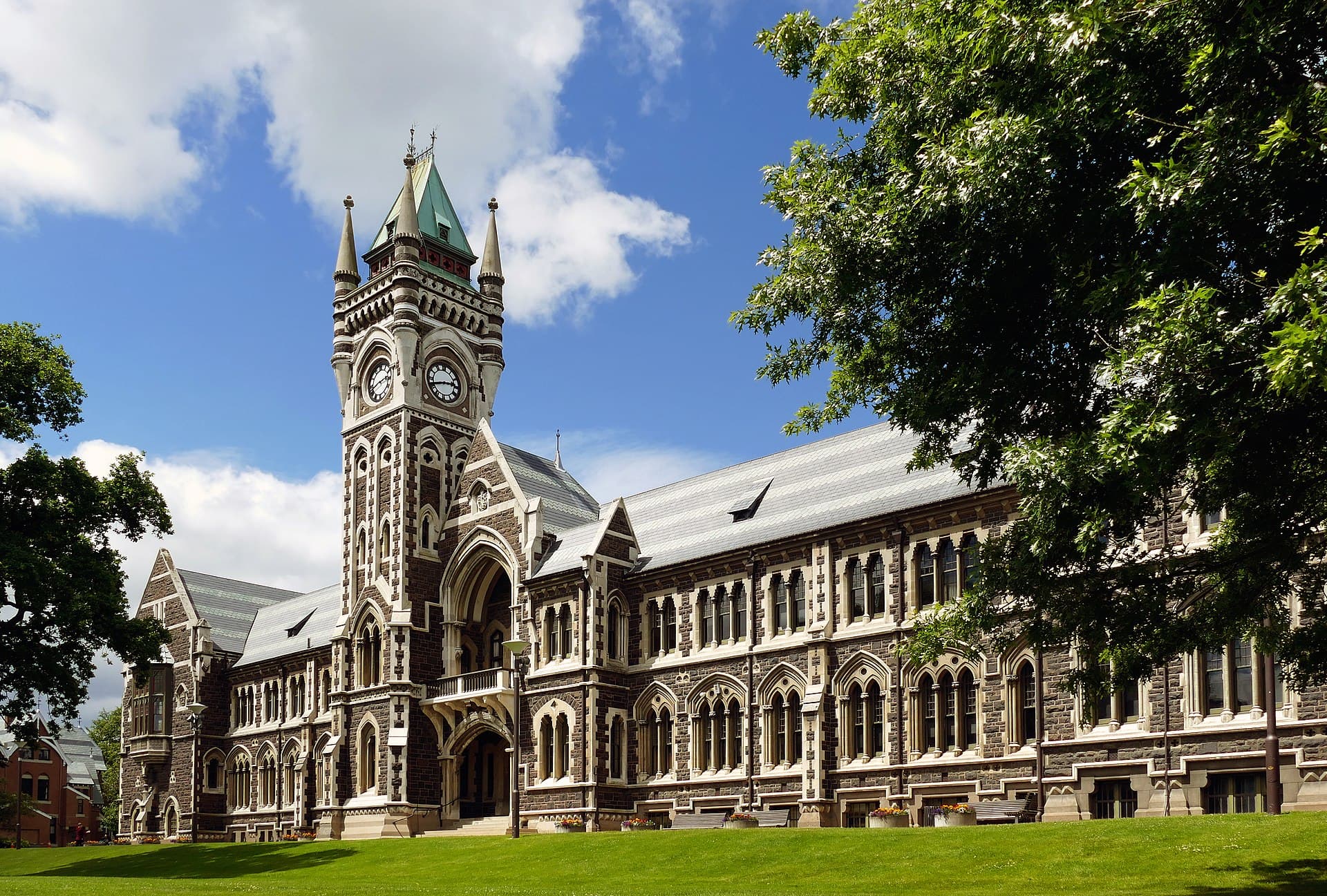
The University of Otago is New Zealand's first university, founded in Dunedin in 1869 by an ordinance of the Otago Provincial Council. The city that built it was barely twenty-one years old at the time, a Free Church of Scotland settlement laid out in 1848 and named Dunedin, the Gaelic form of Edinburgh. That a raw colonial town endowed a university within its first generation says a great deal about the people who founded it, and about the gold lately pulled from the hills behind them. The campus they built along the Water of Leith is now among the most photographed places in the country.
For a site concerned with memory, Otago holds two remarkable archives. One is the Hocken Collections, the great southern library of New Zealand and Pacific history. The other is stranger and more intimate: the Dunedin Multidisciplinary Health and Development Study, which has followed every baby born in the city across a single year, 1972 to 1973, for more than five decades. A university is usually a keeper of books. This one is also the keeper of a thousand documented lives.
Otago's founding runs on a Scottish thread. The settlers who arrived at Port Chalmers in 1848 came under the banner of the Free Church of Scotland, led by William Cargill and the Reverend Thomas Burns, a nephew of the poet. They planned their town deliberately as an Edinburgh of the south, street names copied from the Scottish capital, and they carried the Scottish conviction that a proper society requires schooling at every level, ending in a university. The means arrived in 1861, when Gabriel Read found gold at Gabriel's Gully and the Otago gold rush made Dunedin, for a time, the largest and richest town in New Zealand. Provincial leaders moved the wealth into institutions, and the university ordinance of 1869 set aside land endowments to sustain a college of higher learning.
Teaching began in July 1871 in a converted post office building with three professors and a first roll of eighty-one students. From its opening the university admitted women to all of its classes, a decision confirmed by the University Council in 1871 that placed Otago among the earliest institutions in the British Empire to open every course of study to both sexes. Caroline Freeman, who walked in from Green Island to attend lectures while running a school to support herself, became its first woman graduate with her Bachelor of Arts in 1885.
In 1874 Otago joined the federal University of New Zealand, and for the better part of nine decades its students earned Otago educations but University of New Zealand degrees, until the federal body was dissolved in 1961 and Otago resumed conferring degrees in its own name. Along the way it gathered the professional schools that came to define it: medicine in 1875, mining in 1878, dentistry in 1907, home science in 1911, several serving the whole country rather than one province.
The university's emblem is the Registry Building, known to everyone simply as the Clocktower. Designed by Maxwell Bury in a Gothic revival manner that consciously echoes the University of Glasgow, it opened in 1879 in dark local stone trimmed with pale Oamaru limestone above the channelled banks of the Water of Leith. The tower waited a long time for its purpose: a clock was not installed until 1931. Around it grew a precinct of stone teaching buildings, and beyond them the flat streets of North Dunedin filled with student flats, giving Otago something rare in Australasia, a true university quarter where nearly everything sits within a ten-minute walk.
Otago is organised into four academic divisions covering health sciences, sciences, humanities, and commerce, with around twenty thousand students across its Dunedin campus and health sciences campuses in Christchurch and Wellington. The Otago Medical School, founded in 1875, was New Zealand's first and remained its only medical school for nearly a century, and the Faculty of Dentistry is still the country's sole school of dentistry, so that most of the dentists in New Zealand have passed through Dunedin.
The university's Māori name, Te Whare Wānanga o Ōtākou, records a deeper lineage. Ōtākou is the settlement on the Otago Peninsula whose name, heard through southern Māori pronunciation, became the word Otago itself. The land the university stands on is the territory of Ngāi Tahu, the iwi of most of the South Island, and the university maintains a formal relationship with the iwi through a memorandum of understanding, Māori health and Indigenous studies programmes, and the carved meeting spaces on campus. The connection has a distinguished ancestry. Te Rangi Hīroa, Sir Peter Buck, of Ngāti Mutunga descent, completed his medical degree at Otago in 1904, among the first Māori to graduate in medicine from a New Zealand university. He served as a doctor, a member of Parliament, and a decorated soldier before turning to anthropology, where his work on the peoples of the Pacific, grounded in his own whakapapa, made him one of the great scholars of the Polynesian world and director of the Bishop Museum in Honolulu. A residential college on campus carries his name.
Every university keeps records. Otago keeps a generation. The Dunedin Multidisciplinary Health and Development Study enrolled 1,037 babies born at Dunedin's Queen Mary Maternity Hospital between April 1972 and March 1973, and it has been following them ever since. The members were assessed through childhood, then at fifteen, eighteen, twenty-one, twenty-six, thirty-two, thirty-eight, forty-five, and onward into their fifties, returning to Dunedin each time, many flying in from around the world, for a full day of interviews and examinations covering their bodies, minds, work, relationships, and habits. The retention rate, holding above ninety per cent of surviving members half a century in, is regarded as extraordinary in longitudinal research, and it is the reason the data are so trusted: the people who stayed are not just the fortunate ones.
The findings have travelled far beyond Dunedin. The study showed that self-control measured in early childhood predicts health, wealth, and criminal conviction decades later, that most adults have met the criteria for a mental health condition at some point, and that people of the same age can be ageing biologically at very different speeds. Its papers number in the thousands and are cited across medicine, psychology, criminology, and public policy, making it one of the most closely examined cohorts of human lives anywhere on earth. What began as a modest child-health survey became, by sheer persistence, a complete biography of a city's year of births: a university holding the life records of a generation, updated while that generation is still living them.
Beyond the study, Otago's roll of graduates reaches into most corners of New Zealand life, from medicine and law to the writers of Dunedin's literary culture, which the city now wears as a UNESCO City of Literature. The Hocken Collections anchor its research in the humanities. Built on the gift of Dr Thomas Morland Hocken, a Dunedin physician who spent his life gathering books, manuscripts, paintings, and photographs of New Zealand and the Pacific, the collection passed to the university and opened to the public in 1910. It now holds one of the foremost archives of the country's history, and anyone, not only scholars, may register and read there.
Student culture is its own inheritance. Otago students are called scarfies, after the scarves worn against southern winters, and North Dunedin's flats carry names handed down through generations of tenants. The capping traditions around graduation include the Capping Show, a student revue staged since 1894 and counted among the longest-running such shows anywhere. The quarter has a rowdier side, and the occasional burnt couch has entered national folklore; the university and city have spent recent decades steering that energy toward safer celebrations without flattening the culture that produces it.
Otago remains New Zealand's oldest university and one of its largest research institutions. Its health sciences divisions train the country's dentists and a large share of its doctors, pharmacists, and physiotherapists, and its science programmes range from marine science on the Otago coast to genetics and biochemistry. In 2019 the university marked its 150th anniversary, its partnership with Ngāi Tahu continues to shape teaching and research, and the Dunedin Study has begun assessing its members in their fifties, with no end point set.
The campus sits a short walk north of Dunedin's Octagon, and the grounds are open to walk through at any time. The Clocktower lawn beside the Water of Leith is the classic view, best in autumn when the trees along the river turn. The Hocken Collections welcome the public into their gallery and reading rooms, and the Otago Museum and Dunedin Botanic Garden border the university quarter. Lecture buildings are for students during term, though anyone standing on the Leith bridge with a camera will be in good company.