Heritage · University
University of Michigan: History and Overview
Founded in Detroit in 1817, twenty years before Michigan became a state, the University of Michigan moved to Ann Arbor in 1837 and grew into one of the great public research universities. Its campus witnessed the 1955 announcement that the Salk polio vaccine worked and the 2am speech in which John F. Kennedy first tested the idea of the Peace Corps.Written to last.
By Confinity Heritage Editorial · 2026-08-24 · 8-minute readQuiet tools, kept out of the way.
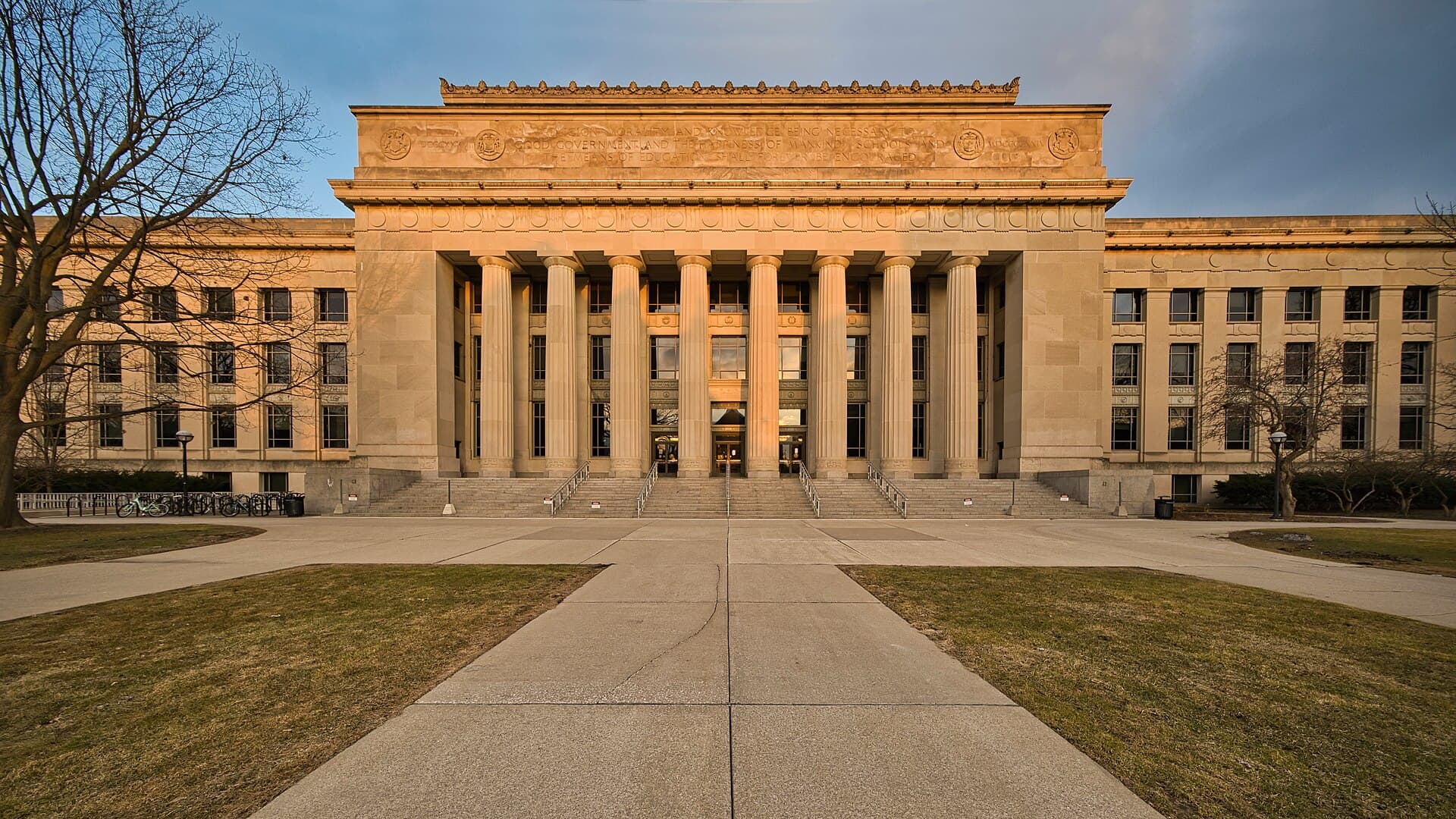
The University of Michigan is one of the oldest public universities in the United States, founded in Detroit in 1817, twenty years before Michigan itself became a state. It moved to Ann Arbor in 1837, the year of statehood, and grew from a frontier academy into a research university of more than fifty thousand students.
Few campuses have gathered so many moments in which knowledge itself changed shape. It was here, in April 1955, that the world learned the Salk polio vaccine worked. It was on the steps of the Michigan Union, at two in the morning, that John F. Kennedy first floated the idea that became the Peace Corps. Claude Shannon, the engineer who taught the world to measure information, took his first degrees here, and the university now keeps the largest archive of social science data on earth.
The university began with one of the strangest names in American education. In August 1817, the territorial government of Michigan established the Catholepistemiad, or University of Michigania, a title coined by Judge Augustus Woodward from mangled Greek and Latin roots meaning something like "universal knowledge." The name lasted only four years before being quietly replaced with University of Michigan in 1821, but the founding date stands, older than the state itself. The institution's first land came in part from the Ojibwe, Odawa, and Potawatomi peoples, who at the 1817 Treaty of Fort Meigs granted acreage with the stated intention that it support a college at Detroit.
In 1837, as Michigan entered the Union, the young university accepted an offer of forty acres from the town of Ann Arbor, land the town had originally set aside in an unsuccessful bid to become the state capital. Classes began in 1841 with two professors and a handful of students. The state's 1850 constitution then did something consequential: it placed the university under an elected Board of Regents with constitutional autonomy, insulating it from legislative micromanagement. That arrangement let a state school chart its own research course early, and made Michigan a template other state universities copied.
The long presidency of James Burrill Angell, from 1871 to 1909, fixed the university's public creed. Angell argued that Michigan should provide "an uncommon education for the common man," and the phrase still describes the institution's self-image: the ambition of the old private colleges, opened to anyone the state could send. Women were admitted in 1870, early among major American universities, and the university added schools of medicine, law, and engineering as enrolment climbed through the twentieth century.
The Central Campus gathers around the Diag, a crossing of diagonal walkways where generations of students have hurried between classes. Its northern edge is held by Angell Hall, completed in 1924 to a design by the Detroit architect Albert Kahn, its long Doric colonnade named for the president who defined the university's mission. A short walk south stands the Law Quadrangle, built between 1924 and 1933 with a fortune given by the alumnus William W. Cook. Its Collegiate Gothic ranges, stained glass, and enclosed lawn feel lifted from an English college and dropped into the Midwest.
The university teaches across nineteen schools and colleges in Ann Arbor, with regional campuses in Flint and Dearborn. Total enrolment in Ann Arbor runs past fifty thousand students, roughly balanced between undergraduates and graduate students.
Sport is part of the architecture of the place. Michigan Stadium, opened in 1927 and known to everyone as the Big House, holds 107,601 people, making it the largest stadium in the Americas. On football Saturdays it becomes, briefly, one of the larger cities in the state. The Wolverines' rivalry with Ohio State is simply called The Game, and the annual meeting with Minnesota has been played since 1903 for the Little Brown Jug, an actual painted water jug.
The university is also a keeper of objects. The University of Michigan Museum of Art, UMMA, holds a collection spanning African, Asian, European, and American art in a Beaux-Arts building on State Street. Nearby, the Kelsey Museum of Archaeology keeps more than one hundred thousand artifacts from the ancient Mediterranean and Near East, including everyday letters, tools, and toys from the university's own excavations at Karanis, a Roman-era town in Egypt.
Two threads make Michigan a landmark in the history of memory itself. The first is a person. Claude Shannon grew up in Gaylord, Michigan, and took two bachelor's degrees at Ann Arbor in 1936, one in electrical engineering and one in mathematics. Twelve years later, at Bell Labs, he published A Mathematical Theory of Communication, the paper that founded information theory and gave the world the bit. Before Shannon, information was a loose idea; after him, it was a measurable quantity, and everything from telephone networks to file compression to the storage of a photograph rests on the mathematics he began. The man who made information countable started with a Michigan education.
The second thread is an institution. In 1962 the university's Institute for Social Research founded the Inter-university Consortium for Political and Social Research, the ICPSR, which has grown into the world's largest archive of digital social science data. More than eight hundred member institutions deposit and draw on its holdings: election studies, censuses, surveys of health and opinion and income reaching back decades. It is a memory institution in the strictest sense, keeping the recorded experience of societies for questions its depositors never imagined.
The university's computing history runs alongside. In the 1960s Michigan built the Michigan Terminal System, one of the earliest time-sharing operating systems, which served universities on three continents. And in the 2010s Michigan engineers produced the Michigan Micro Mote, a full computer measured in millimeters.
The university's most famous single morning came on 12 April 1955. A year earlier, Thomas Francis Jr., the Michigan epidemiologist who had trained Jonas Salk in his Ann Arbor laboratory, had agreed to run an independent evaluation of Salk's polio vaccine, overseeing a field trial in which some 1.8 million children took part. On that April morning, ten years to the day after the death of Franklin Roosevelt, polio's most famous patient, Francis stood before the world's press at the university's Rackham Auditorium and delivered the verdict of his Vaccine Evaluation Center: the vaccine was safe, effective, and potent. Church bells rang in American towns that afternoon. Parents who had kept children from swimming pools every summer wept at the news. It remains one of public health's great mornings, and it happened on this campus because Michigan was where the data could be judged.
Five years later, at 2am on 14 October 1960, Senator John F. Kennedy arrived late to Ann Arbor during his presidential campaign and found ten thousand students waiting outside the Michigan Union. Speaking without a prepared text on the Union steps, he asked how many of them would be willing to spend years of their lives serving in developing countries. The improvised challenge became the Peace Corps within months of his inauguration, and a bronze plaque on the Union steps marks the spot where a presidency's idea was born on a campus, in the middle of the night, in front of students who never forgot it.
The roll of alumni is long. Gerald Ford played center on the football team before becoming the thirty-eighth president of the United States. The playwright Arthur Miller wrote his first plays as a Michigan undergraduate. Google cofounder Larry Page took his engineering degree here, and the crew of Apollo 15, all Michigan-trained, carried the university's presence to the Moon.
Michigan today is perennially among the top few American universities by research volume, and typically first among public institutions, with annual research expenditures that have passed two billion dollars. Its hospital system, Michigan Medicine, anchors one of the country's largest academic medical centers, and its faculty work across fields from automotive engineering and artificial intelligence to social policy, where the Institute for Social Research continues its long-running national surveys.
Ann Arbor is a compact college town, and the Central Campus rewards walking. The Diag, Angell Hall's colonnade, and the Law Quadrangle's courtyard are open to visitors. UMMA and the Kelsey Museum of Archaeology both offer free admission. The plaque marking Kennedy's speech sits on the State Street steps of the Michigan Union, and Michigan Stadium can be seen on game days, when more than one hundred thousand people fill it, or more quietly through university tours. The Nichols Arboretum, along the Huron River east of campus, is where students and townspeople go when the peonies bloom in June.