Heritage · University
National University of Colombia: History and the White City
Founded by law in 1867, the National University of Colombia is the republic's flagship public university. Its Bogotá campus, the Ciudad Universitaria of the 1930s, is a modernist monument in white concrete, and its National Astronomical Observatory has kept sky records since 1803.Written to last.
By Confinity Heritage Editorial · 2026-08-25 · 8-minute readQuiet tools, kept out of the way.
The National University of Colombia is the flagship public university of Colombia, created by an act of the young republic in 1867 and charged from the beginning with educating the nation as a whole rather than any one church, party, or city. Its main campus in Bogotá, the Ciudad Universitaria, is known across the country as the Ciudad Blanca, the White City: a whole university district conceived in the 1930s as a single modernist composition, its white buildings set among lawns and cross axes on what was then the edge of the capital.
The university keeps an older memory as well. It operates the National Astronomical Observatory, founded in 1803 and usually described as the first purpose-built astronomical observatory in the Americas, and its Institute of Natural Sciences holds the national herbarium, a collection that continues the botanical tradition begun under José Celestino Mutis in the eighteenth century. Between the white concrete of the campus and the sky records of the observatory, the institution holds a remarkable share of the country's scientific past.
Colombia entered its republican era with colleges already centuries old. Bogotá's colonial institutions, among them the Dominican university of the Tomista tradition and the Colegio Mayor del Rosario, had been training lawyers, clerics, and physicians since the sixteenth and seventeenth centuries. What the republic lacked was a public university belonging to the state itself. A law of September 1867 supplied it, establishing the Universidad Nacional de los Estados Unidos de Colombia, named for the federal state of the day, and gathering existing schools and chairs into faculties of law, medicine, natural sciences, engineering, arts and crafts, and literature and philosophy. Teaching under the new charter began the following year.
For its first decades the university worked out of scattered buildings in the old city centre. The decisive change came in 1936, when the liberal government of President Alfonso López Pumarejo, in the midst of a broad programme of national reform, set aside land west of Bogotá for a unified campus. The plan was developed by the German-born architect Leopoldo Rother, working with the exiled German educator Fritz Karsen, who brought to the layout his ideas about how a modern university should organise knowledge. Rother went on to design many of the campus buildings himself, and other architects of the period filled in the ensemble in the same spare, white-rendered idiom that gave the place its nickname.
The later twentieth century was harder. The university was closed in the upheaval that followed the assassination of Jorge Eliécer Gaitán in April 1948, when riots devastated central Bogotá, and during the country's long internal conflict the campus was more than once a contested and interrupted place, its gates shut in years of protest and violence. Through those decades it nonetheless remained what the 1867 law intended: the university of the nation, open by competitive examination to students from every region and background.
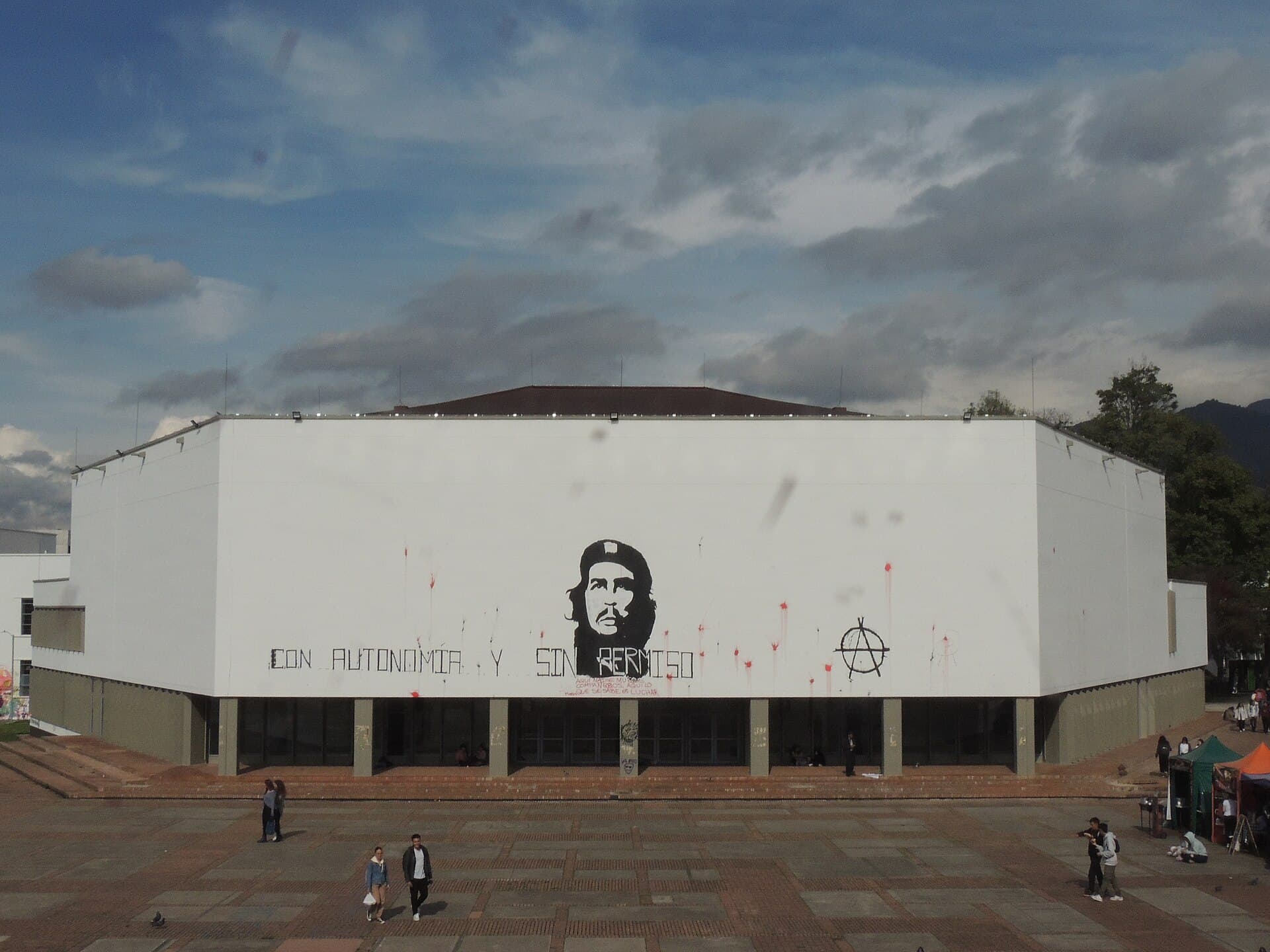
The Ciudad Universitaria is laid out as an ellipse of rings and axes, with faculties arranged around a green heart. Its early buildings, white volumes of the 1930s and 1940s, made the campus Colombia's showcase of modern architecture, a role comparable to the one the Ciudad Universitaria of the National Autonomous University of Mexico would later play for that country, and several of them are protected today as national monuments. At the centre stands the León de Greiff auditorium, the university's concert hall, named for the Colombian poet. The open square before it has been called the Plaza Che by generations of students, after the image of Che Guevara painted on the auditorium's wall; it is a campus that writes its politics on its walls, and the murals are as much a part of its texture as the white facades.
Bogotá is the largest of the university's campuses but far from the only one. Full campuses operate in Medellín, Manizales, and Palmira, and the university maintains frontier campuses in Leticia on the Amazon, on the island of San Andrés in the Caribbean, in Arauca on the eastern plains, and in Tumaco on the Pacific coast, so that the institution reaches the corners of the national map. Across all of them the university teaches the full range of disciplines, from engineering and medicine to agronomy, the arts, and the human sciences, and it grants a large share of the country's doctoral degrees. Admission is by a single competitive examination taken by far more applicants than there are places, which has made a seat at the National University one of the most contested prizes in Colombian education.
The distinctive holdings of this university are an ensemble and an instrument. The ensemble is the campus itself: a republic in the 1930s drawing its future in white concrete, betting that a modern nation needed a modern university district and building one to prove it. The bet has been honoured by protection, and the early buildings are now studied as founding works of Colombian modernism.
The instrument is older than the university by more than sixty years. The National Astronomical Observatory was raised in 1802 and 1803 for the Royal Botanical Expedition of José Celestino Mutis, an octagonal stone tower designed by the Capuchin builder Domingo de Petrés, and it is usually described as the first purpose-built astronomical observatory in the Americas. Its early director Francisco José de Caldas, naturalist and geographer, was executed in 1816 during the Spanish reconquest, and the tower he worked in became a relic of the science of independence. The historic building now stands within the grounds of the presidential palace, while the university, which has run the observatory since the nineteenth century, carries on its observations and teaching from the Bogotá campus. The same Mutis lineage runs through the university's Institute of Natural Sciences, whose Colombian National Herbarium keeps hundreds of thousands of plant specimens, the working memory of one of the most biodiverse countries on Earth.
The university's roll reads like a register of the republic's professions. Colombian presidents have studied and taught there across the generations; Virgilio Barco, president from 1986 to 1990, took his first degree in engineering at the National University before continuing abroad. Antanas Mockus, the mathematician and philosopher who twice served as mayor of Bogotá, led the university as rector before entering public life. Its faculties of law, medicine, and engineering have supplied the country's courts, hospitals, and public works for a century and a half.
Its most famous student never graduated. Gabriel García Márquez enrolled in law at the Bogotá campus in 1947 and published his first short story in a capital newspaper that same year. When the riots of April 1948 closed the university and burned the boarding house where he kept his manuscripts, he moved to Cartagena, continued his studies there for a time, and slid instead into journalism. The law faculty lost a reluctant student; literature gained the author of One Hundred Years of Solitude and the 1982 Nobel Prize in Literature. The university counts him among its own all the same, the great example of what its classrooms started even when they could not finish it.
The National University is consistently ranked the leading public university in Colombia and among the strongest in Latin America. More than 50,000 students study across its campuses, the greater part of them in Bogotá, and its research output is the largest of any Colombian institution. Because its fees are set according to family income, it remains the main route into higher education for talented students of modest means, a role that keeps its entrance examination at the centre of national life each year. The campus continues to serve as the stage for the country's public arguments, in assembly, in mural, and in march, as it has for most of a century.
The Ciudad Universitaria lies west of central Bogotá, bounded by Carrera 30 and Calle 26, and its grounds are open to walkers on ordinary days. The early white buildings, the León de Greiff auditorium, and the murals of the Plaza Che reward an unhurried circuit, and the campus museums, including collections of art, natural history, and architecture, keep public hours. Visitors should check ahead through the university's site, since access arrangements change with the academic calendar and with campus events, and should remember that this is a working university, its lawns and lecture halls in daily use by the students it was built for.