Heritage · University
Leiden University: History and Overview
Founded in 1575 by William of Orange after the city's endurance of the Spanish siege, Leiden University is the oldest university in the Netherlands. Its Academy Building keeps the zweetkamertje, a small room where graduates have signed the walls for generations, and each 26 November the university remembers the wartime protest of dean Rudolph Cleveringa.Written to last.
By Confinity Heritage Editorial · 2026-08-24 · 8-minute readQuiet tools, kept out of the way.
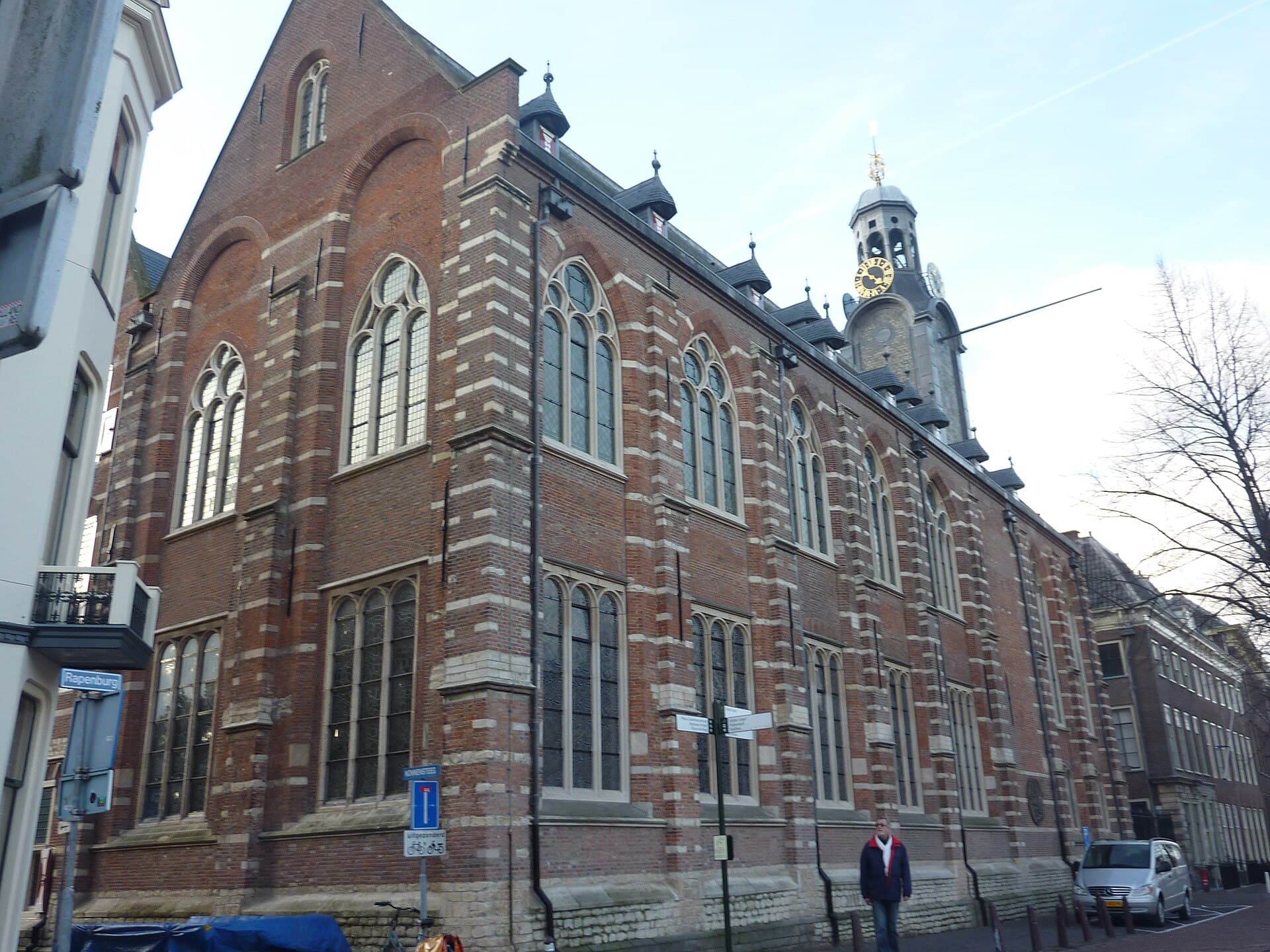
Leiden University is the oldest university in the Netherlands, founded in 1575 by William of Orange in the middle of the Dutch revolt against Spain. Its motto, Praesidium Libertatis, the bastion of liberty, was chosen at the founding and has been tested more than once since. The university sits along the Rapenburg canal in the old centre of Leiden, its Academy Building the ceremonial heart of the institution for four and a half centuries.
Few universities keep their memory in so physical a form. Inside the Academy Building is a small chamber called the zweetkamertje, the little sweat room, where graduates have signed the walls in their thousands, Winston Churchill and Nelson Mandela among them. And each year on 26 November the university remembers a single speech: the 1940 protest of the law dean Rudolph Cleveringa against the dismissal of his Jewish colleagues, answered by the occupiers with the closure of the university itself.
The founding is bound to the siege that preceded it. Through 1574 Leiden held out against Spanish forces in one of the defining episodes of the Dutch revolt, enduring months of starvation until the surrounding land was flooded and relief boats reached the walls on 3 October. A few months later, on 8 February 1575, William of Orange established a university in the city. Tradition holds that he offered Leiden a choice between freedom from certain taxes and a university, and that the citizens chose the university; the story is old and much loved, but no contemporary record supports it, and historians treat it as legend. What is certain is that the new state needed a place to train ministers and administrators beyond the reach of Spain, and that Leiden's endurance made it the fitting home.
The young institution grew into one of the great universities of Europe. In a continent divided by religious war, Leiden became a haven for Protestant scholarship and, more broadly, for learning that needed room to breathe. The French philologist Joseph Justus Scaliger arrived in 1593 on terms that required him only to reside and to lend the university his fame, and around him grew a school of textual and oriental scholarship that drew students from across Europe. Hugo Grotius, later the founder of modern international law, enrolled as a prodigy of eleven in 1594. René Descartes had his Discourse on Method printed in Leiden in 1637, and Baruch Spinoza ground lenses and wrote in Rijnsburg, an hour's walk from the lecture halls, while members of his circle studied in the city.
The university's medical school made the deepest mark. Herman Boerhaave, who taught at Leiden from 1701 until his death in 1738, took his students to the bedsides of patients at the Caecilia Hospital and taught medicine from the living case rather than the ancient text. His clinical method became the template for medical education across Europe, carried home by students from Vienna to Edinburgh; among the visitors his fame drew was the young Carl Linnaeus, in the Netherlands in the 1730s, who found in Boerhaave's circle the support that helped launch his system for naming life.
The university has never had a walled campus. Its buildings are scattered through the old city, and the Academy Building on the Rapenburg, a former convent chapel, has been its ceremonial centre since 1581. Doctoral defences and inaugural lectures are still held there, as they have been since the sixteenth century.
Behind the Academy Building lies the Hortus botanicus, established in 1590 and among the oldest botanical gardens in the world. Its first prefect was the botanist Carolus Clusius, who arrived in 1593 carrying tulip bulbs from the gardens of Vienna and ultimately from the Ottoman world. The tulips he planted flowered in the mid 1590s, among the first ever grown in the Netherlands, and from that small academic bed descends the whole improbable Dutch story of the flower: the connoisseurs, the mania of the 1630s, the bulb fields that still colour the province each spring. The tulip's European career began not in a merchant's warehouse but in a university garden, planted for study.
The city also holds the Leiden Observatory, founded in 1633 and the oldest university observatory still operating, whose astronomers later included Willem de Sitter and Jan Oort. Today the university teaches across seven faculties, from law and humanities to medicine and the sciences, and it also runs a second campus in The Hague, where its programmes in international law, governance and global affairs sit close to the courts and ministries they study. Around thirty thousand students are enrolled across the two cities.
Leiden's most distinctive holdings are not manuscripts but a wall and a date. The zweetkamertje is a small room in the Academy Building where, for generations, candidates waited and perspired while their examiners deliberated next door. In the nineteenth century the waiting students began writing their names on the walls, and the university let the custom stand. Every surface is now layered with signatures, and graduates still add their own after their defence. Among the accumulated names are those of Winston Churchill and Nelson Mandela, who signed when receiving honorary degrees, alongside members of the Dutch royal house and thousands of ordinary graduates whose names sit, without rank, on the same plaster. It is memory kept in the simplest possible way: a name, written by its owner, in the room where their student life ended.
The other tradition is graver. In November 1940, six months into the German occupation of the Netherlands, the occupying authorities ordered the dismissal of all Jewish public employees, university professors among them. On 26 November 1940, Rudolph Cleveringa, dean of the law faculty, stood in the great auditorium at the hour when his dismissed Jewish colleague and teacher, Eduard Meijers, should have lectured, and instead delivered a measured, devastating protest, praising Meijers and naming the injustice plainly. Students went on strike; Cleveringa, who had packed a bag for prison before he spoke, was arrested within days; and the occupiers closed the university, which stayed shut for the rest of the war. The persecution he protested at its beginning is remembered today at sites such as the Anne Frank House in Amsterdam; his speech stands as the moment a university said no at the start of that road.
Leiden has kept the date ever since. Every year on or around 26 November, Cleveringa lectures are delivered in Leiden and by alumni and scholars in dozens of cities around the world, each speaker addressing law, freedom and responsibility in their own time. A single act of conscience has become an annual, worldwide act of institutional memory.
Leiden's early centuries gave it Scaliger's philology, Grotius's law and Boerhaave's medicine; its modern era belongs above all to physics. Hendrik Lorentz, whose work on electromagnetism prepared the ground for relativity, taught at Leiden for decades and shared the Nobel Prize in 1902. His colleague Heike Kamerlingh Onnes built the university's cryogenic laboratory into the coldest place on earth, liquefying helium in 1908 and discovering superconductivity in 1911, when mercury cooled to a few degrees above absolute zero lost all electrical resistance. That Leiden discovery underlies technologies from hospital scanners to particle accelerators.
The Leiden physics circle drew Albert Einstein into its orbit. Bound by his close friendship with the theorist Paul Ehrenfest, Einstein accepted a special professorship in 1920 and returned regularly through the 1920s to lecture and to argue physics at Ehrenfest's kitchen table. The roll of famous names also includes one brief entry from the arts: Rembrandt van Rijn, born in Leiden in 1606, was enrolled at fourteen but soon left for a painter's apprenticeship, a loss to scholarship the world has forgiven.
Leiden remains among the leading research universities of Europe, a founding member of the League of European Research Universities and consistently placed in the upper ranks of the international tables. Its strengths run from astronomy, physics and drug research to law, archaeology and area studies; its centuries-old collections of Asian and Middle Eastern manuscripts still anchor programmes that began in Scaliger's day. The Hague campus has grown into a full second home for thousands of students. The motto chosen in 1575 is still in daily use, and the annual Cleveringa date keeps its meaning current rather than ceremonial.
Leiden is a compact canal city half an hour by train from Amsterdam, with the university woven through it. The Hortus botanicus is open to visitors year round, its old garden laid out behind the Academy Building with a reconstruction of Clusius's original beds. The Academy Building itself is a working ceremonial space, so access to the zweetkamertje depends on the day's defences; guided tours are the reliable way in. The city rewards walking, with Rembrandt's birthplace, the observatory and the almshouse courtyards all within a few minutes of the Rapenburg. On 3 October the whole city celebrates the relief of the siege, and on 26 November the university remembers Cleveringa; a visitor who lands on either date will see how this town keeps its past.