Heritage · University
University of Chile: History and Overview
Founded by law in 1842 and opened in 1843, the University of Chile in Santiago is the country's oldest university and the heir of the colonial Universidad de San Felipe. Its first rector, Andrés Bello, led it for more than two decades, and its classrooms shaped most of Chile's presidents, its teaching profession, and the young Pablo Neruda.Written to last.
By Confinity Heritage Editorial · 2026-08-25 · 8-minute readQuiet tools, kept out of the way.
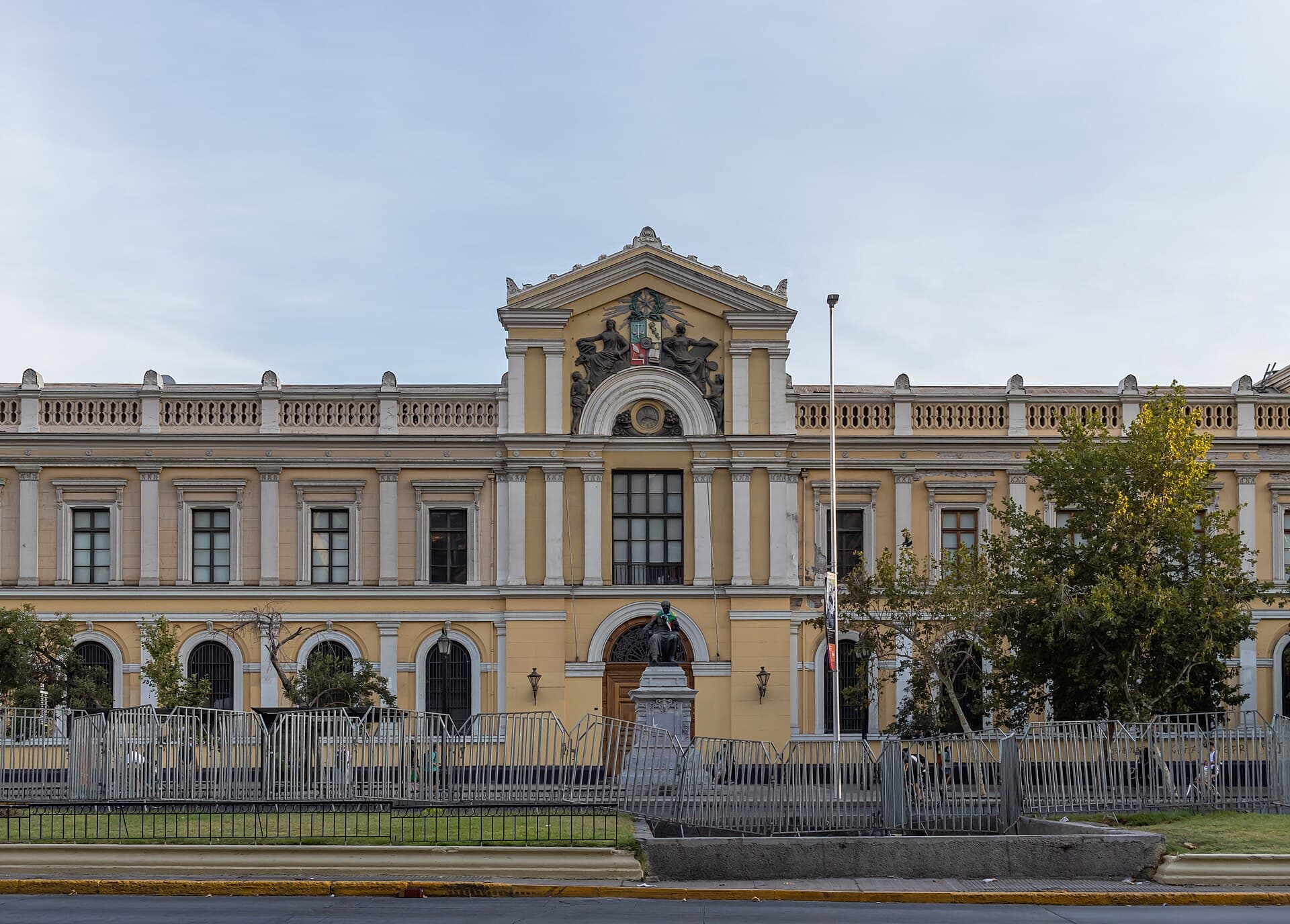
The University of Chile is the oldest university in Chile, created by law on 19 November 1842 and formally opened on 17 September 1843, in a young state that wanted a university answerable to the nation rather than to the crown or the church. Chileans rarely need its full name. They call it la casa de Bello, the house of Bello, after the man who ran it for its first twenty-two years, and the shorthand says something true: few universities anywhere are so closely identified with a single founding mind.
That mind belonged to Andrés Bello, a Venezuelan by birth who became, in Santiago, the quiet architect of Chilean public life. His statue sits before the Casa Central on the Alameda, the broad avenue through the centre of the capital.
Santiago had a university long before it had a republic. The Real Universidad de San Felipe was chartered by Philip V of Spain in 1738, granting degrees in law, theology and medicine through the last century of colonial rule. After independence the old royal foundation wound down, and in 1839 it was dissolved. The law of 1842 created its successor, and the University of Chile has always understood itself as the heir of that colonial house.
The founding law did something unusual: it made the university the superintendent of national education, responsible not only for its own five faculties but for the schools of the whole country. The Instituto Nacional, the great public secondary school founded in 1813, fed its graduates into the university's benches, and in 1889 the university opened the Instituto Pedagógico, the school that trained Chile's secondary teachers and, through them, set the standard for the national teaching profession.
Its first rector was Andrés Bello, born in Caracas in 1781. In Venezuela he had tutored the young Simón Bolívar, and in 1810 he sailed to London with Bolívar on a diplomatic mission for the revolutionary junta. He stayed in London nearly two decades, studying and writing in poverty, before Chile invited him to Santiago in 1829. There he drafted the Chilean Civil Code, adopted in 1855 and imitated across Latin America, and wrote the Gramática de la lengua castellana of 1847, the grammar that treated American Spanish as a language with its own authority rather than a colonial deviation. He led the university from its opening in 1843 until his death in 1865. Among his successors was the Polish-born mineralogist Ignacio Domeyko, who had rebuilt scientific teaching in Chile and served as rector from 1867 to 1883.
The twentieth century brought growth, and then rupture. After the military coup of 11 September 1973, the university was placed under intervention. Its elected authorities were removed and delegate rectors were imposed by the regime; academics and students were dismissed, imprisoned or driven into exile, and whole fields of study were curtailed. The reforms of 1981 stripped the university of its regional campuses and separated the Instituto Pedagógico from it entirely. With the return of democracy in 1990 the university recovered its elected government, and the rebuilding of what had been lost became part of its modern identity. In 2011 its student federation, the FECh, founded in 1906 and among the oldest in the Americas, stood at the centre of national protests over the cost and governance of education; its president that year, Camila Vallejo, became one of the movement's most recognised voices.
The Casa Central, the university's ceremonial and administrative seat, stands on the south side of the Alameda, formally Avenida Libertador Bernardo O'Higgins. The neoclassical building was designed by the French architect Lucien Hénault and raised in the second half of the nineteenth century, its long facade and central portico giving the public university a public face in the middle of the capital. The bronze figure of Bello, seated and robed, faces the avenue in front of it. Inside, the Salón de Honor remains the stage for the university's formal life, from doctoral investitures to national commemorations.
The working university spreads across Santiago in several large campuses. Beauchef, just south of the centre, houses the Faculty of Physical and Mathematical Sciences, the engineering school whose modern Beauchef 851 building is one of the city's larger academic investments. Juan Gómez Millas, to the east, gathers humanities, arts, sciences and communication; the health sciences cluster in the north of the city beside the university's teaching hospital. In total the university teaches through more than a dozen faculties and institutes, with around 40,000 students across undergraduate and graduate programmes.
Science has deep roots here. The naturalist Claudio Gay, whose government-commissioned survey of Chile's territory, flora and fauna filled decades of work, belonged to the university's founding generation, and Domeyko's mineralogy gave the mining country its first systematic geology. The university also carries Chile's oldest astronomical tradition: the National Astronomical Observatory, founded in 1852 and under university administration since 1927, operates from Cerro Calán on the eastern edge of Santiago. As northern Chile became host to many of the world's most powerful telescopes, the university's astronomers were already there.
Every old university has famous alumni. What distinguishes this one is how much of a single country's written identity passed through it. Bello gave Chile its civil law and Spanish America a grammar of its own language, and the institution he built kept producing writers who did the same work in verse.
In 1921 a sixteen-year-old from the southern town of Temuco named Neftalí Reyes arrived at the Instituto Pedagógico to train as a teacher of French. He was already publishing under the name Pablo Neruda, and while still a student he brought out Crepusculario in 1923 and, in 1924, Veinte poemas de amor y una canción desesperada, the collection that made him famous at nineteen and remains among the most read books of poetry in the Spanish language. He never finished the degree; the poems finished him as a student. Chile's other Nobel laureate in literature, Gabriela Mistral, built her teaching career far from the capital and never studied at the university, but on her last visit to Chile in 1954 it conferred an honorary doctorate on the rural schoolteacher who had become the voice of Latin American letters.
The third figure closes the circle. Nicanor Parra, who trained in mathematics and physics at the Instituto Pedagógico in the 1930s, taught those subjects at the university for decades, holding a chair in rational mechanics from the late 1940s. In 1954 the professor of physics published Poemas y antipoemas and invented antipoetry, the plain-spoken, ironic register that changed Spanish-language verse a second time in a single generation. A university where the civil code, the grammar, the love poems and the antipoems share a lineage has a fair claim to having written much of its country.
The university's public role shows most plainly in its graduates. Most of the presidents of Chile since independence studied there, along with a large share of its judges, ministers and scientists; the university counts twenty heads of state among its alumni, Salvador Allende, who took his medical degree there in the 1930s, among them. The national prizes in science, literature and the arts have gone disproportionately to its academics and graduates. Across the Andes, the University of Buenos Aires played a similar part for Argentina, and the two remain the great public reference universities of the southern cone, rivals and mirrors of one another.
The University of Chile and the Pontificia Universidad Católica de Chile stand together at the head of the country's higher education, trading places at the top of the Latin American rankings. The university remains public and state-owned, with research strengths in astronomy, seismology, medicine, engineering and public policy that reflect the country it serves. Its student politics and its rectoral elections are national news, which is itself a measure of what the institution means: in Chile, arguments about the university are arguments about the republic.
The Casa Central is the place to begin. It faces the Alameda in the centre of Santiago, beside the metro station that carries the university's name, whose platforms are decorated with large murals in homage to national history. The building's exterior, the Bello statue and the surrounding stretch of the avenue can be seen freely at any time; access to the interior depends on university activity, and the Salón de Honor opens for ceremonies and cultural events. On Cerro Calán, the observatory grounds host regular public astronomy evenings. The campuses are working academic spaces rather than tourist sites, and they reward the visitor who treats them that way: as the everyday rooms of a university that a country built on purpose.