Heritage · University
UCLA: History and Overview
Founded in 1919 as the Southern Branch of the University of California, UCLA grew from a teachers college into the university that receives more freshman applications than any other in the United States. On 29 October 1969 the first ARPANET message was sent from room 3420 of its Boelter Hall, and its Film & Television Archive keeps the country's second largest collection of moving images.Written to last.
By Confinity Heritage Editorial · 2026-08-24 · 8-minute readQuiet tools, kept out of the way.
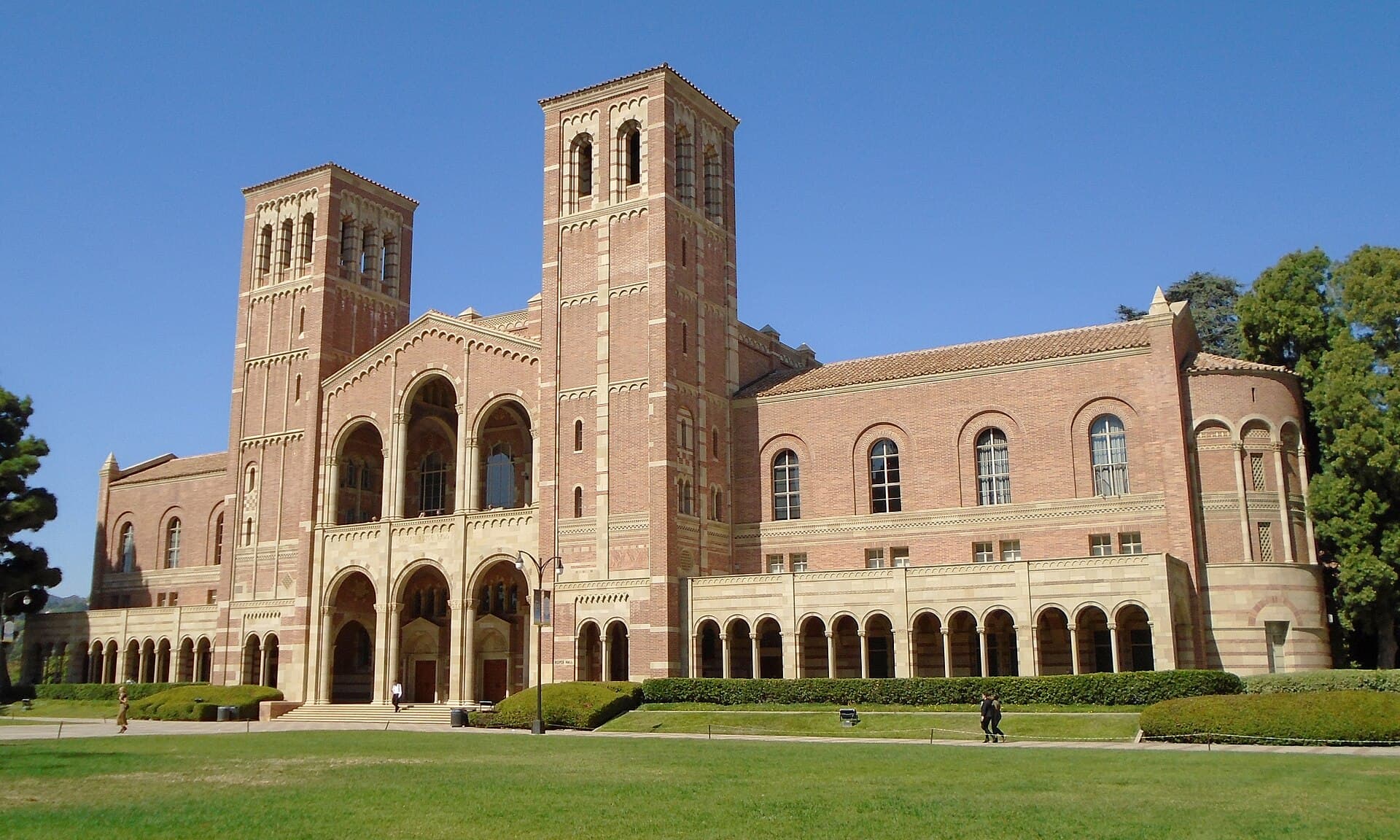
The University of California, Los Angeles occupies 419 acres in Westwood, in west Los Angeles in the United States. It began in 1919 as the Southern Branch of the University of California, the state university's second campus, and spent its first decade being reminded of the word branch. Few institutions have outgrown a diminutive so thoroughly. A century on, UCLA enrols around 46,000 students and runs one of the most admired hospitals in the country.
For an archive concerned with memory, UCLA holds two claims few places can match. On the evening of 29 October 1969, in room 3420 of Boelter Hall, a student programmer sent the first message ever carried over the ARPANET, the network that grew into the internet. The message was supposed to read LOGIN; the receiving system crashed after two letters, so the network that now carries most of the world's remembering began with the syllable LO. Across campus, the UCLA Film & Television Archive keeps the country's second largest collection of moving images in cold vaults, so that a century of film does not quietly decompose. The place where the internet spoke its first word is also a place where Hollywood's memory is kept cold.
UCLA descends from the Los Angeles State Normal School, a teachers college founded in 1881. In 1919 the California legislature converted the school into the Southern Branch of the University of California, giving the fast-growing south of the state its first campus of the university. The name was accurate and resented in equal measure. The system's original campus, the University of California, Berkeley, was four hundred miles north and half a century older, and southern Californians had little interest in remaining a branch of anything. In 1927 the campus was renamed the University of California at Los Angeles, the "at" later softening into a comma.
By then the Vermont Avenue site was already too small. The regents chose a stretch of open chaparral in Westwood, and in September 1929 the new campus opened with four brick and terracotta buildings around a quadrangle: Royce Hall, the library later named for Lawrence Clark Powell, Haines Hall and Kinsey Hall. The architects worked in a Lombard Romanesque style, and Royce Hall, the largest of the four, was modelled on the Basilica of Sant'Ambrogio in Milan, down to its pair of deliberately mismatched towers. The choice gave a campus barely a decade old the silhouette of a building nine centuries older, which was very much the point.
The university was authorised to grant master's degrees in 1933 and doctorates in 1936, and after the Second World War it expanded on every front, opening a school of medicine in 1951. By mid-century UCLA was a research university of the first rank, and the southern branch jokes had gone quiet.
The Westwood campus divides into two informal halves. North campus holds the original Romanesque core and the arts and humanities: the quadrangle of the four 1929 buildings, Dickson Court, and the broad run of the Janss Steps, once the formal entrance to the university. South campus holds science, engineering and medicine, built denser and more modern.
UCLA is organised into the College of Letters and Science and a ring of professional schools, among them medicine, law, engineering, management, and the School of Theater, Film and Television. Around 33,000 undergraduates and 13,000 graduate students study there, and in recent cycles the university has received close to 150,000 freshman applications a year, more than any other university in the United States. Ronald Reagan UCLA Medical Center, opened in 2008, anchors a hospital system consistently ranked among the best in the nation.
Boelter Hall is an unremarkable mid-century engineering building on south campus, and room 3420 is an ordinary laboratory room inside it. On the night of 29 October 1969 it became the birthplace of the connected world. The room housed the first node of the ARPANET, the experimental network of the US Advanced Research Projects Agency, and the laboratory of Leonard Kleinrock, whose queueing theory helped make packet switching credible. A student programmer, Charley Kline, sat at the lab's SDS Sigma 7 and tried to log in to a machine at the Stanford Research Institute, 350 miles north. He typed L, and it arrived. He typed O, and it arrived. Then the SRI system crashed, and the first message ever sent between two computers on the internet's ancestor stood at two letters: LO. Kleinrock came to relish the accident, pointing out that the network could hardly have composed a better opening than "lo," as in "lo and behold." About an hour later the full LOGIN went through. By the end of that year the network had four nodes; today its descendant reaches most of the human race.
 The IMP log for 29 October 1969, with its entry "talked to SRI host to host," the written record of the network's first message. Photograph by Andrew Adams, CC BY-SA 2.0, via Wikimedia Commons.
The room itself was nearly forgotten, used for decades as ordinary lab space. In 2011 it was restored to its 1969 appearance and opened as the Kleinrock Internet History Center, and the original Interface Message Processor, a refrigerator-sized Honeywell machine, still stands in the room. It is a small room for so large an event, and visitors tend to find that fitting.
UCLA's other great memory institution works in a different medium. The UCLA Film & Television Archive, founded in 1965, is the second largest moving-image collection in the United States, exceeded only by the Library of Congress, and the largest held by any university. Its holdings run to hundreds of thousands of films and television programs, including the Hearst Metrotone News collection, some 27 million feet of newsreel. The archive is one of the few institutions in the country equipped to preserve nitrate film, the dangerously flammable stock of early cinema, and its collections rest in cold, humidity-controlled vaults. Its restorations screen at the Billy Wilder Theater in Westwood. Between Boelter Hall and the vaults, one campus keeps both the first words of the digital record and the physical survival of the filmed one.
UCLA's roll of honour begins earlier than its fame. Ralph Bunche graduated from the young campus in 1927 as class valedictorian and went on to mediate the 1949 Arab-Israeli armistice and became the first African American awarded the Nobel Peace Prize. The sciences followed: the chemists Willard Libby, who devised radiocarbon dating and spent his later career on the UCLA faculty, Donald Cram and Paul Boyer all held Nobel Prizes, and in 2020 the astronomer Andrea Ghez shared the Nobel Prize in Physics for demonstrating that a supermassive black hole sits at the centre of our galaxy.
Then there is the sporting inheritance, which at UCLA shades into national history. Jackie Robinson lettered in four sports as a Bruin in 1939 and 1940, the first UCLA athlete to do so; baseball, the game in which he broke the major leagues' colour line in 1947, was by common account his weakest sport in Westwood. A generation later John Wooden's basketball teams won ten NCAA championships between 1964 and 1975, including seven in a row. Lew Alcindor, later Kareem Abdul-Jabbar, anchored three of those titles before a career that made him the NBA's leading scorer for nearly four decades. Bruins have competed at every summer Olympic Games since 1932, when Los Angeles first hosted, and have brought home well over 250 medals.
In recent years US News & World Report has ranked UCLA the top public university in the country, and its faculty and alumni continue to collect Nobel Prizes, Turing Awards and Academy Awards in roughly equal measure. UCLA marked its centennial in 2019, fifty years almost to the month after the two-letter message left Boelter Hall. It remains a public institution in temperament as well as charter: most undergraduates are Californians, and many are the first in their families to attend university.
The campus is open to walk, and the historic quadrangle rewards it: Royce Hall and Powell Library face each other across Dickson Court, and the Janss Steps below give the classic view of both. The Fowler Museum, the Franklin D. Murphy Sculpture Garden and the Mildred E. Mathias Botanical Garden are free to enter, and the Hammer Museum in Westwood Village hosts the Film & Television Archive's screenings at the Billy Wilder Theater. The Kleinrock Internet History Center in Boelter Hall room 3420 keeps limited public hours, and checking ahead is wise; the room is small and sits inside a working engineering building. The university also runs regular student-led tours.
The IMP log for 29 October 1969, with its entry "talked to SRI host to host," the written record of the network's first message. Photograph by Andrew Adams, CC BY-SA 2.0, via Wikimedia Commons.
The room itself was nearly forgotten, used for decades as ordinary lab space. In 2011 it was restored to its 1969 appearance and opened as the Kleinrock Internet History Center, and the original Interface Message Processor, a refrigerator-sized Honeywell machine, still stands in the room. It is a small room for so large an event, and visitors tend to find that fitting.
UCLA's other great memory institution works in a different medium. The UCLA Film & Television Archive, founded in 1965, is the second largest moving-image collection in the United States, exceeded only by the Library of Congress, and the largest held by any university. Its holdings run to hundreds of thousands of films and television programs, including the Hearst Metrotone News collection, some 27 million feet of newsreel. The archive is one of the few institutions in the country equipped to preserve nitrate film, the dangerously flammable stock of early cinema, and its collections rest in cold, humidity-controlled vaults. Its restorations screen at the Billy Wilder Theater in Westwood. Between Boelter Hall and the vaults, one campus keeps both the first words of the digital record and the physical survival of the filmed one.
UCLA's roll of honour begins earlier than its fame. Ralph Bunche graduated from the young campus in 1927 as class valedictorian and went on to mediate the 1949 Arab-Israeli armistice and became the first African American awarded the Nobel Peace Prize. The sciences followed: the chemists Willard Libby, who devised radiocarbon dating and spent his later career on the UCLA faculty, Donald Cram and Paul Boyer all held Nobel Prizes, and in 2020 the astronomer Andrea Ghez shared the Nobel Prize in Physics for demonstrating that a supermassive black hole sits at the centre of our galaxy.
Then there is the sporting inheritance, which at UCLA shades into national history. Jackie Robinson lettered in four sports as a Bruin in 1939 and 1940, the first UCLA athlete to do so; baseball, the game in which he broke the major leagues' colour line in 1947, was by common account his weakest sport in Westwood. A generation later John Wooden's basketball teams won ten NCAA championships between 1964 and 1975, including seven in a row. Lew Alcindor, later Kareem Abdul-Jabbar, anchored three of those titles before a career that made him the NBA's leading scorer for nearly four decades. Bruins have competed at every summer Olympic Games since 1932, when Los Angeles first hosted, and have brought home well over 250 medals.
In recent years US News & World Report has ranked UCLA the top public university in the country, and its faculty and alumni continue to collect Nobel Prizes, Turing Awards and Academy Awards in roughly equal measure. UCLA marked its centennial in 2019, fifty years almost to the month after the two-letter message left Boelter Hall. It remains a public institution in temperament as well as charter: most undergraduates are Californians, and many are the first in their families to attend university.
The campus is open to walk, and the historic quadrangle rewards it: Royce Hall and Powell Library face each other across Dickson Court, and the Janss Steps below give the classic view of both. The Fowler Museum, the Franklin D. Murphy Sculpture Garden and the Mildred E. Mathias Botanical Garden are free to enter, and the Hammer Museum in Westwood Village hosts the Film & Television Archive's screenings at the Billy Wilder Theater. The Kleinrock Internet History Center in Boelter Hall room 3420 keeps limited public hours, and checking ahead is wise; the room is small and sits inside a working engineering building. The university also runs regular student-led tours.
History
Campus and academics
Boelter Hall 3420 and the Film & Television Archive