Heritage · University
University College London: History and Overview
Founded in 1826 as London University, UCL was the first university in England to admit students regardless of religion, and in 1878 the first to admit women on equal terms with men. Behind the Wilkins portico it keeps the auto-icon of Jeremy Bentham, the philosopher who chose to become his own memorial.Written to last.
By Confinity Heritage Editorial · 2026-08-24 · 8-minute readQuiet tools, kept out of the way.
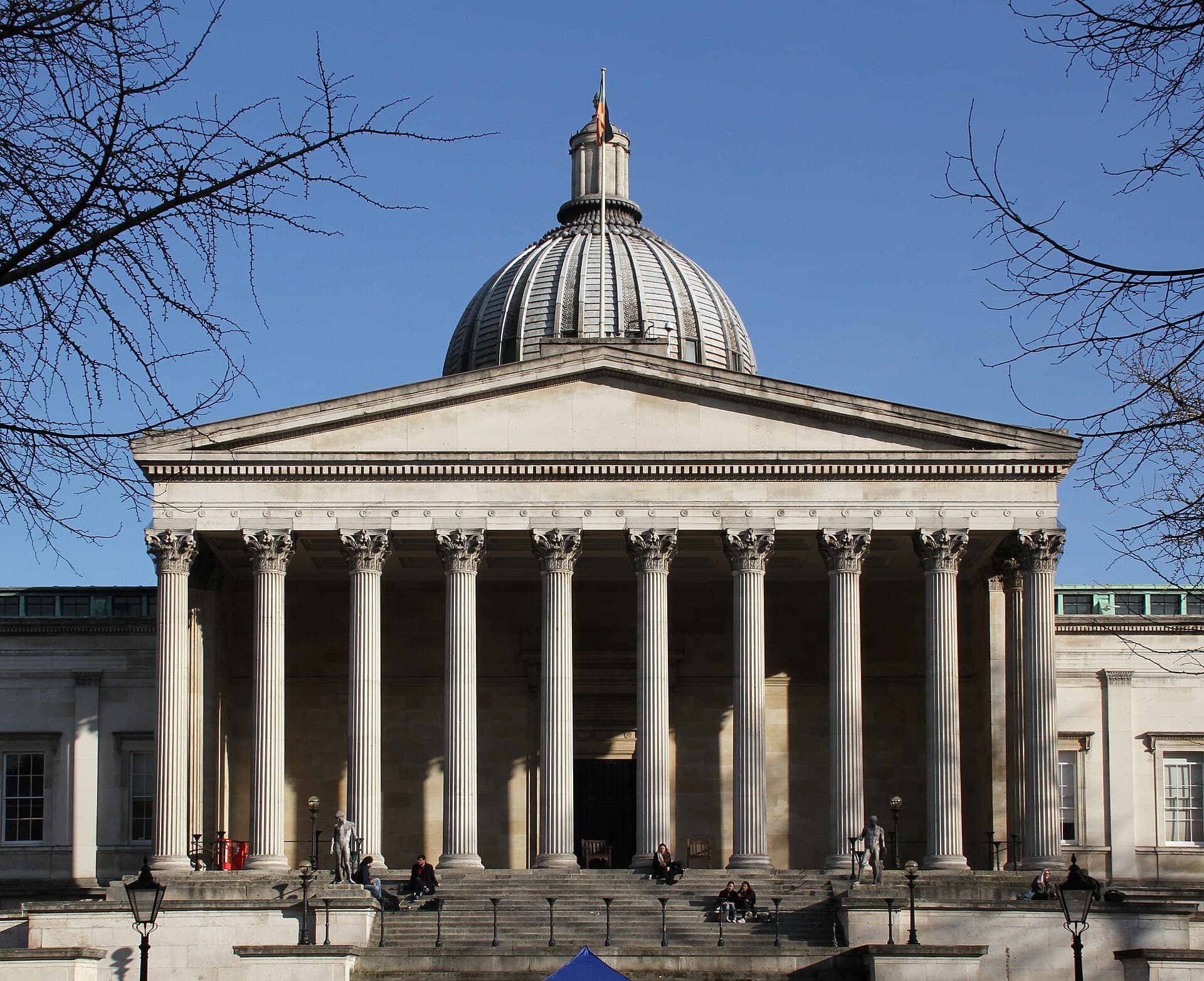
University College London stands on Gower Street in Bloomsbury, in the centre of the United Kingdom's capital, behind a portico of ten Corinthian columns that has served as its emblem for two centuries. It was founded in 1826 as London University, and it opened a door that the two ancient English universities kept shut: it admitted students without asking what they believed. Oxford and Cambridge then required conformity to the Church of England; the new college in Gower Street asked no religious test at all, and its opponents gave it the name that became a badge of honour, the godless institution of Gower Street.
UCL also holds one of the strangest and most instructive memorials anywhere. Jeremy Bentham, the philosopher whose ideas shaped the college's founders, directed in his will that his body be preserved, dressed in his own clothes and displayed. The auto-icon, as he called it, still sits in a glass case at UCL, a founder-figure who decided to curate his own remembrance rather than leave it to others.
The university began as a joint-stock venture rather than a royal or religious foundation. A group of reformers, among them the Scottish poet Thomas Campbell and the lawyer and politician Henry Brougham, raised money by shares to build a university for the capital, which then had none. Their circle drew heavily on the utilitarian philosophy of Jeremy Bentham, who argued that institutions should be judged by the good they do for the greatest number. Bentham, by then in his late seventies, was not a founder in the practical sense, but the project was so plainly an expression of his ideas that UCL has long regarded him as its spiritual father, and the college's openness to students of every faith and none followed directly from the utilitarian case against privilege by creed.
Teaching began in 1828 in the new building on Gower Street. The Anglican establishment answered quickly, founding King's College London in 1829 as a church counterweight. Neither institution could award degrees on its own, and the deadlock was resolved in 1836, when the government chartered the University of London as an examining body. The Gower Street college took the name University College London and became, with King's, a founding college of the new federal university.
The pattern of firsts continued. In 1878 the University of London opened its degrees to women, and UCL became the first university institution in England to admit women on equal terms with men. Oxford would not grant women full degrees until 1920, Cambridge not until 1948. Through the nineteenth and twentieth centuries UCL grew from a radical experiment into one of the largest research universities in the country, absorbing medical schools and institutes across Bloomsbury while remaining part of the University of London federation. Since 2008 it has awarded its own degrees, so the federal tie is today a matter of shared history rather than of examination papers.
The heart of the campus is the Wilkins Building, designed by William Wilkins, the architect who went on to design the National Gallery in Trafalgar Square. Its foundation stone was laid in 1827, and its raised portico and dome close the east side of the main quadrangle off Gower Street; the wings framing the quad were completed in stages over more than a century. The quad remains open ground where students cross between lectures, and the portico steps are the backdrop to every graduation photograph the college takes.
Around this core, UCL runs eleven faculties spanning arts and humanities, laws, engineering, education, the built environment, and the largest concentration of biomedical research in Europe through its medical and life sciences faculties. The Slade School of Fine Art, founded in 1871 through the bequest of the collector Felix Slade, trained Gwen John, Augustus John and Stanley Spencer, and remains one of the leading art schools in Britain. The college also keeps teaching museums of unusual character. The Petrie Museum of Egyptian Archaeology holds around eighty thousand objects from Egypt and Sudan, one of the largest such collections in the world, built around the excavations of Flinders Petrie, whose chair of Egyptology was the first in England. The Grant Museum of Zoology, founded in 1828 as a teaching collection, keeps skeletons of the extinct quagga and thylacine. UCL is one of a cluster of research universities in the capital, alongside Imperial College London in South Kensington and the London School of Economics in Aldwych, but it is the only one whose founding purpose was admission without belief.
Jeremy Bentham died on 6 June 1832, and his will contained an instruction unlike any other in the history of English philosophy. His body was to be dissected for the instruction of medical students, and afterwards his skeleton was to be preserved, padded out to shape, dressed in his own clothes and seated in his own chair, so that he could remain present among his friends. He named the result the auto-icon, a self-image made of the self.
His physician and disciple Thomas Southwood Smith carried out the instructions, delivering a public anatomy lecture over the body before preparing the figure. One part of the plan failed. Bentham had hoped his own head could be preserved and mounted on the skeleton, but the drying method attempted left the face darkened and sunken, too disturbing to display as he had imagined. A wax head was modelled instead, and the real head was kept separately. For years it sat near the figure, and it became the subject of student pranks that passed into college legend, including a celebrated theft by students from rival King's College. The mummified head is now held in secure storage and is not on public display.
Southwood Smith kept the auto-icon until 1850, when he gave it to UCL. For most of its life at the college it sat in a wooden cabinet in the South Cloisters of the Wilkins Building; in 2020 it was moved to a purpose-built glass case in the entrance of the Student Centre, where it now faces the students of the institution his ideas helped call into being. A college story holds that Bentham is wheeled in to meetings of the College Council and recorded as present but not voting; the tale is repeated far more often than it ever happened, which is itself a lesson in how institutions remember. The auto-icon is probably the most famous single object held by any British university. He chose the form of his own memory, and the college has kept faith with that choice for nearly two centuries.
UCL's register of alumni and staff tracks the modern history of open inquiry. Mohandas Gandhi enrolled to study law in London in 1888 during his training for the bar, and Alexander Graham Bell, later the inventor of the telephone, studied at the college in the late 1860s, drawn by its work on speech and elocution, a field his father taught. William Ramsay, professor of chemistry from 1887, discovered argon with Lord Rayleigh and went on to isolate helium, neon, krypton and xenon; he received the Nobel Prize in Chemistry in 1904, the first awarded to a British chemist. Francis Crick took his undergraduate degree in physics at UCL before the war years redirected him toward the biology that led to the double helix.
The college's modern strength in neuroscience continues that line. John O'Keefe, whose discovery of place cells revealed how the brain maps space, carried out the work at UCL and shared the Nobel Prize in Physiology or Medicine in 2014. The Wellcome-funded centres for neuroimaging and the Gatsby Computational Neuroscience Unit have made Bloomsbury one of the most cited addresses in brain science. In all, UCL counts more than thirty Nobel laureates among its former students and staff.
UCL is today the largest university in London by enrolment, with a student body of more than fifty thousand drawn from over 150 countries, and it consistently places in the top ranks of the international league tables. Its campus has spread far beyond Gower Street: the UCL East campus opened on the Queen Elizabeth Olympic Park in Stratford in 2022, the largest single expansion in the college's history. The Bentham Project, based at the college, continues the scholarly edition of Bentham's collected works, transcribing the tens of thousands of manuscript pages he left behind, so the college is still, in a literal sense, reading its spiritual founder.
The main campus lies on Gower Street in Bloomsbury, a short walk from the British Museum and from Euston and Tottenham Court Road stations. The main quadrangle and the Wilkins portico can be seen from the street, and the auto-icon of Jeremy Bentham is displayed in the Student Centre, open to visitors during building hours. The Petrie Museum and the Grant Museum of Zoology are both free to enter, with opening days published on the college's website. The Wilkins portico, the front quad and the Grant Museum are the reasons to come; the rest is a crowded city university at work, and examination weeks are the worst of it for wandering.