Heritage · University
Northwestern University: History and Overview
Founded in 1851 to serve the old Northwest Territory, Northwestern University grew from a stretch of lakeside Illinois prairie into one of the leading research universities in the United States. Its Evanston campus made its own new ground by filling in part of Lake Michigan, and at its heart sits the Rock, a boulder repainted by students so many times that the paint now lies inches thick.Written to last.
By Confinity Heritage Editorial · 2026-08-25 · 8-minute readQuiet tools, kept out of the way.
Northwestern University stands on the western shore of Lake Michigan in Evanston, Illinois, a dozen miles north of Chicago in the United States. Its name records an ambition rather than a compass point on a map of the modern country: the founders of 1851 intended a university for the old Northwest Territory, the region beyond the Ohio River that became Ohio, Indiana, Illinois, Michigan and Wisconsin. The territory was already history when the charter was signed; the name and the ambition stuck.
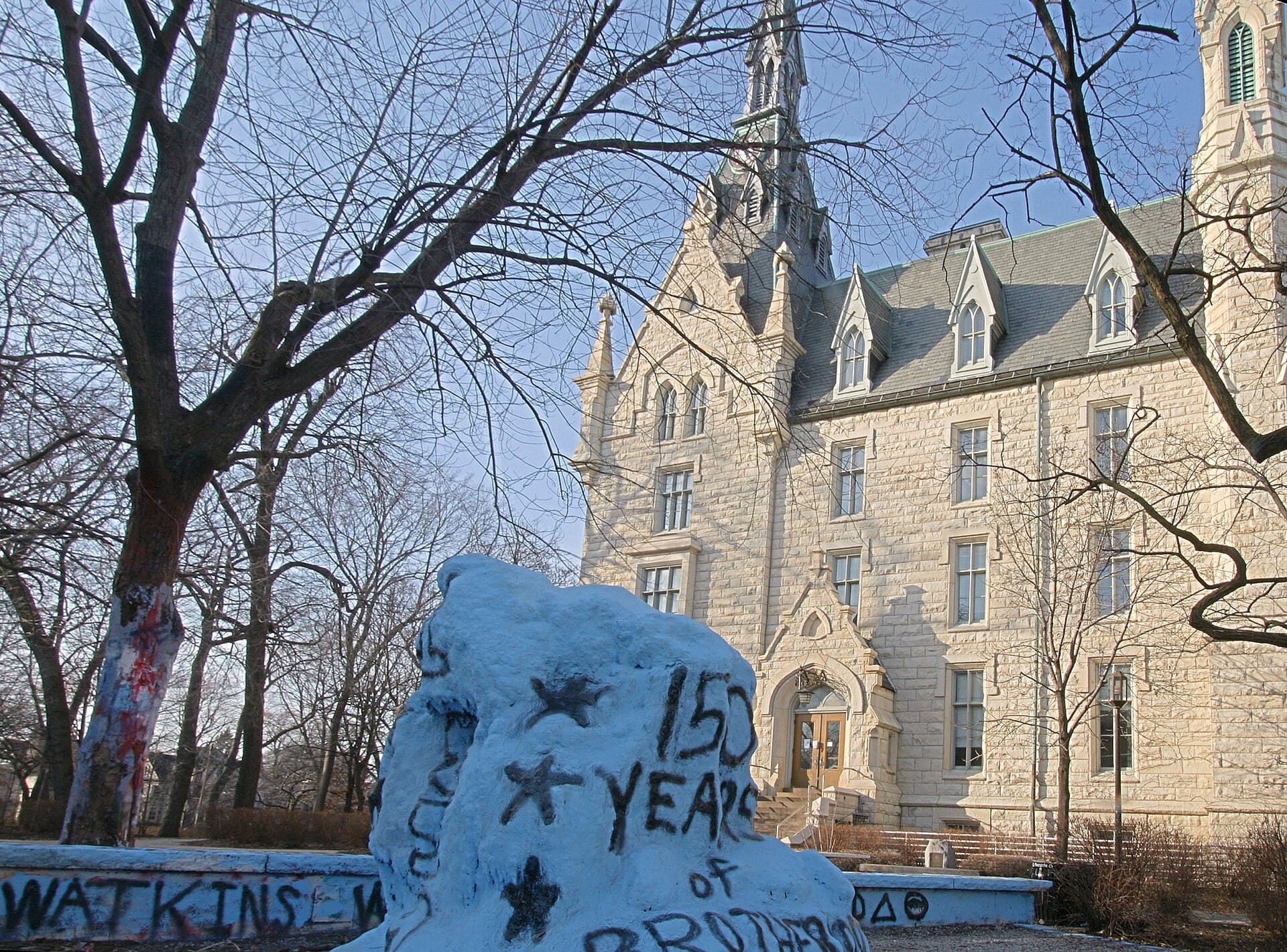
For a site concerned with how places hold memory, Northwestern offers two unusual images. The first is a campus that made its own ground, extending itself into Lake Michigan on landfill in the 1960s so that buildings now stand where there was open water. The second is a boulder near the campus's oldest hall, painted and repainted by students for the better part of a century until the layers of colour grew inches deep, each new coat covering the last without erasing the fact of it.
The founding story begins on 31 May 1850, when nine men, Methodist businessmen and lawyers of frontier Chicago, met in a law office above a hardware store on Lake Street and resolved to establish a university to serve the people of the Northwest Territory. The Illinois legislature granted the charter on 28 January 1851. Among the nine was John Evans, a physician and railway promoter. The founders bought a tract of lakeshore farmland north of the city, platted a town beside the new campus, and named it Evanston in his honour. Classes began in 1855 with two professors and a class of about ten students.
Evans's later life carries a darker chapter that belongs in any account of the place. As territorial governor of Colorado he presided over the period of the Sand Creek Massacre of 1864, in which US troops killed Cheyenne and Arapaho people who had been promised safety, and he resigned under pressure the following year. A committee of Northwestern scholars examined his record in 2014 and found no evidence he planned or knew of the attack in advance, but judged that he shared responsibility for the conditions that produced it and defended it afterward.
The university itself widened steadily. It absorbed the Evanston College for Ladies in 1873, bringing in women students and making Frances Willard, the temperance reformer who had led the women's college, its first dean of women. University Hall, a gothic pile of Joliet limestone finished in 1869, replaced the original frame building and still stands as the oldest structure on campus. Professional schools of medicine and law, founded in Chicago in 1859, were drawn into the university in the decades that followed, giving Northwestern the two-campus shape it keeps today. In 1896 the university joined six other institutions to found the athletic conference that became the Big Ten, and it remains the only private university among its long-standing members.
The boldest change to the campus came not from building on land but from making it. Between 1962 and 1964 the university filled in a stretch of Lake Michigan along its eastern edge, creating a broad new campus of lawns, lecture halls and a curving lagoon where the open lake had been. The main university library, the Norris student centre and a run of arts and science buildings rose on the lakefill in the years that followed. Rather than spreading into the town around it, Northwestern grew by adding ground to the continent, and the seam between old shoreline and new land can still be traced in the line of the lagoon.
The Evanston campus runs for about a mile along the lake, from the gothic quads and elms of the original grounds to the modern lakefill with its views back toward the Chicago skyline. Deering Library, completed in 1933 in the collegiate gothic manner, faces a wide meadow at the campus's centre; University Hall and the Rock stand a short walk south. The Chicago campus, in the Streeterville district, houses the schools of medicine and law alongside the hospitals of the Northwestern Medicine system. A third campus in Doha, Qatar, opened in 2008, teaches journalism and communication.
The professional schools carry much of the university's reputation. The Medill School of Journalism, founded in 1921 and named for Joseph Medill, the Chicago Tribune editor, has trained generations of American reporters, and its students still trade cautionary stories of the Medill F, a failing grade said to await any assignment that misspells a name. The Kellogg School of Management ranks among the leading graduate business schools in the world, and the Pritzker School of Law, the Feinberg School of Medicine and the McCormick School of Engineering and Applied Science anchor the university's professional and technical strength. The Bienen School of Music and the School of Communication round out a roster in which the performing arts hold unusual weight for a research university.
That weight shows in the alumni rolls. Northwestern's theatre programme has fed American stage and screen for generations: Charlton Heston, David Schwimmer, Julia Louis-Dreyfus, Stephen Colbert, Seth Meyers and Meghan Markle all studied there, and Warren Beatty spent a year there before leaving for New York. Every spring since 1929 students have written and staged the Waa-Mu Show, an original musical named for the Women's Athletic Association and the Men's Union that first mounted it.
Near University Hall sits a boulder that has become the university's most beloved object. The Class of 1902 gave it as a fountain; the plumbing never worked well, and by the 1940s students had begun painting the stone instead. The practice hardened into a tradition with its own law: a group that wants to paint the Rock must first guard it around the clock before earning the right to cover it in a new design overnight. Fraternities, cultural groups, sports teams and friends marking a birthday have all taken their turn.
The result, after some eighty years, is a stone wearing layers of paint inches thick, a shell of accumulated colour over the original granite. Chips broken from the surface show bands of pigment like tree rings, each one a message somebody once thought worth staying up all night to make. Nothing painted on the Rock survives on the surface for long, yet nothing is quite gone either; every layer is still in there, pressed under the ones that came after. It is a memorial that works by accumulation rather than preservation, and the university has had the good sense never to seal it, restore it or scrape it back to bare stone.
Northwestern's faculty have earned Nobel recognition across the sciences. John Pople, a pioneer of computational chemistry, shared the Nobel Prize in Chemistry in 1998 while a professor at Northwestern. Dale Mortensen, a Northwestern economist for more than four decades, shared the 2010 prize in economics for his analysis of markets with search frictions. Fraser Stoddart, who built molecular machines from interlocked rings of atoms, shared the Nobel Prize in Chemistry in 2016 while on the Northwestern faculty. The university's research strength runs through materials science and nanotechnology, where its International Institute for Nanotechnology has been a leading centre, along with medicine, economics and the social sciences.
The university's intellectual life has long been sharpened by its neighbour to the south. The University of Chicago, founded four decades later on the city's South Side, became the other pole of scholarly life in the region, and the two institutions have traded students, faculty and friendly rivalry ever since.
Northwestern today enrolls around 23,000 students, roughly a third of them undergraduates, and holds one of the largest endowments of any American university. It has placed in or near the top ten of the major national rankings in recent years, and its research funding places it among the country's leading research engines. The Wildcats compete in the Big Ten in purple and white, and the lakefill that was open water in 1960 is now simply the east side of campus.
Evanston is easy to reach from Chicago on the CTA Purple Line, and the campus is open to walk at any time. The lakefill path gives a long view of the Chicago skyline across the water and circles the lagoon; University Hall, Deering Library and the Rock are all within a few minutes of one another on the older grounds, and the Rock's current paint job may be gone by the weekend. The Block Museum of Art offers free admission, the Shakespeare Garden of 1915 is a quiet detour in season, and Dearborn Observatory opens its historic telescope to the public on scheduled evenings. The lakefill path, the Rock and the Deering lawn are open ground; classrooms and studios are not, and term weeks are crowded.