Heritage · University
University of California, Berkeley: History and Overview
Founded in 1868 from the merger of a private college and a public land-grant school, UC Berkeley became the flagship of the University of California system. Its physicists built the first cyclotrons and its chemists discovered plutonium, berkelium, and californium, while its students launched the 1964 Free Speech Movement.Written to last.
By Confinity Heritage Editorial · Updated 2026-08-25 · 8-minute readQuiet tools, kept out of the way.
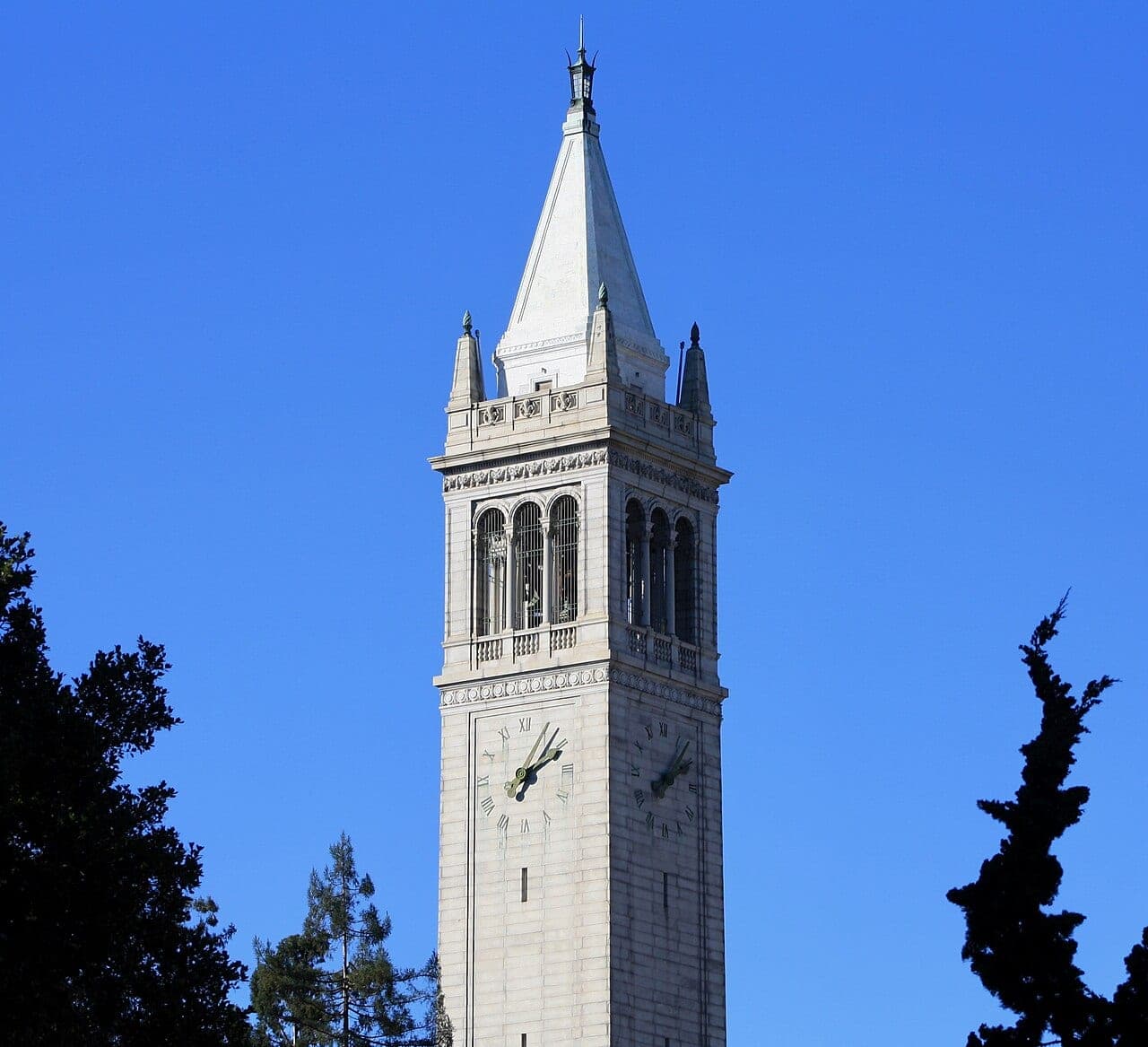
The University of California, Berkeley, known to most people simply as Berkeley or Cal, is the founding campus of the University of California and the oldest of its ten campuses. It was established in 1868, sits on roughly 1,200 acres of hillside above San Francisco Bay, and enrolls more than 45,000 students, which makes it one of the largest and most influential public research universities in the United States. From its terraces the ground falls away toward the water and the Golden Gate, and above it all rises the slender white shaft of the Campanile, the campus landmark visible for miles.
Berkeley is a place where a great deal of the modern world was first written down. Its laboratories mapped the inner structure of the atom and added new elements to the periodic table, two of them named for the university and the state. Its students changed the rules of American campus life in a single autumn of protest in 1964. This archive gathers the founding, the buildings, and the discoveries that give the university its long memory, and the record of the people who made them.
Berkeley began as a marriage of two institutions with very different origins. The first was the College of California, a private school chartered in 1855 and run in Oakland by ministers and educators who wanted a full liberal-arts college for the young state. The second existed only on paper: a public Agricultural, Mining, and Mechanical Arts College that California had created to claim the federal endowment offered under the Morrill Land-Grant Act of 1862. The private college had the faculty, the reputation, and a fine new site north of Oakland, but little money; the state had land and funding but no campus. In 1867 the trustees of the College of California offered to dissolve their institution and deed its property to the state on the condition that the result be a true university rather than a narrow technical school. The legislature agreed, and the Organic Act signed on 23 March 1868 created the University of California from the merger.
The name of the town, and therefore of the university, was chosen before the campus was built. In 1866 the trustees of the College of California gathered at the new site to dedicate the grounds, and, according to a well-known account, one of them, Frederick Billings, proposed naming the place for the Anglo-Irish philosopher George Berkeley. Berkeley, an eighteenth-century bishop and idealist thinker, had written a poem whose opening line, "Westward the course of empire takes its way," seemed to the trustees to describe the reach of learning toward the Pacific. The name stuck to the town, and the university took it in turn.
Teaching began in 1869 in the old College of California buildings in Oakland, with a first class of about forty students under the university's first president, Henry Durant. The move to the new campus at Berkeley came in 1873, when the earliest permanent buildings, North Hall and South Hall, were ready. South Hall, built to house the agricultural and mechanical programs, survives today as the oldest building on campus. Through the late nineteenth century the university grew slowly, then decisively. In 1868 the founding charter had committed it to admit women on equal terms with men, and the first women enrolled in 1870. A turning point came in 1897 when Phoebe Apperson Hearst, the mining heiress and philanthropist, funded an international competition to design a permanent campus plan, an act of patronage that set the architectural character of Berkeley for the next half century.
The most consequential chapter in the university's public history came in 1964. That autumn, students who had been organizing for civil-rights causes clashed with an administration that banned political activity on university property. Their protests grew into the Free Speech Movement, led most visibly by the philosophy student Mario Savio, whose "bodies upon the gears" speech on the steps of Sproul Hall became one of the defining orations of the 1960s. After a mass sit-in and hundreds of arrests, the faculty voted to lift the restrictions on political speech, and Berkeley became a byword for student activism across the country and beyond.
The Berkeley campus is a study in the Beaux-Arts ideal of ordered, classical planning. The winning design from Hearst's competition, later refined by the architect John Galen Howard, who served as supervising architect from 1901, laid out a spine of formal axes descending toward the Bay, framed by granite buildings in a restrained classical style. Howard designed some twenty of the early campus structures, among them Doe Memorial Library, Wheeler Hall, California Hall, the Hearst Memorial Mining Building, and the open-air Hearst Greek Theatre. Sather Gate, given by Jane K. Sather, long marked the southern entrance to the grounds.
 The tower is also a store room. Its lower floors hold some 20,000 fossils from the La Brea tar pits, put there for want of anywhere else to keep them. Photograph by Michael Pihulic, CC BY-SA 4.0, via Wikimedia Commons.
Howard's best-known work is Sather Tower, universally called the Campanile. Modeled on the bell tower of St Mark's Basilica in Venice and funded by the same donor, Jane K. Sather, in memory of her husband, it was built between 1914 and 1915 and opened to the public in 1916. At 307 feet it is the second-tallest bell-and-clock tower in the world, and its observation deck, reached by elevator, gives one of the finest views in the region. Its carillon of bells is played daily, and the tower has served as the emblem of the university for more than a century.
Academically, Berkeley is organized into a set of colleges and schools that between them cover nearly every field of study. The College of Letters and Science is by far the largest and teaches most undergraduates; alongside it stand the College of Engineering, the College of Chemistry, the College of Environmental Design, the Rausser College of Natural Resources, and the newer College of Computing, Data Science, and Society. Professional and graduate education is carried by the Haas School of Business, Berkeley Law, the Goldman School of Public Policy, and schools of education, journalism, public health, information, and social welfare. The university is consistently ranked among the leading public institutions in the world across these fields.
Berkeley's scientific heritage is among the most concentrated of any university. In the early 1930s the physicist Ernest Orlando Lawrence invented the cyclotron, a machine that accelerated charged particles in a spiral and opened the atomic nucleus to experiment. The invention won him the Nobel Prize in Physics in 1939, and the laboratory he founded on the hill above campus grew into what is now the Lawrence Berkeley National Laboratory, one of the national laboratories of the United States Department of Energy.
The cyclotron made Berkeley the birthplace of much of the modern periodic table. Working there in 1940 and 1941, Glenn Seaborg, Edwin McMillan, and their colleagues discovered plutonium, element 94; Seaborg and McMillan shared the 1951 Nobel Prize in Chemistry for their work on the transuranium elements. Berkeley researchers went on to discover sixteen chemical elements in all, more than any other institution. Two of them carry the university's own name and its place: berkelium, element 97, first made in 1949, and californium, element 98, first made in 1950 and named for the university and the state of California. Later discoveries added lawrencium, named for Ernest Lawrence, and seaborgium, one of the few elements named for a living person.
The record of honors is deep. The university counts 101 Nobel laureates among its faculty, alumni, and researchers, along with many winners of the Fields Medal and the Turing Award. J. Robert Oppenheimer taught physics at Berkeley before leading the wartime laboratory at Los Alamos, and the biochemist Jennifer Doudna, a Berkeley professor, shared the 2020 Nobel Prize in Chemistry for the CRISPR gene-editing method. Its graduates have reached far beyond the sciences: Earl Warren, later Chief Justice of the United States, took two degrees at Berkeley; Gordon Moore, co-founder of Intel, earned his first degree in chemistry there; and generations of scholars, judges, writers, and technologists have carried the university's training into public life.
In 1859 a San Francisco bookseller named Hubert Howe Bancroft cleared the shelf beside his desk and put on it every book in the shop that touched California and the West. There were fifty or seventy-five of them. He kept collecting for the rest of his working life, appointing agents in the book markets of Europe and buying whole libraries at auction, until the holdings ran across western North America from Panama to Alaska.
Books alone did not satisfy him. Bancroft hired a staff of interviewers, transcribers, and writers and sent them out to find the people who had lived in California before the American annexation. His team took down roughly 125 dictations, also called testimonios or recuerdos, from Californios and other early residents, twelve of them from women and one of those from a Native American woman. Mariano Guadalupe Vallejo, the most prominent of the narrators, produced five volumes and then objected to the use Bancroft made of them. The dictations survive as a counter-narrative to the histories that were later written over them.
The university bought the collection in 1905 for a fraction of its worth, on two conditions Bancroft wrote into the sale: that it be kept as a library of its own, and that the university go on adding to it. It has. The Bancroft left the attic of California Hall for its present quarters in 1950, took in the private papers of Samuel Clemens in 1971, and now runs an Oral History Center whose five thousand recorded interviews grow by some four hundred hours a year. A collector who could find nobody willing to write his history ended by building the institution that has been writing it ever since.
Berkeley remains the flagship of a University of California system that now spans ten campuses and serves the whole state. It enrolls more than 45,000 undergraduate and graduate students, draws research funding on a scale that few public universities match, and continues to run the Lawrence Berkeley National Laboratory alongside its own departments. The campus keeps the character set a century ago, formal classical buildings threaded by Strawberry Creek and shaded by groves of eucalyptus and redwood, while its research reaches into fields, from climate science to artificial intelligence, that did not exist when Howard drew his plan. Its combination of public mission, low cost relative to private peers, and sustained excellence keeps it near the top of every ranking of public higher education.
The campus lies in the city of Berkeley, directly across the Bay from San Francisco, and is open to visitors throughout the year. The Campanile is the natural starting point: its observation deck is open to the public for a small fee and gives a full view of the Bay, the city, and the Golden Gate. Nearby are Doe Library, the Hearst Greek Theatre, and the classical core of Howard's plan, all within an easy walk. The Berkeley Art Museum and Pacific Film Archive, the University of California Botanical Garden in the hills, and the Lawrence Hall of Science offer more to see for those with time. The campus is reached most easily by public transit, with the Downtown Berkeley BART station a few minutes' walk from the main gate; because hours, tours, and event schedules change, it is worth checking the official university website before a visit.
The tower is also a store room. Its lower floors hold some 20,000 fossils from the La Brea tar pits, put there for want of anywhere else to keep them. Photograph by Michael Pihulic, CC BY-SA 4.0, via Wikimedia Commons.
Howard's best-known work is Sather Tower, universally called the Campanile. Modeled on the bell tower of St Mark's Basilica in Venice and funded by the same donor, Jane K. Sather, in memory of her husband, it was built between 1914 and 1915 and opened to the public in 1916. At 307 feet it is the second-tallest bell-and-clock tower in the world, and its observation deck, reached by elevator, gives one of the finest views in the region. Its carillon of bells is played daily, and the tower has served as the emblem of the university for more than a century.
Academically, Berkeley is organized into a set of colleges and schools that between them cover nearly every field of study. The College of Letters and Science is by far the largest and teaches most undergraduates; alongside it stand the College of Engineering, the College of Chemistry, the College of Environmental Design, the Rausser College of Natural Resources, and the newer College of Computing, Data Science, and Society. Professional and graduate education is carried by the Haas School of Business, Berkeley Law, the Goldman School of Public Policy, and schools of education, journalism, public health, information, and social welfare. The university is consistently ranked among the leading public institutions in the world across these fields.
Berkeley's scientific heritage is among the most concentrated of any university. In the early 1930s the physicist Ernest Orlando Lawrence invented the cyclotron, a machine that accelerated charged particles in a spiral and opened the atomic nucleus to experiment. The invention won him the Nobel Prize in Physics in 1939, and the laboratory he founded on the hill above campus grew into what is now the Lawrence Berkeley National Laboratory, one of the national laboratories of the United States Department of Energy.
The cyclotron made Berkeley the birthplace of much of the modern periodic table. Working there in 1940 and 1941, Glenn Seaborg, Edwin McMillan, and their colleagues discovered plutonium, element 94; Seaborg and McMillan shared the 1951 Nobel Prize in Chemistry for their work on the transuranium elements. Berkeley researchers went on to discover sixteen chemical elements in all, more than any other institution. Two of them carry the university's own name and its place: berkelium, element 97, first made in 1949, and californium, element 98, first made in 1950 and named for the university and the state of California. Later discoveries added lawrencium, named for Ernest Lawrence, and seaborgium, one of the few elements named for a living person.
The record of honors is deep. The university counts 101 Nobel laureates among its faculty, alumni, and researchers, along with many winners of the Fields Medal and the Turing Award. J. Robert Oppenheimer taught physics at Berkeley before leading the wartime laboratory at Los Alamos, and the biochemist Jennifer Doudna, a Berkeley professor, shared the 2020 Nobel Prize in Chemistry for the CRISPR gene-editing method. Its graduates have reached far beyond the sciences: Earl Warren, later Chief Justice of the United States, took two degrees at Berkeley; Gordon Moore, co-founder of Intel, earned his first degree in chemistry there; and generations of scholars, judges, writers, and technologists have carried the university's training into public life.
In 1859 a San Francisco bookseller named Hubert Howe Bancroft cleared the shelf beside his desk and put on it every book in the shop that touched California and the West. There were fifty or seventy-five of them. He kept collecting for the rest of his working life, appointing agents in the book markets of Europe and buying whole libraries at auction, until the holdings ran across western North America from Panama to Alaska.
Books alone did not satisfy him. Bancroft hired a staff of interviewers, transcribers, and writers and sent them out to find the people who had lived in California before the American annexation. His team took down roughly 125 dictations, also called testimonios or recuerdos, from Californios and other early residents, twelve of them from women and one of those from a Native American woman. Mariano Guadalupe Vallejo, the most prominent of the narrators, produced five volumes and then objected to the use Bancroft made of them. The dictations survive as a counter-narrative to the histories that were later written over them.
The university bought the collection in 1905 for a fraction of its worth, on two conditions Bancroft wrote into the sale: that it be kept as a library of its own, and that the university go on adding to it. It has. The Bancroft left the attic of California Hall for its present quarters in 1950, took in the private papers of Samuel Clemens in 1971, and now runs an Oral History Center whose five thousand recorded interviews grow by some four hundred hours a year. A collector who could find nobody willing to write his history ended by building the institution that has been writing it ever since.
Berkeley remains the flagship of a University of California system that now spans ten campuses and serves the whole state. It enrolls more than 45,000 undergraduate and graduate students, draws research funding on a scale that few public universities match, and continues to run the Lawrence Berkeley National Laboratory alongside its own departments. The campus keeps the character set a century ago, formal classical buildings threaded by Strawberry Creek and shaded by groves of eucalyptus and redwood, while its research reaches into fields, from climate science to artificial intelligence, that did not exist when Howard drew his plan. Its combination of public mission, low cost relative to private peers, and sustained excellence keeps it near the top of every ranking of public higher education.
The campus lies in the city of Berkeley, directly across the Bay from San Francisco, and is open to visitors throughout the year. The Campanile is the natural starting point: its observation deck is open to the public for a small fee and gives a full view of the Bay, the city, and the Golden Gate. Nearby are Doe Library, the Hearst Greek Theatre, and the classical core of Howard's plan, all within an easy walk. The Berkeley Art Museum and Pacific Film Archive, the University of California Botanical Garden in the hills, and the Lawrence Hall of Science offer more to see for those with time. The campus is reached most easily by public transit, with the Downtown Berkeley BART station a few minutes' walk from the main gate; because hours, tours, and event schedules change, it is worth checking the official university website before a visit.
History
Campus and academics
Scholarship
The Bancroft Library and the 125 dictations
Berkeley today
Visiting
References and resources
- University of California, Berkeley, official site: admissions, research, and visitor information.
- Encyclopaedia Britannica: University of California: overview of the university's founding and campuses.
- Wikipedia: University of California, Berkeley: detailed history, academics, and notable people with sources.
- Wikipedia: Sather Tower: the Campanile's design, height, and construction.
- Lawrence Berkeley National Laboratory: the laboratory founded by Ernest Lawrence and its research history.
- Wikipedia: Free Speech Movement: the 1964 protests and their outcome.