Heritage · University
Stanford University: History and Overview
Stanford University, founded in 1885 by Leland and Jane Stanford and opened in 1891, is a private research university central to the rise of Silicon Valley.Written to last.
By Confinity Heritage Editorial · Updated 2026-07-31 · 8-minute readQuiet tools, kept out of the way.
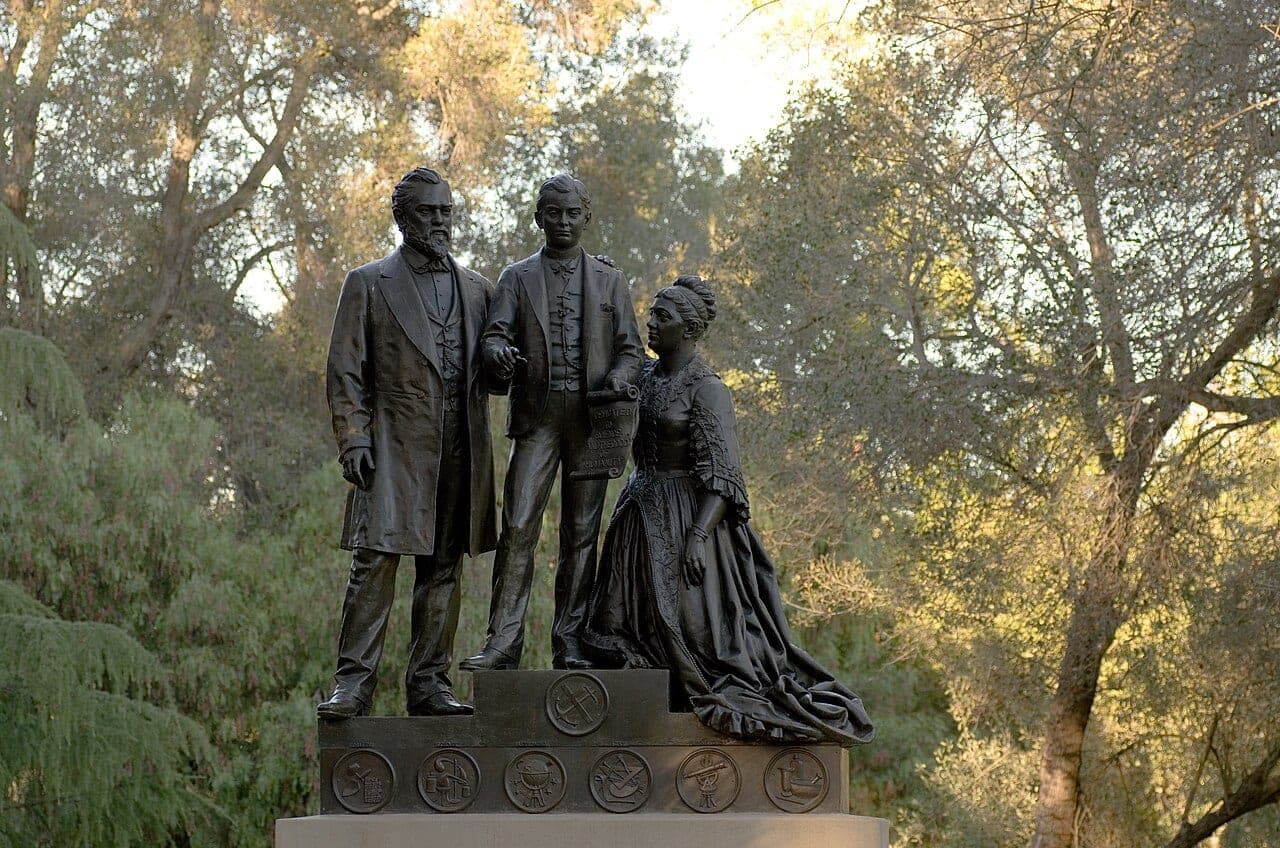
Stanford University, formally Leland Stanford Junior University, is a private research university on an 8,180-acre campus in Stanford, California, about 35 miles south of San Francisco. Leland and Jane Stanford founded it in 1885 in memory of their only child, Leland Stanford Jr., who had died the year before, and the first students arrived in 1891 (Britannica). Over the following century the university grew from a grief-struck memorial into one of the most influential centres of research and teaching in the United States, and its faculty and graduates did more than those of any other institution to create the technology industry now known as Silicon Valley.
Leland Stanford made his fortune as a railroad builder and served as governor of California and later a United States senator. In March 1884, while the family was travelling in Europe, his fifteen-year-old son died of typhoid fever in Florence, Italy. The Stanfords resolved to build a university in his name so that, as Jane Stanford put it, the children of California would become their children. On 11 November 1885 they signed the founding grant, endowing the new institution with a large fortune and land that included the family's Palo Alto stock farm, the source of the campus nickname still in use today, the Farm (Wikipedia).
The university opened on 1 October 1891 as a coeducational and nondenominational institution, both unusual choices for the era, with David Starr Jordan, a naturalist recruited from Indiana University, as its first president. The early years were precarious. Leland Stanford died in 1893, and his estate was frozen by a federal lawsuit seeking repayment of railroad debts. For several years Jane Stanford kept the university open largely on her own resources, at one point meeting the payroll from her household budget, until the courts released the estate in 1896.
Disaster struck again on 18 April 1906, when the great San Francisco earthquake tore through the young campus. The newly completed library and gymnasium were wrecked, Memorial Church lost its spire, and the Memorial Arch at the entrance to the quadrangle was ruined; two people, a student and a staff member, were killed (Stanford Quake '06). President Jordan ordered that classes resume, and the surviving inner quadrangle was repaired, but the losses set the university back for the better part of a decade.
The heart of the campus is the Main Quadrangle, a group of low sandstone buildings joined by arched arcades in a Romanesque style adapted to California, laid out with advice from the landscape architect Frederick Law Olmsted. At its centre is Memorial Church, commissioned by Jane Stanford and completed in 1903, its façade faced in mosaic. Nearby, the 285-foot Hoover Tower, built for the university's fiftieth anniversary in 1941, remains the tallest structure on campus and houses the archives of the Hoover Institution (Britannica).
 Jane Stanford built the church for her husband and set it at the centre of the quadrangle rather than at its edge. The 1906 earthquake brought down the spire, and it was never replaced. Photograph by Frank Schulenburg, CC BY-SA 4.0, via Wikimedia Commons.
Stanford is organised into seven schools, covering humanities and sciences, engineering, medicine, law, business, education, and sustainability. It ranks consistently among the leading universities in the world for research across the sciences, engineering, medicine, and the social sciences, and its graduate schools of business, law, and engineering are especially prominent. The campus also holds major cultural and scientific resources, among them the Cantor Arts Center and the SLAC National Accelerator Laboratory, a particle-physics facility that Stanford operates for the U.S. Department of Energy.
Stanford's part in the birth of Silicon Valley is closely tied to Frederick Terman, an engineering professor and later provost who urged his students to found companies near the university rather than leave for the industrial east. In 1939 two of them, William Hewlett and David Packard, started an electronics business in a rented Palo Alto garage with $538 of pooled capital; Hewlett-Packard became one of the defining firms of the region (HPE history). In 1951 the university opened the Stanford Industrial Park, later the Stanford Research Park, leasing land to technology companies and creating one of the first partnerships of its kind between a university and industry.
That model of close ties between academic research, venture funding, and new companies helped turn the orchards south of San Francisco into the densest concentration of technology firms in the world. Stanford faculty and alumni went on to found or co-found companies including Google, Yahoo, Cisco, and Sun Microsystems, and the licensing of university research has generated substantial income. The relationship has drawn criticism as well as praise: some observers argue that a focus on commercial spin-offs can pull a university toward near-term applications and away from open, disinterested inquiry, and the wealth it helped create has reshaped the surrounding region in ways that remain contested.
Stanford today enrols roughly 17,000 students, divided between undergraduate and graduate programmes, and employs a faculty that has included dozens of Nobel laureates and other major prizewinners (Stanford). Admission is among the most competitive in the country. The endowment, valued at around $40 billion, is one of the largest of any institution of higher education and funds extensive financial aid, research, and construction. The university continues to be a major force in fields from artificial intelligence and biomedicine to climate and energy, the last now anchored by the Doerr School of Sustainability, founded in 2022 as its first new school in more than seventy years.
The campus is open to visitors year-round and free to enter. Its landmarks include the Main Quadrangle and Memorial Church, the Cantor Arts Center and its adjacent Rodin sculpture garden, and Hoover Tower, whose observation deck gives views across the Santa Clara Valley when open. Walking and cycling are the usual ways to cover the large site, and the university runs free shuttle buses; the town of Palo Alto lies immediately to the north, and San Francisco and San José are both within easy reach by road or rail. Because hours, tours, and access change through the academic year, it is worth checking the official website before travelling.
Jane Stanford built the church for her husband and set it at the centre of the quadrangle rather than at its edge. The 1906 earthquake brought down the spire, and it was never replaced. Photograph by Frank Schulenburg, CC BY-SA 4.0, via Wikimedia Commons.
Stanford is organised into seven schools, covering humanities and sciences, engineering, medicine, law, business, education, and sustainability. It ranks consistently among the leading universities in the world for research across the sciences, engineering, medicine, and the social sciences, and its graduate schools of business, law, and engineering are especially prominent. The campus also holds major cultural and scientific resources, among them the Cantor Arts Center and the SLAC National Accelerator Laboratory, a particle-physics facility that Stanford operates for the U.S. Department of Energy.
Stanford's part in the birth of Silicon Valley is closely tied to Frederick Terman, an engineering professor and later provost who urged his students to found companies near the university rather than leave for the industrial east. In 1939 two of them, William Hewlett and David Packard, started an electronics business in a rented Palo Alto garage with $538 of pooled capital; Hewlett-Packard became one of the defining firms of the region (HPE history). In 1951 the university opened the Stanford Industrial Park, later the Stanford Research Park, leasing land to technology companies and creating one of the first partnerships of its kind between a university and industry.
That model of close ties between academic research, venture funding, and new companies helped turn the orchards south of San Francisco into the densest concentration of technology firms in the world. Stanford faculty and alumni went on to found or co-found companies including Google, Yahoo, Cisco, and Sun Microsystems, and the licensing of university research has generated substantial income. The relationship has drawn criticism as well as praise: some observers argue that a focus on commercial spin-offs can pull a university toward near-term applications and away from open, disinterested inquiry, and the wealth it helped create has reshaped the surrounding region in ways that remain contested.
Stanford today enrols roughly 17,000 students, divided between undergraduate and graduate programmes, and employs a faculty that has included dozens of Nobel laureates and other major prizewinners (Stanford). Admission is among the most competitive in the country. The endowment, valued at around $40 billion, is one of the largest of any institution of higher education and funds extensive financial aid, research, and construction. The university continues to be a major force in fields from artificial intelligence and biomedicine to climate and energy, the last now anchored by the Doerr School of Sustainability, founded in 2022 as its first new school in more than seventy years.
The campus is open to visitors year-round and free to enter. Its landmarks include the Main Quadrangle and Memorial Church, the Cantor Arts Center and its adjacent Rodin sculpture garden, and Hoover Tower, whose observation deck gives views across the Santa Clara Valley when open. Walking and cycling are the usual ways to cover the large site, and the university runs free shuttle buses; the town of Palo Alto lies immediately to the north, and San Francisco and San José are both within easy reach by road or rail. Because hours, tours, and access change through the academic year, it is worth checking the official website before travelling.
History
Campus and academics
Silicon Valley
Stanford today
Visiting
References and resources
- Encyclopaedia Britannica: Stanford University: overview of the university's founding, history, and academic profile.
- Stanford University, official site: admissions, schools, research, and visitor information.
- Wikipedia: Stanford University: detailed history, campus, and sourced facts on founding and finances.
- Stanford University and the 1906 Earthquake: the university's account of the earthquake damage and recovery.
- HPE: company history: the founding of Hewlett-Packard by Stanford graduates William Hewlett and David Packard.