Heritage · University
Australian National University: History and Overview
Founded in 1946 by an Act of federal parliament, the Australian National University in Canberra is the only Australian university created by the national legislature. It began as a research-only institution built to bring the country's scholars home, and it has kept the nation's biographical record, the Australian Dictionary of Biography, since 1957.Written to last.
By Confinity Heritage Editorial · 2026-08-24 · 8-minute readQuiet tools, kept out of the way.
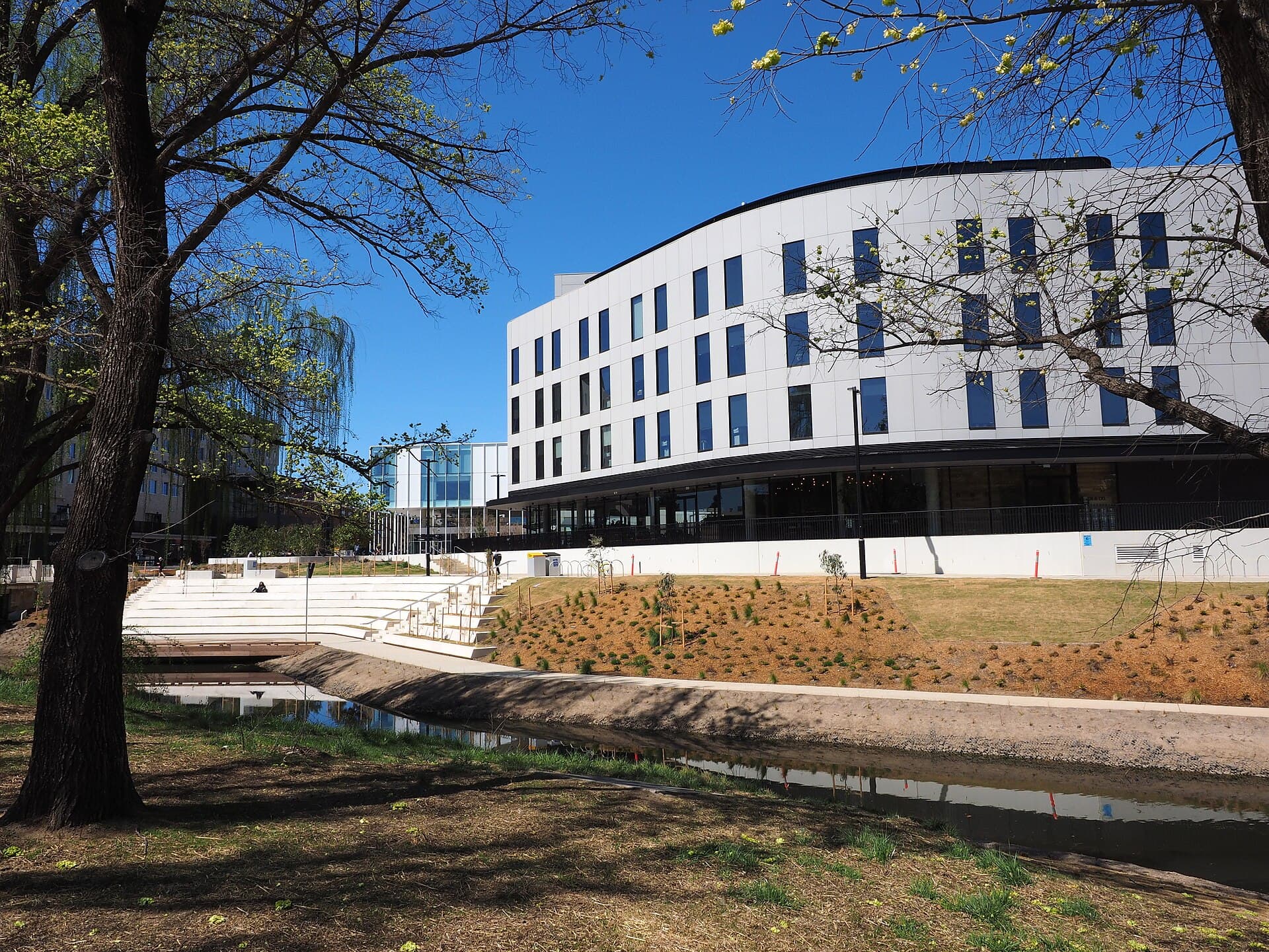
The Australian National University stands in Canberra, the planned capital of Australia, on a campus threaded by Sullivans Creek a short walk from Lake Burley Griffin. It is the only university in the country created by the national legislature: the Australian National University Act of 1946 was passed by the federal parliament in the first year after the Second World War, and the institution it established was conceived as a piece of nation building, a research university for a country that had been sending its best scholars abroad for want of anywhere to keep them.
For an archive concerned with memory, ANU holds an unusual office. Since 1957 it has produced the Australian Dictionary of Biography, the country's record of its own people, a project that has now set down more than thirteen thousand lives. Its observatory on Mount Stromlo watched the southern sky for nearly eighty years, burned in a single afternoon in 2003, and was rebuilt. A university barely into its ninth decade has already accumulated a history of keeping, losing and restoring records, and this page sets that history down plainly.
Australia entered the twentieth century with universities in each state capital, teaching institutions on the British model, but nothing national and little organised research. Ambitious graduates left for Oxford, Cambridge and London, and most did not return. The government of Ben Chifley answered this after the war: the Act of 1946 created a university in the capital devoted, at first, entirely to postgraduate research, organised around four founding research schools covering physical sciences, medical research, social sciences and Pacific studies. The medical school was named for John Curtin, the wartime prime minister who had died in office the year before.
The founders' method was to recruit the most distinguished Australian scholars then working overseas and ask them to come home and build the place. Four expatriates were engaged as academic advisers: the pathologist Howard Florey, who had shared the 1945 Nobel Prize for the development of penicillin, the physicist Mark Oliphant, the historian Keith Hancock and the anthropologist Raymond Firth. Their answers traced the difficulty of the whole enterprise. Oliphant returned, taking up the direction of the Research School of Physical Sciences in 1950. Florey advised closely but remained at Oxford, though the connection held: he later served as the university's chancellor. Hancock came back in 1957 to lead the social sciences school. The university they shaped was, for its first years, a rare thing anywhere in the world, a university with no undergraduates at all.
That changed in 1960, when ANU merged with Canberra University College, the capital's undergraduate college, which since 1930 had taught local students for degrees awarded by the University of Melbourne. The merger brought undergraduate teaching into the national university as its School of General Studies, and the institution assumed the double character it still has: an intensive research establishment joined to a teaching university, both serving a city that was itself still being built.
The campus occupies the suburb of Acton, between the city centre and the lake, with Black Mountain rising behind it. Sullivans Creek runs through the grounds on its way to Lake Burley Griffin, and the university has grown up along both banks in the loose, green manner of the planned capital, with eucalypts between the buildings. On the western edge it meets the city at the precinct known as City West, where Canberra's commercial centre and its academic quarter run into one another.
The heart of the modern campus is Kambri, a precinct of teaching buildings, student residences, a cultural centre and open ground beside the creek, opened in 2019 on the site of the old union court. The name was gifted by local Aboriginal communities and refers to the crossing place on the creek; the choice records the far older history of the Acton land, which lies within the country of the Ngunnawal and Ngambri peoples. Nearby on Acton Peninsula, adjacent to the campus, stands the Australian Institute of Aboriginal and Torres Strait Islander Studies, a separate national institution whose collections of Indigenous language, story and film sit within walking distance of the university's own long tradition of research in Aboriginal history, linguistics and archaeology.
Academically the university spans seven colleges covering the sciences, health and medicine, engineering and computing, law, business and economics, arts and social sciences, and Asia and the Pacific. Around twenty thousand students study there. The research schools created in 1946 survive inside this structure, and the university's special obligation to national policy runs through the Crawford School of Public Policy, which trains public servants and economists across the lake from the parliament whose Act created the university.
Two of the university's possessions belong as much to the nation as to the campus. The first is the Australian Dictionary of Biography, begun at ANU in 1957 and published from 1966, a cooperative national project that commissions concise, researched lives of significant and representative Australians. More than thirteen thousand articles have been written by several thousand contributing authors, covering politicians and painters, shearers and scientists, and the whole record is freely available online. It is the standard reference for Australian lives, and it makes ANU something few universities are: the institution formally charged with writing a nation's biography, one person at a time.
The second is Mount Stromlo Observatory, on a wooded summit west of the city. Established as a Commonwealth solar observatory in 1924 and transferred to the university in 1957, Stromlo became the working home of Australian optical astronomy. On 18 January 2003 a firestorm swept out of the drought-stricken ranges into Canberra's western suburbs, and Stromlo stood in its path. The fires destroyed five telescopes, the workshops, the heritage dome buildings and much of the library in a single afternoon. The university rebuilt the mountain not as a museum but as a working institution, the headquarters of its Research School of Astronomy and Astrophysics and a centre for advanced instrumentation and space technology, while its dark-sky observing moved to the university's telescopes at Siding Spring in northern New South Wales. The ruins of the old domes remain on the summit, kept as they are.
The university counts six Nobel laureates among its staff and alumni. John Eccles, foundation professor at the John Curtin School of Medical Research, shared the 1963 Nobel Prize in Physiology or Medicine for uncovering the ionic mechanisms by which nerve cells pass signals across the synapse, the basic grammar of how neurons speak to one another. In the same school in the mid-1970s, Peter Doherty and Rolf Zinkernagel worked out how killer T cells recognise virus-infected cells, a discovery about the immune system's sense of self that brought them the 1996 prize. Howard Florey's penicillin prize predated the university he helped design, and the economist John Harsanyi, a graduate, shared the 1994 prize for his work on game theory.
The most recent laureate came from the mountain. Working at Mount Stromlo, the astronomer Brian Schmidt led the High-z Supernova Search Team whose measurements of distant exploding stars showed that the expansion of the universe is accelerating, a result so unexpected that it forced dark energy into the standard model of cosmology. Schmidt shared the 2011 Nobel Prize in Physics and later served as the university's vice-chancellor. Beyond the laureates, ANU's record runs from the historian Manning Clark, whose six-volume history of Australia was written there, to generations of Pacific and Asian studies scholars who shaped how the country understands its region. The university also keeps the Noel Butlin Archives Centre, the country's principal collection of business and labour records, where the papers of trade unions and companies preserve the working lives that formal history tends to pass over.
ANU is consistently ranked first or near the top among Australian universities and stands high in the international league tables. Its national role remains written into its character: it hosts public lectures and policy debate for the capital, and its researchers advise governments across the lake. The university continues to invest in astronomy, quantum science, medical research and the study of Asia and the Pacific, fields where its founding schools gave it a long head start.
The campus is open, and visitors can walk the grounds freely, following Sullivans Creek through Kambri toward the lake. The ANU Drill Hall Gallery shows the university's art collection. Mount Stromlo Observatory, about a twenty-minute drive west of the city, is open to the public during the day, with views over the Brindabella Ranges, the rebuilt research precinct and the preserved ruins of the burned domes. The Australian Dictionary of Biography can be read by anyone, anywhere, at its website, which is perhaps the most fitting way to visit a university whose defining work is the keeping of lives.
History
Campus and academics
The Dictionary and the Observatory
Scholarship
The university today
Visiting
References and resources
- Australian National University: Our history (official)
- Australian Dictionary of Biography (official)
- ANU Research School of Astronomy and Astrophysics: Mount Stromlo Observatory (official)
- ANU Archives: Noel Butlin Archives Centre (official)
- Britannica: Australian National University
- Wikipedia: Australian National University