Heritage · University
London School of Economics: History and Overview
Founded in 1895 by Fabian Society members Sidney and Beatrice Webb, Graham Wallas and George Bernard Shaw, the London School of Economics and Political Science set out to study society scientifically for its betterment. Its compact Clare Market campus holds the world's largest social science library, and its staff and alumni have shaped economics, anthropology, social policy and international relations for over a century.Written to last.
By Confinity Heritage Editorial · 2026-08-23 · 8-minute readQuiet tools, kept out of the way.
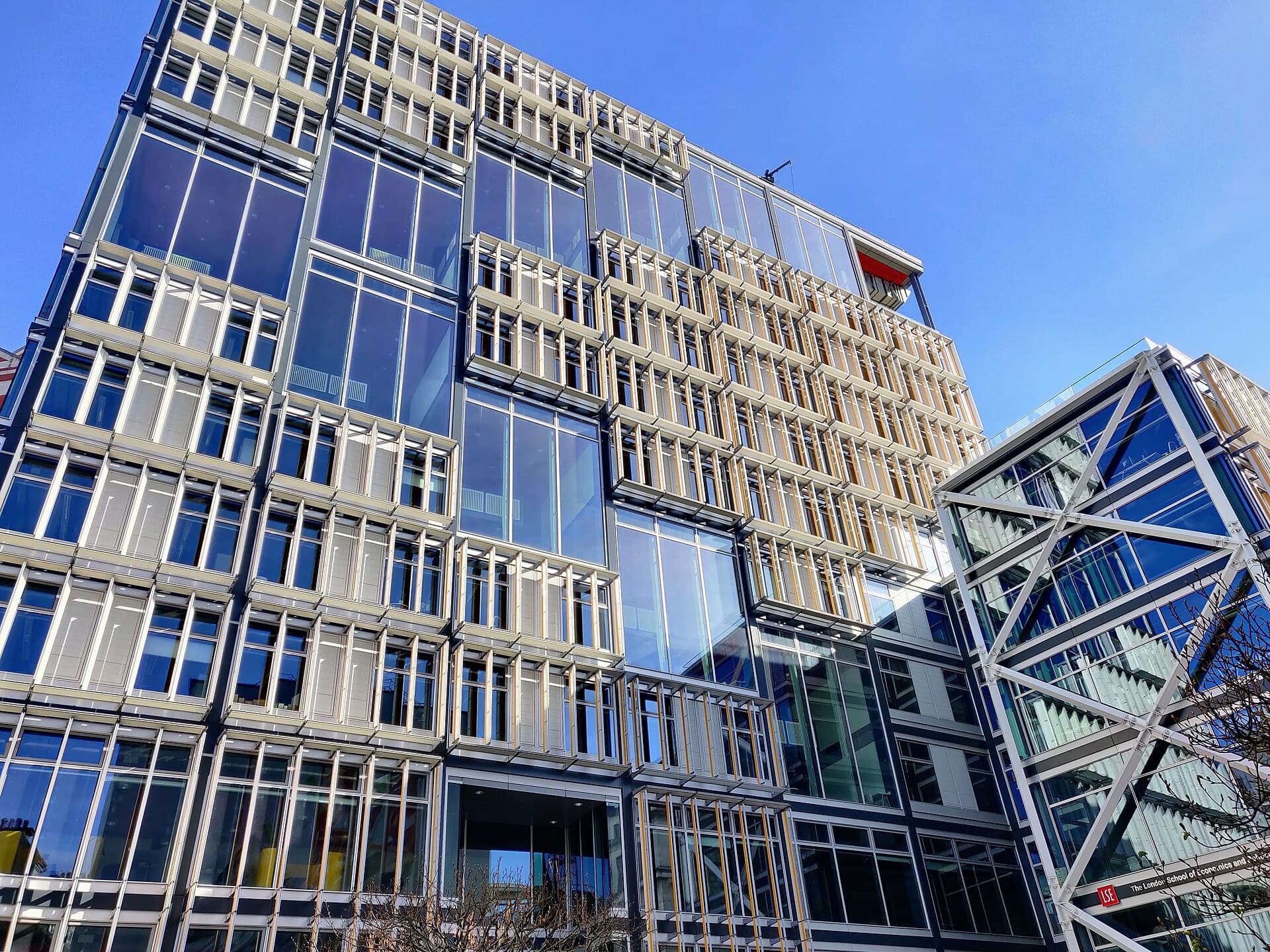
The London School of Economics and Political Science, known almost everywhere simply as LSE, was founded in 1895 to study society with the same discipline that other institutions brought to the natural world. Its founders were four members of the Fabian Society: Sidney and Beatrice Webb, the political scientist Graham Wallas, and the playwright George Bernard Shaw. They believed that poverty, work, law and government could be understood through patient research, and that a society which understood its own workings could set about improving them. The school they started now fills a few dense city blocks around Houghton Street and Clare Market in the centre of London, and it has become the most influential specialist social science university in the United Kingdom.
The school's motto, rerum cognoscere causas, is taken from Virgil's Georgics and means to know the causes of things; its mascot is the beaver, chosen for its industry and quiet persistence. Both were adopted in 1922, and together they describe the institution well. LSE's library, the British Library of Political and Economic Science, is the largest library in the world devoted to the social sciences, and it keeps the working papers of the school's founders, the archives of the Fabian Society, and Charles Booth's street by street maps of London poverty. The school did not only argue for social reform; it kept the data.
The money that made the school possible came from a bequest. Henry Hunt Hutchinson, a solicitor from Derby and a member of the Fabian Society, died in 1894 and left the society around twenty thousand pounds to be used for its purposes. Sidney Webb, who chaired the trust, persuaded his fellow trustees that the most valuable use of the gift would be a school for the scientific study of society, on the model of the great European schools of political science. The London School of Economics and Political Science held its first classes in October 1895 in rented rooms at 9 John Street in the Adelphi, with the economic historian W. A. S. Hewins as its first director.
Growth came quickly. In 1900 the school joined the federal University of London as its Faculty of Economics, and its first degrees in economics were taught from the following year. In 1902 it moved to a purpose-built home, Passmore Edwards Hall, on the old Clare Market site off Aldwych where it has remained ever since. King George V laid the foundation stone of the Old Building in 1920, and its entrance on Houghton Street has been a London landmark since the building opened in 1922, the same year the school took its coat of arms, its motto and its beaver.
The Webbs never treated the school as their only instrument. In 1913 they founded the New Statesman, and their research on the Poor Law and on trade unionism fed directly into the argument for a welfare state. That argument reached its full force through William Beveridge, who served as the school's director from 1919 to 1937 and built it into a leading centre of the social sciences. In 1942 his report, Social Insurance and Allied Services, set out the plan for national insurance and a national health service that the post-war governments carried into law. The school's later history has had its turbulence, most visibly in the student unrest of 1968 and 1969 that closed the gates on Houghton Street for weeks, but its purpose has stayed remarkably close to the one the Webbs wrote down.
LSE is a city campus in the fullest sense. Its buildings stand shoulder to shoulder around Houghton Street, a short pedestrian street between Aldwych and Lincoln's Inn Fields, on ground once occupied by the food stalls of Clare Market. There are no lawns and no quadrangles; the campus works instead as a piece of dense London, threaded with lanes and bridges. Recent decades have added architecture of real ambition: the angular brick Saw Swee Hock Student Centre opened in 2014, the Centre Building by Rogers Stirk Harbour + Partners in 2019, and the Marshall Building by Grafton Architects on Lincoln's Inn Fields in 2022.
The school teaches only the social sciences, and nearly all of them. Its departments cover economics, government, law, sociology, social policy, anthropology, international relations, international history, geography, philosophy, statistics, management and finance, taught to around 13,000 students of whom a large majority come from outside the United Kingdom, drawn from more than 140 countries. Its public lecture programme, running most evenings in term, has for decades given London a free platform where economists, heads of government and public thinkers test their arguments before a general audience.
The school's library was founded in 1896, within a year of the first classes, and it has grown into the largest library in the world devoted to the social sciences. Since 1978 it has occupied the Lionel Robbins Building on Portugal Street, reworked in 2001 by Norman Foster around a spiral staircase that climbs the full height of the building.
Its archives make it a memory institution of the first rank. The library keeps the personal papers of Sidney and Beatrice Webb, the archives of the Fabian Society, and the papers of Beveridge himself, so that the records of the people who founded the school and argued the welfare state into existence sit a few floors above the students reading about them. It also holds the notebooks and maps of Charles Booth's inquiry into life and labour in London, conducted between 1886 and 1903, whose hand-coloured streets, graded from wealth to poverty, remain among the most vivid documents of the Victorian city. The school that was founded to gather evidence about society became the place where the evidence itself is kept.
For much of the twentieth century, LSE was one pole of the central argument in economics. Friedrich Hayek joined the school in 1931 and, with Lionel Robbins, made it the counterweight to John Maynard Keynes's Cambridge; the debates between the two schools over money, capital and the causes of depression shaped the discipline for a generation. Robbins's 1932 essay gave economics its most quoted modern definition, the study of human behaviour as a relationship between ends and scarce means which have alternative uses. Ronald Coase, whose thinking about the nature of the firm began while he was an LSE student, and Amartya Sen, who taught at the school in the 1970s, are among the economists associated with LSE who went on to win the Nobel Prize; close to twenty laureates have studied or taught there, a list that begins with Shaw himself, who took the literature prize in 1925.
The school's influence runs well beyond economics. It housed the first sociology teaching in Britain, from 1904, and built social policy into an academic field. In anthropology, Bronislaw Malinowski's seminar at the school between the wars trained a generation of fieldworkers, among them Raymond Firth and Jomo Kenyatta, whose study Facing Mount Kenya grew out of his LSE research. The Department of International Relations, founded in 1927, is among the oldest anywhere and helped establish the subject as a discipline in its own right.
Its alumni carried that training into government on every continent. B. R. Ambedkar, who earned a doctorate at the school in the 1920s, went on to steer the drafting of India's constitution, and dozens of past or present heads of state or government have studied or taught at LSE.
LSE remains what its founders made it: a specialist university given over entirely to the social sciences, consistently ranked among the leading institutions in the world for those subjects. It is a member institution of the University of London, and its research reaches from inequality and cities to health, climate policy and finance, much of it feeding directly into the advice governments and international bodies act on. The campus keeps changing around the Old Building, but Houghton Street is still the school's spine, and the beaver still presides over its crest.
The campus sits between Covent Garden and Temple, a few minutes on foot from Holborn and Temple Underground stations, and its streets are open to walk through. The main entrance of the Old Building on Houghton Street and the newer showpieces around it can be seen from the street at any time. LSE Library mounts free public exhibitions drawn from its collections, including material from the Booth and Fabian archives, and the school's evening public lectures are open to all, with the most popular ticketed in advance. Teaching rooms are for students and staff; the library's spiral, the Saw Swee Hock building and the Lincoln's Inn Fields side are what a visitor can see.