Heritage · University
Indian Institute of Science: History and Overview
Endowed by the industrialist Jamsetji Tata in the 1890s and opened in Bangalore in 1909, five years after his death, the Indian Institute of Science became the seedbed of modern Indian research. C. V. Raman, Homi Bhabha, Vikram Sarabhai and Satish Dhawan all worked on its wooded campus, and India's atomic and space programmes trace their beginnings to it.Written to last.
By Confinity Heritage Editorial · 2026-08-24 · 8-minute readQuiet tools, kept out of the way.
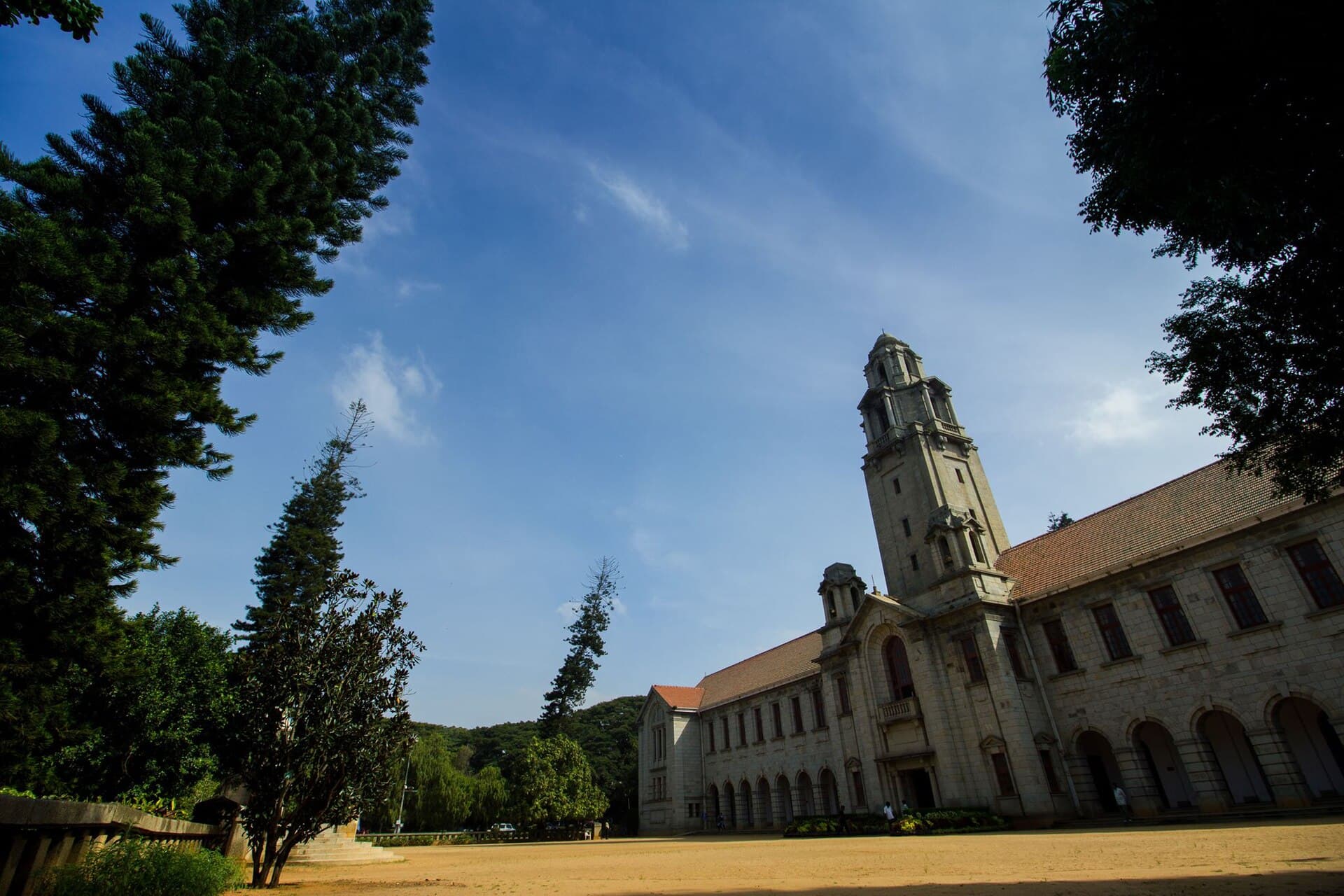
The Indian Institute of Science occupies more than four hundred acres of trees in the northern half of Bengaluru, a canopy of green so dense that the city built around it seems to pause at its gates. It is India's oldest dedicated research institute and, by most measures, its most distinguished: in the national rankings it sits routinely at the top, and the laboratories that grew from its campus include the country's atomic energy establishment, its space programme and much of the aerospace industry that made Bangalore a technology city.
Locals still call it the Tata Institute, and the name records its origin. The institute was conceived, argued for and paid for by the industrialist Jamsetji Nusserwanji Tata, who set aside a large share of his personal fortune to endow it in the 1890s and then died in 1904, five years before the first order constituting the institute was signed. He chose no building, saw no student and attended no opening. The place exists because a man decided that a country he would not live to see needed it.
Jamsetji Tata began pressing the idea of a postgraduate research institution for India in the early 1890s, at a time when the country had universities that examined students but almost nowhere that trained them to investigate. In 1898 he formed a provisional committee under his aide Burjorji Padshah to draw up a scheme, and he pledged an endowment drawn from his own property in Bombay, a gift often described as amounting to half his wealth.
A famous story attaches to the plan's beginnings. In 1893 Tata and the monk Swami Vivekananda sailed on the same ship from Yokohama across the Pacific, Tata on business and Vivekananda on his way to the World's Parliament of Religions in Chicago. Five years later Tata wrote to Vivekananda recalling their shipboard conversations and asking him to champion the proposed research institute, a letter that survives, and Vivekananda's journal published a warm endorsement of the scheme. The more romantic version, in which the two men sketched the institute together at sea, is probably embellishment; the voyage is documented, the letter is documented, and the rest is tradition.
The scheme moved slowly. The colonial government under Lord Curzon was sceptical of its scale, and the chemist William Ramsay, brought out to advise in 1900, recommended Bangalore as the best site. The ruling house of Mysore made the decisive gift: the Maharaja's government donated over three hundred and seventy acres of land in Bangalore along with funds for the new foundation. Tata died in May 1904 with the negotiations still unfinished. His sons carried the endowment through, and on 27 May 1909 the government signed the vesting order that brought the Indian Institute of Science into being. The English chemist Morris Travers, a co-discoverer of neon, became its first director, and the first students arrived in 1911 to departments of general and applied chemistry and electrical technology.
The institute grew through the twentieth century from those two departments into a full scientific establishment, was recognised as a deemed university in 1958, and in 2018 was among the first institutions named under India's Institution of Eminence scheme.
The heart of the campus is the Main Building, a long range of grey granite whose central tower has become the institute's emblem. In front of it stands the memorial statue of Jamsetji Tata, the founder facing the building he never saw, and the avenue that leads to it is lined with flowering trees. The campus as a whole is one of the great green spaces of Bengaluru: gulmohar, jacaranda and rain trees shade its roads, and generations of students have marked the seasons by which avenue is in bloom. Within the grounds are more than forty departments and centres, hostels, a nursery school and a working village of laboratories, so that the institute functions as a small town of research inside the larger city.
Academically the institute is organised into divisions spanning the physical and mathematical sciences, biological sciences, chemical sciences, electrical sciences, mechanical sciences and interdisciplinary research. For most of its history it admitted only postgraduate and doctoral students, which kept it small and unusually senior in character. That changed in 2011, when it began a four-year Bachelor of Science (Research) programme, its first undergraduate degree. Even now the community numbers only a few thousand students, most of them research scholars, supervised by a faculty of several hundred.
Jamsetji Tata's bequest is among the clearest examples anywhere of a legacy outliving its author by design. He funded the institute knowing it might not open in his lifetime, and it did not; the gap between his death in 1904 and the first classes in 1911 meant that the founder and the founded never once shared a year. What he left was not a building but an instruction, and the institutions that grew from it form a remarkable roll.
Homi Bhabha spent the war years at the institute, stranded in India in 1939 and taken into the physics department, where he ran a cosmic ray research unit. In March 1944, writing from Bangalore, he sent the Sir Dorabji Tata Trust a proposal for a school of fundamental physics research; the trust agreed, the Tata Institute of Fundamental Research opened in 1945, and Bhabha went on to lead India's atomic energy programme. Vikram Sarabhai, who came to the institute in 1940 and studied cosmic rays under C. V. Raman's supervision, later founded the Physical Research Laboratory and became the architect of India's space programme. Satish Dhawan closed the circle: appointed director of the institute in 1962, he agreed in 1972 to chair the Indian Space Research Organisation on the condition that he could keep his Bangalore post, and for nearly a decade he ran the national space programme from a campus office while still serving as the institute's director. Around the campus, the city itself changed. Hindustan Aeronautics, the National Aerospace Laboratories, defence research establishments and eventually the software industry all rooted themselves in Bangalore, drawing on the pool of trained people the institute produced.
The institute's most celebrated scientist arrived in 1933, when C. V. Raman left his chair at the University of Calcutta to become the institute's first Indian director, three years after winning the Nobel Prize in Physics for the scattering effect that bears his name. His directorship was brief and turbulent; disagreements over his priorities for the institute led him to step down in 1937, though he stayed on as professor of physics until 1948 and then founded the Raman Research Institute a few miles away. The episode is remembered fairly as both things at once, a difficult administration and the moment the institute passed into Indian scientific leadership.
Other names on the roll include G. N. Ramachandran, who trained at the institute in the 1940s during the Raman era and later, at Madras, devised the Ramachandran plot that structural biologists still use to map protein conformations. The bridge-builder and statesman M. Visvesvaraya served on the institute's council, the wartime cosmic ray group produced a generation of physicists, and in recent decades the faculty has ranged from solid-state chemistry under C. N. R. Rao to climate science, neuroscience and quantum technology.
The institute is consistently ranked first among Indian research universities in the government's National Institutional Ranking Framework and stands at or near the top of the international tables for institutions from India. Its work now spans a second campus at Challakere in central Karnataka, a growing medical school initiative, and deep-technology startups incubated at the edge of the old campus. The undergraduate programme begun in 2011 has settled into the institute's rhythm, adding a few hundred young students to a community still dominated by doctoral research. Through all of it the Tata endowment's original design persists: a council, a director, and a mandate to do original work in the sciences for the country's benefit.
The campus lies in north Bengaluru between Malleswaram and Yeshwanthpur, and it is a working research institution rather than a tourist site; entry is through staffed gates, and visitors should check current access rules on the institute's website before arriving. The Main Building, the Tata statue and the avenues near them are the historic core, and the institute periodically opens the campus to the public for its Open Day, when laboratories put on demonstrations and the grounds fill with schoolchildren. Those who cannot enter can still walk the perimeter roads, where the tree canopy of the institute shades the pavement, a border between the founder's quiet campus and the loud city his endowment helped build.