Heritage · University
Central University of Venezuela: History and the Ciudad Universitaria
Venezuela's oldest and largest university traces its charter to a royal decree of 1721 and its republican refounding to statutes issued by Simón Bolívar in 1827. Its Caracas campus, built to the design of Carlos Raúl Villanueva between the 1940s and the 1960s, carries 108 works of art inside its architecture and has been a UNESCO World Heritage Site since 2000.Written to last.
By Confinity Heritage Editorial · 2026-08-25 · 8-minute readQuiet tools, kept out of the way.
The Central University of Venezuela, the UCV, is the oldest and largest university in Venezuela. Its lineage runs back to a royal charter of the 1720s that raised a Caracas seminary into the Royal and Pontifical University of Caracas. Its present character was fixed much later, in the two decades after 1940, when the republic built it a new campus in the south of the capital and handed the design of the whole of it to one architect.
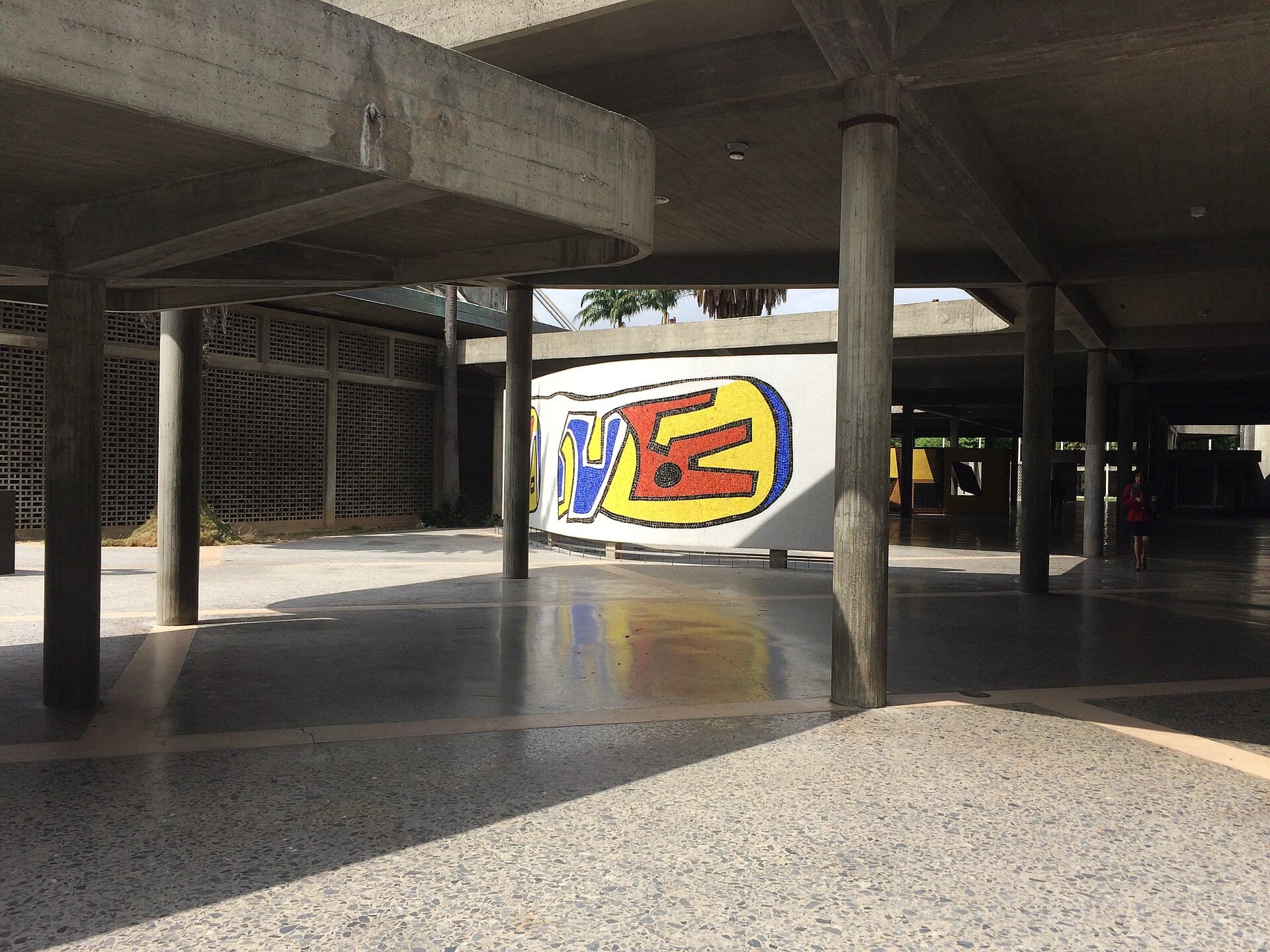
That campus, the Ciudad Universitaria de Caracas, has been a UNESCO World Heritage Site since 2000, and an unusual object for an archive to consider. Carlos Raúl Villanueva conceived it as a synthesis of the arts, commissioning painters and sculptors to work their pieces into the concrete rather than hang them on it. The record of a confident moment in Venezuelan life is therefore not kept inside the buildings but is the buildings, which means that conserving the architecture and conserving the art are one job.
The institution began as the Colegio Seminario de Santa Rosa de Lima, founded in Caracas in 1673 to train clergy. Half a century later the Crown gave it university rank: Philip V signed the decree on 22 December 1721 and Pope Innocent XIII confirmed it by apostolic bull in 1722, from which the Real y Pontificia Universidad de Caracas took its double name. For a century it taught in Latin on the scholastic model, with faculties of theology, canon law, medicine and the arts, and entry restricted by the racial and religious tests of the colonial order.
Independence dissolved that order. In May 1827 the physician José María Vargas was elected rector of what was now the Central University of Venezuela, and on 24 June, the sixth anniversary of Carabobo, Simón Bolívar issued the Republican Statutes drawn up with him. They secularised the institution, lifted the restrictions on who could enrol, ended the requirement to teach in Latin, and set the university's own bodies over its affairs. They also gave it an income: Bolívar endowed it with landed property, among it the cacao haciendas of Chuao and Cata, so that it would not depend on whatever government held Caracas. The endowment lasted until 1883, when Antonio Guzmán Blanco ordered the estates sold.
The twentieth century turned autonomy into the central argument of Venezuelan academic life. Students were arrested and the university closed under successive strongmen; the protest generation of 1928 came out of its lecture halls, and Rafael Caldera, a law graduate of 1939 and later twice president, was expelled and detained under Marcos Pérez Jiménez. When that dictatorship fell, the Law of Universities of 5 December 1958 wrote autonomy into statute and guaranteed teaching and research a protected space. The principle has been contested many times since, and it is still the argument any account of the UCV returns to.
The Ciudad Universitaria was laid out on the grounds of the Hacienda Ibarra, where building began in the early 1940s. The university records a campus of 89 buildings across 164 hectares of built area, holding nine of its eleven faculties along with research institutes, the university hospital, the Olympic Stadium and a botanical garden; the other two, agronomy and veterinary science, sit at Maracay in the state of Aragua. On an ordinary working day it carries a community of more than sixty thousand people.
Teaching runs from medicine and engineering to law, economics, humanities, sciences, dentistry, pharmacy and architecture, and the medical school is the country's oldest; the Hospital Universitario de Caracas, itself part of Villanueva's plan, is both a teaching hospital and a working one. The campus belongs beside the Ciudad Universitaria of the National Autonomous University of Mexico, the other Latin American modernist campus on the World Heritage List, though the two took different routes: Mexico wrapped its history around the outside of its buildings, Caracas threaded its art through the inside.
Villanueva, born in 1900 and trained at the École des Beaux-Arts in Paris, directed the project for close to twenty years through the Institute of the Ciudad Universitaria, an office of the Ministry of Public Works. His governing idea was the synthesis of the arts: architecture, painting and sculpture conceived together, so that a mural was a wall and a sculpture a threshold. He gathered some twenty-eight European and Venezuelan artists, with the painter Mateo Manaure coordinating them. Several hesitated to work for a country under military rule, and Fernand Léger is reported to have answered that "dictatorships pass but art remains".
The university's preservation council catalogues the result as the Colección Síntesis de las Artes, 108 works dating mostly from 1950 to 1957: murals, reliefs, sculptures and stained glass by Léger, Victor Vasarely, Jean Arp, Wifredo Lam, Henri Laurens, Alejandro Otero and Jesús Soto among them. The best known is Alexander Calder's acoustic ceiling in the Aula Magna, a hall of about 2,700 seats: thirty-one coloured panels of laminated wood in steel frames, hung from the ceiling and side walls and designed with the acoustic engineers Bolt, Beranek and Newman, so that the shapes floating above the audience are also what makes the room sound as it does. Caracas calls them the clouds, or the flying saucers. Binding it together is the Plaza Cubierta, a long indoor-outdoor run of ramps, perforated walls and open roof panels linking the library, the rectory, the concert hall and the Aula Magna, meant to be walked as an open museum.
UNESCO inscribed the campus in December 2000 under criteria (i) and (iv), calling it a masterpiece of modern city planning, architecture and art; the university notes it is the only twentieth-century campus designed by one architect to hold that status. The inscription is also frank about what threatens it, recording the decay of the reinforced concrete after fifty years, mosaic surfaces detaching from facades, technical installations added without control, a student population grown from six thousand to tens of thousands, and artwork monitoring that is difficult to finance. The World Monuments Fund placed it on its Watch list in 2010 and again in 2014. The property has not been inscribed on the List of World Heritage in Danger, and remains on the main list under the ordinary reporting cycle. Either way it shows the cost of the original idea: because the art is structural, none of it can be taken down and stored while the rest is repaired.
The medical tradition supplies the university's two best known figures. José Gregorio Hernández graduated in medicine at the UCV in 1888, studied in Paris and returned to teach the experimental sciences; venerated for a century as the physician of the poor, he was beatified in 2021 and canonised on 19 October 2025. Jacinto Convit took his doctorate there in 1938 and taught in the department of tropical medicine. From the mid-1970s, using bacilli from the nine-banded armadillo combined with the BCG vaccine, he developed an immunotherapy against leprosy that helped end the isolation of patients in leprosaria across the region. He won the Prince of Asturias Award for scientific and technical research in 1987, was nominated for the Nobel Prize in Physiology or Medicine the following year, and died in 2014 aged one hundred.
Beyond medicine, the Prussian-born naturalist Adolf Ernst organised the chair of natural history in 1874 and used it to introduce Darwin and Lamarck to Venezuelan science, founding the positivist school that shaped the country's intellectual life for a generation. The writer and statesman Arturo Uslar Pietri took his doctorate in political sciences there in 1929 and later held a chair in political economy. A long line of Venezuelan heads of state studied in its faculties of law and political science, which is one reason its independence has never been a purely academic question.
The UCV remains the country's oldest, largest and highest ranked university, and under considerable strain. Budgets have not kept pace with the economic collapse of the past decade, salaries have fallen sharply in real terms, staff and students have emigrated in numbers, and maintenance of the campus and its artworks has been repeatedly deferred. The university also went fourteen years without renewing its authorities: rectoral elections, last held in 2008, were run again in 2023, when Víctor Rago was chosen for the 2023-2027 term. Teaching, research and the council's conservation work have continued throughout.
The Ciudad Universitaria sits in the Los Chaguaramos district of Caracas and works as a public precinct as much as a campus, crossed daily by people with no university business. The Plaza Cubierta and the mural and sculpture programme can be seen on foot, and COPRED, the university's preservation council, maintains a visitors' service and arranges guided routes through the heritage areas; concerts still fill the Aula Magna beneath Calder's clouds, and the botanical garden is open separately. Anyone planning a visit should check current travel advice for Venezuela, arrange access in advance, and remember that this is a working university.