Heritage · University
EPFL: History and Overview
EPFL, the École Polytechnique Fédérale de Lausanne, began in 1853 as a private engineering school with eleven students in a Lausanne apartment and became a Swiss federal institute in 1969. Its lakeside campus holds the Rolex Learning Center, and its laboratories launched the Blue Brain Project, a decades-long attempt to reconstruct the circuitry of the brain in a computer.Written to last.
By Confinity Heritage Editorial · 2026-08-24 · 8-minute readQuiet tools, kept out of the way.
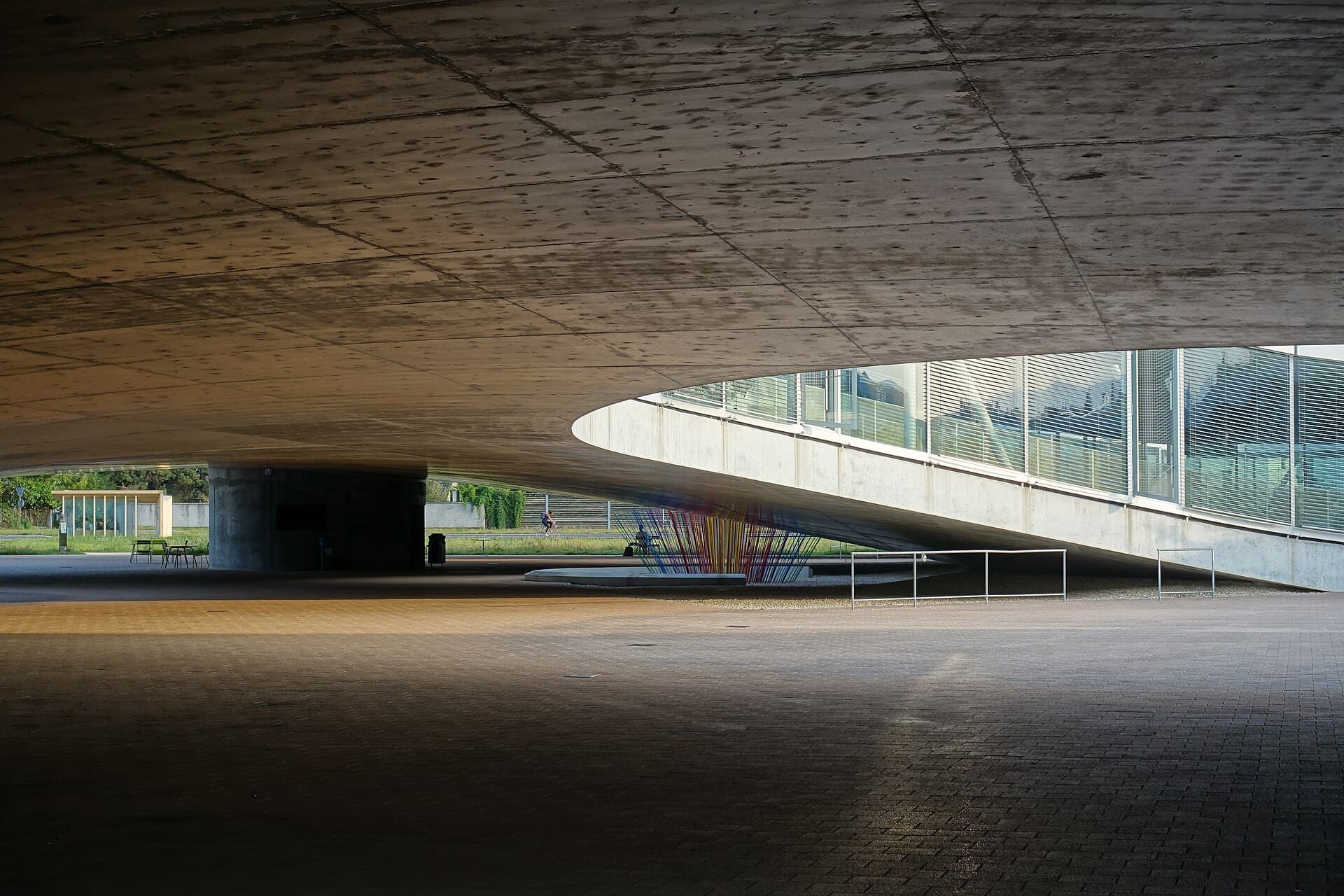
The École Polytechnique Fédérale de Lausanne, known everywhere by its initials EPFL, is one of the two federal institutes of technology in Switzerland. Its campus spreads along the north shore of Lake Geneva just west of Lausanne, a grid of laboratories and lecture halls facing the water and, on clear days, the peaks of the Alps across it. The institution that occupies this ground began at the opposite end of the scale imaginable for a national research university: a private school of eleven students, meeting in a Lausanne apartment in 1853.
The distance between those two facts, a rented flat and a lakeside campus of global standing, was covered in stages over a century and a half, and the last stage was the fastest. Since the 1990s EPFL has grown from a solid national engineering school into one of Europe's leading technical universities, recruiting worldwide and building, among much else, a laboratory that spent nearly two decades trying to reconstruct the living circuitry of the brain inside a computer.
The school was founded in 1853 as the École spéciale de Lausanne, a private venture modelled on the École Centrale in Paris. Its first cohort numbered eleven students, taught on the first floor of an apartment in the centre of Lausanne. In 1869 the young school was absorbed into the cantonal academy as its technical faculty, and when the Académie de Lausanne became the University of Lausanne in 1890, the engineering school went with it, eventually taking the name École polytechnique de l'Université de Lausanne, or EPUL, in 1946.
The decisive change came in 1969, when the Swiss Confederation separated the engineering school from the cantonal university and took it over as a federal institution. The move gave French-speaking Switzerland what German-speaking Switzerland had held since 1855: a national institute of technology, funded and governed at the federal level. EPFL thus became the younger and French-speaking sibling of ETH Zurich, and the two schools have formed the paired summit of Swiss technical education ever since, one teaching in German on the Limmat, one in French on Lake Geneva. At federalization EPFL counted around 1,400 students; in the 1970s it began moving out of central Lausanne to a new purpose-built campus at Écublens, near the lake at Dorigny, where it remains.
The modern transformation is closely associated with Patrick Aebischer, the neuroscientist who served as president from 2000 to 2016. Aebischer pushed the life sciences into the heart of an engineering school, founding a School of Life Sciences and arguing that biology had become an information discipline that engineers should treat as their own. He recruited aggressively from abroad, raised private funds on a scale unusual for continental Europe, and commissioned the signature buildings that changed the campus's face. During his tenure EPFL climbed steeply in the international rankings and roughly doubled in size, and the once regional school became a destination for students and faculty from more than a hundred countries.
The Écublens campus is a compact, walkable quarter of about 136 acres between the motorway and the lake, served by its own metro stops on the Lausanne line. Its best-known building is the Rolex Learning Center, opened in 2010 and designed by the Japanese practice SANAA, whose founders Kazuyo Sejima and Ryue Nishizawa received the Pritzker Prize the same year. The building is a single continuous room of roughly 20,000 square metres whose concrete floor rises and falls in gentle hills, with no interior walls of consequence and almost no stairs; students climb its slopes to reach the library, the study areas and the cafés, and the shell arches off the ground so that people walk beneath the building to enter it. It serves as the campus library and central gathering place, holding hundreds of thousands of volumes, and it has become the image of EPFL in the way a clock tower or a dome stands for older universities.
Nearby stands the SwissTech Convention Center, opened in 2014, a folded-roofed hall seating up to 3,000 that hosts scientific congresses and public events. One of its glass facades is itself a research statement: it incorporates coloured, semi-transparent dye-sensitized solar cells of the kind invented on this campus, turning a west-facing wall into a working solar generator.
Academically, EPFL is organised into schools covering basic sciences; engineering; computer and communication sciences; life sciences; architecture, civil and environmental engineering; and management of technology, together with a college of humanities. Teaching begins in French at bachelor level and shifts largely to English in the master's and doctoral programmes, a structure that has helped the student body become one of the most international in Europe.
In 2005 EPFL launched the Blue Brain Project, led by the neuroscientist Henry Markram and named for the IBM Blue Gene supercomputer on which it first ran. Its aim was unlike anything a university had attempted: to reconstruct the brain's circuitry digitally, neuron by neuron and synapse by synapse, so that the tissue that stores experience could be studied as a simulation. In 2015 the project published a first milestone, a digital reconstruction of a fragment of rat somatosensory cortex about a third of a cubic millimetre in volume, containing some 31,000 model neurons and tens of millions of connections. The simulated tissue reproduced patterns of electrical activity observed in living brains, and the project continued refining and scaling its methods until its planned conclusion at the end of 2024, releasing its software and its atlases openly.
The project drew admirers and critics in equal measure, and the debate over whether a brain can be understood by rebuilding it remains open. But as an emblem of the school it is hard to better. Universities have always been keepers of memory in the archival sense, shelving what past minds set down. EPFL's most famous project inverted the relationship: it asked what memory physically is, and tried to build the answer. The same ambition seeded a larger venture, the Human Brain Project, a European flagship programme launched from EPFL in 2013 with roughly a billion euros in funding, which ran across more than a hundred institutions until 2023.
EPFL's laboratories have a habit of leaving the laboratory. Michael Grätzel, professor of physical chemistry, invented the dye-sensitized solar cell here in 1991 with Brian O'Regan, a device that mimics photosynthesis to turn light into electricity; the invention earned him the Millennium Technology Prize in 2010 and made him one of the most cited chemists in the world, and his group went on to foundational work on the perovskite solar cells now racing toward commercial use. The school's photonics and quantum groups are similarly prominent; work at EPFL on microresonator optical frequency combs, rulers of light used in precision measurement and communications, is counted among the field's landmarks.
The school has also lent its engineering to famous vehicles. It served as official scientific advisor to Alinghi, the Swiss syndicate whose yacht won the America's Cup in 2003, the first European boat to take the trophy in the competition's history, and defended it in 2007. It played the same role for Solar Impulse, the solar-powered aeroplane of Bertrand Piccard and André Borschberg that completed the first round-the-world flight without fuel in 2016.
The commercial habit runs deep. Logitech, today one of the world's largest computer peripheral makers, was co-founded in 1981 by the EPFL graduate Daniel Borel and began life in the Vaud countryside near the school; the company now keeps offices at the EPFL Innovation Park, alongside the dense annual crop of startups the school spins out in robotics, medical technology and software.
EPFL today enrols around 12,000 students, more than half of them at master's and doctoral level, drawn from over 120 countries. With ETH Zurich and four federal research institutes it forms the ETH Domain, the family of institutions the Swiss Confederation funds directly, and it places among the top technical universities in Europe in the major international rankings. Beyond the main campus it operates outposts across French-speaking Switzerland, including sites in Geneva, Fribourg, Neuchâtel and Sion, and its researchers work in fields from computational neuroscience and artificial intelligence to energy, space engineering and personalised health.
The campus lies about five kilometres west of central Lausanne and is easiest to reach on the M1 metro line, which stops at EPFL and at UNIL, the neighbouring University of Lausanne. The grounds are open, and the Rolex Learning Center welcomes the public daily free of charge; its sloping interior is worth the trip on its own, and the campus makes a pleasant walk down to the lakeshore at Dorigny. The site remains a working university, with laboratories closed to the public and quiet expected around teaching spaces in term time.