Heritage · University
The University of Tokyo: History and Overview
Founded in 1877, the University of Tokyo (Todai) is Japan's oldest national university, centred on its historic Hongo campus in the capital.Written to last.
By Confinity Heritage Editorial · Updated 2026-07-31 · 8-minute readQuiet tools, kept out of the way.
The University of Tokyo, known across Japan as Todai, is the country's oldest and most selective national university. Established in 1877 in the new imperial capital, it has trained a large share of Japan's civil servants, scientists, and political leaders for close to a century and a half. Its main Hongo campus, north of the imperial palace, gathers the buildings most bound up with the institution: the domed Yasuda Auditorium at the head of a ginkgo avenue, and the vermilion Akamon, or Red Gate, a survivor of the Edo period that gives the campus its most recognisable landmark.
The University of Tokyo was chartered in 1877, when the young Meiji government merged several of its existing schools into a single national university. Its faculties drew on institutions inherited from the late Tokugawa shogunate (the bakufu), including government schools of Western learning and medicine that had been reorganised after the Meiji Restoration of 1868. At its founding the university opened with faculties of law, science, letters, and medicine, giving Japan its first modern university on a European model.
The institution's name shifted with the shape of the state around it. In 1886 it was reorganised as the Imperial University, the sole such body in the country, and in 1897, once a second imperial university was founded in Kyoto, it became Tokyo Imperial University. For six decades it served as the training ground for the bureaucracy, the professions, and the officer class of imperial Japan. After the Second World War, sweeping educational reform reorganised the whole system, and in 1947 the institution returned to the name University of Tokyo under a new postwar framework.
One structure on the Hongo campus predates the university by half a century. The Akamon, or Red Gate, was built in 1827 by Maeda Nariyasu, the twelfth lord of the Kaga domain, to receive a daughter of the ruling Tokugawa shogun as his bride. The Maeda clan's Edo residence once stood on the land the campus now occupies, and the gate is the only surviving example of its type. It is a nationally designated Important Cultural Property and remains in daily use as an entrance.
Todai's teaching and research are spread across three principal campuses in and around Tokyo. Hongo, the historic core, holds most of the professional faculties and the central administration. Komaba, to the west, is where most undergraduates spend their first two years in the College of Arts and Sciences before advancing to a specialised faculty. Kashiwa, in neighbouring Chiba Prefecture, is a newer campus built for graduate study and frontier research in fields such as the physical sciences and complex systems. Smaller facilities and research stations extend across Japan.
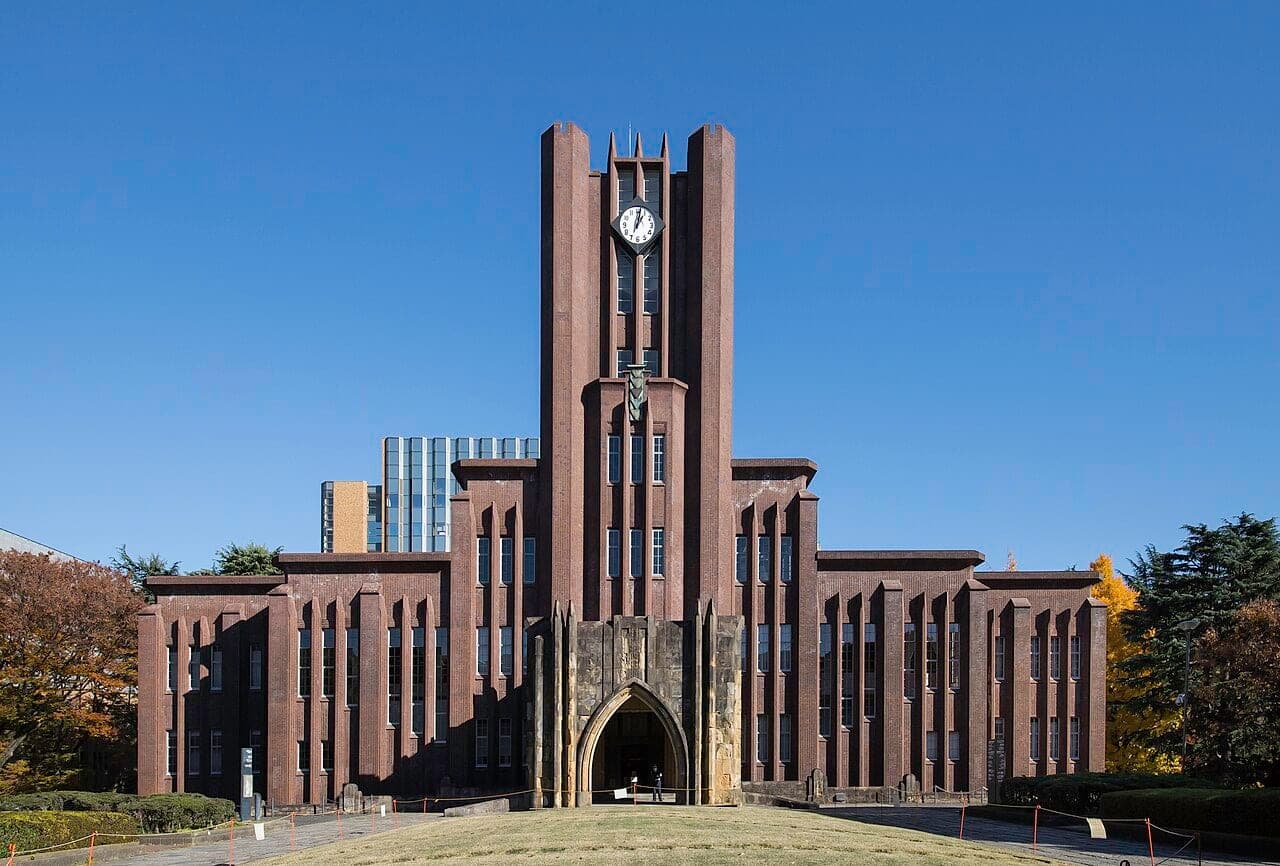
 In January 1969 riot police retook this building from students after a two-day siege, and the entrance examinations for that year were cancelled outright. Photograph by Kakidai, CC BY-SA 4.0, via Wikimedia Commons.
The Hongo campus is organised around the Yasuda Auditorium, completed in 1925 with a donation from the financier Yasuda Zenjiro, founder of the Yasuda business group. Its Gothic-influenced tower closes the vista along a broad avenue lined with ginkgo trees, whose leaf is the university's emblem. The auditorium took on a different kind of fame in 1968 and 1969, when protesting students occupied it during a period of campus unrest and it had to be retaken by riot police; it was later restored and again hosts ceremonies.
Academically the university is broad. It comprises ten faculties, fifteen graduate schools, and eleven affiliated research institutes, covering law, medicine, engineering, science, letters, economics, and agriculture, alongside institutes that range from the Earthquake Research Institute to centres for medical and physical science.
Todai is Japan's foremost research university and one of the most productive in Asia. Its alumni, faculty, and researchers include a large share of the country's Nobel laureates; counts vary with how affiliation is measured, but the university associates itself with well over a dozen Nobel Prize winners across physics, chemistry, medicine, and literature. At least one Fields Medalist, the mathematician Kunihiko Kodaira, is among its graduates.
The institution's influence on public life is just as marked. Around seventeen of Japan's prime ministers studied there, along with generations of senior civil servants, judges, and business leaders, a concentration that reflects its historic role as the gateway to the higher bureaucracy. Its research reaches across the sciences and humanities, supported by extensive laboratories, libraries, and observational facilities.
On 1 September 1923 the Great Kanto earthquake brought down the library at Hongo, and fire spreading from the neighbouring medical faculty took what the shaking had left. The collection had been assembled since the university's founding in 1877; of roughly 560,000 volumes, about 4,000 survived (University of Tokyo Library).
The response was immediate and international. On 3 September, at the League of Nations in Geneva, the Australian delegate moved that the assembly record its sorrow, and the motion carried; a fortnight later the League's Committee on Intellectual Cooperation was asked to work out how books might be gathered for Japan. The university formed its own committee under Yamada Saburo, dean of the law faculty, and wrote to embassies, universities and learned societies. Britain answered through the British Academy, whose president was the former prime minister Arthur Balfour: some 70,000 volumes, among them 187 rarities of English printing history, with the Kelmscott Press Chaucer of 1893 at their head. The United States sent about 95,000 volumes through the Smithsonian Institution. Books came from 36 countries in all, and the choosing was coordinated, each country sending works fundamental to itself and in its own language so that the gifts complemented one another rather than overlapping. Private libraries followed: Mori Ogai's own books, and the Nanki Bunko assembled by Marquis Tokugawa Yorimichi.
The building took longer. It moved when John D. Rockefeller Jr. asked the librarian Anesaki Masaharu what construction would cost and then, on 30 December 1924, cabled an unconditional gift of four million yen. Yoshikazu Uchida's General Library opened on 1 December 1928, its front elevation set out to resemble a row of books facing the plaza, and it is still affectionately called the Rockefeller Library (University of Tokyo). A collection reduced to four thousand volumes was reassembled out of other people's shelves, a plain enough demonstration that a library is a set of relationships before it is a building.
The University of Tokyo is consistently ranked as Japan's leading university and among the strongest institutions in Asia. It enrols roughly 28,000 students and remains fiercely competitive at entry, with admission decided by a demanding examination. In recent years it has expanded English-taught programmes, international partnerships, and research collaborations to broaden a student body that has traditionally been overwhelmingly Japanese. It continues to pair a public mission, training national leaders and advancing research, with a growing global profile.
The Hongo campus, in Bunkyo ward, is open to visitors, who are free to walk the grounds and see the Akamon, the Yasuda Auditorium, and Sanshiro Pond, a landscaped garden that survives from the former Maeda estate. The campus is reached from Hongo-sanchome, Todai-mae, or Nezu stations on the Tokyo subway, each a short walk from a campus gate. Buildings house cafeterias and a university museum, and because this is a working campus, interiors are generally closed except during scheduled events; the official website lists access details and any public openings.
In January 1969 riot police retook this building from students after a two-day siege, and the entrance examinations for that year were cancelled outright. Photograph by Kakidai, CC BY-SA 4.0, via Wikimedia Commons.
The Hongo campus is organised around the Yasuda Auditorium, completed in 1925 with a donation from the financier Yasuda Zenjiro, founder of the Yasuda business group. Its Gothic-influenced tower closes the vista along a broad avenue lined with ginkgo trees, whose leaf is the university's emblem. The auditorium took on a different kind of fame in 1968 and 1969, when protesting students occupied it during a period of campus unrest and it had to be retaken by riot police; it was later restored and again hosts ceremonies.
Academically the university is broad. It comprises ten faculties, fifteen graduate schools, and eleven affiliated research institutes, covering law, medicine, engineering, science, letters, economics, and agriculture, alongside institutes that range from the Earthquake Research Institute to centres for medical and physical science.
Todai is Japan's foremost research university and one of the most productive in Asia. Its alumni, faculty, and researchers include a large share of the country's Nobel laureates; counts vary with how affiliation is measured, but the university associates itself with well over a dozen Nobel Prize winners across physics, chemistry, medicine, and literature. At least one Fields Medalist, the mathematician Kunihiko Kodaira, is among its graduates.
The institution's influence on public life is just as marked. Around seventeen of Japan's prime ministers studied there, along with generations of senior civil servants, judges, and business leaders, a concentration that reflects its historic role as the gateway to the higher bureaucracy. Its research reaches across the sciences and humanities, supported by extensive laboratories, libraries, and observational facilities.
On 1 September 1923 the Great Kanto earthquake brought down the library at Hongo, and fire spreading from the neighbouring medical faculty took what the shaking had left. The collection had been assembled since the university's founding in 1877; of roughly 560,000 volumes, about 4,000 survived (University of Tokyo Library).
The response was immediate and international. On 3 September, at the League of Nations in Geneva, the Australian delegate moved that the assembly record its sorrow, and the motion carried; a fortnight later the League's Committee on Intellectual Cooperation was asked to work out how books might be gathered for Japan. The university formed its own committee under Yamada Saburo, dean of the law faculty, and wrote to embassies, universities and learned societies. Britain answered through the British Academy, whose president was the former prime minister Arthur Balfour: some 70,000 volumes, among them 187 rarities of English printing history, with the Kelmscott Press Chaucer of 1893 at their head. The United States sent about 95,000 volumes through the Smithsonian Institution. Books came from 36 countries in all, and the choosing was coordinated, each country sending works fundamental to itself and in its own language so that the gifts complemented one another rather than overlapping. Private libraries followed: Mori Ogai's own books, and the Nanki Bunko assembled by Marquis Tokugawa Yorimichi.
The building took longer. It moved when John D. Rockefeller Jr. asked the librarian Anesaki Masaharu what construction would cost and then, on 30 December 1924, cabled an unconditional gift of four million yen. Yoshikazu Uchida's General Library opened on 1 December 1928, its front elevation set out to resemble a row of books facing the plaza, and it is still affectionately called the Rockefeller Library (University of Tokyo). A collection reduced to four thousand volumes was reassembled out of other people's shelves, a plain enough demonstration that a library is a set of relationships before it is a building.
The University of Tokyo is consistently ranked as Japan's leading university and among the strongest institutions in Asia. It enrols roughly 28,000 students and remains fiercely competitive at entry, with admission decided by a demanding examination. In recent years it has expanded English-taught programmes, international partnerships, and research collaborations to broaden a student body that has traditionally been overwhelmingly Japanese. It continues to pair a public mission, training national leaders and advancing research, with a growing global profile.
The Hongo campus, in Bunkyo ward, is open to visitors, who are free to walk the grounds and see the Akamon, the Yasuda Auditorium, and Sanshiro Pond, a landscaped garden that survives from the former Maeda estate. The campus is reached from Hongo-sanchome, Todai-mae, or Nezu stations on the Tokyo subway, each a short walk from a campus gate. Buildings house cafeterias and a university museum, and because this is a working campus, interiors are generally closed except during scheduled events; the official website lists access details and any public openings.
History
Campus and academics
Scholarship
Four thousand books, and the gift of thirty-six countries
Todai today
Visiting
References and resources
- Encyclopaedia Britannica: University of Tokyo: overview of the university's founding and history.
- University of Tokyo, official site: faculties, campuses, and institutional facts.
- University of Tokyo: Yasuda Auditorium: the auditorium's construction and its donor.
- University of Tokyo: Akamon Gate: the Red Gate's Edo-period origin.
- University of Tokyo by the Numbers: student, alumni, and award figures.
- Wikipedia: University of Tokyo: detailed history, campuses, and notable people.