Heritage · University
Duke University: History and Overview
Duke University in Durham, North Carolina grew from a Methodist schoolhouse of 1838 into one of America's leading research universities, renamed in 1924 through James Buchanan Duke's endowment. Its Gothic West Campus and 64 metre chapel tower were designed by Julian Abele, a Black architect who could not have enrolled at the university he drew.Written to last.
By Confinity Heritage Editorial · 2026-08-24 · 8-minute readQuiet tools, kept out of the way.
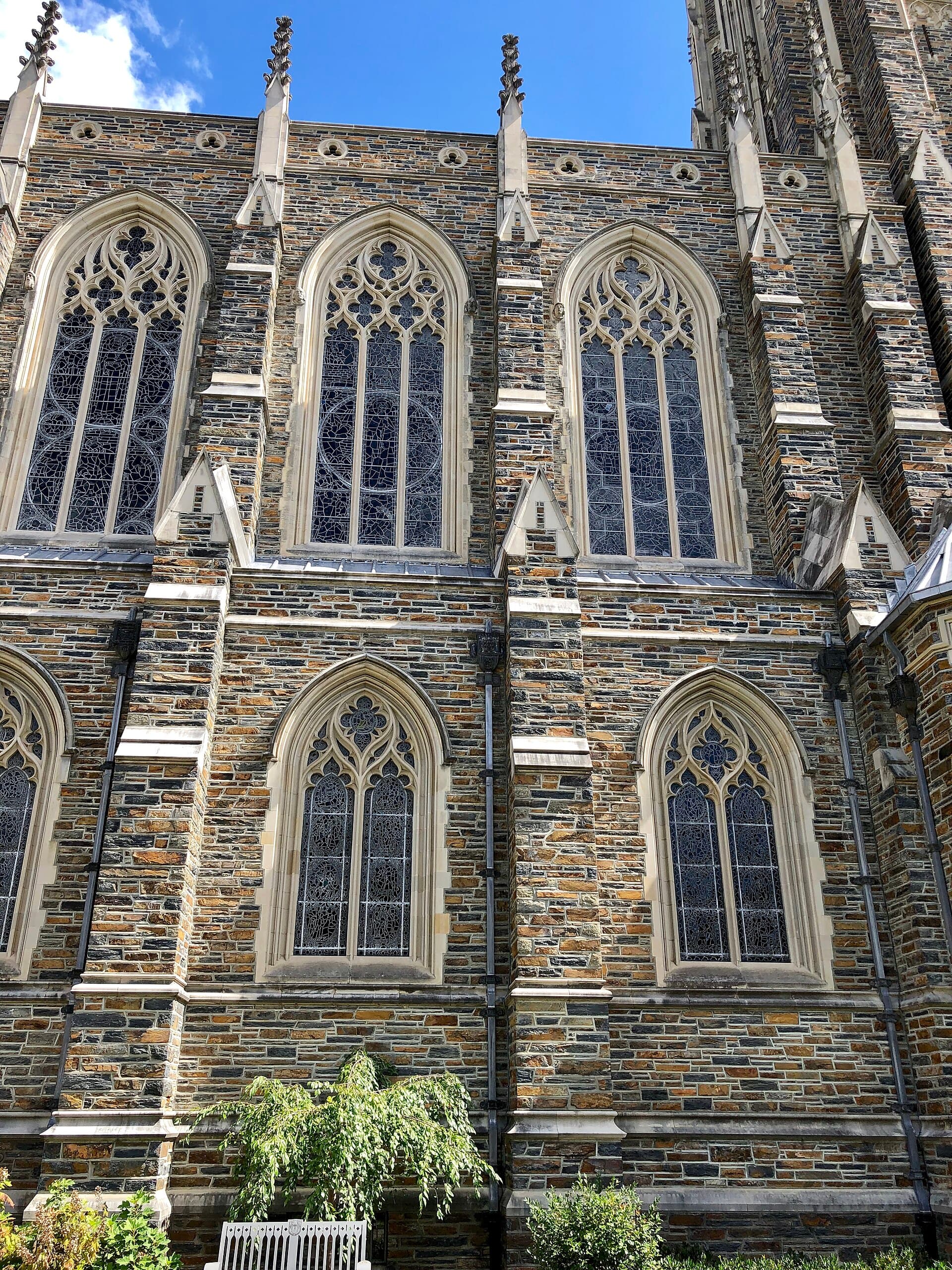
Duke University stands on the wooded western edge of Durham, North Carolina, in the United States, a private research university whose Gothic stone quadrangles look centuries older than they are. The campus was raised in the late 1920s and early 1930s on one of the great industrial fortunes of the American South, and it announces itself with a chapel tower 64 metres high, visible above the pines for miles.
The university's memory holds two stories. One is a familiar arc of American ambition: a schoolhouse that became a Methodist college, then a national university carried upward by tobacco and hydroelectric money. The other took far longer to be told. Julian Abele, the architect who gave Duke its face, was a Black man who could not have studied at the segregated university he designed, and whose name went largely unspoken there for half a century.
Duke traces its founding to 1838, when Methodist and Quaker families in rural Randolph County, North Carolina opened a subscription school known as Brown's Schoolhouse. Reorganised as Union Institute in 1841 and chartered as Normal College in 1851, it took the name Trinity College in 1859 as its Methodist ties deepened, and for decades it remained a small denominational college in the countryside.
In 1892 the college moved to Durham, a fast growing tobacco town, on land given by the industrialist Julian S. Carr and money given by Washington Duke, whose family firm was becoming the American Tobacco Company. One of Washington Duke's later gifts carried a notable condition: that women be admitted on an equal footing with men, which the college did from 1896.
The transformation of 1924 was of a different order. James Buchanan Duke, Washington's youngest son, had built fortunes in tobacco and then in hydroelectric power. In December 1924 he signed the indenture creating the Duke Endowment, a philanthropic trust of 40 million dollars for the Carolinas, with Trinity College as a principal beneficiary. The college was renamed Duke University in honour of Washington Duke and his family, and James B. Duke added further millions for a building programme on a scale no Southern university had attempted. He died in 1925, before a single stone was laid.
Through the Depression years, a mile and a half to the west, an entire Gothic university then rose from farmland and forest: quadrangles, dormitories, a library, a medical school and hospital, and the chapel at the centre, all in a local volcanic stone from nearby Hillsborough that breaks in shades from grey to rust and gives the walls their warm, mottled colour. The old campus, rebuilt in Georgian brick, became East Campus and housed the Woman's College until 1972.
West Campus is organised around the chapel: James B. Duke asked that a great towering church dominate the university. Duke Chapel closes the main quadrangle with a 64 metre tower modelled on the Bell Harry Tower of Canterbury Cathedral. Built between 1930 and 1932 and dedicated in 1935, it seats around 1,600 beneath its vaulted nave and carries a 50 bell carillon. In the Memorial Chapel off the chancel lie the sarcophagi of Washington, Benjamin and James Buchanan Duke, and in the crypt below are buried several of the university's presidents, making the building the institution's memorial vault as well as its church.
South of the chapel lie the Sarah P. Duke Gardens, 55 acres of terraces, ponds and woodland begun in the 1930s with a gift from Sarah Pearson Duke, Benjamin Duke's wife, with Italianate terraces by the landscape architect Ellen Biddle Shipman at their heart. The gardens draw hundreds of thousands of visitors a year, free of charge.
The university comprises ten schools and colleges, from Trinity College of Arts and Sciences and the Pratt School of Engineering to the Fuqua School of Business and schools of law and divinity. The School of Medicine and Duke University Hospital opened together in 1930 and grew into one of the leading academic medical centers in the United States. Two collections deserve particular mention. The David M. Rubenstein Rare Book and Manuscript Library holds the papers of the philanthropist Doris Duke alongside major collections in documentary photography, advertising and women's history. And in the forest a short drive from West Campus, the Duke Lemur Center, founded in 1966, cares for the largest colony of lemurs outside Madagascar, a research sanctuary where lemurs leap through North Carolina pines.
The man who gave Duke its Gothic silhouette never saw his name honoured there in his lifetime. Julian Francis Abele was born in Philadelphia in 1881 and in 1902 became the first Black graduate of the architecture programme at the University of Pennsylvania. He joined the office of Horace Trumbauer, one of the grand firms of Gilded Age America, and rose to chief designer, shaping buildings such as the Free Library of Philadelphia and the Philadelphia Museum of Art.
When James B. Duke engaged the Trumbauer firm for the new university, the design work fell substantially to Abele. The chapel, the quadrangles of West Campus and the Georgian buildings of East Campus came from his drawing board in Philadelphia. He produced them for a university in the Jim Crow South that would not have admitted him: Duke did not enroll Black graduate and professional students until 1961, or its first Black undergraduates until 1963, a quarter century after Abele's campus was complete. Family accounts hold that he was reluctant to travel into the segregated South at all.
Abele died in 1950 with his authorship known to specialists and barely acknowledged in public. The correction began in 1986, during student protests against apartheid, when a Duke sophomore named Susan Cook wrote to the student newspaper pointing out that her great granduncle, a Black man, had designed the university around them. In 1988 Abele's portrait was hung in the Allen Building, the first portrait of a Black person displayed in the university's main administration building. In 2016 Duke named the main West Campus quadrangle, the heart of his design, Abele Quad. The stone had stood for eighty years; the name took that long to be set beside it.
Duke's rise as a research university has been anchored by its medical center. Among its documented firsts is the physician assistant profession itself: in 1965 Dr. Eugene Stead established at Duke the first physician assistant programme in the United States. The laboratories have earned Nobel recognition as well. Robert Lefkowitz, on the Duke faculty since 1973, shared the Nobel Prize in Chemistry in 2012 for revealing how cell receptors work; his colleague Paul Modrich shared the 2015 prize for mapping how cells repair their DNA.
The alumni run across public life. Richard Nixon took his law degree at Duke in 1937 and became the thirty seventh president of the United States. Ricardo Lagos earned a doctorate in economics at Duke and later served as president of Chile. Tim Cook, the chief executive of Apple, holds an MBA from the Fuqua School of Business, and Melinda French Gates, the philanthropist, earned both her undergraduate degree and her MBA at Duke in the 1980s.
Then there is basketball, which at Duke is less a sport than a campus liturgy. Cameron Indoor Stadium, opened in 1940 and holding barely nine thousand, is one of the loudest rooms in American sport, its student section, the Cameron Crazies, camping for weeks in a tent village called Krzyzewskiville for courtside places. Under Mike Krzyzewski, head coach from 1980 to 2022, the Blue Devils won five national championships, and the annual games against North Carolina, eight miles down the road, stop both campuses cold.
Duke enrolls around 18,000 students, roughly a third of them undergraduates, and places consistently in the upper ranks of American and international league tables. It anchors the Research Triangle alongside the University of North Carolina at Chapel Hill and North Carolina State University in Raleigh. Research Triangle Park, founded between them in 1959, grew into one of the largest research parks in the world. The Nasher Museum of Art, opened on campus in 2005 in a building by Rafael Viñoly, has made the university a serious presence in contemporary art, and Duke Kunshan University, a joint venture campus in China, extends its teaching abroad.
Duke's campus is open to visitors, and the chapel is the place to begin: it is generally open daily outside services, and the view down Abele Quad from its steps is the university's defining prospect. The Sarah P. Duke Gardens are free year round and at their best in spring. The Nasher Museum keeps regular public hours, and the Lemur Center welcomes visitors on guided tours booked in advance, the only way to meet the lemurs. Basketball tickets at Cameron Indoor Stadium are famously scarce, but the arena can be seen on a walk through West Campus, and Durham itself, a city remade from its tobacco warehouses, is ten minutes away.