Heritage · Landmark
Wat Pho: Bangkok's oldest temple and first university
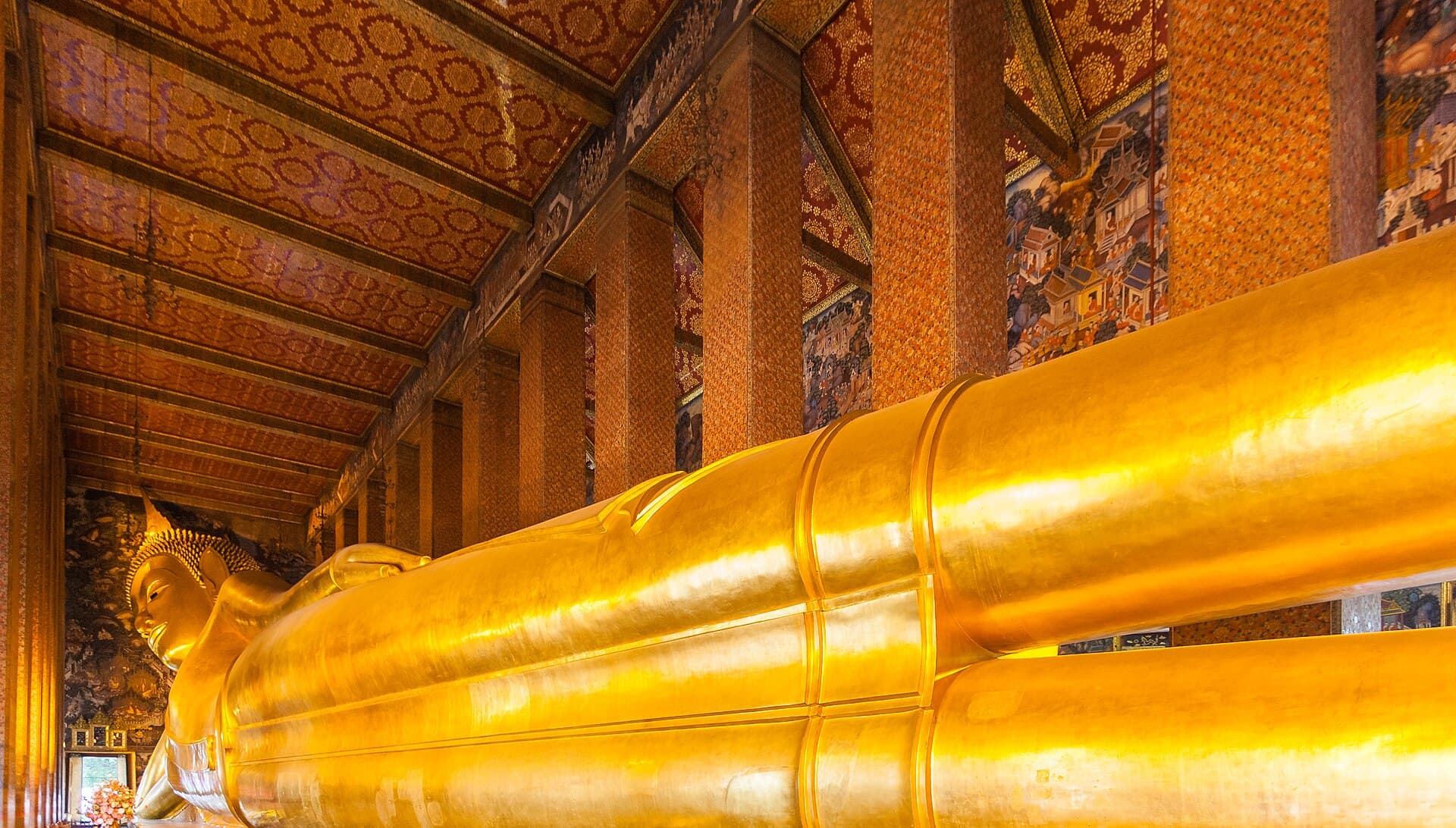
Bangkok's oldest and largest temple holds a gold Reclining Buddha forty-six metres long, its feet inlaid with mother-of-pearl. It also holds something rarer: more than 1,400 stone inscriptions carved in the 1830s so that a kingdom's medicine, massage, and poetry could never be burned out of memory again.Written to last.
By Confinity Heritage Editorial · 2026-08-23 · 7-minute readQuiet tools, kept out of the way.
On the river side of old Bangkok, in the historic heart of Thailand, a walled compound of gilded spires and steep orange roofs presses up against the southern edge of the Grand Palace. This is Wat Phra Chetuphon Wimon Mangkhlaram, known to almost everyone as Wat Pho, the oldest and largest temple complex in the capital. It was already standing when Bangkok was founded: an Ayutthaya-era monastery called Wat Photaram occupied this ground before there was a city around it, and the short name Thais still use preserves that older identity. Within the walls stand more than ninety chedis, a double cloister lined with gilded Buddha images, teaching pavilions, rock gardens, and a hall built around one of the most famous statues in Asia.
That statue, the Reclining Buddha, draws the crowds, and it earns them: forty-six metres of gold-leafed brick and plaster, reclining into final release, its feet a mother-of-pearl catalogue of auspicious signs. But the deeper claim Wat Pho makes on human memory is quieter and easier to walk past. In the 1830s, King Rama III had the knowledge of a kingdom carved onto more than 1,400 stone tablets set into the temple's walls and pavilions, open to anyone who could read. Thailand had watched its libraries burn once, when Ayutthaya fell in 1767. Wat Pho was the answer: a temple that became a library no fire could take.
Wat Pho began as Wat Photaram, a monastery of the Ayutthaya period generally placed in the sixteenth or seventeenth century, when Bangkok was a small riverside outpost serving the capital upstream. That world ended in April 1767, when Burmese armies captured Ayutthaya after a long siege and burned it, destroying palaces, temples, and the manuscript libraries that held centuries of learning. The kingdom's center shifted downriver, first to Thonburi on the west bank, and then, in 1782, across the water, when King Phutthayotfa Chulalok, Rama I, founded Bangkok on Rattanakosin Island as a capital built to recall the lost one.
The old monastery stood immediately south of the site he chose for his Grand Palace, and he made it a royal project. From 1788, Rama I had the decayed temple rebuilt on a grand scale, a campaign that ran for more than a decade and gave the complex its ordination hall, its first great chedi, and its formal name. The bond between king and temple became literal at his death: his ashes were enshrined beneath the pedestal of the principal Buddha image in the ordination hall, where they remain.
The temple a visitor sees today is largely the work of Rama I's grandson. From 1831, King Rama III launched an expansion and restoration that continued for some sixteen years, enlarging the compound and adding chapels and pavilions. It was under Rama III that Wat Pho took on its double character: still a working temple, and at the same time a deliberate act of national record-keeping.
The dynasty is written into the skyline. At the center of the western compound rise the four great chedis of the Phra Maha Chedi Si Rajakarn group, each sheathed in glazed tiles of a different color and each dedicated to one of the first four Chakri kings. The green chedi honors Rama I, and it holds a story that anticipates everything the temple would become. Inside it are the remains of the Phra Si Sanphet, a revered standing Buddha some sixteen metres tall that the Burmese stripped of its gold during the sack of Ayutthaya, leaving the core ruined beyond repair. Rather than discard what was left, Rama I enshrined it inside a new monument in his new capital. White and yellow chedis followed for Rama II and Rama III, and Rama IV added a blue-tiled fourth before decreeing the group complete. From the beginning, Wat Pho was a place where what had been broken at Ayutthaya was gathered up and kept.
In 1832, as part of the great expansion, Rama III commissioned the image that would make the temple famous far beyond Thailand. The Reclining Buddha is forty-six metres long and fifteen metres high, built of brick, shaped in plaster, and finished entirely in gold leaf. Its chapel was raised around it, and the fit is deliberately tight: there is no vantage point from which the whole figure can be seen at once. Visitors move along its flank in sections and assemble the statue in memory rather than in a single view.
The posture is often misread as sleep. It shows the Buddha in his final moments before entering parinibbana, the release from the cycle of rebirth, which is why the expression is one of calm rather than rest. The masterpiece within the masterpiece is at the far end of the hall: the soles of the feet, each three metres high and four and a half metres long, are inlaid with mother-of-pearl depicting the 108 auspicious symbols by which a Buddha is known, arranged around a chakra at the center of each sole. Along the opposite wall run 108 bronze bowls, one for each symbol, and visitors drop a coin into each in turn, a slow metallic rhythm of merit-making that has become the chapel's constant background sound.
The decision that gives Wat Pho its singular place in the history of memory came from Rama III in the 1830s. The fall of Ayutthaya had cost the kingdom more than a capital; it had cost the texts, treatises, and technical learning held in palace and monastery libraries. What survived did so in fragments, in private hands, or in the memories of aging experts. Rama III assembled scholars, physicians, and craftsmen and had that knowledge compiled, edited, and then carved onto stone tablets set into the walls, pillars, and pavilions of the temple, where 1,431 inscriptions survive today.
The range is astonishing: treatises on medicine and pharmacy, diagrams of the body and its therapeutic pressure points, texts on Thai massage, astrology, and midwifery, guides to Buddhist doctrine, verse in the demanding classical meters, epigraphy, and accounts of the customs of neighboring peoples. Marble slabs illustrate the self-stretching exercises known as rusi dat ton, and stone hermit statues in the temple gardens model the postures in three dimensions. What made the project radical was not only its scope but its address. This was learning that had lived in palaces and closed monastic libraries, and Rama III published it, in the plainest sense of the word, on walls any literate visitor could stand before and read. For this, Wat Pho is remembered as Thailand's first university, a school with no admission and no walls between the knowledge and the reader. In 2011, UNESCO inscribed the epigraphic archives of Wat Pho on the international Memory of the World register, three years after their regional listing, recognizing the tablets as documentary heritage of significance to humanity.
One body of that carved knowledge never stopped being used. The massage texts and diagrams on the temple walls made Wat Pho the recognized home of nuad Thai, traditional Thai massage, and the tradition still teaches where it was first published. The Wat Pho Thai Traditional Medical and Massage School, operating within and beside the temple since the mid-twentieth century, trains students from across the world in courses descended from the treatises Rama III ordered carved, and its practitioners treat visitors in open pavilions a few steps from the inscriptions themselves. In 2019, UNESCO added nuad Thai to its list of the intangible cultural heritage of humanity, a nomination that pointed back to Wat Pho's tablets as the tradition's documentary anchor. It is a rare, complete circuit: knowledge nearly lost in 1767, fixed in stone in the 1830s, and still passing from hand to hand in the same courtyards today.
For all its fame, Wat Pho remains a working monastery of the highest royal grade. A community of monks and novices lives in the southern quarter of the compound, apart from the tourist circuit, and the rhythm of chanting, almsround, and study continues underneath one of the heaviest visitor flows in Bangkok. The temple's calendar still turns with the Thai year of merit-making, from ordinations to the festivals by which families honor their dead, such as the sat thai festival of the tenth lunar month.
The quieter galleries reward the visitor who lingers past the Reclining Buddha. The Phra Rabiang, a double cloister enclosing the ordination hall, holds nearly four hundred gilded Buddha images seated in long meditative ranks; in total the complex keeps more than a thousand images, among the largest collections in Thailand, many of them refugees from ruined Ayutthaya and Sukhothai given a second home here. The temple opens daily from morning until early evening, a short walk from the Tha Tien pier and the Grand Palace, and it asks the usual courtesies of a sacred site: covered shoulders and knees, shoes off at the chapel door, a lowered voice among the ranked Buddhas. Early in the morning, before the tour groups arrive, the cloisters fall nearly silent, and the temple feels closest to what it has always been.
Every monument keeps something. What Wat Pho keeps is a kingdom's decision about loss. The men who rebuilt this temple had watched a capital's learning vanish in a single season of war, and they answered in the most durable medium they had. They gathered the broken image of Ayutthaya into a chedi, the orphaned Buddhas of ruined provinces into a cloister, and the knowledge of physicians, poets, and astrologers onto stone that has now outlasted many more generations of paper. The inscriptions were a wager that memory survives by being shared rather than guarded, and the wager paid: the massage tradition first fixed on these walls is now taught on every continent. Wat Pho endures as the temple that answered a burned library by becoming one in stone, and its lesson is carved where anyone can read it. What a people cannot bear to lose twice, they must write where everyone can find it.
Older than the city it anchors
Rama III and the sixteen-year expansion
The Buddha who fills a building
A university published in stone
The school of the healing hand
A living monastery amid the crowds
The temple that answered a burned library
References and resources
- Encyclopaedia Britannica. "Wat Pho." britannica.com/topic/Wat-Pho.
- UNESCO Memory of the World. "Epigraphic Archives of Wat Pho," inscribed on the international register 2011. unesco.org/en/memory-world/epigraphic-archives-wat-pho.
- UNESCO Intangible Cultural Heritage. "Nuad Thai, traditional Thai massage," inscribed 2019. ich.unesco.org/en/RL/nuad-thai-traditional-thai-massage-01384.
- Wat Phra Chetuphon (Wat Pho), official site. watpho.com.
- Wikipedia. "Wat Pho," "Phra Buddha Saiyas," and "Ayutthaya Kingdom." Retrieved 2026.
- Tourism Authority of Thailand. "Wat Pho (Wat Phra Chetuphon)." tourismthailand.org.