Heritage · University
University of Helsinki: History and Overview
Founded in 1640 as the Royal Academy of Turku under Queen Christina of Sweden, the University of Helsinki is Finland's oldest and largest university. After the Great Fire of Turku destroyed the academy and most of its library in 1827, the university moved to Helsinki, where its neoclassical main building anchors Senate Square and its library became the National Library of Finland.Written to last.
By Confinity Heritage Editorial · 2026-08-24 · 8-minute readQuiet tools, kept out of the way.
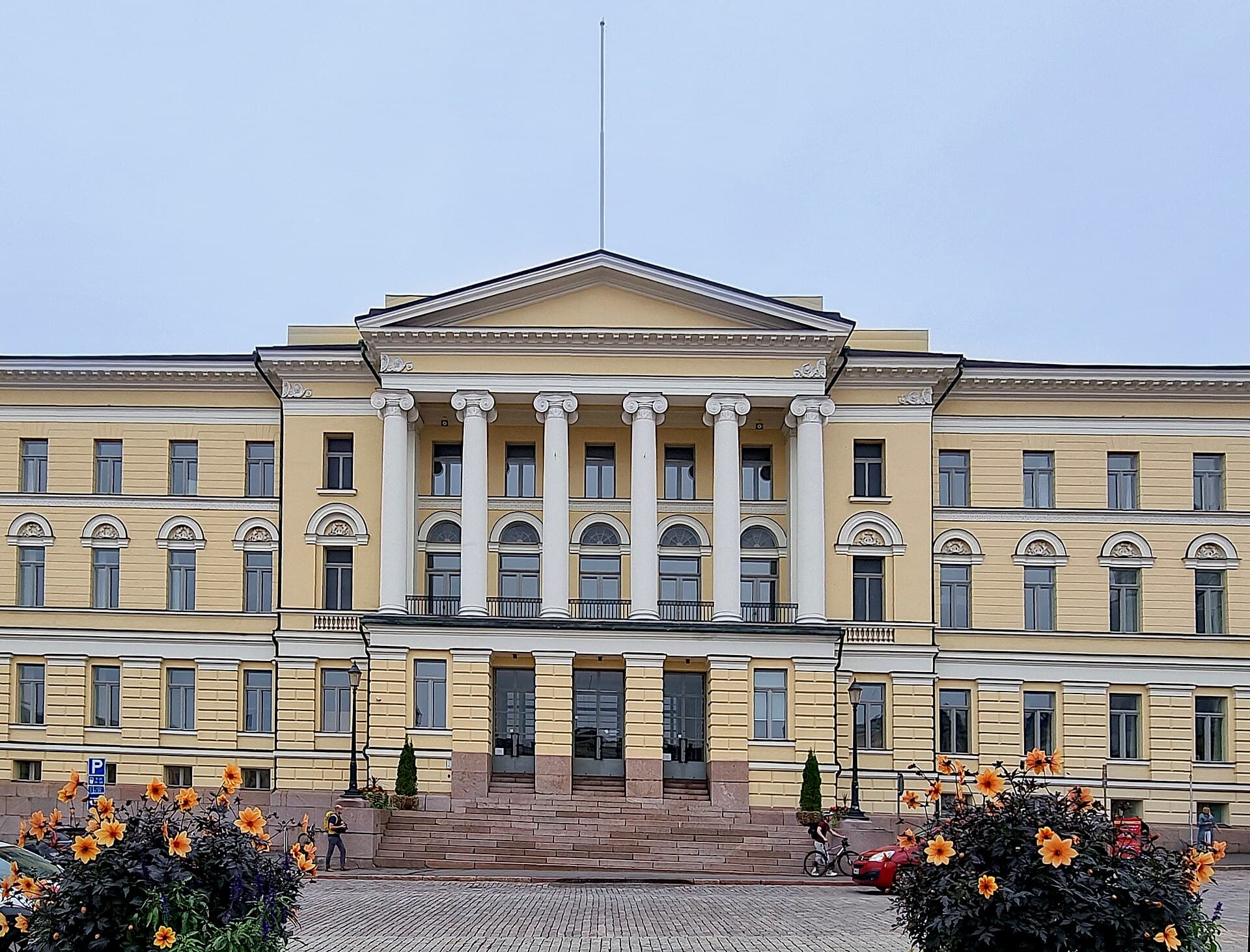
The University of Helsinki is Finland's oldest and largest university, and its story is unusual among the old universities of Europe: it was founded in one city and lives in another. It began in 1640 as the Royal Academy of Turku, on the country's southwest coast, and moved to Helsinki only after a fire in 1827 burned the old capital and took most of the academy's library with it. What was rebuilt on Senate Square became more than a school. Through a century of Russian rule its lecture halls carried the argument for a Finnish nation, its professors assembled the national epic, and its library grew into the National Library of Finland.
The university's modern face is quieter but no less consequential: Nobel laureates in chemistry and medicine, and a computer science student who in 1991 released a small operating system kernel that now runs most of the world's servers.
The academy was founded by a charter issued on 26 March 1640 in the name of Queen Christina of Sweden, then a girl of thirteen, with the regency government acting for her. The driving figure was Count Per Brahe the Younger, Governor-General of Finland, who pressed for a full university in the eastern half of the Swedish realm and became the academy's first chancellor. Turku, then called Åbo in Swedish, was Finland's leading town and the seat of its bishop, and the new Royal Academy of Turku grew out of the cathedral school there. It was modelled on the collegiate learning of the realm's older foundation, Uppsala University, with faculties of theology, law, medicine and philosophy, and it made Turku the intellectual centre of Swedish Finland for nearly two centuries.
The realm itself did not last. Sweden lost Finland to Russia in the war of 1808-1809, and Finland became a Grand Duchy under the tsar, keeping its own laws and institutions; the academy continued under the new sovereign as the Imperial Academy of Turku. Then came the catastrophe. On 4 September 1827 a fire spread through the wooden city, and by the next day the Great Fire of Turku had destroyed most of the town, the worst urban fire in the history of the Nordic countries. The academy's buildings burned with it, and so did nearly all of its library.
Tsar Nicholas I ordered the academy transferred to Helsinki, the small town that had been made the Grand Duchy's capital in 1812, and in 1828 it reopened there as the Imperial Alexander University of Finland, named for his predecessor Alexander I. Through the nineteenth century it was, in practice, the only university in the country, and it became the place where the Finnish nation was argued into being. The philosopher and statesman J. V. Snellman, who had enrolled at Turku and moved with the university, taught that a nation survives through its language and letters, and his campaign helped win Finnish, until then largely a spoken peasant tongue, official standing alongside Swedish in 1863. Elias Lönnrot, a physician trained at the academy, walked the eastern song lands collecting oral poetry and compiled it into the Kalevala, the epic published in 1835 that gave Finland a founding literature; in 1853 he returned as the university's professor of Finnish language and literature. Generations of students carried that national feeling through the years of Russification, and when Finland declared independence in 1917, many of the new state's leaders had come through the university's halls. In 1919 it took its present name, the University of Helsinki.
The university's main building stands on the west side of Senate Square, the neoclassical heart of Helsinki designed almost entirely by one man, the German-born architect Carl Ludvig Engel. Engel gave the square its cathedral on the north side, the Government Palace, built for the Senate, on the east, and the university facing the Senate across the cobbles, completed in 1832. The composition was deliberate: church, state and learning as the three faces of the capital, built in matching pale stucco and Corinthian columns. The university's share of that monumental centre also includes Engel's finest interior, the domed rotunda of the old university library a block away, finished in the 1840s and now the home of the National Library of Finland.
The modern university has long since outgrown the square. It teaches across four campuses: the City Centre for humanities, law, social sciences, theology and education; Kumpula for the exact sciences; Viikki for life sciences and forestry; and Meilahti for medicine. Eleven faculties serve roughly thirty thousand students, and the university remains bilingual by law, teaching in Finnish and Swedish, a living trace of its two founding centuries, with much graduate instruction now in English as well.
The library that burned in 1827 was the memory of a country. From 1707 the academy in Turku held the right of legal deposit, receiving a copy of what was printed in the Swedish realm, and by the 1820s its collection of some forty thousand volumes, with manuscripts and archives reaching back to the Middle Ages, was the largest in Finland. Almost all of it was lost in a single night. The books that survived were, for the most part, the ones that happened to be somewhere else: several hundred volumes out on loan to professors and students, away from the shelves when the fire came. The destruction ranks among the gravest library losses the Nordic countries have known, and it left the new university in Helsinki with the strange task of rebuilding a national memory nearly from zero.
The rebuilding was swift and, in its way, moving. Donations arrived from individuals, universities and learned societies across Europe, and substantial gifts came from Russia, including thousands of volumes from the imperial collections in St Petersburg. The university had also, since 1820, held the right to receive deposit copies of works printed across the Russian empire, a privilege that continued until 1917 and built the great Slavonic collection scholars still travel to Helsinki to use. Legal deposit for Finnish printing resumed, and earlier Finnish books were sought out in Swedish and other foreign collections where the Turku shelves had failed. The collection, housed from the 1840s in Engel's library building, became the National Library of Finland, formally so named in 2006, and today it preserves the published record of the nation whose earlier record burned. Few institutions carry a plainer lesson about memory: what survives is what has been copied, shared and kept in more than one place.
The university's scientific record is anchored by two Nobel laureates. Artturi Ilmari Virtanen, professor of biochemistry, won the Nobel Prize in Chemistry in 1945 for his work on the preservation of fodder, research with direct consequences for food supply in northern countries. Ragnar Granit took his medical degree at Helsinki and taught there before moving to Stockholm, where his work on the physiology of vision brought the Nobel Prize in Physiology or Medicine in 1967. In mathematics, Rolf Nevanlinna built at Helsinki the theory of value distribution that bears his name, one of the central achievements of twentieth-century function theory, and drew students from across the world, among them the young Lars Ahlfors, later a first winner of the Fields Medal.
The most widely used piece of work ever begun at the university, though, came from a student. In 1991 Linus Torvalds, then studying computer science at Helsinki, wrote the first version of the Linux kernel on his home computer and posted it to an internet newsgroup, describing it as "just a hobby". The hobby became the foundation of most of the modern internet: Linux now runs the majority of the world's web servers, every Android phone, and nearly all of its supercomputers.
The University of Helsinki is Finland's largest research university, a member of the League of European Research Universities and regularly placed among the leading hundred or so universities in international tables. Its research strengths run from atmospheric science and forestry to law, linguistics and medicine. The bilingual mandate remains, and the university sees itself, with some justice, as the institution around which the Finnish state's intellectual life was first organised.
Senate Square is the natural starting point: the main building faces the Government Palace across the square, Helsinki Cathedral rises above them both, and the ensemble is best taken in from the centre of the cobbles. The National Library, a short walk along Unioninkatu, is open to visitors, and its domed Cupola Hall is among the finest rooms in Finland. The Helsinki University Museum Flame, inside the main building, tells the university's story from Turku onward, and the botanic garden at Kaisaniemi, founded for the university's botanists, offers a green pause a few minutes away. All of this sits in the walkable heart of Helsinki, and a visit takes an unhurried half day.