Heritage · University
Addis Ababa University: History and Overview
Founded in 1950 as the University College of Addis Ababa, Addis Ababa University is Ethiopia's oldest and largest institution of higher learning. In 1961 Emperor Haile Selassie I gave it his own residence, the Genete Leul Palace, which since 1963 has held the Institute of Ethiopian Studies and its collection of Ge'ez manuscripts.Written to last.
By Confinity Heritage Editorial · 2026-08-25 · 8-minute readQuiet tools, kept out of the way.
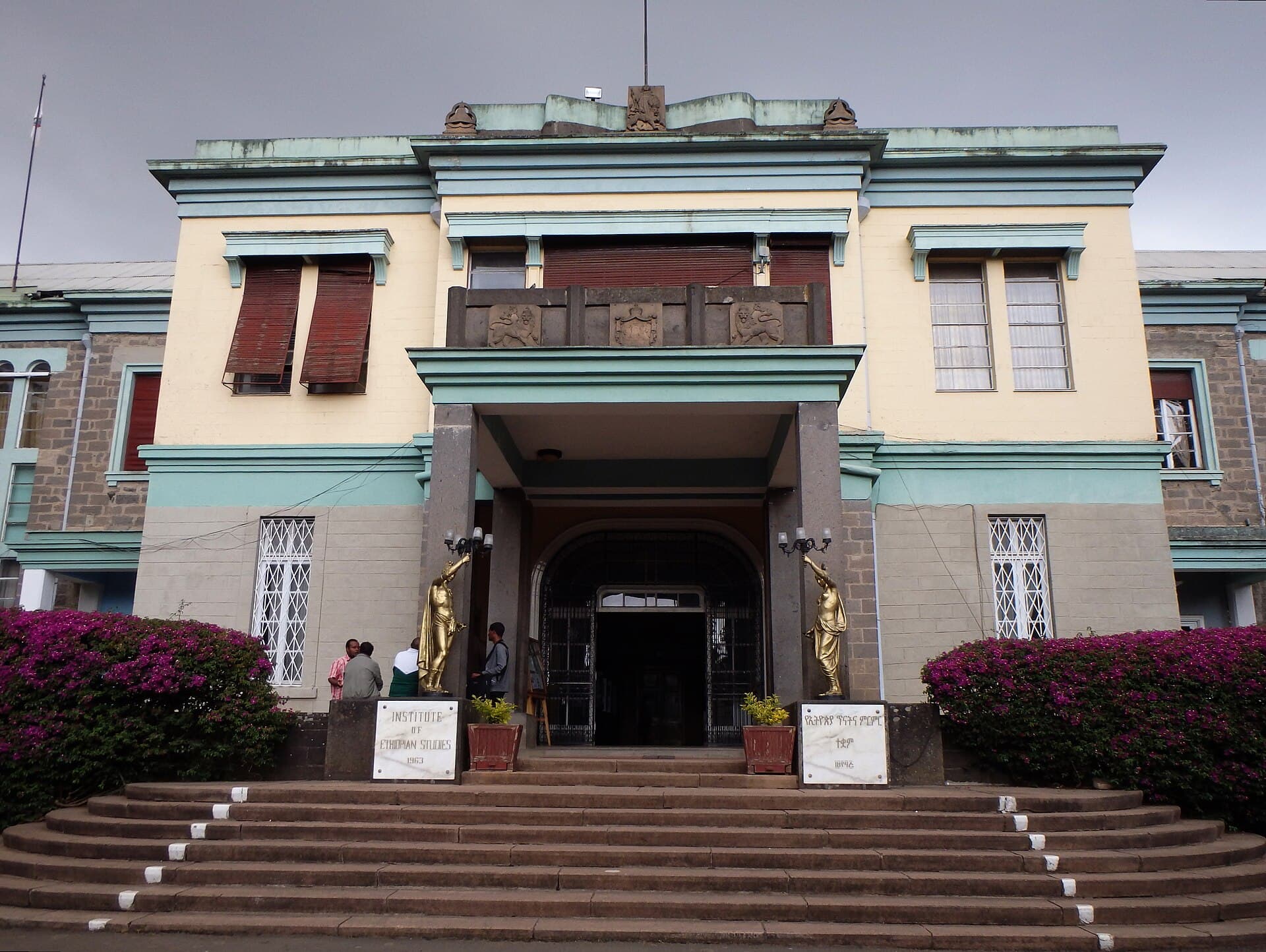
Addis Ababa University is the oldest and largest institution of higher learning in Ethiopia. It opened on 20 March 1950 as the University College of Addis Ababa, a two-year college established at the appeal of Emperor Haile Selassie I and led by Lucien Matte, a French Canadian Jesuit. The first intake numbered 33 students. The university now runs thirteen campuses, twelve in the capital and one at Bishoftu some 45 kilometres away, with an enrolment in the tens of thousands.
The building at the centre of its story was not designed for teaching. In February 1961 the emperor handed the university his own residence, the Genete Leul Palace at Sidist Kilo, and the colleges gathered under that gift took the name Haile Selassie I University. Since 1963 the palace has housed the Institute of Ethiopian Studies, whose library holds one of the great collections of Ethiopian manuscripts and whose museum runs through the emperor's private rooms upstairs. A residence became a national memory, and the record it keeps is written in a script with a line of its own reaching back two thousand years.
The college chartered in 1954 grew quickly. A Building College followed in 1955, and in February 1961 those faculties were brought together with the Theological College to form a single university. Haile Selassie gave the Genete Leul Palace to serve as its administration building and the nucleus of the Sidist Kilo campus. He had reasons of his own for leaving it: during the attempted coup of December 1960 officials of his government were killed inside the building, and he moved to the newer Jubilee Palace.
The setting matters for what the university became. Ethiopia was not colonised. It defeated an Italian invasion at Adwa in 1896 and kept its sovereignty through the era of partition, interrupted only by the occupation of 1936 to 1941. Higher education here was founded by an Ethiopian state for its own purposes, in a country that already had its own script, its own church scholarship and a tradition of learning carried in monastic schools. Makerere University in Kampala, founded in 1922, was built inside a colonial system and inherited by independent states; this one was commissioned by a sovereign as an instrument of his own modernising project.
That project produced consequences its founder did not intend. Through the late 1960s and early 1970s the campus was the main venue of the Ethiopian student movement, whose slogan "Land to the Tiller" pressed for land reform and whose members and teachers helped expose the famine of 1973 that the government had kept quiet. The movement played a central part in the revolution of 1974 that ended the monarchy. Under the military government that followed, the university was briefly renamed the University of Ethiopia before taking its present name in 1975, and it closed for two years while students and staff were drafted into the Development through Cooperation Campaign, the zemecha. The Derg years were costly. Students and academics were among those killed in the political violence of the late 1970s, others left the country, and the university lost the autonomy of its original charter. Teaching recovered slowly: the first master's programmes opened in 1979, the first doctorates in 1987.
The university is spread across the city rather than gathered behind a wall. Sidist Kilo, the sixth-kilometre district, holds the main campus and the old palace; Arat Kilo, downhill from it, holds much of the natural sciences. Others house technology, business, law and the health sciences, and the veterinary and agricultural college sits out at Bishoftu.
Teaching is organised into eleven colleges and a set of research institutes. The College of Health Sciences runs the School of Medicine, the School of Public Health and the School of Pharmacy, with Tikur Anbessa Specialized Hospital, the Black Lion, established in 1964 as its principal teaching hospital. Generations of Ethiopian physicians, surgeons and public health officers trained there, and for decades the school supplied most of the country's senior medical staff. Alongside it stand the Addis Ababa Institute of Technology, the College of Law and Governance Studies, the Alle School of Fine Arts and Design and the Yared School of Music, with institutes of pathobiology, water resources, geophysics and peace and security studies.
The Genete Leul Palace, its name usually translated as the Paradise of Princes, was built for Haile Selassie in the early 1930s. It housed the Italian viceroys during the occupation, and the attack on Rodolfo Graziani in its gardens in February 1937 was followed by the mass reprisal against the city remembered as Yekatit 12. A spiral staircase added in those years still stands outside, topped after the restoration by the Lion of Judah.
Inside, the ground floor that had been a banquet hall is now a library, and the emperor's bedroom and study on the floor above are part of a museum. The Institute of Ethiopian Studies was established in 1963 to gather the record of Ethiopian civilisation, its histories, cultures and languages. Its first director was Richard Pankhurst, its first librarian Stanislaw Chojnacki, and its journal, the Journal of Ethiopian Studies, began publishing in the same year in English and Amharic.
The library preserves manuscripts in Ge'ez, Amharic, Tigrinya, Oromo and other Ethiopian languages, and its restoration laboratory conserves texts going back to the fifteenth century. These are physical objects of a particular kind. A Ge'ez codex is written on parchment prepared from goat or sheep skin, ruled and copied by hand, bound between wooden boards covered in tooled leather, and often carried in a fitted leather satchel so that it could travel with a priest. Many hold full-page painted miniatures in mineral pigments: archangels, the Virgin and Child, scenes from the Gospels and from the lives of Ethiopian saints, drawn in a manner that developed inside the country rather than arriving with it.
Ge'ez is the reason the collection reads as a continuous tradition. The script began as an abjad used for the Ge'ez language in the Aksumite kingdom, acquired vowel marking in late antiquity, and became the abugida still used for Amharic and Tigrinya. Ge'ez remains the liturgical language of the Ethiopian Orthodox Tewahedo Church, whose schools trained scribes, taught the composition of qene poetry, and copied the texts the Institute now catalogues and digitises.
The museum around the library is the first university museum in Ethiopia, with permanent collections in anthropology, art, ethnomusicology, numismatics and philately and objects reaching back to the early Aksumite period. The anthropology galleries follow the course of a human life, from birth through childhood, work, belief and death, and the art gallery holds processional and hand crosses, icons and painted panels. In the middle of it, the emperor's bedroom and bathroom are kept as they were, his robes and uniform displayed nearby, so that a visitor moving from a case of manuscripts to a private bathroom crosses between two kinds of record in a few steps.
The university trained the scholars who wrote modern Ethiopian history in Ethiopia. Taddesse Tamrat, Merid Wolde Aregay and Bahru Zewde worked from the Institute and its sources, and several of them later directed it. In the natural sciences it produced the botanist Sebsebe Demissew, the environmental scientist Tewolde Berhan Gebre Egziabher and the plant pathologist Segenet Kelemu.
Its clearest scientific line runs through palaeoanthropology. Berhane Asfaw, Yohannes Haile-Selassie and Zeresenay Alemseged all studied here before going on to lead field research in the Afar rift, and Ethiopian geologists and archaeologists trained here staff those excavations. The fossils themselves are held elsewhere: Lucy and the other Afar hominin finds belong to the National Museum of Ethiopia, a short distance from the campus.
In public life the university educated the prime ministers Abiy Ahmed and Hailemariam Desalegn, the jurist Meaza Ashenafi, and writers including Sebhat Gebre-Egziabher and Baalu Girma.
Addis Ababa University remains the country's largest, with a student body in the tens of thousands across undergraduate, master's and doctoral programmes. In August 2023 it became the first public university in Ethiopia to be granted formal autonomy by proclamation, restoring a self-governing status it had not held since the revolution and opening a transition period intended to give it control of its own academic and financial affairs.
The Institute continues to catalogue, conserve and digitise, work that matters because the wider Ethiopian manuscript corpus is scattered across churches, monasteries and foreign libraries, and much of it has never been described.
The Institute's Ethnological Museum on the Sidist Kilo campus is open to the public and ticketed, and it is how most visitors see the palace. Allow time for the upper floor, where the imperial rooms are preserved, and for the art gallery. The National Museum of Ethiopia, with the Afar fossils, lies nearby and is often seen on the same day. These are working campuses, so photography rules and quiet periods apply during term.